
News
When Evangelical Journalists Sang a Cappella, Something Unexpected Happened

Faith Facts
- Christian journalists from various evangelical denominations united in a cappella worship at the Evangelical Press Association conference in Franklin, Tennessee
- Songwriters Keith and Kristyn Getty, co-writers of “In Christ Alone,” led the group in singing the classic hymn “Holy, Holy, Holy” without instrumental accompaniment
- Getty advocates for churches to sing three traditional hymns for every modern song, emphasizing that great hymns provide lasting spiritual gifts across generations
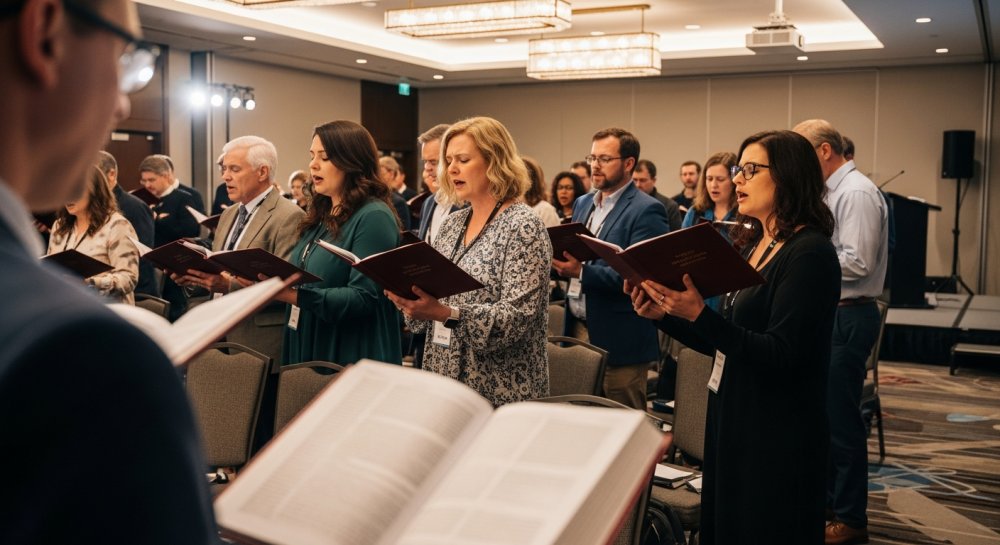
FRANKLIN, TENN. — When journalists gather for a professional conference, you expect panel discussions, networking, and perhaps a keynote speaker. But an impromptu a cappella worship service? That’s something altogether different.
Yet that’s exactly what happened at this year’s Evangelical Press Association conference in the Nashville suburb of Franklin, where representatives from Baptist, Presbyterian, Pentecostal, and other evangelical publications found themselves united in unaccompanied song.
Three representatives from The Christian Chronicle attended the conference—a testament to how the publication has grown in recent years. Managing editor Calvin Cockrell traveled from Tuscaloosa, Alabama, while intern Ephraim Rodenbach came from nearby Murfreesboro, where he studies at Middle Tennessee State University.
The conference opened with contemporary Christian music. Singer-songwriter Jason Gray performed several pieces, including a timely song about navigating today’s culture wars titled “Jesus Loves You (And I’m Trying).”
But the evening session brought an unexpected turn. Keith and Kristyn Getty, the Northern Ireland songwriting duo who collaborated with Stuart Townend to create “In Christ Alone,” were scheduled to present their latest project—”The Sing! Hymnal,” a comprehensive collection of 900 worship songs spanning centuries of Christian tradition.
Rather than a typical presentation, Keith Getty asked the room to turn to hymn number four: “Holy, Holy, Holy.” The song, penned in 1826 by Reginald Heber, represents what Getty called “the perfect hymn” in terms of lyrics, structure, and theological balance.
Then came Getty’s surprising request.
“And can we do this a cappella?”
The room—filled with representatives from denominations spanning the evangelical spectrum—answered with enthusiastic agreement. What followed was a moment of profound unity as voices blended without instrumental accompaniment, creating what participants described as an absolutely heavenly sound.
Getty’s impromptu lesson extended beyond that single hymn. He shared his conviction that churches should maintain a three-to-one ratio of traditional to contemporary hymns in worship.
“The great hymns are a 50-year gift to people, whereas a modern hymn is a five-year gift,” Getty explained.
His wife Kristyn added that newer hymns tend to be “more transient” in their impact and staying power.
Getty illustrated his point with hymn number 434, “Be Thou My Vision.” Based on a 10th-century Irish poem and adapted into hymn form in the early 1900s by Mary Elizabeth Byrne and Eleanor Hull, the song takes believers through life’s journey—from seeking purpose and wisdom in youth, through the temptations of middle life, to the hope of eternal rest.
Getty emphasized the creative and formative power of sacred lyrics.
“God created with words, and words have creative power. They can speak new realities into existence,” he said.
Good hymns, he explained, communicate “truth beyond the scratches on the paper.”
The rest of the conference addressed contemporary challenges facing Christian media—artificial intelligence, covering controversial topics, and bridging generational divides. But it was the opening session’s emphasis on timeless truths expressed through traditional hymnody that set the tone.
Throughout the conference, attendees found themselves humming melodies—some by the Gettys, some by Jason Gray, and some by songwriters who lived centuries ago. These songs, both ancient and modern, served as a constant reminder of the eternal truths that unite Christians across denominational lines.
In an era of rapid cultural change and church division, the spontaneous a cappella moment demonstrated something powerful: when believers focus on the unchanging character of God expressed in timeless worship, unity becomes natural. The journalists present may have represented different traditions and publications, but they shared one voice in praise.
That’s the enduring gift of great hymns—they remind us who we are as children of God, transcending the temporary divisions that too often separate us.
Let us know what you think, please share your thoughts in the comments below.

Faith Facts
- The House passed a resolution limiting presidential war powers against Iran, sparking constitutional debates about executive authority
- President Trump issued a memo to remove the Kennedy family name from the Kennedy Center, citing ongoing political disputes
- Key legislative battles this week highlighted fundamental disagreements about federal power and national security
This week in Washington brought significant developments that reveal the ongoing clash between traditional American governance and progressive resistance to executive authority. President Trump’s administration faced renewed challenges from Congress while continuing to assert constitutional prerogatives.
The House of Representatives passed a controversial resolution aimed at limiting presidential war powers specifically targeting potential military action against Iran. The measure reflects Democrats’ continued efforts to constrain executive decision-making on matters of national security, raising concerns among conservatives about undermining America’s ability to respond swiftly to threats.
Constitutional scholars have debated whether such congressional actions properly balance the separation of powers or inappropriately handcuff the Commander-in-Chief. Supporters of strong executive authority argue that the president needs flexibility to protect American interests abroad, particularly when facing adversaries like Iran that sponsor terrorism and threaten regional stability.
In another significant move, President Trump issued a memo directing the removal of the Kennedy family name from the Kennedy Center for the Performing Arts. The decision sparked immediate controversy, with the administration citing ongoing political disputes with certain Kennedy family members who have been vocal critics of Trump’s policies.
The Kennedy Center, a living memorial to President John F. Kennedy, has operated under federal charter since 1964. Trump’s directive raises questions about the appropriate role of politics in managing national cultural institutions and whether partisan disagreements should influence such decisions.
These developments underscore the deep divisions in American political life and the ongoing tension between different visions for the country’s future. For faith-based conservatives, the week’s events highlight the importance of principled leadership that upholds constitutional order while advancing policies that protect American sovereignty and traditional values.
The legislative battles over war powers reflect broader concerns about America’s role in the world and the proper balance between congressional oversight and presidential authority in an era of asymmetric threats. Many Christians who prioritize peace through strength see these constraints as potentially dangerous to national security.
Let us know what you think, please share your thoughts in the comments below.
Faith Facts
- Cities Church pastor condemns St. Paul city government for refusing to press charges against Don Lemon and anti-ICE protesters who disrupted their January worship service
- The protesters entered the church during Sunday service, creating chaos and violating the sanctity of worship
- Local authorities declined to pursue state charges despite the disruption, raising concerns about religious liberty protections
A Minnesota pastor is speaking out against what he calls a failure of local government to protect religious freedom. The leader of Cities Church in St. Paul issued a strong statement this week after city officials declined to press charges against former CNN host Don Lemon and anti-ICE activists who disrupted a worship service in January.
The incident has sparked outrage among Christians who see it as yet another example of worship spaces being treated with less respect than other public venues. The protesters entered the church during Sunday service, creating disruption and chaos at a time when families had gathered for prayer and worship.
The pastor’s statement condemned the city government’s decision not to pursue state charges against those involved. His rebuke highlighted the growing concern among faith leaders that houses of worship are not receiving adequate protection under the law when it comes to preserving the sanctity of religious services.
For many in the Christian community, the incident represents a troubling pattern. Churches across America have faced increasing intrusions from political activists who seem to face few consequences for disrupting worship. The decision by St. Paul authorities not to prosecute has raised questions about whether religious liberty is being adequately protected by local governments.
The January disruption at Cities Church brought unwanted attention and fear to a congregation simply trying to worship in peace. Families who attend the church have expressed concern about their safety and the precedent this sets for future incidents.
Critics of the city’s decision argue that if similar disruptions occurred at government meetings or secular events, charges would likely be filed. The apparent double standard has frustrated religious leaders who believe their constitutional right to free exercise of religion should include protection from harassment during worship.
The involvement of Don Lemon, a high-profile media personality, has brought additional attention to the case. Many conservatives see this as emblematic of a broader cultural divide, where progressive activists feel emboldened to target traditional institutions, including churches, without facing legal consequences.
As cities and states grapple with questions of immigration enforcement and sanctuary policies, churches have found themselves caught in the crossfire. Some faith communities support ICE enforcement, while others oppose it, but nearly all agree that worship services should remain sacred spaces free from political disruption.
The pastor’s public statement serves as a call to action for Christians concerned about protecting their right to worship without interference. Religious liberty advocates are watching cases like this closely, concerned about the precedent being set when local governments decline to hold protesters accountable for disrupting religious services.
Let us know what you think, please share your thoughts in the comments below.

Faith Facts
- Regnum Books has appointed Angus Crichton as its first dedicated director to expand Global South theological scholarship
- Regnum Books serves as the publishing arm of the Oxford Centre for Mission Studies
- The appointment marks a strategic commitment to amplifying Christian voices from developing nations
A significant development in Christian publishing is set to amplify voices from the Global South as Regnum Books announces a groundbreaking leadership appointment. The publishing arm of the Oxford Centre for Mission Studies has named Angus Crichton as its first dedicated director, signaling a new chapter in theological scholarship.
This historic appointment represents more than just an administrative change. It reflects a deliberate strategy to elevate Christian perspectives from regions often underrepresented in Western academic circles.
Regnum Books has long served as a platform for theological thought emerging from the developing world. The creation of this dedicated directorship demonstrates the organization’s commitment to ensuring these vital voices reach a broader audience in the global Christian community.
The Oxford Centre for Mission Studies has positioned itself as a bridge between traditional academic excellence and the dynamic Christian movements flourishing across Africa, Asia, and Latin America. By investing in dedicated leadership for its publishing operations, the Centre is doubling down on its mission to make scholarship from these regions more accessible.
Crichton’s appointment comes at a crucial time when the center of gravity in global Christianity continues to shift southward. While Western churches face declining attendance, vibrant faith communities in the Global South are experiencing unprecedented growth and theological innovation.
This leadership decision reflects a recognition that the future of Christian thought increasingly lies in perspectives shaped by different cultural contexts and challenges than those familiar to Western audiences. By prioritizing these voices, Regnum Books aims to enrich the entire Body of Christ with diverse insights grounded in Scripture and lived experience.
The expansion of Regnum Books’ capacity through dedicated directorship signals confidence in the demand for authentic Christian scholarship that speaks to contemporary challenges while remaining rooted in biblical truth. This development promises to strengthen connections between believers worldwide and foster mutual understanding across cultural boundaries.
Let us know what you think, please share your thoughts in the comments below.


-

 Self-Reliance1 year ago
Trump’s Bold Move Uncovers Massive Social Security Fraud
-

 Faith1 year ago
New Clues Emerge in Noah’s Ark Mystery
-

 News1 year ago
Governor Walz’s Rhetoric Sparks National Controversy
-

 News1 year ago
Mel Gibson’s ‘The Passion of the Christ’ Sequel Title Announced
-

 Family1 year ago
Texas Lawmaker Targets Furries in Schools
-

 Freedom1 year ago
Maine Lawmaker Challenges Sports Fairness Controversy
-

 Family1 year ago
Canada’s Controversial Policy Sparks Ethical Debate
-
Faith6 months ago
Congress Hears Pleas for Nigerian Christians