
News
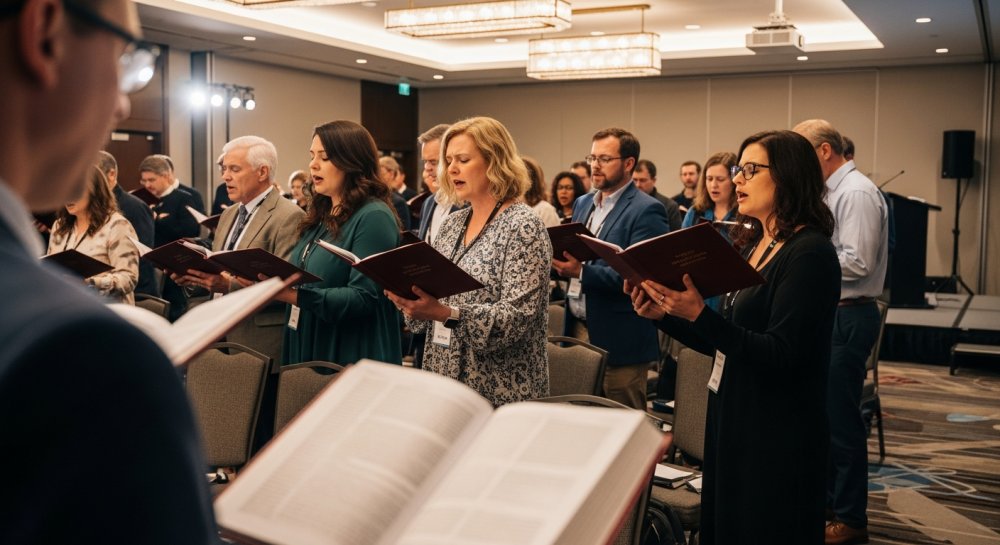
When Evangelical Journalists Sang a Cappella, Something Unexpected Happened

Faith Facts
- Christian journalists from various evangelical denominations united in a cappella worship at the Evangelical Press Association conference in Franklin, Tennessee
- Songwriters Keith and Kristyn Getty, co-writers of “In Christ Alone,” led the group in singing the classic hymn “Holy, Holy, Holy” without instrumental accompaniment
- Getty advocates for churches to sing three traditional hymns for every modern song, emphasizing that great hymns provide lasting spiritual gifts across generations
FRANKLIN, TENN. — When journalists gather for a professional conference, you expect panel discussions, networking, and perhaps a keynote speaker. But an impromptu a cappella worship service? That’s something altogether different.
Yet that’s exactly what happened at this year’s Evangelical Press Association conference in the Nashville suburb of Franklin, where representatives from Baptist, Presbyterian, Pentecostal, and other evangelical publications found themselves united in unaccompanied song.
Three representatives from The Christian Chronicle attended the conference—a testament to how the publication has grown in recent years. Managing editor Calvin Cockrell traveled from Tuscaloosa, Alabama, while intern Ephraim Rodenbach came from nearby Murfreesboro, where he studies at Middle Tennessee State University.
The conference opened with contemporary Christian music. Singer-songwriter Jason Gray performed several pieces, including a timely song about navigating today’s culture wars titled “Jesus Loves You (And I’m Trying).”
But the evening session brought an unexpected turn. Keith and Kristyn Getty, the Northern Ireland songwriting duo who collaborated with Stuart Townend to create “In Christ Alone,” were scheduled to present their latest project—”The Sing! Hymnal,” a comprehensive collection of 900 worship songs spanning centuries of Christian tradition.
Rather than a typical presentation, Keith Getty asked the room to turn to hymn number four: “Holy, Holy, Holy.” The song, penned in 1826 by Reginald Heber, represents what Getty called “the perfect hymn” in terms of lyrics, structure, and theological balance.
Then came Getty’s surprising request.
“And can we do this a cappella?”
The room—filled with representatives from denominations spanning the evangelical spectrum—answered with enthusiastic agreement. What followed was a moment of profound unity as voices blended without instrumental accompaniment, creating what participants described as an absolutely heavenly sound.
Getty’s impromptu lesson extended beyond that single hymn. He shared his conviction that churches should maintain a three-to-one ratio of traditional to contemporary hymns in worship.
“The great hymns are a 50-year gift to people, whereas a modern hymn is a five-year gift,” Getty explained.
His wife Kristyn added that newer hymns tend to be “more transient” in their impact and staying power.
Getty illustrated his point with hymn number 434, “Be Thou My Vision.” Based on a 10th-century Irish poem and adapted into hymn form in the early 1900s by Mary Elizabeth Byrne and Eleanor Hull, the song takes believers through life’s journey—from seeking purpose and wisdom in youth, through the temptations of middle life, to the hope of eternal rest.
Getty emphasized the creative and formative power of sacred lyrics.
“God created with words, and words have creative power. They can speak new realities into existence,” he said.
Good hymns, he explained, communicate “truth beyond the scratches on the paper.”
The rest of the conference addressed contemporary challenges facing Christian media—artificial intelligence, covering controversial topics, and bridging generational divides. But it was the opening session’s emphasis on timeless truths expressed through traditional hymnody that set the tone.
Throughout the conference, attendees found themselves humming melodies—some by the Gettys, some by Jason Gray, and some by songwriters who lived centuries ago. These songs, both ancient and modern, served as a constant reminder of the eternal truths that unite Christians across denominational lines.
In an era of rapid cultural change and church division, the spontaneous a cappella moment demonstrated something powerful: when believers focus on the unchanging character of God expressed in timeless worship, unity becomes natural. The journalists present may have represented different traditions and publications, but they shared one voice in praise.
That’s the enduring gift of great hymns—they remind us who we are as children of God, transcending the temporary divisions that too often separate us.
Let us know what you think, please share your thoughts in the comments below.


Faith Facts
- Scripture warns against creating images that could lead to idolatry, as seen in the account of the golden calf in Exodus 32.
- The Bible teaches that God alone deserves worship, and any object resembling a pagan deity raises serious spiritual concerns.
- Christian leaders have long called for vigilance against cultural influences that could subtly compromise faithfulness to biblical truth.
A senior official in the Trump administration has reportedly raised concerns about plans to display a bull statue at an international exhibition, citing its resemblance to the golden calf condemned in the book of Exodus.
The official expressed worry that the statue could be interpreted as honoring a Canaanite deity rather than serving as a neutral cultural artifact.
“We should not be participating in something that could be seen as promoting idolatry,” the official stated, according to reports.
Critics of the exhibit argue that such displays risk normalizing symbols once associated with pagan worship, especially at a time when many Americans are seeking to reaffirm biblical values in public life.
Supporters of the display claim the statue is merely artistic and historical, but faith-based observers remain unconvinced that context alone removes the spiritual implications.
Concerned believers point to Exodus 20:3-5, which commands, “Thou shalt have no other gods before me,” as a clear reminder that God’s people must avoid anything that could lead to misplaced reverence.
Let us know what you think, please share your thoughts in the comments below.

Faith Facts
- Scripture teaches that wisdom is a gift from God, not merely human achievement (Proverbs 2:6).
- Believers are called to seek discernment and understanding in times of rapid change (James 1:5).
- Technology must serve human dignity and moral responsibility, never replace them.
The world is racing ahead with artificial intelligence at a moment when traditional institutions are already strained.
Many leaders worry that the speed of development leaves little room for careful moral reflection.
“The world does not lack intelligence. It lacks time for wisdom.”
Christians have long held that true understanding comes from the fear of the Lord, not from raw computational power.
Rapid deployment of AI tools risks amplifying existing divisions rather than healing them.
“The world does not lack intelligence. It lacks time for wisdom.”
Families and churches are urged to ground new technologies in biblical principles before embracing them uncritically.
Let us know what you think, please share your thoughts in the comments below.
Faith Facts
- The Rev. Jim Rigby, pastor of U.S. Senate candidate James Talarico, publicly endorsed an ‘inclusive’ Bible that removes gendered references to God and eliminates titles such as ‘Son of God’ and ‘Lord.’
- Traditional Christian doctrine holds that Jesus Christ is the eternal Son of God, a truth affirmed in Scripture and central to the historic faith of the church.
- Scripture warns against altering God’s Word, stating that ‘every word of God is pure’ (Proverbs 30:5).
The Rev. Jim Rigby, pastor of Democratic Senate candidate James Talarico, was recorded promoting a new translation of the Bible that removes all gendered language for God.
Rigby encouraged listeners to ‘let go of the stupid stuff’ and praised the so-called ‘Inclusive Bible’ for replacing titles such as ‘Lord’ and ‘Son of God’ with gender-neutral terms.
“Let go of the stupid stuff.”
Critics argue that such changes distort the clear teaching of Scripture and undermine the deity of Christ.
The move reflects a broader effort by progressive churches to align biblical language with modern cultural preferences rather than preserving the historic text.
Let us know what you think, please share your thoughts in the comments below.
NEW: James Talarico’s longtime spiritual mentor, Rev. Jim Rigby, says his church provides copies of the “Inclusive Bible” to new members.
The “Inclusive Bible” strips the Bible of “gendered language.” It refuses to call Jesus the Son of God and describes traditional… pic.twitter.com/R6Nf4SPisg
— Amber Duke (@ambermarieduke) September 17, 2026


-

 Self-Reliance1 year ago
Trump’s Bold Move Uncovers Massive Social Security Fraud
-

 Faith1 year ago
New Clues Emerge in Noah’s Ark Mystery
-

 News2 years ago
Governor Walz’s Rhetoric Sparks National Controversy
-

 News1 year ago
Mel Gibson’s ‘The Passion of the Christ’ Sequel Title Announced
-

 Family1 year ago
Texas Lawmaker Targets Furries in Schools
-

 Freedom1 year ago
Maine Lawmaker Challenges Sports Fairness Controversy
-

 Family1 year ago
Canada’s Controversial Policy Sparks Ethical Debate
-
Faith10 months ago
Congress Hears Pleas for Nigerian Christians