
Faith
Pope Leo XIV Warns AI Cannot Replace What Only God Can Give


Faith Facts
- Pope Leo XIV released his first encyclical letter addressing the spiritual dangers of artificial intelligence replacing human relationships and dignity.
- The pontiff argues that Christianity offers a superior understanding of human existence that machines can never replicate.
- The encyclical emphasizes that authentic human connection and divine purpose cannot be substituted by technological advancement.
In his inaugural encyclical letter, Pope Leo XIV has issued a powerful warning about the spiritual and relational dangers posed by artificial intelligence. The Pope’s message comes at a critical time when technology increasingly dominates daily life and threatens to reshape fundamental aspects of human existence.
The Holy Father’s letter directly challenges the notion that AI can serve as an adequate substitute for genuine human relationships or the divine connection between God and His creation. His words serve as a timely reminder that no technological advancement, no matter how sophisticated, can replace the inherent dignity that comes from being made in the image of God.
According to the encyclical, artificial intelligence fundamentally undermines two pillars of human flourishing: authentic relationships and human dignity. These concerns reflect growing anxieties among faith communities about technology’s role in modern society and its potential to distance people from both their Creator and one another.
The Pope’s message resonates deeply with Christian conservatives who have long raised concerns about society’s increasing dependence on technology at the expense of traditional values and human connection. As families spend more time interacting with screens than with each other, and as AI systems are increasingly trusted with decisions that require wisdom and moral judgment, the Pope’s warnings take on added urgency.
Pope Leo XIV presents Christianity as offering a more complete and compelling understanding of human existence than any machine learning algorithm or artificial intelligence system could provide. This argument centers on the belief that humans possess souls, free will, and an eternal destiny—qualities that transcend mere computation and data processing.
The encyclical arrives amid rapid technological changes that are transforming society in unprecedented ways. From AI chatbots replacing human customer service representatives to algorithms making hiring decisions, the encroachment of artificial intelligence into traditionally human domains raises profound questions about the future of work, relationships, and human purpose.
For Christian Americans, the Pope’s message serves as an important call to maintain proper priorities in an increasingly digital age. While technology can serve as a useful tool, it must never become an idol that displaces God or diminishes the value of human life and relationships that He established.
The letter emphasizes that authentic human connection—rooted in love, empathy, and shared experiences—cannot be replicated by machines, no matter how advanced they become. This understanding aligns with biblical teaching that humans are created for relationship, first with God and then with one another, in ways that reflect the Triune nature of the Godhead itself.
Pope Leo XIV’s encyclical also addresses the matter of human dignity, which Christianity teaches is inherent and God-given rather than earned or assigned. This stands in stark contrast to utilitarian views that might assess human value based on productivity, capability, or usefulness—metrics that AI systems might optimize but can never truly understand.
The timing of this encyclical reflects the Church’s recognition that rapid technological advancement requires clear moral and spiritual guidance. As AI continues to develop capabilities that once seemed like science fiction, questions about the nature of consciousness, personhood, and purpose become increasingly urgent.
For believers who hold to traditional Christian values, the Pope’s message affirms what Scripture has always taught: that humans are fearfully and wonderfully made, created with purpose and dignity that no machine can possess. This truth remains constant regardless of technological progress.
The encyclical serves as a call to Christians to remain vigilant about protecting what makes us distinctly human—our capacity for love, moral reasoning, creativity, and relationship with the Divine. These qualities reflect our Creator and set us apart from even the most sophisticated artificial intelligence systems.
As American families navigate an increasingly digital world, Pope Leo XIV’s words offer important wisdom about maintaining proper boundaries with technology while preserving the relationships and values that truly matter. His message reminds us that some things—faith, family, and human dignity—must never be outsourced to machines.
Let us know what you think, please share your thoughts in the comments below.


Faith Facts
- Actor Jim Caviezel says Jesus physically appeared to him more than twenty years ago while he was deciding whether to portray Christ in Mel Gibson’s 2004 film.
- Caviezel credits the encounter with giving him the courage to accept the role in The Passion of the Christ despite the physical risks involved.
- The actor’s testimony highlights how divine guidance can strengthen believers facing difficult decisions in their calling.
Jim Caviezel says Jesus Christ physically appeared to him while he was still weighing the offer to play the Savior in Mel Gibson’s upcoming movie. The actor made the claim during a recent interview, recalling the moment that changed his mind about the role.
The encounter came more than twenty years ago, just before Caviezel signed on to star in The Passion of the Christ. He described feeling a clear divine presence that gave him the peace and conviction he needed to move forward.
“I don’t have anybody else.” Jim Caviezel recalls the moment he says Jesus appeared at the foot of his bed before taking on his role in The Passion of the Christ. Full episode out Tuesday on YouTube, Spotify, and Apple Podcasts. https://t.co/cY1Vtek4mv
— Sean Hannity ???????? (@seanhannity) November 8, 2026
“I was asked to play Jesus Christ,” Caviezel said. “And I said, ‘I can’t do it.’ And then Jesus appeared to me.”
That supernatural moment settled the question for the actor. Caviezel went on to portray Christ in the film, which went on to become one of the most watched and discussed Christian movies of its time.
“He appeared to me,” Caviezel repeated, underscoring the personal nature of the visitation. The actor has often spoken about the spiritual preparation required for such a role and the physical toll it took on his body.
His testimony serves as an encouragement to believers that God still speaks and leads His people in clear ways when they seek His will. Caviezel’s account reminds Christians that obedience to a divine calling may require stepping out in faith even when the path looks difficult.
Let us know what you think, please share your thoughts in the comments below.

Faith Facts
- Christian artists like Amy Grant, Michael W. Smith, and Rich Mullins have shaped generations through their music.
- Scripture set to melody can strengthen biblical literacy in children during daily routines like car rides.
- Parents have a biblical responsibility to pass faith to the next generation through everyday moments.
Parents searching for ways to anchor their children in Scripture may find an unexpected classroom in the family vehicle. Familiar Christian songs from decades past continue to plant God’s Word in young hearts through simple repetition and melody.
Producer Brown Bannister, who worked with Amy Grant, Michael W. Smith, and Rich Mullins, notes that the same songs that once ministered to adults can now serve as effective tools for teaching children biblical truth.
“The songs that have Scripture in them, they just stick,” Bannister stated.
Many families already use car time for conversation or entertainment, but incorporating worship music offers a practical way to redeem those minutes for spiritual growth. Parents who remember the lyrics of classic Christian songs often discover their children are learning Scripture without realizing it.
With biblical values under increasing pressure in schools and media, faithful parents are looking for every opportunity to reinforce truth at home and on the go.
“If you grew up on Amy Grant, Michael W. Smith or Rich Mullins, you can probably still sing every word,” Bannister said.
Let us know what you think, please share your thoughts in the comments below.
Faith Facts
- Tony Rucinski urges Christian men to embrace courage, self-control, and sacrificial service as the foundation of biblical masculinity.
- The call emphasizes a return to traditional manhood grounded in Scripture and family responsibility.
- Churches are challenged to raise men willing to speak truth in a culture that often rejects these values.
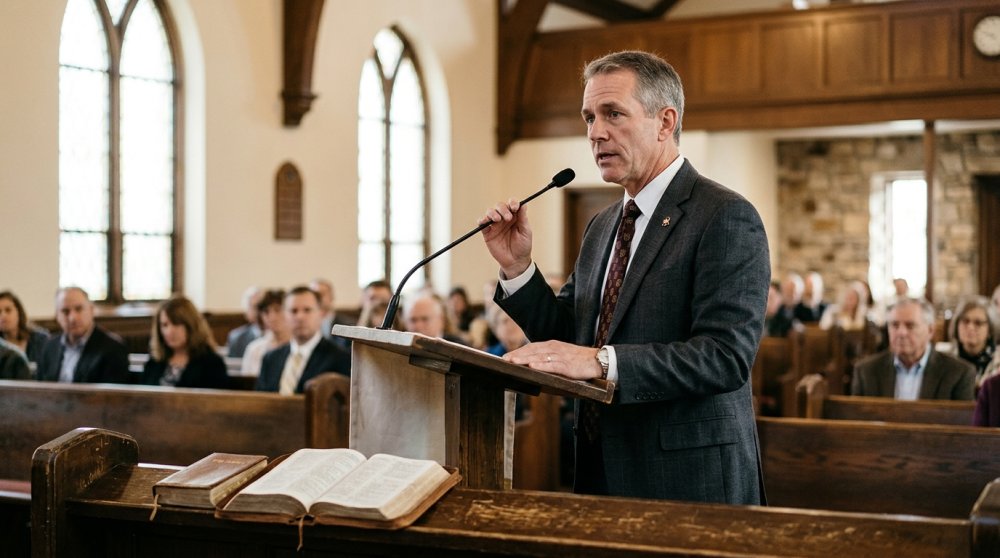
Tony Rucinski is calling on Christian men to recover a biblical vision of masculinity centered on courage, self-control, and sacrificial service. He believes the church needs men who are unafraid to speak up for truth in a time when such convictions are increasingly under attack.
According to Rucinski, modern culture has distorted the role of men, leaving many confused about their God-given responsibilities. He argues that true masculinity is not defined by cultural trends but by the clear teachings of Scripture.
“The church needs men willing to speak up,” Rucinski stated, stressing that silence is no longer an option for faithful believers.
His message challenges husbands and fathers to lead their families with conviction, modeling self-control and sacrificial love as Christ did for the church. Rucinski sees this as essential for restoring strong homes and communities.
The campaigner also warns that when men abandon their biblical roles, society suffers. He points to rising fatherlessness and moral confusion as evidence of what happens when traditional manhood is dismissed.
Rucinski calls on pastors and church leaders to boldly teach these truths rather than soften them to fit cultural preferences. He believes that a renewed commitment to biblical masculinity will strengthen both families and the wider body of Christ.
Let us know what you think, please share your thoughts in the comments below.


-

 Self-Reliance2 years ago
Trump’s Bold Move Uncovers Massive Social Security Fraud
-
 Faith2 years ago
New Clues Emerge in Noah’s Ark Mystery
-

 News2 years ago
Governor Walz’s Rhetoric Sparks National Controversy
-

 News2 years ago
Mel Gibson’s ‘The Passion of the Christ’ Sequel Title Announced
-

 Family2 years ago
Texas Lawmaker Targets Furries in Schools
-

 Freedom2 years ago
Maine Lawmaker Challenges Sports Fairness Controversy
-

 Family1 year ago
Canada’s Controversial Policy Sparks Ethical Debate
-
Faith12 months ago
Congress Hears Pleas for Nigerian Christians