
Freedom
Court Ruling Reinforces Pronoun Use in Florida Schools


In a significant victory for those who champion traditional values and the sanctity of individual freedom, the United States Court of Appeals for the 11th Circuit has ruled that public school teachers in Florida cannot compel students and staff to use pronouns that do not align with biological sex. This decision underscores the importance of maintaining clarity and truth in our educational institutions, aligning with the values that have long been the foundation of our great nation.
The case involved Katie Wood, a high school math teacher who identifies as a woman despite being biologically male. Wood sought to enforce the use of feminine pronouns and the honorific “Ms.” in the classroom. However, the court’s majority opinion, authored by Circuit Judge Kevin Newsom, upheld Florida Statute § 1000.071. This law, passed in 2023, asserts that “[a]n employee or contractor of a public K-12 educational institution may not provide to a student his or her preferred personal title or pronouns if such preferred personal title or pronouns do not correspond to his or her sex.”
Judge Newsom highlighted that “a teacher’s right to speak is not without limits,” emphasizing that Wood’s role as a teacher requires adherence to state guidelines. He further noted that “when a public-school teacher addresses her students within the four walls of a classroom — whether orally or in writing — she is unquestionably acting ‘pursuant to official duties.’”
This ruling is a reaffirmation of the principle that public education should focus on imparting knowledge and truth, rather than catering to individual preferences that may confuse or mislead students. It is a reminder that our schools should be places where children learn to respect facts and biological realities, rather than being drawn into ideological debates that distract from their education.
Judge Newsom contrasted Wood’s situation with the landmark 2022 Supreme Court case Kennedy v. Bremerton School District. In that case, the court ruled in favor of Joe Kennedy, a high school football coach who prayed on the field after games. Newsom noted that Kennedy was not performing official duties when he prayed, unlike Wood, who was actively teaching.
While Circuit Judge Adalberto Jordan dissented, arguing that Wood’s pronouns are a matter of personal identity, the majority opinion rightly prioritizes the educational environment over individual expression within the classroom. Judge Jordan’s perspective, while acknowledging personal identity, overlooks the broader responsibility of educators to maintain a consistent and clear learning atmosphere.
This decision is a testament to the enduring values of faith, family, and freedom. It serves as a reminder that our educational institutions must remain grounded in reality and truth, ensuring that future generations are equipped with the knowledge and principles necessary to navigate the complexities of the world with integrity and wisdom. As we continue to uphold these values, let us remain vigilant in protecting the freedoms that define our nation and the faith that guides us.
Let us know what you think, please share your thoughts in the comments below.

Faith Facts
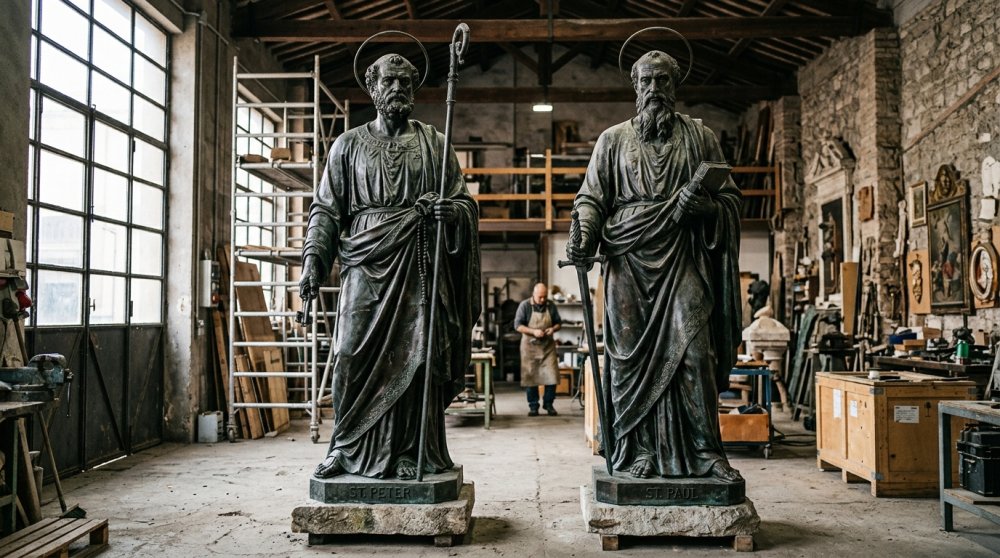
- Massachusetts Supreme Judicial Court upheld a decision blocking two 10-foot bronze statues of Catholic saints from being displayed on a government building
- The $850,000 statues were intended for a new public building but faced legal challenges from residents citing separation of church and state
- The ruling represents another example of religious expression being removed from the public square despite America’s Christian heritage
In a troubling decision that underscores the ongoing assault on religious expression in America’s public spaces, Massachusetts’ highest court has sided with residents seeking to prevent the display of Catholic statues on government property. The case involves two substantial bronze statues, each standing 10 feet tall, depicting Catholic saints that were planned for installation on a new municipal building.
The statues, valued at $850,000, became the center of a legal battle that reached the state’s Supreme Judicial Court. Residents who opposed the religious displays challenged the city’s plan, arguing that placing Catholic saints on public property violated the principle of separation of church and state.
The court’s decision to uphold the block represents a continuation of efforts to sanitize public spaces of religious imagery, even as our nation’s founding documents and historic buildings are replete with acknowledgments of divine providence and biblical principles. For generations, religious art and symbols adorned government buildings across America without controversy, reflecting the nation’s deep spiritual roots.
The $850,000 price tag for the statues indicates the significant investment the city had planned to make in these works of religious art. Bronze statues of this scale represent both artistic achievement and cultural heritage, particularly for communities with strong Catholic traditions.
This ruling fits a broader pattern of courts removing Christian and religious symbols from public view, often at the behest of small groups of objectors. From Ten Commandments monuments to Christmas displays, religious expression in the public square faces increasing hostility despite the First Amendment’s guarantee of free exercise of religion.
The Massachusetts decision stands in contrast to the historical reality that religious imagery, including depictions of Moses and the Ten Commandments, adorns the U.S. Supreme Court building itself. The founding fathers never intended the First Amendment to scrub all religious acknowledgment from government property.
For many Christians and traditional Americans, such decisions reflect a misunderstanding of the Constitution’s intent. The Establishment Clause was designed to prevent a national church, not to erase all religious expression from civic life. The Free Exercise Clause, meanwhile, protects the right of citizens to express their faith publicly.
The case highlights tensions in communities across America where Christian heritage and modern secular interpretations of constitutional law collide. As religious liberty advocates often point out, neutrality toward religion has increasingly become hostility toward religion in practice.
Let us know what you think, please share your thoughts in the comments below.
Freedom
Texas Pastor Arrested While Preaching Against Abortion, Attorney Says Police Sided With Anti-Christian Left

Faith Facts
- Four Christians were arrested in Texas while peacefully proclaiming a pro-life message on public property.
- A First Amendment attorney says police acted on behalf of anti-Christian leftists rather than protecting religious freedom.
- The arrests represent a growing pattern of selective enforcement against Christian street evangelists and pro-life advocates.
Christian advocates are sounding the alarm after four believers were arrested in Texas while peacefully sharing their faith and opposing abortion on public streets. The incident has raised serious concerns about religious freedom and the First Amendment rights of Christians across America.
According to a longtime First Amendment attorney, the arrests were not about maintaining public order but about police “doing the bidding” of anti-Christian leftists who want to silence the Gospel message and pro-life advocacy in public spaces.
The four individuals were engaging in street evangelism and peacefully protesting abortion when law enforcement intervened. Rather than protecting their constitutional rights to free speech and religious expression, police took them into custody.
First Amendment advocates warn this represents a disturbing trend of selective enforcement. While protests from the left are often permitted and even encouraged, Christians exercising their constitutionally protected rights are increasingly facing arrest and harassment.
The attorney representing the arrested Christians argues that police departments are yielding to pressure from anti-Christian activists rather than upholding the law equally for all citizens. This selective application of justice undermines both religious liberty and the rule of law.
Street evangelism has a long and protected history in American jurisprudence. The Supreme Court has repeatedly affirmed that public sidewalks and streets are traditional public forums where citizens have broad free speech rights, including the right to share religious messages and engage in peaceful protest.
Pro-life advocates and street preachers have faced increasing opposition in recent years, often from local officials and activists who object to their message. However, the Constitution does not permit viewpoint discrimination, and police are sworn to protect all citizens’ rights regardless of the popularity of their message.
The Texas arrests follow a pattern seen in other states where Christian evangelists and pro-life activists have been targeted for enforcement actions while other protesters are left alone. This double standard has created a chilling effect on religious expression in public spaces.
Religious freedom advocates emphasize that if Christians can be arrested for peacefully sharing their faith and defending life, then the First Amendment means nothing. The freedom to proclaim truth in public spaces is foundational to American liberty and must be vigorously defended.
Legal experts note that such arrests often do not survive constitutional scrutiny when challenged in court. Cities and police departments have paid significant settlements after violating the First Amendment rights of street preachers and pro-life advocates.
The case highlights the urgent need for law enforcement training on First Amendment protections and for elected officials to stand firm in defending religious liberty. Police should be protecting peaceful Christians exercising their constitutional rights, not arresting them at the behest of those who oppose their message.
As America faces increasing hostility toward Christian values in the public square, believers must remain steadfast in proclaiming truth and defending the right to do so. The freedom to share the Gospel and advocate for life cannot be surrendered simply because opponents find the message offensive.
Let us know what you think, please share your thoughts in the comments below.
Faith Facts
- California’s SB 934 would allow lawsuits against Christian counselors to be revived up to 17 years after the statute of limitations has expired
- The bill retroactively punishes conduct that was legal at the time it occurred, raising serious constitutional concerns about ex post facto laws
- This legislation sets a dangerous precedent that could be used to target other faith-based practices and religious freedom protections
A new California bill is raising alarm bells among religious freedom advocates and constitutional scholars. SB 934, promoted under the banner of protecting survivors of so-called “conversion therapy,” contains provisions that could fundamentally undermine legal protections that have existed for centuries.
The legislation would grant the state unprecedented power to reach back nearly two decades to revive expired legal claims. More troubling still, it would punish counselors and ministries for conduct that was entirely legal when it occurred.
At its core, this bill represents more than a policy dispute over counseling methods. It establishes a framework where the government can retroactively redefine legal conduct as punishable — a concept that violates basic American principles of due process and fair notice.
Christian counselors who provided biblically-based guidance years ago, operating within the law and their sincerely held religious convictions, could now face lawsuits for actions the state has decided to retroactively criminalize. This creates an impossible situation where citizens cannot know whether their lawful conduct today will be deemed illegal tomorrow.
The statute of limitations exists for good reason. It protects defendants from stale claims where evidence has disappeared, memories have faded, and witnesses may no longer be available. These protections apply to everyone, regardless of the popularity of their views.
By allowing plaintiffs to revive claims that expired years ago, SB 934 strips away these fundamental fairness protections. It opens the door for similar retroactive targeting of other unpopular groups or practices — a power that could easily be turned against any faith community.
Religious organizations have long provided counseling consistent with their theological beliefs. Whether helping individuals align their lives with biblical teaching on sexuality, marriage, or other matters of conscience, these ministries operate from a place of compassion and conviction.
While proponents frame this as protection for vulnerable individuals, the bill’s actual mechanism threatens to weaponize the legal system against religious practice. It sends a chilling message: hold traditional Christian beliefs at your own risk, because the rules can change retroactively.
The precedent extends far beyond this specific issue. If California can revive expired lawsuits and retroactively punish previously legal religious counseling, what prevents future legislatures from doing the same with other faith practices? Homeschooling curricula? Pastoral counseling on marriage? Religious education on gender?
Constitutional safeguards exist precisely to prevent this kind of overreach. The prohibition on ex post facto laws — laws that retroactively criminalize conduct — is foundational to American jurisprudence. It reflects the understanding that citizens must be able to know what the law is and conform their conduct accordingly.
Americans of all backgrounds should be concerned when any group faces retroactive punishment for conduct that was legal when performed. Today it may target one unpopular practice; tomorrow it could reach any belief or behavior the government decides to redefine.
Religious freedom means little if it can be revoked retroactively. The freedom to live according to one’s faith requires the assurance that lawful religious practice today won’t become the basis for punishment years from now when political winds shift.
California lawmakers should recognize that this bill, whatever its stated intentions, establishes a dangerous precedent that threatens foundational legal protections. The power to reach back in time to punish previously legal conduct is a power no government should possess in a free society.
Let us know what you think, please share your thoughts in the comments below.


-

 Self-Reliance1 year ago
Trump’s Bold Move Uncovers Massive Social Security Fraud
-

 Faith1 year ago
New Clues Emerge in Noah’s Ark Mystery
-

 News1 year ago
Governor Walz’s Rhetoric Sparks National Controversy
-

 News1 year ago
Mel Gibson’s ‘The Passion of the Christ’ Sequel Title Announced
-

 Family1 year ago
Texas Lawmaker Targets Furries in Schools
-

 Freedom1 year ago
Maine Lawmaker Challenges Sports Fairness Controversy
-

 Family1 year ago
Canada’s Controversial Policy Sparks Ethical Debate
-
Faith9 months ago
Congress Hears Pleas for Nigerian Christians