
Family
When God Changed His Jamboree Plans

Faith Facts
- A young Eagle Scout’s childhood dream of attending the National Jamboree was fulfilled in an unexpected way when God led him there as a Christian journalist instead of a participant
- Nearly 200 Scouts and volunteers gathered under a tin-roofed pavilion to worship together in a cappella hymns at the 2026 National Jamboree
- A divine moment of remembrance occurred when the reporter discovered the same quote honoring service that was engraved on his late father’s memorial bench 400 miles away
Since he was 6 years old, Scouting has been a cornerstone of Ephraim Rodenbach’s life. Alongside honing skills like knot tying and leadership, it has also strengthened his faith, reminding him that serving others is one of the ways the Bible teaches us to serve God.
In 2021, after months of planning his project and passing his board of review, Rodenbach became an Eagle Scout at the age of 14. Like many Scouts, he dreamed of attending the National Jamboree, Scouting’s capstone event every three to four years.
But as happens so many times in life, the path God lays out isn’t always the one you had in mind.
While reviewing a previous issue over the phone with his editor, an advertisement for the Members of Churches of Christ for Scouting caught their attention. Given Rodenbach’s decade-long background in Scouting, they realized that the approaching National Jamboree presented an opportunity to tell a unique story.
Five years after earning his Eagle, a series of conversations led him to the Summit Bechtel Reserve in Glen Jean, West Virginia — not as a participant, but as a journalist covering the event.
While hiking miles around camp, he had the opportunity to meet Scouts and volunteers from across the country and explore the beautiful Mountain State. Standing among towering oak trees in front of the world’s longest steel-arch bridge at New River Gorge National Park, it was hard not to marvel at God’s creation.
However, the beauty of West Virginia isn’t what stuck with him — it was the people.
Over the course of the week, he met leaders who dedicated nearly two weeks to more than 12,000 Scouts and Scouters at the National Jamboree. From chaplains offering a listening ear to volunteers staffing activity areas, their willingness to serve reflected the ideals Scouting strives to instill.
For the volunteers with MCCS, it wasn’t just about staffing a booth or putting on a worship service. These adults and youths were building relationships, answering questions about Christ and, as they described, planting seeds.
That mission became especially evident during the Sunday morning worship service.
With nearly 200 people crowded beneath a tin-roofed pavilion, hundreds of voices blended in praise of the Lord.
“The hymn ‘In Christ Alone’ echoed through the camp, and for an hour, the National Jamboree’s activities faded away as everyone remembered the one who made it all possible.”
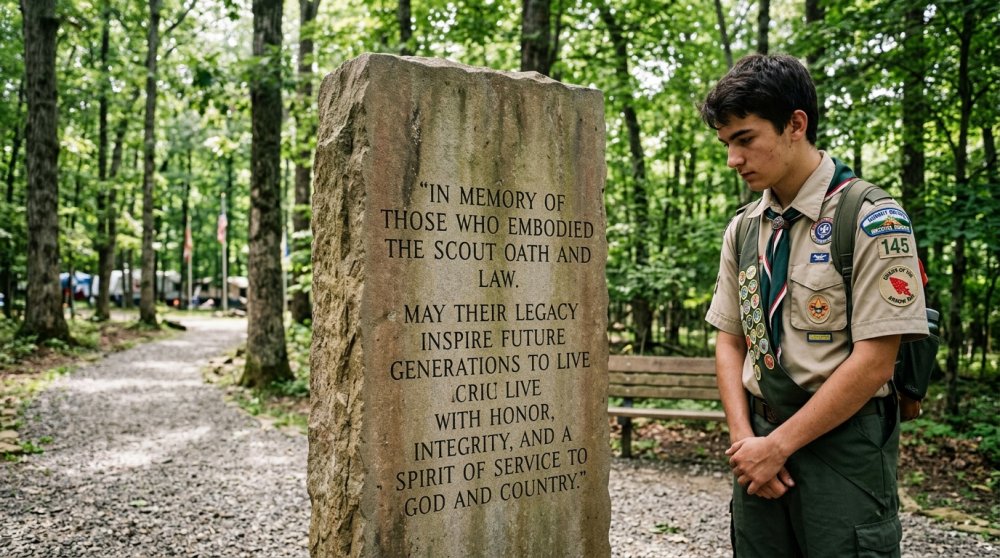
Later that evening, Rodenbach made the trek to see the Summit Circle, a memorial campfire area commemorating the 100th anniversary of the Order of the Arrow, Scouting’s national honor society. As he walked down the gravel path to the main fire ring, one of the first stone pillars bore a familiar quote from the order’s founder, E. Urner Goodman.
“He who serves his fellows is, of all his fellows, greatest.”
This quote — one he had seen countless times before — was the same one engraved on a memorial bench over 400 miles away, honoring his late father, Stacey Rodenbach.
For a moment, he stood still. After spending four days surrounded by examples of faith, the coincidence between the two places felt anything but random.
His first response was to thank God in prayer.
After thanking God for all the blessings He had provided through Scouting and his family, he finished his hike and witnessed the beautiful stonework built by Scouts just like him.
As he hiked back from the Summit Circle that evening, he realized God had fulfilled the dreams he carried as an ambitious 14-year-old looking for adventure at the National Jamboree — just not in a way he could have ever imagined. The Lord led him to West Virginia to tell others’ stories and, in the process, reminded him of His faithfulness.
This testimony serves as a powerful reminder that God’s plans often exceed our own expectations. When we surrender our dreams to His will, He transforms them into something far more meaningful than we could design ourselves.
The intersection of faith and service demonstrated at the National Jamboree reflects the biblical principle found in Matthew 20:28, where Christ teaches that He “did not come to be served, but to serve.” These young Scouts are learning early what it means to live out their Christian values through practical action.
Let us know what you think, please share your thoughts in the comments below.

Faith Facts
- Argentina has officially rejoined the Geneva Consensus Declaration, a coalition of nations defending life from conception and rejecting abortion as an international right
- The move reverses the country’s 2023 withdrawal and places Argentina back alongside pro-life nations including the United States, Brazil, and Hungary
- The Geneva Consensus emphasizes national sovereignty, family values, and women’s health without promoting abortion as a method of healthcare
Argentina has made a bold return to the international pro-life movement by rejoining the Geneva Consensus Declaration, a coalition of nations united in defense of unborn life and traditional family values. The decision signals a significant shift in the South American nation’s stance on the sanctity of life and marks a victory for Christian conservatives worldwide who have long advocated for the protection of the unborn.
The Geneva Consensus Declaration was originally co-sponsored by the United States under the Trump administration in 2020, bringing together countries committed to affirming that there is no international right to abortion. The declaration also emphasizes the importance of national sovereignty in health policy and promotes authentic women’s health without resorting to the destruction of innocent life.
Argentina’s return to this vital covenant reopens critical conversations about the defense of life at every stage, the importance of the traditional family structure, and the rights of nations to govern according to their own values and beliefs. The move comes as a stark contrast to the country’s brief withdrawal in 2023, which had disappointed many faith leaders and pro-life advocates both within Argentina and abroad.
The reinstatement places Argentina once again in fellowship with a growing global coalition that includes Brazil, Hungary, Uganda, and other nations that have refused to bow to international pressure to embrace abortion as a fundamental right. This alliance represents millions of people who believe that every human life, from conception to natural death, possesses inherent dignity and worth.
For Christian conservatives in America and around the world, Argentina’s decision is a reminder that the battle for life continues on multiple fronts. While the United States celebrated a historic victory with the overturning of Roe v. Wade, the international arena remains a crucial battleground where nations must stand firm against efforts to normalize abortion worldwide.
The Geneva Consensus also underscores the vital role of the family as the foundational unit of society. By affirming natural family structures and parental rights, the declaration stands against radical ideologies that seek to undermine God-ordained institutions. Argentina’s renewed commitment to these principles is a testament to the enduring power of faith-based values in shaping public policy.
National sovereignty is another pillar of the Geneva Consensus that resonates deeply with conservative principles. The declaration affirms that health policy decisions should be made by individual nations, not dictated by unelected international bureaucrats or organizations that often promote agendas contrary to biblical values. Argentina’s participation reinforces the idea that countries have the right and responsibility to legislate according to the conscience and culture of their own people.
The timing of Argentina’s return is particularly significant as global abortion advocates continue their aggressive campaigns to expand so-called “reproductive rights” worldwide. International organizations and foreign governments have increasingly attempted to pressure developing nations into liberalizing abortion laws, often conditioning aid and trade relationships on compliance with progressive social agendas.
Argentina’s stand is a powerful rebuke to this cultural imperialism. By rejoining the Geneva Consensus, the nation is declaring that the lives of the unborn matter more than international approval or financial incentives. This is the kind of moral courage that Christians are called to exhibit in an age when convenient lies often triumph over uncomfortable truths.
The pro-life movement in Argentina has been active and vocal despite significant opposition. Faithful believers throughout the country have organized prayer vigils, marches, and educational campaigns to promote a culture of life. Their perseverance has been instrumental in bringing about this policy shift, demonstrating that grassroots faith activism can indeed influence national and international affairs.
For American Christians, Argentina’s example serves as both an encouragement and a challenge. It proves that nations can change course, that pro-life principles can gain ground even in difficult cultural climates, and that international cooperation among like-minded countries can strengthen the global defense of life. At the same time, it challenges believers in the United States to remain vigilant and active in promoting life-affirming policies both domestically and in the international arena.
The global pro-life movement gains strength when nations stand together in defense of God’s creation. Argentina’s return to the Geneva Consensus is not merely a political decision—it is a moral statement that reverberates across continents. It reminds the world that human life is not a commodity to be discarded for convenience, but a sacred gift to be protected and cherished.
As this development unfolds, prayer and continued advocacy remain essential. Believers must pray for Argentina’s leaders, that they will have wisdom and courage to maintain this commitment in the face of inevitable opposition. Prayer is also needed for other nations to join this growing coalition and for the hearts of people worldwide to be turned toward a recognition of the sanctity of life.
Let us know what you think, please share your thoughts in the comments below.

Faith Facts
- Hannah Strege became the first baby born through embryo adoption, surviving where 19 other embryos did not
- Her story has profoundly influenced how Christians view the sanctity of frozen embryos
- Embryo adoption offers pro-life families a way to give life to frozen embryos that would otherwise remain unused
Hannah Strege’s very existence is a testament to the value of every human life, no matter how small. She holds a unique place in history as the first baby ever born through embryo adoption, a groundbreaking alternative that allows families to rescue frozen embryos and bring them to life.
Out of 20 embryos her parents adopted, Hannah was the only one to survive the freezing, thawing, and transfer process. Her survival stands as a powerful reminder of both the fragility and resilience of human life at its earliest stages.
“I was the only one to survive the freeze and the thaw and the transfer,” Hannah shared, reflecting on the miraculous nature of her birth.
Her story has become a beacon for Christians seeking to honor the sanctity of life in practical ways. Embryo adoption provides a life-affirming option for the hundreds of thousands of frozen embryos currently in storage across America, many of which face an uncertain future.
For pro-life Christians, Hannah’s testimony reinforces the conviction that life begins at conception and that every embryo represents a unique individual created in God’s image. Her parents’ decision to adopt embryos demonstrated their commitment to protecting the most vulnerable among us.
The practice of embryo adoption has grown significantly since Hannah’s birth, offering hope to both donor families who want their unused embryos to have a chance at life and to adopting families who long for children. It represents a beautiful intersection of adoption ministry and pro-life advocacy.
Hannah’s survival against overwhelming odds continues to inspire families considering embryo adoption. Her life serves as living proof that these tiny lives matter and deserve the opportunity to grow, be born, and fulfill their God-given potential.
As the debate over frozen embryos continues in medical, legal, and political spheres, Hannah Strege’s story provides a powerful human face to the issue. She is not a theoretical concept or a scientific specimen—she is a beloved daughter, a survivor, and a witness to the wonder of life itself.
Let us know what you think, please share your thoughts in the comments below.

Faith Facts
- Christian parents increasingly prioritize comfort over character development, potentially undermining children’s spiritual resilience
- Scripture consistently shows God permits struggles to build faith rather than removing all obstacles from believers’ paths
- Shielding children from all difficulty may prevent them from developing the perseverance needed for lifelong faith and maturity
American parents face a troubling paradox in raising the next generation. While wanting the best for their children, many Christian families have shifted from preparing kids for life’s inevitable valleys to attempting to eliminate those valleys entirely. This well-intentioned approach carries spiritual and practical consequences that deserve careful examination.
God’s pattern throughout Scripture reveals a consistent truth: He doesn’t rescue His people from every difficulty but instead walks with them through trials. From Joseph’s imprisonment to David’s persecution to the apostles’ suffering, biblical heroes developed character through adversity, not in spite of it. Yet modern parenting often operates on a different principle—one that equates good parenting with maximum comfort and minimum struggle.
The cultural shift toward comfort-focused parenting has created what some observers call a crisis of resilience. Children raised in environments where every obstacle is removed, every disappointment is cushioned, and every challenge is smoothed over often reach adulthood unprepared for the realities of a fallen world. They may lack the spiritual and emotional muscles needed to persevere when faith is tested or when circumstances don’t align with their expectations.
This approach contradicts the developmental wisdom found in James 1:2-4, which instructs believers to “count it all joy when you fall into various trials, knowing that the testing of your faith produces patience.” The passage continues: “But let patience have its perfect work, that you may be perfect and complete, lacking nothing.” The completeness described here comes through tested faith, not protected comfort.
Parents who consistently intervene to prevent their children from experiencing natural consequences, disappointment, or appropriate struggle may inadvertently communicate dangerous messages. Children may come to believe they are fragile, that discomfort is abnormal, or that faith should produce a problem-free existence. These beliefs set the stage for spiritual crisis when real hardship inevitably arrives.
The distinction between harmful suffering and character-building challenge matters greatly. Parents are called to protect children from genuine harm, abuse, and dangers beyond their maturity level. But this protective instinct becomes problematic when extended to shield children from age-appropriate difficulties, failures, and the natural consequences of their choices.
Consider the difference between a parent who rescues a teenager from every social conflict versus one who provides support while allowing the young person to navigate relationship challenges. The first approach may provide immediate comfort but teaches dependency and avoidance. The second builds social resilience, problem-solving skills, and confidence in God’s presence during interpersonal trials.
Academic struggles present another arena where the comfort-focused approach shows its limitations. Parents who complete homework assignments, negotiate grade changes for work their child didn’t earn, or blame teachers for their student’s lack of effort may believe they’re advocating for their child. In reality, they’re preventing the development of personal responsibility, work ethic, and the ability to persevere through intellectual challenge—qualities essential for adult functioning and spiritual maturity.
The spiritual implications extend beyond practical skills. Children who never experience struggle while depending on God may never develop deep, personal faith. Their relationship with Christ risks remaining theoretical rather than tested and proven. Faith that hasn’t been challenged often proves shallow when life’s inevitable storms arrive.
This doesn’t mean parents should artificially create hardship or remain uninvolved in their children’s lives. Rather, it calls for wisdom in discerning when to step in and when to step back. It requires the courage to allow children to experience disappointment, failure, and difficulty while providing support, perspective, and direction toward God’s sufficiency.
The goal of Christian parenting isn’t to raise comfortable children but to raise faithful adults. This requires exposing young people to progressively greater challenges appropriate to their age and maturity, teaching them to seek God in difficulty, and modeling perseverance through our own trials. It means prioritizing character development over immediate happiness and eternal perspective over temporal comfort.
Parents modeling this approach demonstrate their own dependence on God through difficulties rather than projecting an image of problem-free Christian living. They share age-appropriate information about their own struggles and how faith sustains them. They pray with their children through challenges rather than simply praying problems away.
The cultural pressure to provide maximum comfort and advantage creates real tension for Christian parents. Comparison with families who seem to smooth every path for their children can generate guilt or second-guessing. Yet the biblical standard calls parents to a different measure of success—not whether their children avoided all difficulty but whether they developed faith that endures through difficulty.
Churches and Christian communities can support families in this challenging balance. Teaching that normalizes struggle as part of the Christian experience, mentoring relationships that allow young people to see mature faith tested and proven, and community support for parents making difficult decisions all contribute to raising resilient believers.
The cost of raising comfortable kids becomes apparent in young adults unprepared for college challenges, workplace demands, marriage difficulties, or spiritual doubts. Without the foundation of tested faith and developed perseverance, they often struggle to maintain Christian commitment when comfort gives way to reality. The short-term pain parents sought to avoid becomes long-term crisis as adult children lack the tools to navigate life’s valleys.
Scripture’s wisdom offers a better path. Proverbs 22:6 instructs parents to “train up a child in the way he should go,” recognizing that training involves practice, difficulty, correction, and progressive challenge. Hebrews 12:11 acknowledges that “no chastening seems to be joyful for the present, but painful; nevertheless, afterward it yields the peaceable fruit of righteousness to those who have been trained by it.”
The challenge for this generation of Christian parents is recovering the courage to allow appropriate struggle while maintaining loving support. It requires trusting God’s faithfulness to walk with our children through valleys rather than demanding He remove every valley from their path. It means accepting that the discomfort of watching our children struggle may be the very thing that produces the character and faith they’ll need for a lifetime of following Christ.
Let us know what you think, please share your thoughts in the comments below.


-

 Self-Reliance1 year ago
Trump’s Bold Move Uncovers Massive Social Security Fraud
-

 Faith1 year ago
New Clues Emerge in Noah’s Ark Mystery
-

 News1 year ago
Governor Walz’s Rhetoric Sparks National Controversy
-

 News1 year ago
Mel Gibson’s ‘The Passion of the Christ’ Sequel Title Announced
-

 Family1 year ago
Texas Lawmaker Targets Furries in Schools
-

 Freedom1 year ago
Maine Lawmaker Challenges Sports Fairness Controversy
-

 Family1 year ago
Canada’s Controversial Policy Sparks Ethical Debate
-
Faith9 months ago
Congress Hears Pleas for Nigerian Christians