Connect with us

Family

When God Changed His Jamboree Plans

Published

on

Faith Facts

  • A young Eagle Scout’s childhood dream of attending the National Jamboree was fulfilled in an unexpected way when God led him there as a Christian journalist instead of a participant
  • Nearly 200 Scouts and volunteers gathered under a tin-roofed pavilion to worship together in a cappella hymns at the 2026 National Jamboree
  • A divine moment of remembrance occurred when the reporter discovered the same quote honoring service that was engraved on his late father’s memorial bench 400 miles away

Since he was 6 years old, Scouting has been a cornerstone of Ephraim Rodenbach’s life. Alongside honing skills like knot tying and leadership, it has also strengthened his faith, reminding him that serving others is one of the ways the Bible teaches us to serve God.

In 2021, after months of planning his project and passing his board of review, Rodenbach became an Eagle Scout at the age of 14. Like many Scouts, he dreamed of attending the National Jamboree, Scouting’s capstone event every three to four years.

But as happens so many times in life, the path God lays out isn’t always the one you had in mind.

While reviewing a previous issue over the phone with his editor, an advertisement for the Members of Churches of Christ for Scouting caught their attention. Given Rodenbach’s decade-long background in Scouting, they realized that the approaching National Jamboree presented an opportunity to tell a unique story.

Five years after earning his Eagle, a series of conversations led him to the Summit Bechtel Reserve in Glen Jean, West Virginia — not as a participant, but as a journalist covering the event.

While hiking miles around camp, he had the opportunity to meet Scouts and volunteers from across the country and explore the beautiful Mountain State. Standing among towering oak trees in front of the world’s longest steel-arch bridge at New River Gorge National Park, it was hard not to marvel at God’s creation.

However, the beauty of West Virginia isn’t what stuck with him — it was the people.

Over the course of the week, he met leaders who dedicated nearly two weeks to more than 12,000 Scouts and Scouters at the National Jamboree. From chaplains offering a listening ear to volunteers staffing activity areas, their willingness to serve reflected the ideals Scouting strives to instill.

For the volunteers with MCCS, it wasn’t just about staffing a booth or putting on a worship service. These adults and youths were building relationships, answering questions about Christ and, as they described, planting seeds.

That mission became especially evident during the Sunday morning worship service.

With nearly 200 people crowded beneath a tin-roofed pavilion, hundreds of voices blended in praise of the Lord.

“The hymn ‘In Christ Alone’ echoed through the camp, and for an hour, the National Jamboree’s activities faded away as everyone remembered the one who made it all possible.”

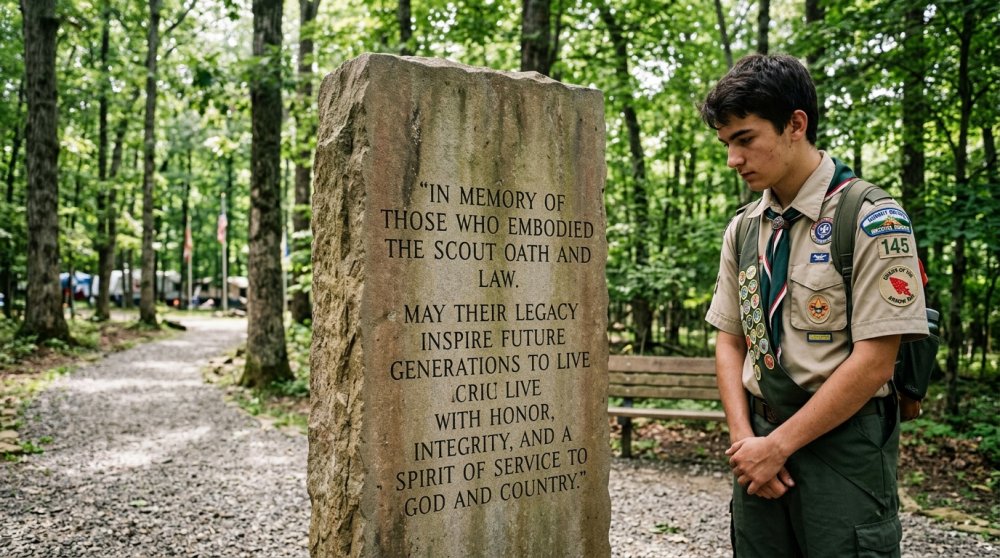
Later that evening, Rodenbach made the trek to see the Summit Circle, a memorial campfire area commemorating the 100th anniversary of the Order of the Arrow, Scouting’s national honor society. As he walked down the gravel path to the main fire ring, one of the first stone pillars bore a familiar quote from the order’s founder, E. Urner Goodman.

“He who serves his fellows is, of all his fellows, greatest.”

This quote — one he had seen countless times before — was the same one engraved on a memorial bench over 400 miles away, honoring his late father, Stacey Rodenbach.

For a moment, he stood still. After spending four days surrounded by examples of faith, the coincidence between the two places felt anything but random.

His first response was to thank God in prayer.

After thanking God for all the blessings He had provided through Scouting and his family, he finished his hike and witnessed the beautiful stonework built by Scouts just like him.

As he hiked back from the Summit Circle that evening, he realized God had fulfilled the dreams he carried as an ambitious 14-year-old looking for adventure at the National Jamboree — just not in a way he could have ever imagined. The Lord led him to West Virginia to tell others’ stories and, in the process, reminded him of His faithfulness.

This testimony serves as a powerful reminder that God’s plans often exceed our own expectations. When we surrender our dreams to His will, He transforms them into something far more meaningful than we could design ourselves.

The intersection of faith and service demonstrated at the National Jamboree reflects the biblical principle found in Matthew 20:28, where Christ teaches that He “did not come to be served, but to serve.” These young Scouts are learning early what it means to live out their Christian values through practical action.

Let us know what you think, please share your thoughts in the comments below.

Continue Reading
Click to comment

Leave a Reply

Your email address will not be published. Required fields are marked *

Family

From 9/11 Survivor to Warrior Against Modern-Day Slavery

Published

on

Faith Facts

  • A survivor of the 9/11 attacks arrived in America in 2001 with only $50 and two suitcases, searching for purpose
  • The tragedy became a turning point that eventually led to a divine calling to fight human trafficking
  • A cry for help from a trafficking victim revealed God’s purpose for his survival

When the Twin Towers fell on September 11, 2001, one man’s brush with death would become the beginning of an extraordinary journey of faith and purpose. Having arrived in America just months earlier with nothing but hope and determination, he had no idea that surviving one of history’s darkest days would set him on a path to rescue others from darkness.

The survivor recalls arriving on American soil with modest means — just $50 in his pocket and two suitcases containing all his worldly possessions. He came with dreams like so many immigrants before him, but without a clear sense of calling or direction for his life.

“When I arrived in America in 2001 with $50 and two suitcases, I had dreams — but no sense of purpose.”

Then came September 11th. The attacks that shook our nation and took nearly 3,000 innocent lives also marked a turning point in his own story. The trauma and survival would plant seeds that wouldn’t fully bloom for years to come.

“Then 9/11 changed everything, and it would take years, and a cry for help from a trafficking victim, before I understood why I survived.”

In the years following that fateful day, he searched for meaning in his survival. Why had God spared him when so many perished? The answer wouldn’t come immediately, but when it did, it arrived with unmistakable clarity.

The moment of revelation came through the desperate plea of a human trafficking victim. In that cry for help, he finally understood the divine purpose behind his survival — he was meant to be a voice for the voiceless and a defender of the vulnerable.

Human trafficking remains one of the darkest sins plaguing our modern world, with millions trapped in various forms of slavery. It’s an evil that Christians are called to confront, standing firm on biblical principles that affirm the dignity and worth of every human life created in God’s image.

This survivor’s transformation from a man without purpose to a warrior against human trafficking exemplifies how God can redeem even our most traumatic experiences. His story serves as a powerful reminder that our trials often prepare us for our true calling.

The fight against human trafficking requires courage, commitment, and compassion — qualities forged in the fires of adversity. For this 9/11 survivor, those qualities were born from ashes and refined through years of searching for meaning.

His journey demonstrates a fundamental truth that resonates with Christian values: no experience is wasted in God’s economy. Every hardship can become a tool for His purpose, and every survival story can inspire others to action.

As Americans who cherish freedom and human dignity, we must join the fight against modern slavery in all its forms. Whether through prayer, advocacy, or direct action, we each have a role to play in protecting the vulnerable and pursuing justice.

Let us know what you think, please share your thoughts in the comments below.
Continue Reading

Family

The Crisis Most Churches Are Missing When Foster Children Turn 18

Published

on

Faith Facts

  • Over 20,000 foster youth age out of the system annually with no family support or safety net
  • Christian communities are being called to provide long-term mentorship and support beyond the foster care system’s cutoff age
  • A single committed adult can transform the trajectory of a young person’s life after foster care ends

Every year, more than 20,000 young Americans reach the age when the foster care system stops caring. At 18, often alone and unprepared, these young men and women are suddenly cut off from the only support structure they’ve known. No family waiting. No safety net to catch them. And far too often, no one showing up to help them navigate adulthood.

For the American Church, this represents both a sobering failure and a profound opportunity. These aren’t statistics — they’re sons and daughters, created in God’s image, who desperately need the body of Christ to live out the Biblical call to care for the fatherless.

The transition out of foster care is perilous. Without family connections or financial resources, many of these young adults face homelessness, unemployment, and a future that seems impossibly dark. The challenges they encounter would overwhelm anyone, let alone teenagers who have already experienced trauma and instability.

But there is hope, and it comes in a surprisingly simple form: one caring adult who refuses to walk away. Research consistently shows that young people who have at least one committed mentor or supportive adult in their lives fare dramatically better than those who face the world alone.

This is where the Church should be stepping forward with conviction and compassion. Christian families and individuals across America are uniquely positioned to provide the long-term relationships these young people need. This isn’t just foster care — it’s spiritual family, extended beyond legal obligations and bureaucratic timelines.

The call to care for orphans didn’t come with an age limit. James 1:27 reminds believers that pure religion includes looking after orphans in their distress. When the government stops providing care at 18, the Church’s responsibility doesn’t end — it intensifies.

Many churches are already answering this call through mentorship programs, housing assistance, job training, and simply by opening their homes and hearts. But the need far exceeds the current response. Thousands of young people are still falling through the cracks because Christians haven’t fully recognized this mission field in their own communities.

The beauty of this ministry is that it doesn’t require specialized training or massive resources. It requires presence, consistency, and love — showing up for birthdays, helping with job applications, answering late-night calls, being the family that biology or circumstance didn’t provide.

For congregations serious about putting faith into action, supporting aged-out foster youth offers a practical way to live out the Gospel. It’s messy, challenging, and requires long-term commitment. But it’s also exactly what Jesus modeled: entering into broken situations and refusing to abandon the vulnerable.

American churches have a legacy of leading social reform and caring for society’s most vulnerable. From the abolition movement to crisis pregnancy centers, Christians have historically recognized that faith demands action. Supporting aged-out foster youth is the next frontier of this faithful witness.

The question facing every believer isn’t whether these young people need help — the data makes that clear. The question is whether we will be the ones who show up, who refuse to walk away, who become the family they never had.

This generation of foster youth didn’t choose their circumstances, but the Church can choose its response. Twenty thousand young people will age out this year. Will twenty thousand Christians step forward?

Let us know what you think, please share your thoughts in the comments below.
Continue Reading

Family

Why Your Accountability Partner Isn’t Enough to Keep You on Track

Published

on

Faith Facts

  • One-on-one accountability relationships often fail when built on just two people, according to ministry leader Derek Hughes
  • Scripture emphasizes communal accountability through the body of Christ, not isolated pairs
  • Christian men are rediscovering that faithful accountability requires multiple witnesses and a community of support

For years, the standard advice in Christian circles has been simple: find an accountability partner. One trusted friend, one phone call away, one person to keep you honest. But what happens when that relationship quietly fades, when the texts go unanswered, when life gets busy and the weekly check-ins stop?

Derek Hughes has watched this pattern repeat itself countless times. After years of seeing one-to-one mentoring relationships collapse under the weight of unspoken expectations, he began asking a difficult question: What if accountability was never designed to rest on the shoulders of just two people?

The traditional accountability partner model sounds biblical on the surface. We’re told that iron sharpens iron, that two are better than one. But Hughes suggests we may have misunderstood the blueprint. The early church didn’t practice accountability in isolated pairs—they practiced it in community, with elders overseeing the flock, with brothers and sisters bearing one another’s burdens together.

When accountability exists between just two people, several problems emerge. First, there’s no backup when one person falters or life circumstances change. Second, the relationship can become unbalanced, with one person doing all the confessing and the other doing all the advising. Third, without multiple perspectives, blind spots go unaddressed and poor counsel can go unchallenged.

The Scripture speaks of accountability in the context of the body of Christ—not isolated limbs, but interconnected members. When Paul instructed the Galatians to “bear one another’s burdens,” he was addressing the entire church community, not suggesting they pair off into accountability duos. When James wrote about confessing sins to one another, he envisioned a community of believers walking in transparency together.

Hughes advocates for what he calls “a room” rather than just “a pair.” This means small groups of three to five men or women who meet regularly, where accountability is shared among multiple relationships. In this setting, if one person misses a meeting, the group continues. If one member offers unwise counsel, others can provide correction. If someone struggles, multiple believers are there to support and pray.

This isn’t about abandoning close friendships or one-on-one discipleship. Those relationships remain vital. But when it comes to the vulnerable work of accountability—confessing struggles, addressing sin patterns, pursuing growth—there’s wisdom in having multiple witnesses and supporters rather than placing all that weight on a single friendship.

The isolation of the one-to-one model can also create unhealthy dynamics. One person may feel responsible for “fixing” the other. Codependency can develop. Or worse, the accountability becomes superficial, with both parties going through the motions of asking surface-level questions while avoiding the harder conversations.

In contrast, a small group provides built-in checks and balances. Different members bring different perspectives, life experiences, and spiritual gifts. One may offer wise counsel, another encouragement, another tough love when needed. The diversity strengthens the accountability rather than weakening it.

For Christian men especially, this shift could address the epidemic of isolation many face. Studies show Christian men are increasingly disconnected from meaningful friendships and spiritual community. The pressure to “find an accountability partner” can feel daunting, and when that relationship inevitably falters, men often retreat into isolation rather than trying again.

A small group removes some of that pressure. There’s less riding on any single relationship. The commitment is to the group, not to performing a role in someone else’s spiritual life. And the shared experience of walking together toward holiness creates bonds that isolated pairs often lack.

This approach also aligns better with how church discipline and restoration are described in Scripture. When Jesus outlined the process for addressing sin in Matthew 18, He spoke of bringing one or two others, then telling it to the church. The pattern moves toward community involvement, not away from it.

Hughes isn’t suggesting that every Christian needs to join a formal accountability group immediately. But he is challenging the assumption that accountability primarily happens in pairs. For those who have tried and failed at the accountability partner model, perhaps the issue wasn’t a lack of commitment or the wrong partner—perhaps the structure itself was insufficient.

The beauty of accountability in community is that it mirrors the gospel itself. We aren’t saved into isolation but into the body of Christ. We don’t grow alone but together, as living stones being built into a spiritual house. Our sanctification happens in relationship with other believers, shaped by their prayers, challenged by their questions, encouraged by their faithfulness.

As churches and ministries rethink how to foster genuine accountability, the shift from pairs to small communities could prove transformative. It won’t solve every problem, and it requires commitment from multiple people rather than just two. But for those who have experienced the quiet collapse of yet another accountability partnership, it offers a more sustainable, biblical path forward.

Let us know what you think, please share your thoughts in the comments below.
Continue Reading

Trending