
Faith
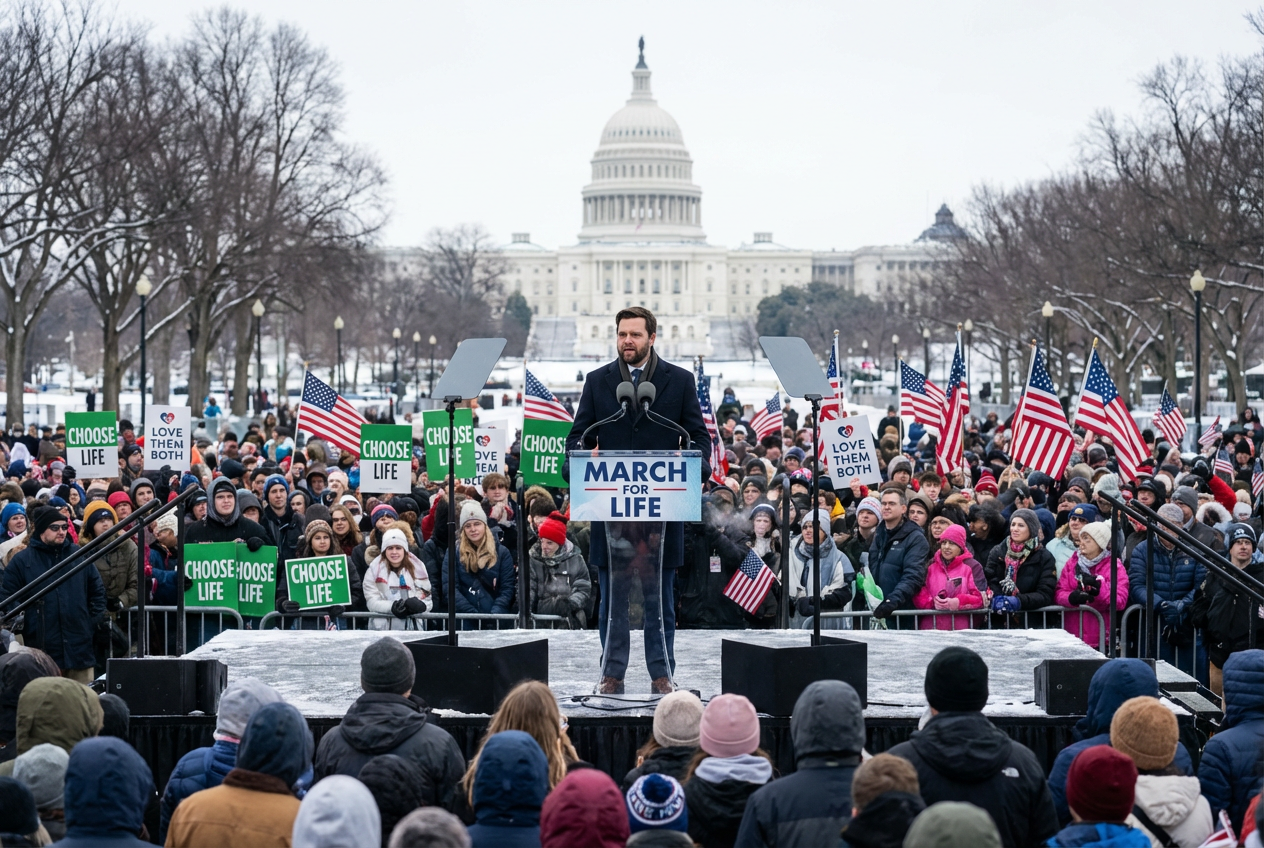
Vance: Choosing Life Affirms God’s Design

Faith Facts
- Vice President JD Vance declared that America’s abortion debate is a choice between following God or embracing pagan values.
- He praised the Trump administration’s support for pro-life activism, highlighting pardons for activists and ending taxpayer funding of research using aborted fetal cells.
- Vance contrasted a Judeo-Christian respect for life with past pagan practices that disregarded the value of babies.
The March for Life remains the nation’s largest annual pro-life demonstration, gathering believers to uphold Biblical dignity for every child.
Vance emphasized that civilization rooted in Christian morals cherishes children as precious gifts, not burdens.
“This is shocking to us because we grew up in a Christian culture and were formed by religious values. Even those of us who aren’t particularly faithful, it’s a shocking thing to hear,” said Vance.
He reminded attendees that, “The mark of barbarism is that we treat babies like inconveniences to be discarded rather than the blessings to cherish that they are.”
Invoking Psalm 139, Vance affirmed that every human is “fearfully and wonderfully made” by God.
He said the March for Life is about preserving a civilization under God rather than returning to the paganism of the past.
Vance also rejected the left’s claims that marriage and children hold people back, asserting that strong families form the bedrock of a godly society and our country.
He encouraged Americans to seek meaning in family and the gift of every child, not in empty pursuits.



Faith Facts
- More than half of self-identifying Christians in America attend church services less than once a month
- Regular church attendees rate their congregations highly despite widespread discipleship challenges
- Research reveals a significant gap between Christian identification and active faith practice
A new comprehensive study has revealed a troubling reality facing the American church: while regular attendees express satisfaction with their congregations, there exists what researchers are calling a “massive discipleship gap” among those who identify as Christian.
The findings paint a complex picture of faith in America. On one hand, churches are performing well in the eyes of their committed members. On the other hand, the research exposes a critical disconnect between those who claim Christianity and those who actively participate in church life.
According to the study, more than half of Americans who identify themselves as Christians attend worship services less than once per month. This stark reality raises serious questions about the depth of faith formation and biblical literacy among those who claim allegiance to Christ.
The term “discipleship gap” refers to the significant divide between nominal Christianity and genuine, active faith practice. Discipleship — the process of becoming more like Christ through biblical teaching, spiritual formation, and active participation in the body of believers — appears to be lacking among a majority of self-professed Christians.
For those who do attend regularly, the news is more encouraging. These committed believers report positive experiences within their church communities, suggesting that congregations are effectively ministering to their core membership. This indicates that when churches have the opportunity to engage believers consistently, they are doing meaningful work.
However, the broader implications cannot be ignored. The discipleship gap represents a fundamental challenge to the Great Commission — Christ’s command to make disciples of all nations. When more than half of those who identify with Christianity rarely or never participate in corporate worship, biblical teaching, or fellowship, the church’s ability to fulfill its mission is severely hampered.
This research arrives at a critical moment for American Christianity. Cultural pressures, secular influences, and changing attitudes toward institutional religion have created an environment where casual Christianity has become increasingly common. Many identify with the Christian label for cultural or familial reasons without embracing the transformative commitment that authentic faith requires.
The findings also raise important questions about evangelism and church growth strategies. Are churches focusing too heavily on initial conversions without adequate emphasis on long-term spiritual formation? Are believers being equipped to live out their faith beyond Sunday morning?
Church leaders across the nation must grapple with these realities. The satisfaction of regular attendees, while positive, cannot mask the urgent need to reach and disciple the millions who claim Christ but remain disconnected from His body, the church. Effective discipleship requires consistent biblical teaching, meaningful relationships within the faith community, and accountability in spiritual growth.
The path forward demands renewed commitment to the biblical model of discipleship — not merely attracting crowds, but making devoted followers of Jesus Christ who are grounded in Scripture, active in worship, and engaged in mission.
Let us know what you think, please share your thoughts in the comments below.

Faith Facts
- Former NFL linebacker O.J. Brigance died at age 56 after battling ALS for nearly two decades with unwavering faith
- Brigance repeatedly declared ‘God’s grace is sufficient’ throughout his courageous fight against the neurodegenerative disease
- The Baltimore Ravens champion is remembered as a hero who exemplified Christian perseverance and hope in the face of tremendous suffering
Former NFL linebacker O.J. Brigance has passed away at age 56 after a nearly two-decade battle with amyotrophic lateral sclerosis (ALS). Throughout his long fight against the devastating neurodegenerative disease, Brigance remained a powerful witness to faith, repeatedly declaring that “God’s grace is sufficient.”
The Baltimore Ravens community and the broader football world are mourning the loss of a man remembered not only for his athletic achievements but for his extraordinary courage and Christian witness. Brigance’s determination to live fully despite his diagnosis inspired countless individuals facing their own trials.
ALS, also known as Lou Gehrig’s disease, progressively robs patients of their ability to control muscle movement. Despite the disease’s relentless advance, Brigance refused to let it define him. His faith became the foundation upon which he built a life of purpose and service that extended far beyond his playing days.
Brigance’s story is one of remarkable resilience grounded in Christian hope. Rather than retreating from public life after his diagnosis, he became an advocate and inspiration to others. His testimony demonstrated that even in our weakest moments, God’s strength can shine through.
The Ravens organization and the city of Baltimore have lost a true champion—not just of football, but of faith and perseverance. Brigance’s legacy will endure as a reminder that God’s grace truly is sufficient, even in our darkest valleys.
His life stands as a powerful testament to the truth that our identity is not found in our physical abilities or circumstances, but in Christ. Through suffering that would crush many, Brigance pointed others to the source of his hope and strength.
Let us know what you think, please share your thoughts in the comments below.
Faith Facts
- Keith Getty warns that the rise of AI makes biblical singing more critical than ever for the Church
- The Sing! Conference, celebrating its 10th anniversary, has grown from a one-time event into an international movement
- Getty emphasizes that congregational singing must be rooted in Scripture to withstand cultural and technological challenges
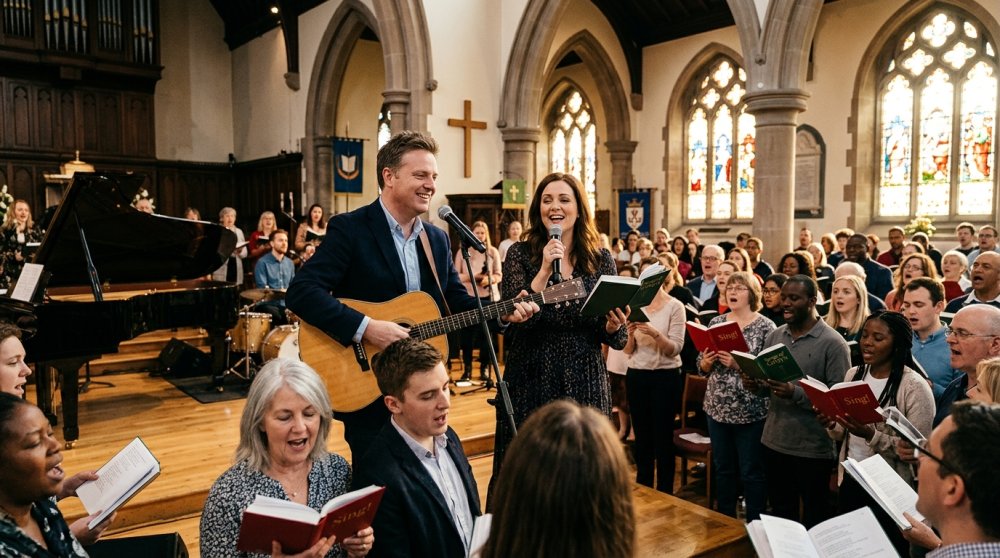
As artificial intelligence reshapes every corner of modern life, one of Christianity’s leading hymn writers is sounding an urgent call: the Church must return to singing the Bible itself. Keith Getty, co-founder of the Sing! Conference alongside his wife Kristyn, believes that the digital age has made doctrinally rich, Scripture-saturated worship music not just preferable, but essential for the survival of biblical faith.
The Sing! Conference, which marks its tenth anniversary this year, began as a modest celebration of a book on congregational singing. What the Gettys envisioned as a single gathering has blossomed into an international movement drawing pastors, theologians, musicians, and everyday believers united by a common mission: strengthening the singing life of the Church in an age of distraction and deception.
Getty’s concern is not merely aesthetic or musical. In an era when technology can manufacture emotion, manipulate truth, and create artificial experiences, he argues that believers need worship anchored in the unchanging Word of God. Singing Scripture, he contends, builds a theological foundation that can withstand the shifting sands of cultural trends and digital illusions.
The conference represents a growing recognition among Christian leaders that what congregations sing on Sunday mornings shapes what they believe on Monday mornings. Hymns and worship songs function as portable theology, embedding biblical truth in the hearts and minds of believers in ways that sermons alone cannot achieve.
For the Gettys, this is not about nostalgia or resistance to contemporary expression. Rather, it’s about ensuring that the content of Christian worship remains deeply biblical, doctrinally sound, and spiritually nourishing across all musical styles and generations. The Sing! Conference has become a hub for this vision, bringing together diverse voices committed to the primacy of Scripture in corporate worship.
The tenth anniversary gathering promises to continue equipping the Church with tools, training, and inspiration to make congregational singing a vibrant expression of biblical faith. As technology advances at an unprecedented pace, the Gettys are betting that the ancient practice of singing God’s Word together remains the Church’s most powerful weapon against error and indifference.
In an age of AI-generated content and algorithm-driven culture, the call to “sing the Bible” is a clarion reminder that truth is not manufactured—it is revealed. And the Church’s song must echo that eternal revelation.
Let us know what you think, please share your thoughts in the comments below.


-

 Self-Reliance1 year ago
Trump’s Bold Move Uncovers Massive Social Security Fraud
-

 Faith1 year ago
New Clues Emerge in Noah’s Ark Mystery
-

 News1 year ago
Governor Walz’s Rhetoric Sparks National Controversy
-

 News1 year ago
Mel Gibson’s ‘The Passion of the Christ’ Sequel Title Announced
-

 Family1 year ago
Texas Lawmaker Targets Furries in Schools
-

 Freedom1 year ago
Maine Lawmaker Challenges Sports Fairness Controversy
-

 Family1 year ago
Canada’s Controversial Policy Sparks Ethical Debate
-
Faith9 months ago
Congress Hears Pleas for Nigerian Christians