
Faith
One Simple Question This British Influencer Hasn’t Asked Yet


Faith Facts
- Steven Bartlett, host of the popular ‘Diary of a CEO’ podcast, has been interviewing leading Christian apologists about faith and the meaning of life
- Bartlett demonstrates rare intellectual curiosity in a cultural landscape often hostile to Christian worldviews
- His journey from asking questions to encountering the living Christ represents the next crucial step in his search for truth
In an era when many public figures dismiss Christianity without investigation, one British podcaster stands out for his willingness to genuinely explore the faith that built Western civilization. Steven Bartlett, whose ‘Diary of a CEO’ podcast reaches millions, has been conducting thoughtful conversations with prominent Christian thinkers—and his intellectual honesty deserves recognition from the Christian community.
Bartlett’s approach reflects something increasingly rare in modern media: authentic curiosity about truth. Rather than dismissing Christianity as outdated or irrelevant, he’s engaging with the intellectual foundations that have shaped human history and continue to transform lives today.
His conversations with Christian apologists reveal a man genuinely grappling with life’s biggest questions—questions about meaning, purpose, morality, and existence itself. In a culture that often settles for shallow answers or retreats into moral relativism, this pursuit of truth is refreshing and commendable.
Yet there’s a crucial distinction between intellectual exploration and personal encounter. The Christian faith isn’t merely a philosophical system to be analyzed—it’s a relationship with the living God who created us, loves us, and sent His Son to redeem us.
All the evidence, all the apologetics, all the intellectual arguments—while valuable and important—ultimately point toward a Person. Jesus Christ doesn’t simply offer answers to life’s questions; He declares Himself to be “the way, the truth, and the life.”
The greatest minds throughout history have discovered that knowing about God differs fundamentally from knowing God. C.S. Lewis, one of the 20th century’s most brilliant intellects, wrote extensively about Christianity before his intellectual assent became personal surrender.
For those watching Bartlett’s journey, there’s an invitation to pray for him—that his honest questions would lead him not just to satisfying answers, but to the One who is the Answer. That his intellectual pursuit would become a personal encounter with the God who has been drawing him all along.
America was founded on principles rooted in the Christian worldview—the dignity of every human being, the existence of transcendent truth, the accountability of leaders to a higher moral law. When public figures like Bartlett take these foundations seriously, it benefits everyone, regardless of where their journey ultimately leads.
His willingness to platform Christian voices in an increasingly secular media landscape demonstrates courage. Many influencers fear the cultural backlash that can come from giving Christianity a fair hearing, yet Bartlett has proceeded anyway.
The Christian community should respond not with pressure or judgment, but with prayer and gratitude—prayer that his search for truth would lead him to Truth Himself, and gratitude that he’s willing to explore these questions publicly when so many refuse to consider them at all.
Every person’s faith journey is unique, but certain patterns emerge across the centuries. Intellectual inquiry often precedes personal commitment, questions pave the way for answers, and honest seeking ultimately finds what—or rather, Who—it’s looking for.
The invitation to Steven Bartlett is the same invitation extended to every human being: keep thinking, keep asking, but don’t stop at intellectual assent. The God who created you isn’t content to be merely an interesting subject for discussion; He desires relationship, transformation, and eternal life.
As Christians, we recognize that no amount of evidence alone converts a heart—that’s the work of the Holy Spirit. Yet we also trust that God honors genuine seeking and that those who seek Him with their whole heart will find Him.
May Steven Bartlett’s journey continue, may his questions lead him deeper, and may he discover that the meaning of life isn’t found in an idea, but in a Person who died and rose again so that we might truly live.
Let us know what you think, please share your thoughts in the comments below.

Faith Facts
- Frank Turek continues sharing the Gospel on college campuses despite the trauma of witnessing Charlie Kirk’s assassination.
- Turek credits his faith in Christ for helping him process the violence and remain committed to truth.
- The Christian apologist warns that America is engaged in a spiritual battle over reality itself.
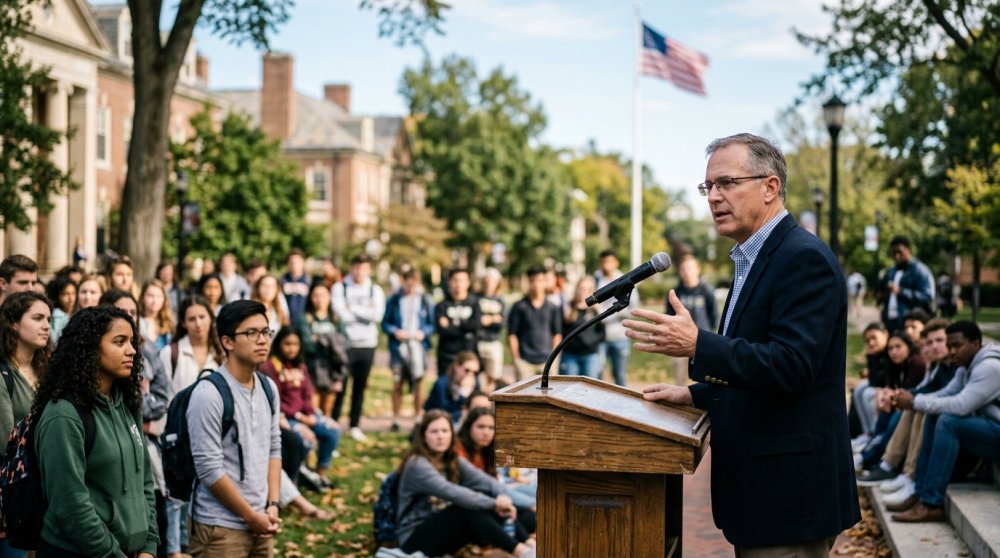
Christian apologist Frank Turek has spoken candidly about the profound effect of watching Charlie Kirk’s assassination unfold before his eyes. The shocking act of violence has not silenced his message. Instead, it has strengthened his resolve to continue proclaiming the Gospel on university campuses across the nation.
Turek explained that his faith has been the anchor keeping him steady through the aftermath of the tragedy. He described turning to Scripture and prayer as he grappled with the reality of what he witnessed. That same faith now fuels his determination to keep engaging students with biblical truth.
“The war on reality is real, and it is spiritual,” Turek stated.
He emphasized that the same cultural forces celebrating the murder of Charlie Kirk are the forces actively opposing biblical Christianity on campuses and in the public square. Turek refused to retreat in the face of such hostility, insisting that the Gospel must still be proclaimed even when the cost is high.
“I refuse to back down,” he declared.
Turek’s commitment reflects a broader pattern among Christian leaders who view current cultural battles as part of an ongoing spiritual conflict. He continues to equip believers with apologetics while urging them to stand firm in the face of increasing opposition to traditional values and religious liberty.
Let us know what you think, please share your thoughts in the comments below.

Faith Facts
- Parents in Connecticut challenged a state law that removed religious exemptions for school vaccine requirements.
- The lawsuit was dismissed after a judge ruled the exemptions are not protected under existing religious freedom statutes.
- The decision leaves families with no legal recourse when their sincerely held beliefs conflict with state mandates.
Parents who filed suit to protect their right to decline vaccines on religious grounds saw their case dismissed by a Connecticut judge. The court ruled that the state law eliminating religious exemptions does not violate the state’s religious freedom protections.
The decision means children whose parents hold sincere religious objections to certain vaccines will still be required to receive them in order to attend public school. Families who believe vaccination conflicts with their faith now face limited options within the state.
“The plaintiffs have failed to demonstrate that the religious exemptions are protected under the state religious freedom law,” the ruling stated.
Advocates for parental rights argue the ruling prioritizes government mandates over deeply held beliefs. They warn that similar efforts to remove religious exemptions could spread to other states if left unchallenged.
Critics of the original law contend it undermines the principle that parents, not the state, hold primary responsibility for medical decisions involving their children. They say the ruling sets a troubling precedent that could erode other conscience protections.
Let us know what you think, please share your thoughts in the comments below.

Faith Facts
- Crieve Hall Church of Christ in Nashville remains committed to a cappella worship, male leadership in preaching and communion, and a statement of faith that affirms “correctly handling His Word without adding to or taking from it.”
- Lipscomb University, four miles away, now welcomes instrumental worship, female speakers, and lecturers from various Christian traditions, reflecting a widening theological gap within Churches of Christ.
- Both the Connect Conference at Crieve Hall and the Lipscomb Faith and Leadership Forum stressed discipleship, biblical faithfulness, and spiritual growth, yet neither event made significant mention of the other.
Two events unfolded just four miles apart in Nashville, yet the theological distance between them felt far greater. One gathering championed what attendees called “sound preaching” rooted in Scripture alone. The other focused on discerning the cultural moment and leading faithfully in changing times.
Crieve Hall Church of Christ hosted its sixth annual Connect Conference, drawing 1,322 believers from more than 300 congregations. Organizers described the three-day meeting as “rooted firmly in Scripture and centered on Christ,” with sessions on evangelism, discipleship, and spiritual growth.
“I love the sound preaching,” said attendee Tonja McRady. “All it means to me is that it comes from the Bible. Are you preaching from the whole Bible, the whole counsel of God?”
Meanwhile, Lipscomb University held its inaugural Faith and Leadership Forum for about 160 ministers and leaders. Sessions addressed faith and politics, ministry burnout, and discipleship in a digitally saturated world. Bible professor Leonard Allen described the two streams as “conservative mainstream” and “moderate mainstream” Churches of Christ.
“With truth becoming loose and malleable in our time, we need more focus on the essentials of the faith,” Allen said. “This was a key theme at the Forum.”
The central question remains: What qualifies as essential? At Connect, speakers repeatedly pointed to “one Lord, one faith, one baptism” from Ephesians 4 and stressed the necessity of baptism and proper biblical leadership.
“What if we just settle on going with what God says, God’s way?” asked minister Hiram Kemp. “God doesn’t want our creativity. He wants our compliance. It’s been revealed to us in Scripture.”
At Lipscomb, participants wrestled with cultural decline and spiritual seeking. Allen noted that 40 million Americans have left the faith in the past quarter-century, yet many young people still search for meaning.
“Is America standing on the edge of spiritual renewal, or are we witnessing the continuing, steady decline of Christian faith in America?” Allen asked. “The old patterns are no longer stable. New patterns have not yet emerged. It seems there is energy but also confusion all around.”
Both gatherings closed with calls for unity, yet each framed it differently. Matt Cook at Connect warned, “Unity without truth is just togetherness.” Carlus Gupton at Lipscomb urged leaders to pursue Holy Spirit-formed leadership that is “calm, steady and deeply rooted in Christ.”
Gupton later reflected, “The proximity of these two conferences actually gives me more reason for hope than concern. Connect seeks to strengthen Christians in biblical faithfulness, discipleship, evangelism and spiritual growth. The Faith and Leadership Forum seeks to equip church leaders for faithful, discerning leadership in a changing culture.”
Let us know what you think, please share your thoughts in the comments below.


-

 Self-Reliance1 year ago
Trump’s Bold Move Uncovers Massive Social Security Fraud
-

 Faith1 year ago
New Clues Emerge in Noah’s Ark Mystery
-

 News2 years ago
Governor Walz’s Rhetoric Sparks National Controversy
-

 News1 year ago
Mel Gibson’s ‘The Passion of the Christ’ Sequel Title Announced
-

 Family2 years ago
Texas Lawmaker Targets Furries in Schools
-

 Freedom2 years ago
Maine Lawmaker Challenges Sports Fairness Controversy
-

 Family1 year ago
Canada’s Controversial Policy Sparks Ethical Debate
-
Faith10 months ago
Congress Hears Pleas for Nigerian Christians