
Faith
Kyrgyz Pastor Tortured, Suffers Brain Injury

Faith Facts
- Pastor Pavel Shreider, 65, was tortured in Kyrgyzstan’s prison, now suffering from traumatic brain injury with cognitive impairment.
- Kyrgyz authorities charged him with “inciting enmity” and banned his church, while credible reports of torture remain unaddressed.
- Five U.N. Special Rapporteurs have urged investigation into the violations against Shreider and his congregation.
Pastor Shreider’s ordeal highlights the persecution Christians can face for their faith, with his physical suffering underscoring the cost of standing for the Gospel. Despite abuse and imprisonment, his witness remains a sobering call to uphold religious freedom and defend believers abroad.
Protecting the vulnerable and holding authorities accountable is central to a Biblical worldview, reminding us to advocate for justice and uphold the God-given right to worship in peace. Let us pray for Pastor Shreider’s healing and for all persecuted Christians to remain steadfast under trial as we stand united for faith and liberty.
To learn more about this case, visit: Christian Today



Faith Facts
- A major global conference on Western civilization’s future emphasized Christianity’s essential role in cultural restoration
- Speakers at the Alliance for Responsible Citizenship (ARC) conference argued that rebuilding the West cannot happen without returning to Christian foundations
- Growing recognition among thought leaders that faith-based values are indispensable for renewing traditional Western society
The second day of the Alliance for Responsible Citizenship (ARC) conference shifted from diagnosing the problems plaguing Western civilization to exploring the path forward. After day one’s sobering assessment of cultural decline, attendees turned their attention to a question that matters deeply to millions of faithful Americans: what will it take to rebuild our civilization?
The answer, according to numerous speakers and participants, cannot be found without Christianity at its center. This recognition marks a significant shift in mainstream discourse about the future of Western nations.
For too long, secular voices have dominated conversations about culture, policy, and the common good. Yet increasingly, thinkers across disciplines are acknowledging what Christians have always known: a society built on anything less than biblical truth will crumble under its own weight.
The ARC conference represents a growing movement of leaders who understand that technical solutions, economic reforms, and political changes—while important—cannot restore what has been lost without spiritual renewal. The foundations of the West were laid by men and women who believed in absolute truth, human dignity rooted in being made in God’s image, and the moral framework provided by Scripture.
As families struggle with broken institutions, children face ideological confusion in schools, and communities fragment under the weight of relativism, the case for Christianity’s indispensable role becomes clearer. The conference’s focus on reconstruction rather than mere criticism signals a mature understanding that complaint without solutions leads nowhere.
This conversation matters because it speaks to the heart of what many Americans are experiencing: a longing for the restoration of a culture that honors God, strengthens families, and upholds the values that made Western civilization a beacon of freedom and human flourishing. The recognition that Christianity must be central to this restoration is not nostalgia—it’s wisdom born from observing what happens when societies abandon their spiritual moorings.
The road ahead requires more than policy wins or electoral victories. It demands a return to the faith that built hospitals, universities, and systems of justice rooted in the belief that every person bears the image of their Creator.
Let us know what you think, please share your thoughts in the comments below.
Faith Facts
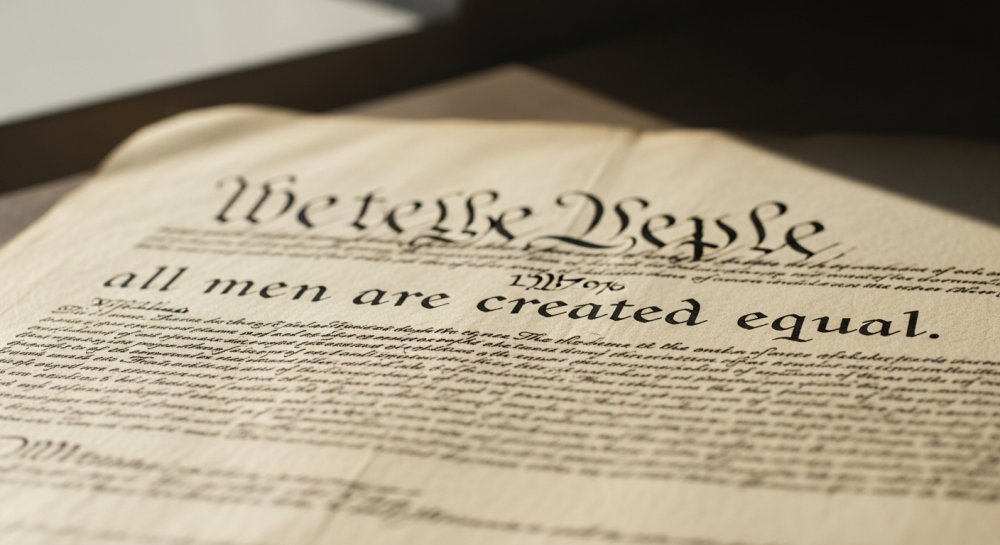
- The Declaration of Independence proclaimed ‘all men are created equal’ 250 years ago, yet unborn children remain excluded from this fundamental promise.
- Over 63 million abortions have been performed in America since Roe v. Wade, representing a moral crisis that demands Christian conviction.
- Compromise on life issues has failed to protect the unborn, making principled action more essential than ever.
As America approaches the 250th anniversary of the Declaration of Independence, the nation faces a sobering reality: the self-evident truth that “all men are created equal” has never fully extended to those waiting to be born.
The contradiction between our founding principles and the treatment of unborn life represents one of the most profound moral failures in American history. Since the Supreme Court’s Roe v. Wade decision in 1973, more than 63 million lives have been ended through abortion—a staggering toll that dwarfs any other tragedy in our nation’s story.
For Christians and conservatives who believe life begins at conception, this anniversary serves as both a celebration of American ideals and a stark reminder of how far we’ve fallen short. The Declaration’s assertion that our Creator endows us with unalienable rights, including life itself, rings hollow when the most vulnerable among us receive no protection.
The path forward requires conviction, not compromise. Too often, political calculations and cultural pressures have led defenders of life to settle for incremental progress while millions continue to perish.
America’s children—born and unborn—deserve leaders willing to stand firmly on principle. They deserve a nation that extends the promise of equality to every human being from the moment of conception. They deserve better than a country that celebrates freedom while denying the most basic right to its smallest citizens.
As we reflect on 250 years of the American experiment, we must ask ourselves whether we will finally honor the Declaration’s promise in full. Will we be a nation that truly believes all are created equal? Or will we continue to exclude those who cannot yet speak for themselves?
The answer to that question will define not just our legal framework, but our character as a people. It will determine whether future generations look back at this moment as the turning point when America finally embraced all human life—or as another chapter in our ongoing failure to live up to our founding ideals.
Let us know what you think, please share your thoughts in the comments below.
Faith Facts
- Political commentator Tucker Carlson recently discussed President Donald Trump’s spiritual worldview in a new interview
- Carlson stated that Trump believes in supernatural forces while maintaining a complex relationship with traditional Christianity
- The discussion centered on Trump’s stance toward Christians who actively oppose abortion
Political commentator Tucker Carlson has shared an intriguing perspective on President Donald Trump’s spiritual beliefs, revealing insights that may surprise many Americans of faith. In a recent interview, Carlson offered his assessment of where the 45th president stands on matters of faith and the supernatural.
According to Carlson, Trump maintains a belief in supernatural forces and spiritual realities. However, the conservative commentator also suggested that the president’s relationship with traditional Christianity, particularly evangelical Christianity, may be more complicated than many assume.
The discussion touched on a particularly sensitive issue for Christian conservatives: the sanctity of life and opposition to abortion. Carlson’s comments specifically addressed Trump’s posture toward Christians who take a strong pro-life stance, suggesting tensions may exist in that relationship.
This revelation comes at a time when understanding the faith perspectives of our nation’s leaders matters deeply to millions of Christian Americans. The relationship between political leadership and Christian values continues to shape the national conversation about the direction of our country.
For many conservative Christians, the question of how political leaders view traditional faith and biblical principles remains paramount. These discussions help voters discern where candidates and officeholders truly stand on the values that undergird American society.
Carlson’s willingness to speak candidly about these spiritual matters reflects the ongoing importance of faith in American public life. As our nation faces moral and cultural challenges, the beliefs of those in positions of influence and authority deserve careful examination and honest discussion.
Let us know what you think, please share your thoughts in the comments below.


-

 Self-Reliance1 year ago
Trump’s Bold Move Uncovers Massive Social Security Fraud
-

 Faith1 year ago
New Clues Emerge in Noah’s Ark Mystery
-

 News1 year ago
Governor Walz’s Rhetoric Sparks National Controversy
-

 News1 year ago
Mel Gibson’s ‘The Passion of the Christ’ Sequel Title Announced
-

 Family1 year ago
Texas Lawmaker Targets Furries in Schools
-

 Freedom1 year ago
Maine Lawmaker Challenges Sports Fairness Controversy
-

 Family1 year ago
Canada’s Controversial Policy Sparks Ethical Debate
-
Faith7 months ago
Congress Hears Pleas for Nigerian Christians