
Faith
White House Transforms into Sanctuary of Prayer


In a powerful demonstration of faith and leadership, President Donald Trump has transformed the White House into a sanctuary of prayer and worship, marking the first 100 days of his second term with an event that underscores the administration’s commitment to Christian values and religious freedom. This remarkable gathering of nearly 100 faith leaders at the White House is a testament to the president’s unwavering dedication to upholding the principles that have long been the bedrock of American society.
The event, spearheaded by Trump’s personal pastor, Paula White-Cain, and former administration official Jennifer Korn, brought together pastors and worship leaders from across the nation. Their presence at the White House symbolizes a renewed focus on faith and family, echoing the president’s vision for a nation guided by biblical principles.
“Jesus is being lifted up TODAY at the White House,” proclaimed worship leader Sean Feucht, highlighting the spiritual revival taking place within the halls of power.
“The prayers of millions across the world are truly changing this place! Today it has become a house of prayer!”
This gathering is not merely symbolic; it represents a broader mission to ensure religious freedom and liberty are preserved and celebrated in America. The White House Faith Office, established under President George W. Bush and elevated by President Trump, plays a crucial role in advocating for faith-based communities nationwide. It stands as a bulwark against anti-Christian discrimination and a champion for religious rights.
Rev. Samuel Rodriguez, president of the National Hispanic Christian Leadership Conference, aptly described the current administration’s efforts as “a different reality” with “unprecedented access and an unparalleled commitment to affirming our Judeo-Christian value system.”
Under Trump’s leadership, the White House has taken decisive action to halt anti-Christian targeting within federal institutions such as the DOJ, IRS, and FBI, while also addressing antisemitism with equal fervor.
The presence of faith leaders at the White House is a clear indication of the administration’s resolve to uphold traditional values and protect the rights of believers across the nation. As Korn emphasized, “We have the opportunity to come to the White House, for America to be able to take on that mantle for other people of faith, to make sure that religious liberty and religious freedom are alive and well in America.”
This gathering of worship and prayer is a clarion call for revival, not just within the White House, but across the nation. It is a reminder that faith, family, and freedom remain at the heart of America’s identity, and under President Trump’s leadership, these values will continue to guide the nation towards a brighter, more unified future.
Let us know what you think, please share your thoughts in the comments below.


Faith Facts
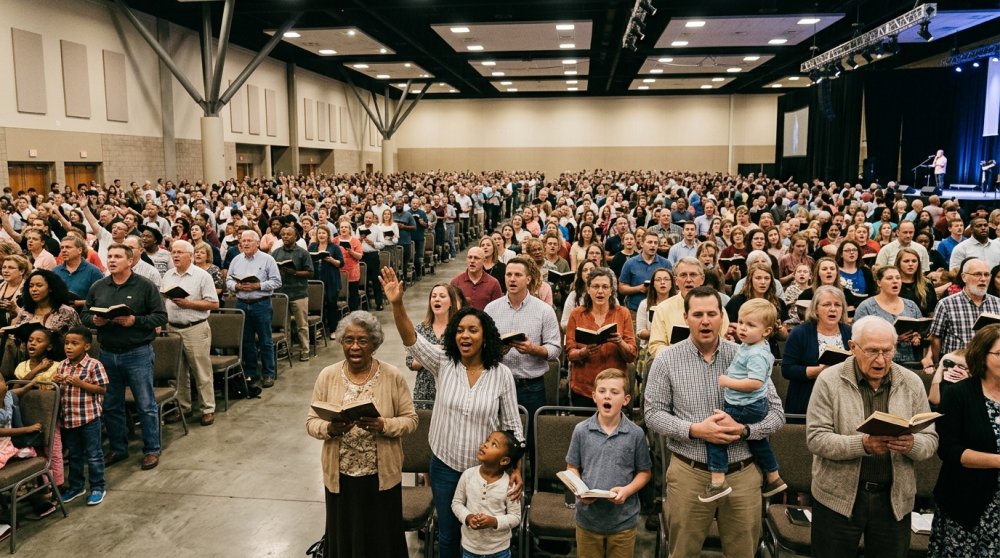
- More than 5,000 Christians from across the nation gathered in Sevierville, Tennessee for the annual Polishing the Pulpit conference, with an additional 2,300 attending a sister event in Branson, Missouri
- The weeklong event featured Bible teaching sessions for all ages, from toddlers to grandparents, with keynote messages exploring Jesus Christ’s role as the Great Physician healing every aspect of life
- Families from military communities and across the country described the conference as a vital opportunity for spiritual renewal, fellowship, and strengthening faith in the next generation
In the foothills of the Great Smoky Mountains, thousands of Christian families converged for a powerful week of worship, Bible study, and spiritual renewal. The Polishing the Pulpit conference in Sevierville, Tennessee drew believers from as far as Hawaii, Maine, and even Australia for intensive Christian education that strengthened faith across generations.
Dan Winkler, minister for the Spring Meadows Church of Christ in Spring Hill, Tennessee, delivered a compelling message about Jesus as the Great Physician during the keynote series.
“He went to the university of hard knocks. He majored in humanity, not humanities. He graduated summa cum laude because he never made anything but A-plus. And he stepped into his post-grad work to become the Great Physician, not doing classes online but on the front line — healing the leper, giving sight to the blind, making whole the lame. And he can make a difference in your life.”
The conference’s family-focused approach sets it apart from typical religious gatherings. From toddlers to grandparents, attendees found age-appropriate biblical instruction throughout the week. Popular sessions filled to capacity, with many standing at room edges or sitting on floors to hear teachings on theology, Christian living, and scriptural truth.
Ellis Thorne, a 43-year-old member of the U.S. Coast Guard who worships with the North Hamilton Church of Christ in Soddy Daisy, Tennessee, brought three generations of his family to the event.
“One of the great things about Polishing the Pulpit is there’s something for the entire family,” said Thorne, who attended with his parents, wife, and three children ages 6 to 12. “And, you know, it’s extremely important to us to make our family as strong as possible in Christ.”
For military families like the Thornes who relocate frequently, the annual gathering provides crucial continuity. “It’s not just our physical family, but I’m in the military, and we have to move around a lot, and so there’s a lot of people that we get to see here that (are) part of our Christian family from various congregations — as far away as Hawaii, Maine, South Carolina, Alabama.”
“We get to reunite with our family here and many people that my kids were very close to when they were growing up,” he added. “It’s just a great experience to be around and show them how many people that there are that love the Lord and want to do his will.”
Chanel Smith, 41, made the journey from New Orleans with her husband, children, and in-laws for her fourth time attending. The Smith family worships with the Degaulle Drive Church of Christ.
“It’s been really great because there’s classes for the kids, and it’s just a really good time for my husband and I to recharge because we both work,” she said. “It gives us time to recharge and really focus in on God.”
From Small Beginnings to National Movement
The conference’s humble origins stand in stark contrast to its current scope. In 1994, three preachers and alumni of Faulkner University in Montgomery, Alabama — Allen Webster, Mark Howell, and Floyd Bailey — began meeting to workshop sermon plans, rotating among their offices in different states.
As word spread, the gathering expanded to include other preachers, then church elders, deacons, youth ministers, and eventually all church members. The first Sevierville conference in 2008 drew just under 1,000 attendees. Growth necessitated adding a second location in Branson in 2024.
Allen Webster, now 60 and director of Polishing the Pulpit, reflected on the conference’s remarkable expansion.
“You look back on it, and you see the hand of God in it. We always wanted it to glorify God, and we wanted it to be good for his kingdom. … It’s amazing what God has done with this.”
Webster, who also founded the House to House, Heart to Heart ministry, emphasized the conference’s multigenerational impact. “When you’re a parent … it really helps to broaden the educational experience with others who reinforce what you’re teaching. So that helps them to see a wider spectrum of the brotherhood and reinforce the Scriptural teaching.”
This year’s keynote series explored lesser-discussed aspects of Jesus Christ, examining how the Savior heals and transforms every part of a Christian’s life as physician, counselor, and redeemer.
“Let’s bring Jesus back into the focus,” Webster said. “What does the church need now? We need to be close to him. You know, we need to understand him. … So it’s just a new way to look at some old truths.”
Worship and Fellowship Draw Thousands
Beyond the teaching sessions covering theology, doctrine, Scripture, Christian lifestyle, culture, and law, the conference featured extensive a cappella congregational singing. Evening singing sessions in the convention center atrium drew over 1,000 voices in traditional hymns and worship songs.
Tiffany Bryan, a 19-year-old first-time attendee from the West Metro Church of Christ in Yukon, Oklahoma, found the worship particularly moving.
“The singing was really, really good. Like, it was tear jerking.”
Bryan attended after encouragement from her sister Zoey, who had experienced the Branson conference. The young woman emphasized the importance of Christians understanding their beliefs more deeply.
“Sometimes we just trust everything the preacher says, you know,” she explained after attending a session on “The Myth of Neutrality.” “And sometimes we just walk along not doing anything … not doing our part.”
The conference’s reach extends internationally. Andrew Young traveled from Queensland, Australia, where he serves as a missionary preacher for the Gipps Street Church of Christ in Toowoomba. The former salesman and father of three first attended while studying at the Southeastern Institute of Biblical Studies in Knoxville, Tennessee.
“In the entire country of Australia, there are 1,700 members of the Church of Christ, which basically means there are more Christians in this room than there are in the entire country of Australia,” Young said from his exhibitor space, where he was raising funds for a 12-seat church bus to transport workers to rural congregations across Queensland, a region nearly three times the size of Texas.
“It’s insane to think that you get this many people who are like-minded Christians, like-minded in our belief. … It was just unbelievable to have that many people together singing, praising God. It was just amazing.”
The conference continues to serve as a vital gathering point for Christian families seeking to strengthen their faith, educate their children in biblical truth, and connect with fellow believers committed to living according to Scripture. As American culture increasingly challenges traditional Christian values, events like Polishing the Pulpit provide essential community and spiritual fortification for families determined to raise the next generation in the faith.
Let us know what you think, please share your thoughts in the comments below.

Faith Facts
- A death at Big Church Festival prompted not only grief but widespread mockery of Christian faith on social media and in public forums
- The hostile response demonstrates that even in spiritually hungry times, opposition to God and His people remains a constant reality
- Christians are called to remain steadfast and grieved but unsurprised when facing cultural hostility toward the faith
When tragedy strikes, the natural human response is compassion and solidarity. But the aftermath of a recent death at Big Church Festival revealed something darker lurking beneath the surface of our culture. Alongside genuine expressions of grief and condolence, a wave of insults and mockery directed at the Christian faith flooded social media and public discourse.
This response should grieve us deeply as believers. Yet it should not surprise us.
We live in what many describe as a spiritually hungry society—one where mindfulness apps flourish, where yoga studios fill with seekers, where interest in meditation and alternative spirituality grows each year. People are searching for meaning, for transcendence, for something beyond the material world. But despite this hunger, or perhaps because of it, hostility toward the God of the Bible and toward His people remains fierce and unrelenting.
The mockery that followed this tragedy is a stark reminder that we are still in a spiritual battle. This is not a battle fought with physical weapons or political power. It is a battle for hearts, minds, and souls—a battle that has raged since the Garden of Eden and will continue until Christ returns.
Scripture warns us repeatedly to expect opposition. Jesus Himself told His disciples they would be hated because of Him. The Apostle Paul wrote that the message of the cross is foolishness to those who are perishing. Peter encouraged believers not to be surprised at the fiery trial they were experiencing, as though something strange were happening to them.
The hostility we see is not new. It is the same ancient rebellion against God dressed in modern language and amplified by social media platforms. When tragedy strikes believers, some see it not as an opportunity for empathy but as a chance to question God’s goodness, to mock faith, and to dismiss Christianity as naive or dangerous.
This reaction reveals a profound spiritual reality: the human heart, apart from God’s grace, is at enmity with Him. No amount of cultural sophistication or spiritual curiosity can bridge that gap. Only the transforming power of the Holy Spirit can turn a mocker into a worshiper, a scoffer into a servant.
As Christians, our response to such hostility must be rooted in both truth and love. We grieve—for the loss of life, for the pain of those who mourn, and for the hardness of heart displayed by mockers. We stand firm in our faith, knowing that our hope is not in the approval of the world but in the unchanging character of God.
We also recognize that behind the mockery are people made in God’s image, people who are themselves spiritually lost and in desperate need of the gospel. Our calling is not to return insult for insult, but to entrust ourselves to Him who judges justly, and to continue proclaiming the good news with gentleness and respect.
The tragedy at Big Church Festival and the mockery that followed remind us that the spiritual battle is real and ongoing. But they also remind us that our faith is not dependent on favorable circumstances or cultural acceptance. It is anchored in the resurrection of Jesus Christ and the promise that one day every knee will bow and every tongue confess that He is Lord.
Until that day, we press on—grieved by hostility, but not defeated by it. We love our enemies, pray for those who persecute us, and trust that God is working all things together for the good of those who love Him. The battle may be fierce, but the victory is already won.
Let us know what you think, please share your thoughts in the comments below.
Faith Facts
- Jesus preached with passion and conviction, sometimes offending listeners, yet scripture provides no evidence He shouted during His teachings
- Modern preaching styles increasingly emphasize volume and intensity, raising questions about effective communication of the Gospel
- Church leaders are re-examining whether passionate delivery requires raised voices or if quieter conviction can reach hearts more effectively
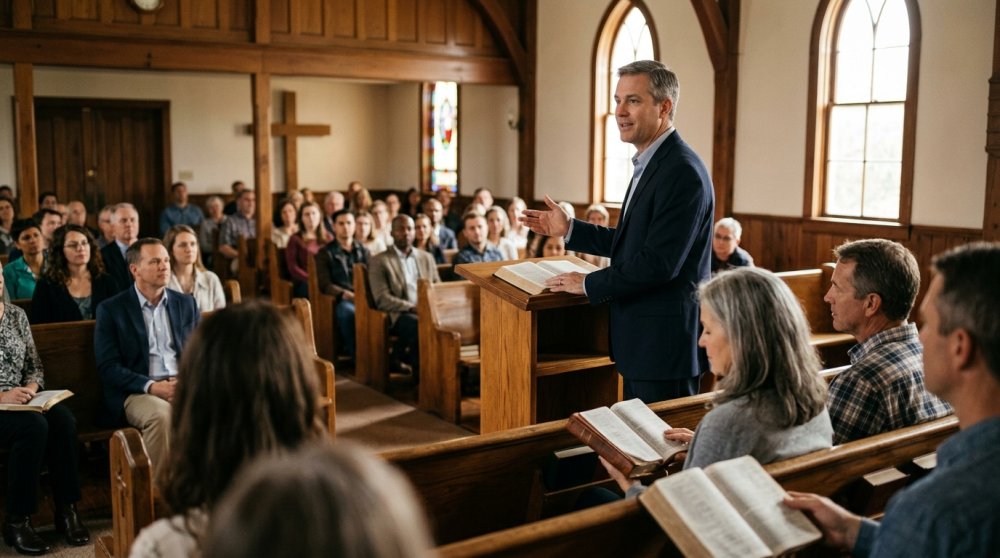
A growing conversation among Christian leaders is challenging long-held assumptions about how the Gospel should be delivered from the pulpit. The question isn’t about passion or conviction—it’s about volume.
Dr. Claire Williams, a respected voice in pastoral studies, has raised an intriguing observation that’s resonating across denominational lines. While Jesus clearly preached with passion and wasn’t afraid to offend when truth demanded it, there’s a conspicuous absence in Scripture of any indication He shouted His sermons.
The distinction matters more than many realize. In an age where megachurch pastors often employ theatrical delivery and amplification systems that can shake the rafters, Williams suggests we may be confusing volume with power, intensity with impact.
“Jesus preached passionately, and even offended people,” Williams notes, acknowledging the Savior’s uncompromising approach to truth-telling. But the method of delivery—the actual volume and tone—deserves closer examination by today’s church leaders.
The American church has long embraced passionate preaching as a cornerstone of effective ministry. From the Great Awakening’s fire-and-brimstone sermons to modern stadium-filling evangelists, raised voices have been synonymous with spiritual fervor. Yet this cultural norm may not reflect biblical precedent as clearly as we’ve assumed.
Consider the teaching style of Jesus as recorded in the Gospels. He spoke in parables to curious crowds on hillsides. He engaged in intense theological debates with religious leaders. He confronted hypocrisy and called out sin without hesitation. But nowhere do we find descriptions of Him shouting, yelling, or raising His voice to make His point.
In fact, Scripture tells us Jesus often withdrew to quiet places to pray. His most profound teachings—the Sermon on the Mount, His final discourse with the disciples—are presented as measured, thoughtful communications, not shouted proclamations.
This observation challenges contemporary assumptions about what makes preaching effective. Many pastors believe volume conveys urgency, that raising one’s voice demonstrates conviction about eternal matters. Williams questions whether this approach actually enhances communication or potentially hinders it.
The human response to shouting is complex. While it can command attention initially, sustained volume often triggers psychological defensiveness. Listeners may focus more on the delivery than the message itself, or worse, feel assaulted rather than invited into truth.
Quiet conviction, by contrast, can be profoundly powerful. A pastor who speaks with controlled intensity, allowing the weight of Scripture itself to carry the message, may actually create more space for the Holy Spirit to work in hearts.
This doesn’t mean preaching should be boring or emotionless. Jesus was neither. He wept over Jerusalem. He overturned tables in the temple. He spoke with authority that astonished listeners. Passion and conviction are non-negotiable elements of faithful Gospel proclamation.
The question is whether that passion must be loud to be legitimate. Williams suggests the answer is no—and that discovering alternative modes of powerful communication might actually strengthen the church’s witness.
For congregations accustomed to high-volume preaching, this shift might feel uncomfortable at first. We’ve been culturally conditioned to associate loud with important, quiet with weak. Breaking that association requires intentionality from both pulpit and pew.
Some of the most effective communicators in Christian history—including Billy Graham in his later years—demonstrated that you can hold massive audiences spellbound without shouting. Their secret was substance over style, allowing the gravity of the Gospel itself to do the heavy lifting.
Modern worship services often feature loud music, dramatic lighting, and high-energy elements designed to engage contemporary audiences. In that context, a shouting preacher might seem consistent with the overall experience. But Williams asks whether we’re inadvertently training believers to equate spiritual depth with sensory stimulation.
The early church met in homes, sharing meals and teaching in intimate settings. The Reformers emphasized careful exposition of Scripture. Puritan preachers were known for hour-long sermons delivered with intellectual rigor, not theatrical flair. Throughout church history, faithful Gospel proclamation has taken many forms—not all of them loud.
For pastors willing to reconsider their delivery, the adjustment isn’t about becoming timid or compromising conviction. It’s about exploring whether the same passion that currently expresses itself through volume might be channeled differently—with equal or greater effect.
This conversation also touches on pastoral health. Chronic shouting can damage vocal cords, leading to medical issues that shorten ministry careers. More importantly, it can create an unsustainable model where perceived anointing depends on physical capacity rather than spiritual depth.
Williams’ observation invites all believers to think more carefully about how we communicate truth. In our personal evangelism, our family devotions, our small group discussions—do we default to volume when we want to emphasize importance? Or can we trust that truth spoken in love, regardless of decibel level, carries its own power?
The Holy Spirit doesn’t need amplification. He convicted the world of sin, righteousness, and judgment long before microphones existed. He can work through a whisper as easily as a shout—perhaps more easily, since whispers require listeners to lean in rather than recoil.
None of this diminishes the prophetic tradition of bold proclamation. There remains a vital place for preachers who will courageously confront cultural decay, call out compromise, and declare unpopular truths regardless of consequence. The question is simply whether that boldness requires volume or whether it can be delivered with quiet strength.
As the American church faces increasing cultural marginalization, our witness may benefit from reconsidering not just what we say, but how we say it. A faith that speaks with confident conviction, grounded in Scripture and empowered by the Spirit, doesn’t need to shout to be heard. It needs to be true.
Jesus offended people not through volume but through truth. He challenged assumptions, exposed hypocrisy, and demanded decisions. His words cut to the heart not because they were loud, but because they were accurate, authoritative, and spoken in love.
That’s a model worth emulating—passionate without being aggressive, convicting without being combative, powerful without being loud. It’s preaching that trusts the Gospel itself to do what only the Gospel can do: transform hearts and save souls.
Let us know what you think, please share your thoughts in the comments below.


-

 Self-Reliance1 year ago
Trump’s Bold Move Uncovers Massive Social Security Fraud
-

 Faith1 year ago
New Clues Emerge in Noah’s Ark Mystery
-

 News1 year ago
Governor Walz’s Rhetoric Sparks National Controversy
-

 News1 year ago
Mel Gibson’s ‘The Passion of the Christ’ Sequel Title Announced
-

 Family1 year ago
Texas Lawmaker Targets Furries in Schools
-

 Freedom1 year ago
Maine Lawmaker Challenges Sports Fairness Controversy
-

 Family1 year ago
Canada’s Controversial Policy Sparks Ethical Debate
-
Faith9 months ago
Congress Hears Pleas for Nigerian Christians