
Faith
Vice President Vance Defends Sacred Foundation Under Fire


Faith Facts
- Vice President JD Vance defended Texas law requiring Ten Commandments displays in public schools during Joe Rogan podcast appearance
- Vance characterized the biblical text as a fundamental ‘cultural element of Western civilization’ rather than purely religious doctrine
- The exchange highlights ongoing national debate over the proper role of faith expression in public education
Vice President JD Vance mounted a spirited defense of a Texas law requiring the Ten Commandments to be displayed in public school classrooms during a recent appearance on Joe Rogan’s podcast, pushing back against the host’s concerns about religious indoctrination.
The controversial Texas legislation has sparked intense debate about the relationship between faith and public education. Rogan, a comedian and podcast host whose show reaches millions of listeners, voiced skepticism about government-mandated religious displays in taxpayer-funded schools.
“I think it’s a cultural element of Western civilization,” Vance responded, framing the commandments as foundational to American society rather than sectarian religious content.
The vice president’s remarks underscore a broader conservative movement to restore traditional religious expression in the public square. For decades, progressive activists have sought to scrub faith from public institutions, arguing that any acknowledgment of America’s Judeo-Christian heritage violates the separation of church and state.
Conservative Christians counter that the erasure of biblical principles from schools has contributed to moral decline among young people. They argue that the Ten Commandments represent universal ethical principles that transcend any particular denomination.
The Texas law reflects a growing willingness among red-state legislatures to challenge decades of court precedent that have restricted religious expression in government settings. Several other states have considered similar legislation, signaling that the battle over faith in public life is far from settled.
Legal challenges to the Texas measure are virtually certain, with secularist organizations already preparing litigation. Previous attempts to display the Ten Commandments in public schools have faced mixed results in federal courts, with outcomes often depending on how the displays are framed and whether they appear alongside other historical documents.
Vance’s willingness to engage the issue on a platform like Rogan’s podcast demonstrates the administration’s commitment to defending religious liberty. Rather than retreating from controversial cultural questions, the vice president made a case for the commandments as essential to understanding Western legal and moral traditions.
The exchange also highlights the complex political coalitions shaping contemporary debates. Rogan, who has described himself as politically independent, represents a segment of Americans uncomfortable with government-imposed religious displays even if they personally respect faith traditions.
For many Christians, the Ten Commandments represent more than historical artifacts—they are divine instruction for righteous living. The prohibition against murder, theft, and bearing false witness forms the basis for much of Western law, while commandments about honoring parents and avoiding adultery reinforce family structures that have sustained civilizations for millennia.
The debate over classroom displays ultimately reflects deeper questions about American identity. Is the United States a nation rooted in biblical principles, or a purely secular democracy where faith must be privatized? How Americans answer that question will shape education policy, legal standards, and cultural norms for generations to come.
Let us know what you think, please share your thoughts in the comments below.

Faith Facts
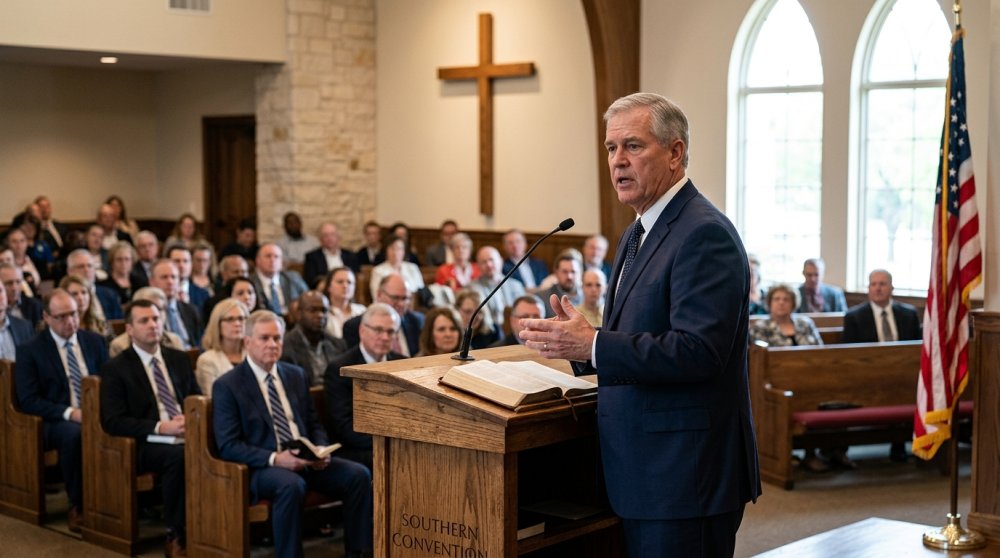
- Southern Baptist Convention President Willy Rice has proposed amending the Baptist Faith & Message to address cultural confusion over marriage and gender.
- The proposed amendment seeks to reaffirm the biblical understanding of marriage as between one man and one woman.
- Rice’s initiative reflects a commitment to upholding traditional Christian values in the face of societal changes.
Southern Baptist Convention President Willy Rice is calling for an amendment to the Baptist Faith & Message that would strengthen the denomination’s stance on marriage and gender. The move comes amid growing cultural confusion over these foundational issues. Rice believes the change is necessary to clearly articulate biblical truth in an age of shifting definitions.
The proposal aims to protect the integrity of the faith statement that guides Southern Baptist beliefs and practices. By updating the language, Rice hopes to equip churches and members with a clearer doctrinal foundation. This effort aligns with longstanding Christian teachings on the sanctity of marriage and the created order.
“We must be clear about what Scripture teaches regarding marriage and human identity,”
Rice stated. The amendment would serve as a safeguard against progressive ideologies that challenge traditional Christian doctrine. It also reinforces the Southern Baptist commitment to the authority of Scripture in all matters of faith and practice.
Supporters of the proposal argue that such clarity is vital for maintaining unity within the denomination. They view the amendment as a proactive step to ensure that future generations understand and uphold biblical standards. Opponents may see it as unnecessary, but Rice maintains that doctrinal precision is essential in a rapidly changing world.
Let us know what you think, please share your thoughts in the comments below.

Faith Facts
- Jesus taught that true life comes through surrender, just as a seed must die to produce fruit.
- Autumn’s cycle of falling leaves reflects the Christian call to lay down our lives in obedience to Christ.
- The changing season points believers to the promise of resurrection and eternal hope in Jesus.
Hidden within this changing season is a truth that echoes something Jesus once said about His own death and about the life to which He calls those who follow Him.
The turning leaves and shortening days remind us that death often precedes new life in God’s design. Just as trees release what is no longer needed, followers of Christ are called to surrender their own ambitions and comforts.
“Unless a kernel of wheat falls to the ground and dies, it remains only a single seed. But if it dies, it produces many seeds,” Jesus told His disciples.
This biblical principle is displayed across the landscape each October. Fields once full of growth now rest, preparing for the renewal of spring under God’s faithful hand.
Christians see in autumn not an ending, but a picture of resurrection hope. The same God who brings new life after winter promises to raise those who trust in His Son.
Let us know what you think, please share your thoughts in the comments below.

Faith Facts
- A new survey indicates Generation Z adults are more likely than older Americans to describe themselves as religious.
- Many in this generation also engage in practices that conflict with traditional Christian teaching.
- The findings highlight both the spiritual interest and the doctrinal challenges facing younger believers today.
A recent poll finds that Generation Z stands out as the age group most inclined to identify as religious. The data challenges assumptions that younger Americans are drifting away from faith altogether.
At the same time, researchers note that many who claim a religious identity still participate in activities that run counter to biblical standards. This mix of self-identification and inconsistent practice raises questions about the depth of their convictions.
“Generation Z adults are more likely than older Americans to describe themselves as ‘religious,’ even as many also engage in practices at odds with Christian teaching, according to a new survey.”
Let us know what you think, please share your thoughts in the comments below.


-

 Self-Reliance1 year ago
Trump’s Bold Move Uncovers Massive Social Security Fraud
-

 Faith1 year ago
New Clues Emerge in Noah’s Ark Mystery
-

 News2 years ago
Governor Walz’s Rhetoric Sparks National Controversy
-

 News1 year ago
Mel Gibson’s ‘The Passion of the Christ’ Sequel Title Announced
-

 Family2 years ago
Texas Lawmaker Targets Furries in Schools
-

 Freedom2 years ago
Maine Lawmaker Challenges Sports Fairness Controversy
-

 Family1 year ago
Canada’s Controversial Policy Sparks Ethical Debate
-
Faith10 months ago
Congress Hears Pleas for Nigerian Christians