
Faith
The Hidden Path Through Grief That Scripture Reveals


Faith Facts
- Migration trauma requires spiritual processing for true mental health recovery
- Scripture promises God’s presence during life’s darkest transitions
- Biblical healing model emphasizes embracing grief rather than avoiding it
When families uproot their lives and move to unfamiliar lands, they carry invisible wounds that modern psychology is only beginning to understand. But the Bible has always known the path to healing — and it leads directly through the valley of grief, not around it.
Migration creates a unique kind of trauma. Families leave behind not just places, but entire networks of relationships, cultural identities, and the comfort of the familiar. The losses accumulate: language, community, professional status, even the ability to navigate daily life with confidence.
Many immigrants try to suppress these feelings, believing they should simply be grateful for new opportunities. Yet this avoidance only delays healing. Scripture offers a different model entirely — one that acknowledges suffering as the gateway to restoration.
The biblical imagery of “passing through the waters” captures this journey perfectly. God doesn’t promise to keep us from the flood; He promises to be with us in it. This distinction matters deeply for anyone processing profound loss.
Isaiah 43:2 declares this promise clearly:
“When you pass through the waters, I will be with you; and when you pass through the rivers, they will not sweep over you.”
The passage assumes difficulty, assumes the waters, assumes the crossing. What it also assumes is God’s faithful presence throughout.
For Christian counselors working with immigrant communities, this biblical framework provides essential guidance. Grief isn’t the enemy of faith — it’s often the doorway to deeper trust. When we allow ourselves to fully feel loss, we create space for God to meet us in our pain.
This principle extends far beyond immigration. Anyone who has lost a loved one, endured divorce, faced serious illness, or watched dreams die knows the temptation to bypass grief. American culture particularly pressures people to “move on” quickly, to “stay positive,” to deny the weight of what they’ve lost.
But Scripture consistently models lament as a sacred practice. The Psalms overflow with honest cries of anguish. Jesus himself wept at Lazarus’s tomb, even knowing resurrection was moments away. God created us with the capacity to grieve because grief is how we honor what mattered.
The pathway through grief follows a pattern: acknowledgment, expression, time, and gradual transformation. We cannot rush it. We cannot skip steps. But we can trust that God walks every step with those who seek Him.
For immigrant families especially, finding spaces to grieve collectively makes tremendous difference. When churches create opportunities for people to share their stories, to name their losses, to cry together — healing accelerates. Isolation intensifies trauma; community disperses it.
Mental health professionals increasingly recognize what Scripture has always taught: suppressed grief doesn’t disappear. It manifests as anxiety, depression, physical illness, relational dysfunction, and spiritual emptiness. The only way out is through.
This doesn’t mean wallowing in sorrow indefinitely. Biblical grief moves toward hope, but it refuses to rush that movement. It trusts God’s timeline more than cultural expectations or personal impatience.
The promise of “new life” on the other side of grief isn’t about returning to how things were. It’s about discovering how God redeems what was lost into something we couldn’t have imagined before the breaking.
For the immigrant who has left everything familiar, new life might mean building bridges between two cultures, raising children who draw strength from multiple heritages, or discovering gifts that only emerged through displacement. But none of this comes without first honoring what was lost.
The Christian faith uniquely equips believers to walk this path. We worship a God who entered human suffering, died, and rose again — the ultimate pattern of loss transformed into life. We don’t grieve as those without hope, but we do grieve. The resurrection doesn’t erase the crucifixion; it redeems it.
Churches can serve as sanctuaries for healthy grief processing by rejecting toxic positivity, making space for lament in worship, training leaders to sit with people in pain rather than rushing to fix it, and teaching that emotional honesty is spiritual maturity, not weakness.
When we embrace grief rather than fear it, we discover something remarkable: the same God who promises to be with us through the waters also brings us to the other shore. Changed, yes. Scarred, perhaps. But also healed in ways we couldn’t access by any other route.
Let us know what you think, please share your thoughts in the comments below.


Faith Facts
- Christians are called to redeem every tool for God’s glory and the spread of the Gospel.
- Artificial intelligence is a human creation and remains under God’s sovereign authority.
- Believers must approach emerging technologies with wisdom rooted in Scripture.
Christians around the world are asking an important question as artificial intelligence grows more powerful. How can this technology be captured for the glory of God and the advancement of the Gospel?
Scripture teaches that every good gift comes from above. Technology itself is not evil, but its use must be directed by truth and righteousness.
AI systems are built by people and trained on data created by people. They reflect human choices and remain limited by the boundaries God has established.
Believers have a responsibility to guide these tools toward purposes that honor Christ and serve others. That includes sharing the Gospel, protecting life, and strengthening families.
“Whether therefore ye eat, or drink, or whatsoever ye do, do all to the glory of God,” 1 Corinthians 10:31 reminds us.
Churches and ministries are already exploring ways to use AI for translation, accessibility, and discipleship resources. These efforts must stay anchored in sound doctrine and prayerful discernment.
At the same time, Christians are right to raise concerns about privacy, truth, and the temptation to place ultimate trust in machines rather than in the Lord.
“Trust in the Lord with all thine heart; and lean not unto thine own understanding,” Proverbs 3:5 declares.
Ultimately, the future belongs to the One who created all things, not to any algorithm or invention of man. AI will never have the final word over humanity.
Let us know what you think, please share your thoughts in the comments below.

Faith Facts
- The little log church has stood along the historic Oregon Trail route, serving as a steadfast reminder of Christian faith amid the rugged American frontier.
- U.S. Highway 191 passes near this enduring structure, connecting modern travelers to the spiritual legacy of pioneer families who settled the West.
- The church continues to bear witness to the traditional values of faith, family, and freedom that shaped our nation’s westward expansion.
Along U.S. Highway 191 stands a little log church that looks as though it has occupied this windswept landscape since the days of wagon trains.
The humble structure serves as a tangible link to the pioneer families who carried their Bibles and their faith across the plains in search of new beginnings.
Its weathered logs and simple steeple rise against the vast Western sky, a quiet testament to the enduring strength of Christian witness in America.
Travelers passing by are reminded that the values of hard work, self-reliance, and devotion to God helped build this nation from the ground up.
Let us know what you think, please share your thoughts in the comments below.
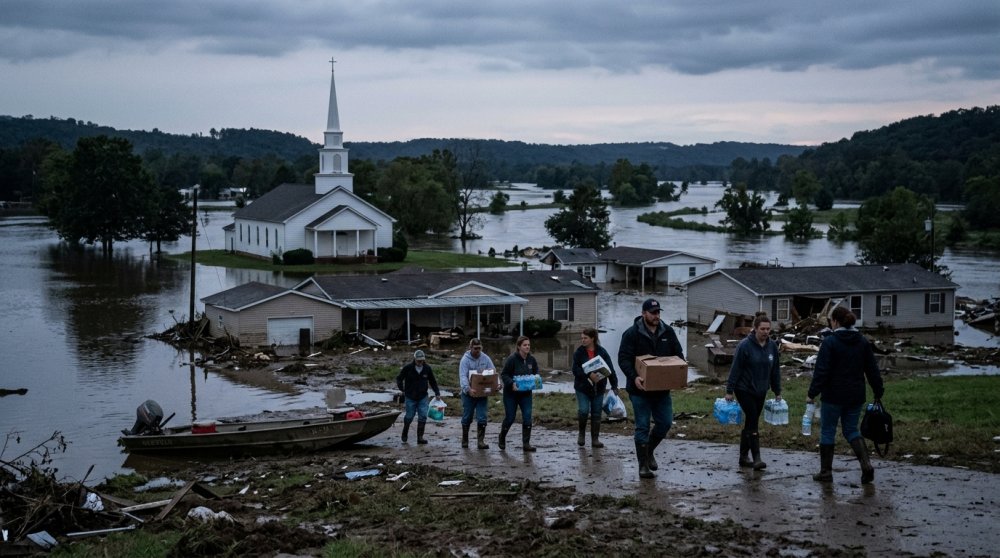
Faith Facts
- Scripture teaches that creation groans under the weight of sin and awaits redemption
- Christian teaching holds that believers are called to reflect God’s compassion through practical help
- History shows the church has long been first on the scene after floods, fires, and storms
Every natural disaster reminds us that we live in a fallen world — that mankind’s sin irreparably marred the world’s original perfection.
We call these events “natural disasters,” but the reality is that these tragedies are anything but “natural.”
Let us know what you think, please share your thoughts in the comments below.


-

 Self-Reliance1 year ago
Trump’s Bold Move Uncovers Massive Social Security Fraud
-

 Faith1 year ago
New Clues Emerge in Noah’s Ark Mystery
-

 News2 years ago
Governor Walz’s Rhetoric Sparks National Controversy
-

 News1 year ago
Mel Gibson’s ‘The Passion of the Christ’ Sequel Title Announced
-

 Family1 year ago
Texas Lawmaker Targets Furries in Schools
-

 Freedom1 year ago
Maine Lawmaker Challenges Sports Fairness Controversy
-

 Family1 year ago
Canada’s Controversial Policy Sparks Ethical Debate
-
Faith10 months ago
Congress Hears Pleas for Nigerian Christians