
Family
The Crisis Most Churches Are Missing When Foster Children Turn 18


Faith Facts
- Over 20,000 foster youth age out of the system annually with no family support or safety net
- Christian communities are being called to provide long-term mentorship and support beyond the foster care system’s cutoff age
- A single committed adult can transform the trajectory of a young person’s life after foster care ends
Every year, more than 20,000 young Americans reach the age when the foster care system stops caring. At 18, often alone and unprepared, these young men and women are suddenly cut off from the only support structure they’ve known. No family waiting. No safety net to catch them. And far too often, no one showing up to help them navigate adulthood.
For the American Church, this represents both a sobering failure and a profound opportunity. These aren’t statistics — they’re sons and daughters, created in God’s image, who desperately need the body of Christ to live out the Biblical call to care for the fatherless.
The transition out of foster care is perilous. Without family connections or financial resources, many of these young adults face homelessness, unemployment, and a future that seems impossibly dark. The challenges they encounter would overwhelm anyone, let alone teenagers who have already experienced trauma and instability.
But there is hope, and it comes in a surprisingly simple form: one caring adult who refuses to walk away. Research consistently shows that young people who have at least one committed mentor or supportive adult in their lives fare dramatically better than those who face the world alone.
This is where the Church should be stepping forward with conviction and compassion. Christian families and individuals across America are uniquely positioned to provide the long-term relationships these young people need. This isn’t just foster care — it’s spiritual family, extended beyond legal obligations and bureaucratic timelines.
The call to care for orphans didn’t come with an age limit. James 1:27 reminds believers that pure religion includes looking after orphans in their distress. When the government stops providing care at 18, the Church’s responsibility doesn’t end — it intensifies.
Many churches are already answering this call through mentorship programs, housing assistance, job training, and simply by opening their homes and hearts. But the need far exceeds the current response. Thousands of young people are still falling through the cracks because Christians haven’t fully recognized this mission field in their own communities.
The beauty of this ministry is that it doesn’t require specialized training or massive resources. It requires presence, consistency, and love — showing up for birthdays, helping with job applications, answering late-night calls, being the family that biology or circumstance didn’t provide.
For congregations serious about putting faith into action, supporting aged-out foster youth offers a practical way to live out the Gospel. It’s messy, challenging, and requires long-term commitment. But it’s also exactly what Jesus modeled: entering into broken situations and refusing to abandon the vulnerable.
American churches have a legacy of leading social reform and caring for society’s most vulnerable. From the abolition movement to crisis pregnancy centers, Christians have historically recognized that faith demands action. Supporting aged-out foster youth is the next frontier of this faithful witness.
The question facing every believer isn’t whether these young people need help — the data makes that clear. The question is whether we will be the ones who show up, who refuse to walk away, who become the family they never had.
This generation of foster youth didn’t choose their circumstances, but the Church can choose its response. Twenty thousand young people will age out this year. Will twenty thousand Christians step forward?
Let us know what you think, please share your thoughts in the comments below.

Faith Facts
- One-on-one accountability relationships often fail when built on just two people, according to ministry leader Derek Hughes
- Scripture emphasizes communal accountability through the body of Christ, not isolated pairs
- Christian men are rediscovering that faithful accountability requires multiple witnesses and a community of support
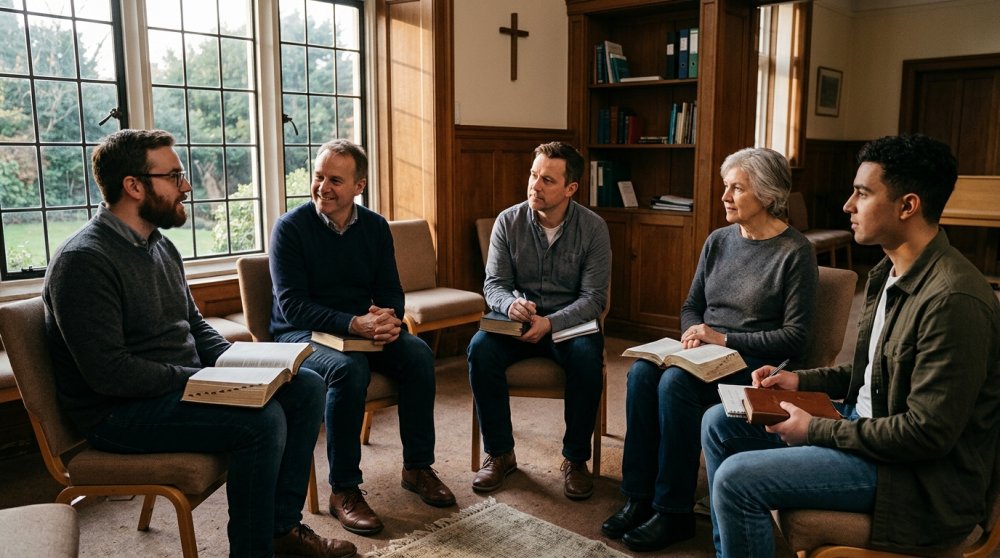
For years, the standard advice in Christian circles has been simple: find an accountability partner. One trusted friend, one phone call away, one person to keep you honest. But what happens when that relationship quietly fades, when the texts go unanswered, when life gets busy and the weekly check-ins stop?
Derek Hughes has watched this pattern repeat itself countless times. After years of seeing one-to-one mentoring relationships collapse under the weight of unspoken expectations, he began asking a difficult question: What if accountability was never designed to rest on the shoulders of just two people?
The traditional accountability partner model sounds biblical on the surface. We’re told that iron sharpens iron, that two are better than one. But Hughes suggests we may have misunderstood the blueprint. The early church didn’t practice accountability in isolated pairs—they practiced it in community, with elders overseeing the flock, with brothers and sisters bearing one another’s burdens together.
When accountability exists between just two people, several problems emerge. First, there’s no backup when one person falters or life circumstances change. Second, the relationship can become unbalanced, with one person doing all the confessing and the other doing all the advising. Third, without multiple perspectives, blind spots go unaddressed and poor counsel can go unchallenged.
The Scripture speaks of accountability in the context of the body of Christ—not isolated limbs, but interconnected members. When Paul instructed the Galatians to “bear one another’s burdens,” he was addressing the entire church community, not suggesting they pair off into accountability duos. When James wrote about confessing sins to one another, he envisioned a community of believers walking in transparency together.
Hughes advocates for what he calls “a room” rather than just “a pair.” This means small groups of three to five men or women who meet regularly, where accountability is shared among multiple relationships. In this setting, if one person misses a meeting, the group continues. If one member offers unwise counsel, others can provide correction. If someone struggles, multiple believers are there to support and pray.
This isn’t about abandoning close friendships or one-on-one discipleship. Those relationships remain vital. But when it comes to the vulnerable work of accountability—confessing struggles, addressing sin patterns, pursuing growth—there’s wisdom in having multiple witnesses and supporters rather than placing all that weight on a single friendship.
The isolation of the one-to-one model can also create unhealthy dynamics. One person may feel responsible for “fixing” the other. Codependency can develop. Or worse, the accountability becomes superficial, with both parties going through the motions of asking surface-level questions while avoiding the harder conversations.
In contrast, a small group provides built-in checks and balances. Different members bring different perspectives, life experiences, and spiritual gifts. One may offer wise counsel, another encouragement, another tough love when needed. The diversity strengthens the accountability rather than weakening it.
For Christian men especially, this shift could address the epidemic of isolation many face. Studies show Christian men are increasingly disconnected from meaningful friendships and spiritual community. The pressure to “find an accountability partner” can feel daunting, and when that relationship inevitably falters, men often retreat into isolation rather than trying again.
A small group removes some of that pressure. There’s less riding on any single relationship. The commitment is to the group, not to performing a role in someone else’s spiritual life. And the shared experience of walking together toward holiness creates bonds that isolated pairs often lack.
This approach also aligns better with how church discipline and restoration are described in Scripture. When Jesus outlined the process for addressing sin in Matthew 18, He spoke of bringing one or two others, then telling it to the church. The pattern moves toward community involvement, not away from it.
Hughes isn’t suggesting that every Christian needs to join a formal accountability group immediately. But he is challenging the assumption that accountability primarily happens in pairs. For those who have tried and failed at the accountability partner model, perhaps the issue wasn’t a lack of commitment or the wrong partner—perhaps the structure itself was insufficient.
The beauty of accountability in community is that it mirrors the gospel itself. We aren’t saved into isolation but into the body of Christ. We don’t grow alone but together, as living stones being built into a spiritual house. Our sanctification happens in relationship with other believers, shaped by their prayers, challenged by their questions, encouraged by their faithfulness.
As churches and ministries rethink how to foster genuine accountability, the shift from pairs to small communities could prove transformative. It won’t solve every problem, and it requires commitment from multiple people rather than just two. But for those who have experienced the quiet collapse of yet another accountability partnership, it offers a more sustainable, biblical path forward.
Let us know what you think, please share your thoughts in the comments below.
Faith Facts
- A growing number of therapists are encouraging clients to completely sever ties with family members, raising concerns about whether this approach aligns with biblical principles of forgiveness and reconciliation.
- Tim and Zach Clinton argue that labeling family members as ‘toxic’ has become a cultural trend masquerading as legitimate clinical care, potentially doing more harm than good.
- Christian counselors warn that abandoning family relationships without pursuing biblical restoration contradicts Scripture’s emphasis on family bonds and the transformative power of forgiveness.
The secular therapy world is increasingly promoting a troubling solution to family conflict: just walk away. Under the banner of mental health and self-care, countless Americans are being told that cutting off parents, siblings, and other relatives is not only acceptable — it’s therapeutic.
But is it really healing, or have we simply repackaged cultural alienation as clinical wisdom?
Tim and Zach Clinton are sounding the alarm on this dangerous trend. They argue that the therapeutic community has embraced a shortcut that violates fundamental biblical principles about family, forgiveness, and restoration.
The problem begins with the label itself. Calling someone “toxic” isn’t a clinical diagnosis — it’s a cultural buzzword that has infiltrated therapy sessions across America. It’s vague, subjective, and often applied to family members who simply hold different values or make us uncomfortable.
For Christian families, this trend is particularly insidious. Scripture places enormous value on family relationships and calls believers to pursue reconciliation, bear with one another, and extend forgiveness — even when it’s difficult. The Bible never promises that family relationships will be easy, but it does provide a framework for navigating conflict that doesn’t involve permanent estrangement.
The Clintons emphasize that while there are legitimate cases where boundaries are necessary — particularly in situations involving abuse or serious harm — the current therapeutic climate has normalized family abandonment as a first response rather than a last resort. Instead of equipping people with tools for healthy communication, conflict resolution, and biblical reconciliation, too many therapists are handing out permission slips to cut and run.
This approach doesn’t just damage families; it damages the individuals who follow this advice. Research consistently shows that strong family connections contribute to mental health, longevity, and overall well-being. Severing these ties may provide temporary relief from conflict, but it often leads to long-term regret, unresolved pain, and a loss of identity rooted in family heritage.
Moreover, the “cut them off” mentality reflects a broader cultural shift away from commitment, sacrifice, and the hard work of loving imperfect people. It’s the relational equivalent of cancel culture — if someone offends you or makes your life difficult, you simply erase them. This stands in stark contrast to the Christian call to love our enemies, pray for those who persecute us, and extend the same grace we’ve received from God.
The Clintons advocate for a different path: one that acknowledges the reality of difficult family dynamics while refusing to abandon the biblical mandate for reconciliation. This means setting healthy boundaries where necessary, seeking godly counsel, and doing the hard work of forgiveness — not because family members deserve it, but because Christ commands it and because it frees us from the prison of bitterness.
It also means discerning the difference between toxic behavior and simple disagreement. In today’s polarized climate, families are often divided over politics, theology, lifestyle choices, and values. But having a family member who votes differently, attends a different church, or makes choices you wouldn’t make doesn’t constitute toxicity — it’s just reality in a fallen world.
True healing doesn’t come from isolation; it comes from transformation. And transformation requires engagement, not escape. It requires us to confront our own sin, extend forgiveness, and trust God to work in relationships that seem beyond repair.
Christian families facing conflict need therapists who understand this biblical framework — counselors who will help them navigate difficult relationships without immediately advising estrangement. They need wisdom rooted in Scripture, not secular trends that prioritize comfort over character development.
The family is God’s design, and while it’s been deeply affected by sin, it remains a foundational institution for human flourishing. When we too quickly discard family relationships in the name of mental health, we’re not just rejecting difficult people — we’re rejecting God’s plan for refining us through those relationships.
The answer to family conflict isn’t always separation. Sometimes, it’s repentance, forgiveness, and the patient work of rebuilding trust. That’s not an easy message to hear in a culture that prizes self-protection above all else, but it’s the message the Church must continue to proclaim.
Let us know what you think, please share your thoughts in the comments below.

Faith Facts
- The F-word has transitioned from culturally taboo to commonplace in modern American discourse across workplaces, entertainment, and casual conversation.
- The normalization of vulgar language reflects broader cultural shifts away from traditional standards of decency and respect.
- Christians are called to elevate their speech as a reflection of faith, choosing words that honor God and build up others.
There was a time in America when certain words were simply not spoken in polite company. The boundaries were clear, the standards understood. That world seems increasingly distant.
The F-word, once relegated to the margins of acceptable discourse, has become ubiquitous. It saturates our entertainment, punctuates workplace conversations, and fills everyday exchanges that would have shocked previous generations.
This dramatic transformation didn’t happen overnight. It represents a decades-long erosion of standards that once protected the dignity of public discourse and reflected shared values about decency and respect.
Hollywood led the charge, gradually pushing boundaries in film and television. What began as occasional transgressions for shock value became routine, then expected. Today, profanity-laced dialogue is considered authentic, even artistic.
The workplace followed suit. Professional environments that once maintained strict decorum now tolerate language that would have ended careers a generation ago. The justification is often framed as authenticity or stress relief, but the result is a coarsening of our shared spaces.
Social media accelerated the trend, removing traditional gatekeepers and normalizing shock value as engagement strategy. Algorithms reward provocation, and vulgarity proves effective at capturing attention in an oversaturated information landscape.
But what do we lose when vulgarity becomes ordinary? Language shapes thought, and thought shapes character. When we abandon standards for speech, we signal something deeper about our values and our vision for community.
The Christian understanding of speech has always been clear. Words matter because they reflect the heart. Scripture repeatedly calls believers to choose language that builds up rather than tears down, that honors God rather than debases His image in ourselves and others.
“Let no corrupting talk come out of your mouths, but only such as is good for building up, as fits the occasion, that it may give grace to those who hear,” Paul writes in Ephesians 4:29. This isn’t legalistic restriction but recognition that our words carry weight and consequence.
The normalization of the F-word and similar profanity represents more than changing linguistic preferences. It reflects a culture that has lost confidence in the value of restraint, the wisdom of boundaries, and the importance of protecting spaces where dignity and respect prevail.
When everything is permissible, nothing is sacred. When all language is acceptable, no language is special. The flattening of distinctions between profane and elevated speech diminishes our ability to mark important moments and communicate profound truths.
Parents face particular challenges navigating this landscape. Children absorb the language they encounter, and the ubiquity of profanity makes protection increasingly difficult. Yet the calling remains unchanged: to model better speech and explain why standards matter.
The corporate world’s embrace of casual profanity also creates pressure for Christians who maintain different standards. Refusing to participate can mark one as uptight or inauthentic, yet compromising personal convictions for workplace acceptance carries its own cost.
Recovery of better speech habits won’t come through legislation or top-down mandates. It requires individuals choosing to speak differently, families establishing their own standards, and communities celebrating rather than mocking those who maintain traditional boundaries.
This isn’t about prudishness or arbitrary rules. It’s about recognizing that how we speak reflects who we are and shapes who we become. Language disciplines thought, and thought directs life.
The widespread acceptance of vulgarity signals cultural exhaustion with restraint itself. We live in an age that mistakes boundary-breaking for authenticity and constraint for hypocrisy. But true freedom isn’t found in the absence of all limits.
Christians have an opportunity to model an alternative. Not through judgment or condemnation, but through the simple practice of choosing words that reflect faith, convey respect, and build rather than destroy.
The question isn’t whether American culture will reverse course on profanity tomorrow. It won’t. The question is whether believers will maintain distinctive speech that points to something higher, or whether we’ll be swept along by the coarsening tide.
What we say matters because of who we represent. Our speech is witness, whether we intend it or not. In a culture drowning in vulgarity, the choice to speak differently becomes its own form of testimony.
The normalization of the F-word tells us something important about where we are as a nation. We’ve traded shared standards for individual autonomy, boundaries for authenticity, elevation for crude realism. The cost of that trade is only beginning to become clear.
Let us know what you think, please share your thoughts in the comments below.


-

 Self-Reliance1 year ago
Trump’s Bold Move Uncovers Massive Social Security Fraud
-

 Faith1 year ago
New Clues Emerge in Noah’s Ark Mystery
-

 News1 year ago
Governor Walz’s Rhetoric Sparks National Controversy
-

 News1 year ago
Mel Gibson’s ‘The Passion of the Christ’ Sequel Title Announced
-

 Family1 year ago
Texas Lawmaker Targets Furries in Schools
-

 Freedom1 year ago
Maine Lawmaker Challenges Sports Fairness Controversy
-

 Family1 year ago
Canada’s Controversial Policy Sparks Ethical Debate
-
Faith10 months ago
Congress Hears Pleas for Nigerian Christians