Connect with us

Faith

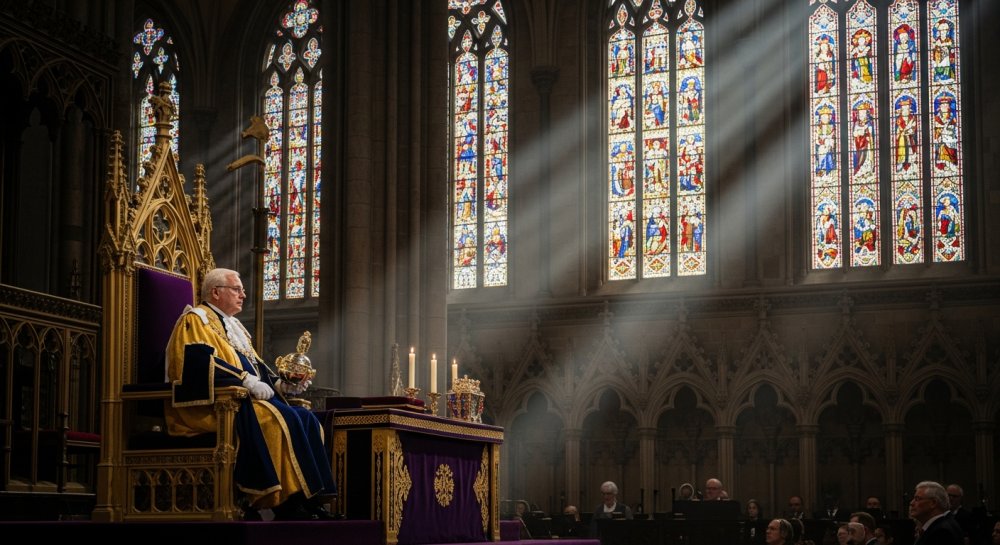
The Coronation Oath King Charles Just Quietly Changed

Published

on

Faith Facts

  • King Charles III has quietly altered the description of his coronation oath on official royal accounts, removing reference to defending “the Christian faith”
  • The revised language now simply states he will “defend the faith” without specific reference to Christianity
  • Former Chaplain to Queen Elizabeth II warns this subtle change represents a significant departure from centuries of royal tradition

In a move that has largely escaped public scrutiny, King Charles III has modified the wording describing his sacred coronation oath on official royal social media accounts. The change, though appearing minor at first glance, carries profound implications for the relationship between the British Crown and Christianity.

The original coronation oath, sworn by British monarchs for centuries, includes an explicit promise to defend “the Christian faith.” This commitment has been a cornerstone of the monarchy’s identity since the Reformation. However, the King’s official accounts now describe his pledge more broadly as defending “the faith,” omitting the specific reference to Christianity.

Gavin Ashenden, who served as Chaplain to Queen Elizabeth II, has raised concerns about this revision. The former chaplain suggests this change reflects a broader trend of distancing Britain’s institutions from their Christian foundations. For a nation whose identity and legal system were built upon Christian principles, such modifications to royal commitments deserve serious attention from believers and citizens alike.

The coronation oath itself remains unchanged in the official ceremony, but the way the monarchy now presents this commitment to the public has shifted. This distinction between the formal oath and its public description raises questions about how future generations will understand the Crown’s relationship with Christianity.

The British monarchy has served as “Defender of the Faith” since King Henry VIII received the title from Pope Leo X in 1521. While the title’s meaning evolved after England’s break with Rome, it has consistently represented the Crown’s special responsibility toward Christianity and the Church of England specifically.

King Charles has previously spoken about his desire to be seen as a defender of “faith” in a more inclusive sense, reflecting Britain’s increasing religious diversity. While respect for all citizens is certainly appropriate, critics argue that abandoning the specific Christian commitment diminishes the historical and spiritual foundation that has sustained British society for centuries.

The change also comes at a time when Christianity faces increasing marginalization in public life across the Western world. From restrictions on public prayer to the removal of Christian symbols from public spaces, believers have watched their faith steadily pushed to the margins of societies it helped build.

For American Christians observing these developments, the situation in Britain serves as a cautionary tale. When a nation’s leaders begin to distance themselves from explicit Christian commitments, it often signals a broader cultural shift away from the values and principles that made that nation great in the first place.

The question facing Britain now is whether a monarchy that no longer explicitly defends the Christian faith can maintain the moral authority and purpose that has sustained it through centuries of change. History suggests that institutions which abandon their founding principles rarely survive in any meaningful form.

As people of faith on both sides of the Atlantic, we must remain vigilant about subtle changes that erode Christian influence in public life. What begins as inclusive language often ends with the complete exclusion of Christian voices and values from the public square.

Let us know what you think, please share your thoughts in the comments below.

Continue Reading
Click to comment

Leave a Reply

Your email address will not be published. Required fields are marked *

Faith

When Faith and Freedom Rang Together in Philadelphia

Published

on

Faith Facts

  • On July 4, 1976, America’s Bicentennial celebration opened with an interfaith service on Independence Mall featuring church leaders and prayers of gratitude
  • President Gerald Ford emphasized America’s spiritual heritage, declaring that the nation continues ‘with a firm reliance on the protection of Divine Providence’
  • Christian families across the nation combined worship services with patriotic celebrations, demonstrating the inseparable link between faith and American identity

My 7-year-old grandson, Bennett, donned a red, white and blue top hat like Uncle Sam. He grinned as he posed for a picture with his father, Brady, outside Independence Hall, where delegates to the Second Continental Congress adopted the Declaration of Independence on July 4, 1776.

But I’m not certain Bennett grasped the full significance of Philadelphia at the Semiquincentennial — I think I spelled that right — the 250th anniversary of America’s founding.


“I don’t want to wait in that long line just to see a bell,”

my grandson said of the Liberty Bell. His grumbling made me smile.

We were in the City of Brotherly Love to enjoy America’s favorite pastime and decided to explore a bit of our nation’s history while here. I was close to Bennett’s age on July 4, 1976, when the U.S. marked the Bicentennial.

Honestly, I don’t recall a whole lot about the 200th anniversary, except for the special coins: quarters, half-dollars and dollars. My family lived in West Monroe, La., at the same apartment complex as the late Phil Robertson, the future “Duck Dynasty” reality TV star.

My father, Bob, was about to graduate from preaching school, and we’d soon move to North Carolina. I interviewed the Duck Commander decades later but didn’t know him then.

Despite the Fourth of July holiday, I’m sure we worshiped that Lord’s Day at the White’s Ferry Road Church of Christ. We maybe had a fellowship meal with star-spangled napkins and lit sparklers afterward.

At some point, I know we watched Walter Cronkite of the “CBS Evening News” anchor coverage of the nation’s festivities.

Faith Mixed With Fireworks

Since the Bicentennial fell on a Sunday, the celebrations of many Americans mixed faith, family and fireworks. The New York Times’ front-page coverage on July 5, 1976, described it this way:

“The nation celebrated its 200th birthday yesterday with pageantry and prayer, with games and parades, with picnics and fireworks, with the peal of bells and the chant of protests.”

“It began with a flag‐raising atop Mars Hill Mountain in Maine, where dawn reached the continent, and moved on to Fort McHenry, in Baltimore Harbor, where it was greeted by the rocket’s red glare of the national anthem.”

“At 2 P.M., Eastern daylight time, descendants of the Revolutionaries laid hands symbolically on the Liberty Bell in Philadelphia, and bells rang in the 50 states and in American communities overseas. At Independence Hall, President Ford read the day’s keynote address.”

In its August 1976 edition, Christianity Today featured coverage headlined “Bicentennial Blessings” that noted:

“Most attention was focused on the two main Bicentennial cities, Philadelphia and Washington.”

“July 4 dawned bright and warm in Philadelphia, where official observances began with an interfaith service conducted under a canopy on Independence Mall. Taking part were Greek Orthodox archbishop Iakovos, Cardinal John Kroll, and other church leaders.”

“President Ford arrived by helicopter a short time later, following a stop at Valley Forge, and delivered a televised address to the nation from the steps of Independence Hall before a crowd of tens of thousands. The speech underscored the nation’s spiritual heritage. ‘The American adventure began here with a firm reliance on the protection of Divine Providence,’ declared Ford. ‘It continues in a common conviction that the source of our blessings is a loving God in whom we trust.’ In closing, he asked everyone to join him ‘in a moment of silent prayer in gratitude for all we have received and for continued happiness in the United States of America.'”

“At 2 P.M. as a parade passed, the Liberty Bell was tolled, signaling the simultaneous ringing of bells across the land.”

A Journey of Faith and Patriotism

Penny Stafford Eubank, then 11 years old, joined her late grandparents, Gorden and Elizabeth Coley, on a 1,500-mile road trip from Longview, Texas, to experience the Bicentennial in Philadelphia. Throughout the two-week adventure, Eubank shared the back seat of a “big, four-door American sedan” with her older sister, Stacie Fischer, then 12, and her cousin Carla Matthews, 11.

Along the way, the family stopped to explore sites such as the Vicksburg National Battlefield in Mississippi and Stone Mountain in Georgia. Eubank — one of my former communication professors at Oklahoma Christian University — remembers her grandparents as people of strong faith and patriotism.

Gorden Coley served in the Marines in World War II. He was an elder of the former Mobberly Avenue Church of Christ in Longview.

The night before Independence Day, Eubank and her loved ones slept in a dormitory at the now-defunct Northeastern Christian Junior College in Villanova, Pennsylvania, northwest of Philadelphia.

“Then we got up and had Communion before we left,”

said Eubank, who now lives in the Atlanta area.

“I feel like the devotional was in a gathering area of the dorm. I remember they had chairs set up. … I guess they didn’t want to send someone off into downtown Philadelphia without having had their Sunday service.”

After the service, the family made its way to the city.

“This is crazy, but the first thing we did was go to the post office,”

Eubank said, recalling the desire to get envelopes postmarked “July 4, 1976.”

“I was in a stamp club the year before in my school, and I thought that was a great idea. So we waited in line for that, and then we stood in line for the parade.”

Eubank still has treasured photos — albeit a bit blurry — of the eight-tier, 50,000-pound birthday cake that Sara Lee baked for the occasion, of a Texas high school band marching in the parade and of her sister, cousin and her posing by the Liberty Bell and with Uncle Sam.

“I tell everyone about it. We’re talking about 250 now, but for me, the Bicentennial was a bigger deal.”

“I guess it’s more even or something. But the fact that we were there tells you something about my grandparents and what great people they were.”

Worship on America’s Birthday

Eddie Woodhouse was 17 at the time of the Bicentennial. He organized the trip that his family and three others from the Brooks Avenue Church of Christ in Raleigh, N.C., made to Philadelphia.

“I was kind of surprised that they would allow me to do that,”

Woodhouse said of making the arrangements at that age.

“We stopped in D.C. along the way and ate crab cakes in Baltimore and then got to Philadelphia. And at 17, Philadelphia was the biggest city I’d ever seen, and it seemed like the whole world was converging there.”

The Woodhouses — father, mother and three children — made the 400-mile journey in a wood-paneled Plymouth station wagon. The families stayed in a high-rise Holiday Inn.

“We took the public transportation, started to feel our way around, and every street corner had a vendor selling everything under the sun, not just the typical T-shirts,”

Woodhouse said.

“For instance, there were machines where you could insert a penny, and then you pulled down the lever, and it smashed a penny out to show July 4, 1776, to July 4, 1976. And you paid a quarter to get a smashed penny that had that as a souvenir.”

Before the Fourth of July festivities, the North Carolina families joined a throng of out-of-town guests for worship at the King of Prussia Church of Christ in a suburb of Philadelphia.

“We could not have been more warmly greeted. There were some references to the Bicentennial in the service, but then we left to get back to being the Southern tourists in Philadelphia.”

Among his memories of that day: President Gerald Ford speaking.

“The crowd was pretty deep. My brother and I, we were able to successfully work our way to the middle of that, but that was about as close as we were able to get. There were people who had essentially camped out for an opportunity to get toward the front.”

Half a century later, Woodhouse — now a political consultant who lives in Asheville, N.C., and worships with the Biltmore Church of Christ — identifies with the words of James 4:14 from the Bible.

“My, time does pass swiftly, like a mist, as James describes.”

Still, Woodhouse’s patriotism has not waned.

“The founders of our nation were brilliant. They were imperfect, but the men and women who founded our nation were brilliant, and they gave you and me a way to govern ourselves, not from the top down but from the bottom up. And as Benjamin Franklin said, ‘We have a republic if we can keep it.'”

Looking Toward Tomorrow

While most of my Bicentennial recollections are vague, I vividly recall Cronkite’s reflections at the end of his broadcast.

“Well, the party’s just about over. We’re 200 years old. It’s a milestone that makes us wonder what will become of us as a nation. We’re not sure of the future. No one can be. We don’t know what’s behind the doors that we must open. We only know that the keys we have — keys cut in Independence Hall, which became our ideals. Liberty. Justice. Equality.”

“Our people have suffered and died for those ideals. We have as a nation written a remarkable history certainly. But we should remember that we have not fulfilled our ideals even after 200 years. Correcting wrongs will be part of our future. It will demand courage. But correcting wrongs has been a dramatic part of our history. Courage is a remarkable part of our heritage. It can open the doors to justice for everyone.”

“We will be all right if we keep in our hearts the story of America. If we do, well, then 100 years from now, our country’s hearts will still be host to those ideals that we gave the world on July 4, 1776. And that’s the way it is on July 4, 1976.”

What way will it be on July 4, 2076 — the Tricentennial?

I don’t expect to be around to find out, but I pray Bennett will. Maybe he’ll even wait in line to see the Liberty Bell.

Let us know what you think, please share your thoughts in the comments below.
Continue Reading

Faith

America’s Largest Presbyterian Denomination Faces Exodus of Believers

Published

on

Faith Facts

  • Presbyterian Church (USA) lost over 26,000 members in 2025
  • The denomination also saw 128 congregations depart during the same period
  • PCUSA remains the largest Presbyterian body in America despite the decline

The Presbyterian Church (USA) is experiencing a significant exodus as new data reveals the denomination lost more than 26,000 members and 128 congregations in 2025. The decline continues a troubling trend for the mainline Protestant body, which has struggled to maintain membership in recent years.

As America’s largest Presbyterian denomination, PCUSA’s losses reflect broader challenges facing mainline Protestant churches that have often embraced progressive theological positions. The departure of both individual members and entire congregations signals deep divisions within the denomination over doctrinal matters and biblical interpretation.

The membership drop represents more than just numbers on a ledger. Each departing member and congregation reflects families seeking churches that align with traditional Christian teachings and biblical authority. Many conservative Presbyterian congregations have left PCUSA in recent years over disagreements regarding scripture, marriage, and ordination standards.

The continued decline raises questions about the future direction of mainline Protestant denominations that have moved away from historic Christian orthodoxy. Meanwhile, theologically conservative Presbyterian bodies and evangelical churches have generally shown more stability or growth, suggesting Americans continue to hunger for biblically grounded teaching.

For families and believers seeking a church home, the data underscores the importance of finding congregations committed to the authority of Scripture and the historic Christian faith. The marketplace of religious ideas continues to demonstrate that compromise on core biblical principles often leads to institutional decline rather than relevance.

Let us know what you think, please share your thoughts in the comments below.
Continue Reading

Faith

Catholic Bishop Defends Biblical Truth in Public Education

Published

on

Faith Facts

  • A Catholic bishop who served on the White House Religious Liberty Commission is defending Texas’ decision to include Bible curriculum in public schools
  • The bishop argues that Western morality cannot be understood without Scripture
  • Critics have raised concerns about religious instruction in public education settings

A prominent Catholic leader is taking a stand for biblical literacy in American classrooms, defending Texas’ bold move to incorporate Scripture into public school curriculum. The bishop, who previously served on the White House Religious Liberty Commission, is pushing back against secular critics who oppose students learning from the foundational text of Western civilization.

The debate centers on whether public schools should teach biblical content, a question that touches the heart of America’s cultural identity. For generations, the Bible served as a cornerstone of American education, shaping the moral framework that built this nation.

The bishop’s central argument cuts through modern confusion about faith and education.

“We cannot understand Western morality apart from the Scriptures,” he stated, pointing to an undeniable truth about our cultural heritage.

This defense comes as Texas moves forward with integrating biblical teaching into its public school system. The Lone Star State is standing firm on the principle that students deserve to learn about the religious foundations that shaped American law, literature, art, and civic life.

Critics of the curriculum claim it violates separation of church and state, but supporters argue that teaching about the Bible’s historical and cultural influence is both constitutional and necessary. Without understanding Scripture, students cannot fully grasp the references in classic literature, the motivations of historical figures, or the origins of concepts like human dignity and equality before the law.

The bishop’s experience on the White House Religious Liberty Commission gives his perspective added weight. He understands both the legal framework surrounding religious freedom and the practical importance of faith in public life. His defense of biblical education reflects a broader movement among Christian conservatives to reclaim space for traditional values in American institutions.

For Christian families across Texas and beyond, this development represents hope that public education might once again acknowledge the role of faith in forming good citizens. The Bible’s teachings on honesty, service, compassion, and justice have guided countless Americans throughout history.

The controversy also highlights a fundamental question facing our nation: Can we raise informed, moral citizens while systematically excluding the religious tradition that shaped our founding principles? Christian conservatives increasingly answer with a resounding “no.”

As this debate continues, parents and educators who value biblical truth must remain engaged, ensuring that future generations understand the foundations of liberty and virtue. The bishop’s willingness to speak out encourages others to defend the place of Scripture in American public life.

Let us know what you think, please share your thoughts in the comments below.
Continue Reading

Trending