Faith
Tennessee Church That Blessed Community With Free Gas Faces Devastating Fire
Faith Facts
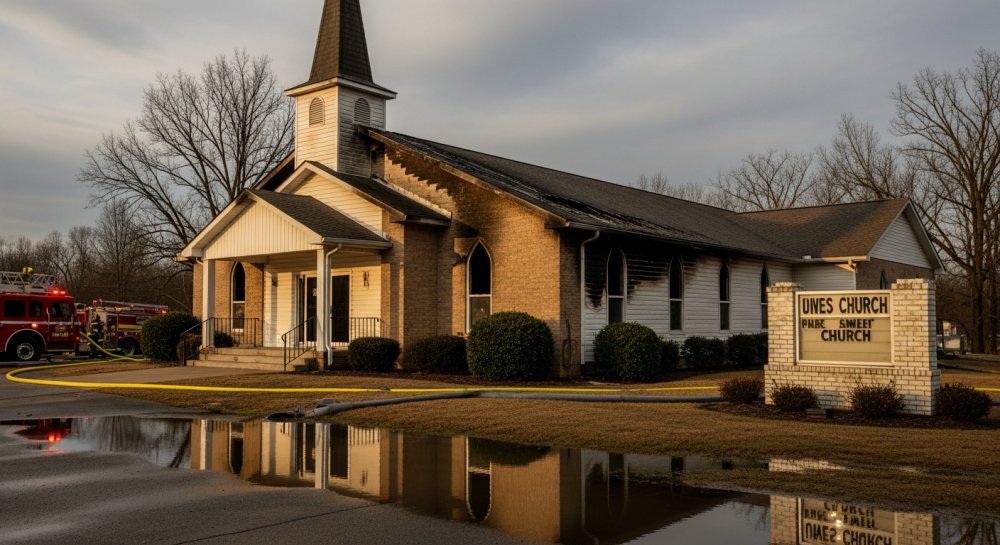
- A Tennessee church known for giving away free gas to hundreds of commuters earlier this year has suffered a devastating fire on their property.
- Despite the significant damage, church leaders maintain their ministry will continue, declaring the fire ‘didn’t stop the word.’
- The congregation demonstrated Christ’s love through practical generosity by providing free gasoline to struggling families during difficult economic times.
A Tennessee congregation that made headlines for their generous outreach to the community is now facing a significant trial of their own. The church, which blessed hundreds of families with free gasoline during a time of economic hardship, has suffered severe fire damage to their property.
Earlier this year, the church captured hearts across the nation when they opened their doors and their wallets to help commuters struggling with high gas prices. The ministry initiative provided tangible relief to families dealing with the burden of inflation and rising fuel costs, embodying the Biblical principle of loving your neighbor in action.
Now, the church that gave so freely finds itself in need. The fire caused substantial damage to the church property, though details about the extent of the destruction and the cause of the blaze are still emerging. What remains unshaken, however, is the faith and determination of the congregation.
Church leaders responded to the devastating loss with remarkable resolve, stating that the fire “didn’t stop the word.” This declaration reflects a deep commitment to their mission and ministry that transcends physical buildings and material loss.
The church’s response exemplifies the resilience that comes from faith rooted in Christ rather than circumstances. Their witness reminds believers that the Church is not a building but a body of believers united in purpose and calling.
This trial comes as a test for a congregation that has already demonstrated extraordinary generosity. Their earlier gas giveaway wasn’t just charity—it was an expression of Christian love that met people at their point of need, building bridges between the church and community.
The incident serves as a reminder that even those who minister to others face their own valleys. Yet it also presents an opportunity for the broader Christian community to rally around these faithful servants, returning the blessing they so freely gave to others.
As this Tennessee church rebuilds, their testimony stands as an encouragement to believers everywhere: faith perseveres through fire, ministry continues through trials, and God’s Word cannot be stopped by any earthly circumstance.
Let us know what you think, please share your thoughts in the comments below.
Faith
New Prime Minister Vows Social Care Reform — But Faith Communities Must Lead
Faith Facts
- Prime Minister Andy Burnham has pledged to address the ongoing adult social care crisis in the United Kingdom
- Christian charity leader Stephen Hammersley warns the Church cannot wait for government action to care for elderly congregants and community members
- The promise represents a major policy shift, but faith-based organizations continue to be essential in meeting the spiritual and practical needs of seniors
The United Kingdom’s new Prime Minister Andy Burnham made headlines this week with a bold commitment to overhaul the nation’s struggling adult social care system. While the announcement has been met with cautious optimism across the political spectrum, Christian leaders are reminding believers that government action alone cannot address the deeper crisis facing elderly citizens.
Stephen Hammersley, chief executive of Pilgrims’ Friend Society, a Christian organization dedicated to serving older adults, applauded Burnham’s recognition of the problem but emphasized that the Church has a biblical mandate that transcends political promises. “We welcome any serious effort to improve care for our elderly population,” Hammersley stated. “However, the body of Christ has always been called to care for the vulnerable, especially widows and the aging, regardless of what policies emerge from Westminster.”
The adult social care system in Britain has faced mounting pressure for years, with underfunding, workforce shortages, and an aging population creating what many experts describe as a perfect storm. Families across the nation have struggled to find adequate, affordable care for elderly relatives, while care workers themselves face challenging conditions and low wages.
Burnham’s pledge to “end the drought” in social care signals a recognition at the highest levels of government that the current system is unsustainable. Yet the details of how such reform would be implemented and funded remain unclear. For Christians, this uncertainty underscores the importance of grassroots ministry and community support networks that don’t depend on government budgets or political cycles.
“Scripture is clear about our responsibility to honor and care for the elderly,” Hammersley continued. “In Leviticus 19:32, we’re told to ‘stand up in the presence of the aged, show respect for the elderly and revere your God.’ This isn’t optional for believers — it’s a core expression of our faith.”
Churches across the United Kingdom have long been at the forefront of caring for seniors, from visiting programs and meal deliveries to offering fellowship and spiritual support that institutional care often cannot provide. These ministries become even more critical as families become geographically dispersed and traditional support structures weaken.
The challenge facing Christian communities is not just about physical care but addressing the epidemic of loneliness and isolation that affects millions of elderly people. While government programs can provide healthcare and financial assistance, they cannot replace the personal connection, spiritual encouragement, and sense of belonging that faith communities uniquely offer.
Hammersley’s organization, Pilgrims’ Friend Society, operates care homes and retirement housing with an explicitly Christian ethos, demonstrating how faith-based approaches can complement secular services. “We’ve seen firsthand how integrating spiritual care with physical care transforms lives,” he explained. “Residents don’t just receive assistance with daily tasks — they’re part of a community centered on Christ, where they’re valued as image-bearers of God, not just recipients of services.”
The call for churches to step up comes at a time when many congregations are already stretched thin, facing their own resource constraints and demographic challenges. Yet Christian leaders argue that caring for the elderly shouldn’t be seen as an additional burden but as central to the Church’s mission and identity.
“When we care for older believers, we’re honoring those who built the faith communities we now enjoy,” Hammersley noted. “We’re also modeling for younger generations what it means to live out the gospel in practical ways. And we’re preparing for our own later years, creating the kind of communities we hope will care for us.”
While Burnham’s commitment to reforming social care is encouraging, the timeline and effectiveness of government action remain uncertain. Political promises, even well-intentioned ones, often face obstacles in implementation, funding disputes, and changing priorities. This reality makes the Church’s independent action all the more vital.
Christian organizations are encouraged to evaluate how they can expand or improve ministries to seniors, whether through formal care arrangements, volunteer visiting programs, intergenerational activities, or advocacy for better policies. Individual believers can also make a difference by regularly checking on elderly neighbors, inviting isolated seniors to family gatherings, or simply offering the gift of unhurried conversation and companionship.
The intersection of faith and social care policy also presents opportunities for Christians to influence public discourse with biblical values. Advocating for care systems that respect human dignity, support family involvement, and recognize the spiritual dimensions of wellbeing reflects a Christian worldview that can enrich secular policy debates.
As the Burnham government begins to flesh out its social care agenda, believers have reason to hope for meaningful improvements while recognizing that no government program can fully replace the compassionate, Christ-centered care that the Church is called to provide. The challenge ahead requires both celebrating political progress and redoubling efforts at the local church level to ensure no elderly person is forgotten or neglected.
Let us know what you think, please share your thoughts in the comments below.

Faith
African Mission Leader Reveals What Blood and Sacrifice Really Mean for Asia’s Future
Faith Facts
- African missionary leader Joshua Bogunjoko addressed thousands at the Arise Asia 2026 Congress in Manila, challenging perceptions about Africa’s role in global evangelism
- Bogunjoko emphasized the biblical principle of perseverance through sacrifice, stating Christians always have something to give as long as they have life
- The message centered on Africa’s spiritual legacy and the call for Asian believers to embrace joyful perseverance in spreading the Gospel despite hardship
When Joshua Bogunjoko took the stage at the Arise Asia 2026 Congress in Manila on July 30, he didn’t begin with platitudes or comfortable greetings. Instead, he posed a direct challenge to the thousands gathered before him.
“When you hear the word Africa, what comes to your mind first?” Bogunjoko asked the participants.
The question hung in the air, forcing attendees to confront their preconceptions about a continent often defined by Western media through images of poverty and struggle. But Bogunjoko’s message would turn those assumptions on their head.
The African mission leader came bearing a counter-cultural truth that cuts against modern comfort Christianity. His declaration—”As long as we have blood, we have something to give”—echoed the sacrificial call that has defined faithful witnesses throughout church history.
This wasn’t abstract theology. Bogunjoko spoke from the lived experience of African Christians who understand persecution, deprivation, and the cost of discipleship in ways many Western believers cannot fathom.
The Arise Asia Congress represents a gathering of believers committed to advancing the Great Commission across the Asian continent. In a region where Christianity often exists under threat—from communist governments, radical Islamic persecution, and hostile Hindu nationalism—the call to joyful perseverance isn’t optional.
Bogunjoko’s message challenged Asian Christians to look beyond material resources and embrace the biblical truth that God equips those He calls. The reference to blood wasn’t merely metaphorical—it spoke to the reality that faithful witness may cost everything.
This perspective stands in stark contrast to the prosperity gospel that has infected too many churches worldwide. Instead of promising health and wealth, Bogunjoko called believers to the ancient path: taking up the cross daily, counting the cost, and finding joy in sacrifice for the Kingdom.
Africa’s explosive Christian growth over the past century demonstrates the power of this committed faith. While Europe’s churches empty and American Christianity battles compromise, African believers have multiplied through persecution and poverty, proving that the Gospel thrives when believers embrace sacrifice rather than comfort.
The timing of this message carries particular significance. As Asia becomes the focal point of 21st-century missions—with China’s underground church, India’s persecuted believers, and Southeast Asia’s unreached peoples—the call to perseverance through hardship resonates with urgent relevance.
Bogunjoko’s challenge to Asian Christians draws from deep biblical wells. From the prophets who faced rejection and death, to the apostles who counted suffering as joy, to the martyrs whose blood became the seed of the church—Scripture consistently elevates sacrifice over safety.
This message also carries prophetic weight for American believers comfortable in their freedoms. As cultural hostility toward biblical Christianity increases in the West, the example of African and Asian perseverance offers both warning and inspiration.
The “joy of perseverance” Bogunjoko proclaimed isn’t masochistic suffering—it’s the deep satisfaction of faithfulness, the peace that surpasses understanding, and the crown of life promised to those who endure. It’s the same joy that enabled early Christians to sing hymns in prison and face lions with confidence.
As the Arise Asia Congress continued, Bogunjoko’s words set a tone far removed from comfortable Western Christianity. His call echoed the words of missionary Jim Elliot: “He is no fool who gives what he cannot keep to gain what he cannot lose.”
For Asian believers facing uncertain futures under hostile regimes and cultures, this message provided both challenge and comfort: You have enough. As long as you have life, you have something to give for the Gospel. And that sacrifice brings joy that the world cannot understand or take away.
Let us know what you think, please share your thoughts in the comments below.

Faith
Missionary Endured Two Years in Turkish Prison Clinging to Faith Through Divine Silence
Faith Facts
- American missionary Andrew Brunson spent 23 years planting churches in Turkey before being arrested on false espionage and terrorism charges
- During two years of imprisonment in a Turkish prison, Brunson experienced God’s silence rather than His expected presence
- Speaking at Arise Asia 2026 Congress in Manila, Brunson testified that persevering through that silence became the greatest test of his Christian faith
For more than two decades, Andrew Brunson faithfully served the Lord by planting churches throughout Turkey, bringing the Gospel to a predominantly Muslim nation. His dedication to spreading Christianity in one of the world’s most challenging mission fields exemplifies the courage and commitment of modern Christian missionaries who answer God’s call to serve in difficult places.
In a stunning act of persecution, Turkish authorities arrested Brunson on fabricated charges of espionage and terrorism. The arrest marked the beginning of a dark chapter that would test every fiber of his faith.
Confined within the cold walls of a Turkish prison for two years, Brunson anticipated feeling God’s nearness during his trial. Instead, he encountered something far more challenging: divine silence. This unexpected spiritual wilderness became the crucible in which his faith would either be refined or broken.
Speaking before thousands of delegates gathered at the Arise Asia 2026 Congress in Manila, Brunson shared his powerful testimony of perseverance through spiritual desolation. His message resonated with Christians worldwide who have experienced seasons when heaven seems silent and God feels distant.
“Even if You’re silent, I still love You,” Brunson declared, revealing the heart-wrenching prayer that sustained him through his darkest hours.
His unwavering commitment to loving God regardless of feeling His presence demonstrates the mature faith that transcends circumstances and emotions. This kind of steadfast devotion reflects the biblical examples of Job, who declared his trust in God despite devastating loss, and Jesus Himself, who cried out from the cross yet remained obedient unto death.
Brunson’s imprisonment became international news, with American Christian leaders and government officials advocating tirelessly for his release. His case highlighted the ongoing persecution of Christians in Turkey and throughout the Middle East, where believers often face imprisonment, torture, and death for their faith.
The missionary’s testimony serves as a powerful reminder that authentic Christianity sometimes requires believers to trust God in the darkness, to love Him when He seems absent, and to remain faithful when the promised comfort doesn’t come as expected. His experience challenges comfortable Western Christianity and calls believers to a deeper, more resilient faith.
For Christians facing their own seasons of divine silence—whether through persecution, personal tragedy, or spiritual dryness—Brunson’s testimony offers hope. His willingness to choose love over bitterness, faith over despair, and perseverance over surrender demonstrates that the greatest victories often occur not when God feels close, but when we choose to trust Him anyway.
The Arise Asia 2026 Congress provided a platform for Brunson to encourage fellow believers throughout Asia, where Christian persecution remains widespread and intense. His message particularly resonates in nations where professing faith in Jesus Christ can result in imprisonment, family rejection, or martyrdom.
Let us know what you think, please share your thoughts in the comments below.
-
Self-Reliance1 year agoTrump’s Bold Move Uncovers Massive Social Security Fraud
-

Faith1 year agoNew Clues Emerge in Noah’s Ark Mystery
-

News1 year agoGovernor Walz’s Rhetoric Sparks National Controversy
-

News1 year agoMel Gibson’s ‘The Passion of the Christ’ Sequel Title Announced
-

Family1 year agoTexas Lawmaker Targets Furries in Schools
-

Freedom1 year agoMaine Lawmaker Challenges Sports Fairness Controversy
-

Family1 year agoCanada’s Controversial Policy Sparks Ethical Debate
-
Faith8 months ago
Congress Hears Pleas for Nigerian Christians