
Faith
Rise of Humanist Weddings Challenges Faith Traditions

Faith Facts
- Humanist weddings may now be the third most common type of ceremony in Northern Ireland.
- They accounted for roughly 15 percent of all weddings so far in 2024, surpassing Protestant weddings according to preliminary data.
- Traditional Protestant marriage ceremonies have experienced a decline over recent years.
The latest statistics from the Northern Ireland Statistics and Research Agency reveal a noteworthy growth in humanist ceremonies, now possibly outnumbering Protestant weddings. Catholic and civil weddings remain the most frequently chosen, but the heritage of Protestant marriage is facing change.
When humanist weddings gained legal status in 2018, only a handful took place, but their share has increased every year since then. Many people, particularly the younger generation, are distancing themselves from their religious roots, leading to fewer Christian marriages.
Trends similar to those in Northern Ireland are also seen in Scotland and the Republic of Ireland. As secular ceremonies rise, fewer young adults are identifying with either Protestant or Catholic faiths, raising questions about the spiritual direction of future generations.
Now, more than ever, Christians are called to uphold the sanctity of marriage as designed by God, affirming biblical values in the face of cultural shifts. Let us continue to uplift marriage in prayer, stand firm on faith, and share Christ-centered hope for families and society.



Faith Facts
- Scripture teaches wise stewardship of resources in times of uncertainty.
- Joseph stored grain for seven years of plenty to prepare for seven years of famine.
- Proverbs 22:3 commends the prudent who foresee danger and take refuge.
Warnings about war, cyberattacks, and climate disruptions have moved the conversation about emergency preparedness beyond fringe circles. Government officials now encourage households to maintain basic supplies of non-perishable food, water, and medicine. Christian families are asking what the Bible actually teaches about readiness and trust in God.
The Bible does not present preparation and faith as opposites. Instead, it offers examples of God-honoring foresight. Joseph followed God’s direction to store grain during years of abundance, saving countless lives when famine struck. His actions demonstrated both trust in the Lord and responsibility toward others.
“The prudent sees danger and hides himself, but the simple go on and suffer for it.”
Proverbs 22:3 presents foresight as wisdom, not fear. Christian households can apply this principle by maintaining modest reserves without abandoning reliance on God’s provision. Preparation becomes an act of love for family and neighbors who may need help in a crisis.
Emergency planning also reflects love of country. A prepared citizenry strengthens communities when systems are strained. Churches that encourage practical readiness serve both their members and the wider society.
Scripture balances preparation with contentment. Jesus warned against anxious hoarding in Matthew 6, yet He also praised the servant who used talents wisely. The difference lies in motive: fear-driven accumulation versus faithful stewardship.
“For which of you, desiring to build a tower, does not first sit down and count the cost, whether he has enough to complete it?”
Jesus used the builder’s example to teach thoughtful planning. Christian families can apply the same principle by assessing genuine needs, setting reasonable limits, and avoiding excess. Moderation keeps preparation from becoming idolatry of security.
Local congregations are well positioned to coordinate community response. Many already maintain food pantries and disaster-relief teams. These ministries multiply the impact of individual households that have prepared in advance.
Ultimately, Scripture calls believers to trust God while exercising prudent responsibility. Stockpiling a few weeks of supplies need not signal panic. It can reflect the same wisdom Joseph displayed when he stored grain for the sake of many.
Let us know what you think, please share your thoughts in the comments below.

Faith Facts
- God’s grace is a gift, not a reward for good behavior.
- Trials often reveal whether our faith rests on blessings or on Christ alone.
- Loss can become the doorway to deeper dependence on God’s mercy.
I had followed the formula. I went to school, earned a scholarship, built a career, went to church and tithed.
Then I lost my job, and I discovered I had been a quid pro quo believer.
After the pink slip came, the bills piled up and the savings dwindled.
Soon afterward, my son walked away from the faith we had raised him in.
In the quiet of an empty house, the old assumptions crumbled.
I realized I had treated obedience like a contract: if I kept my end of the bargain, God owed me security and happy children.
Grace does not work that way.
“For by grace you have been saved through faith. And this is not your own doing; it is the gift of God, not a result of works, so that no one may boast.”
Scripture calls believers to serve God out of love, not leverage.
Months later, a brother in Christ handed me a shovel and a job on a construction crew.
The work was humbling, but every paycheck reminded me that provision comes from the Lord, not from résumés.
Phone calls with my son grew shorter, yet I learned to pray without bargaining.
Grace began to look less like a reward and more like daily bread.
“My grace is sufficient for you, for my power is made perfect in weakness.”
Today the résumé still sits in a drawer, but the heart rests in the hands that never let go.
Let us know what you think, please share your thoughts in the comments below.
Faith Facts
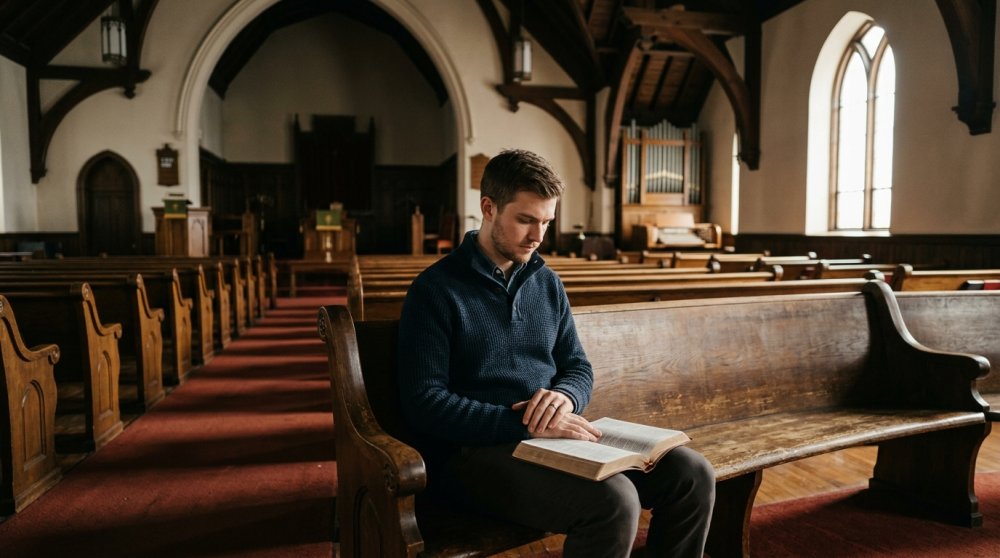
- A survey of more than 1,000 young Christian men found that frequent church attendance did not reduce antisemitic attitudes.
- The study revealed that beliefs about God's promises to the Jewish people strongly influenced views toward Jews.
- The findings highlight the importance of biblical teaching on Israel within American churches.
A new survey of more than 1,000 young Christian men reveals that regular church attendance alone does not prevent antisemitic attitudes. Researchers found that how often participants attended services showed no meaningful link to their views on Jewish people.
Instead, the study identified theology as the decisive factor. Young men who rejected or downplayed God's promises to the Jewish people were far more likely to hold negative or hostile attitudes toward Jews.
“What they believed about God's promises to the Jewish people did,” the report states, and that distinction should prompt serious reflection across American churches.
The results challenge the assumption that simply showing up on Sunday morning protects believers from cultural or ideological errors. Sound doctrine, particularly concerning Israel and the covenants of Scripture, appears to play a far greater role.
Christian leaders are now being urged to examine how their congregations teach about God's faithfulness to His chosen people. The study suggests that replacing biblical clarity with vague sentiment leaves young men vulnerable to antisemitic ideas circulating in secular culture.
Let us know what you think, please share your thoughts in the comments below.


-

 Self-Reliance2 years ago
Trump’s Bold Move Uncovers Massive Social Security Fraud
-

 Faith1 year ago
New Clues Emerge in Noah’s Ark Mystery
-

 News2 years ago
Governor Walz’s Rhetoric Sparks National Controversy
-

 News2 years ago
Mel Gibson’s ‘The Passion of the Christ’ Sequel Title Announced
-

 Family2 years ago
Texas Lawmaker Targets Furries in Schools
-

 Freedom2 years ago
Maine Lawmaker Challenges Sports Fairness Controversy
-

 Family1 year ago
Canada’s Controversial Policy Sparks Ethical Debate
-
Faith11 months ago
Congress Hears Pleas for Nigerian Christians