
Freedom
Religious Freedom Victory at Stake as Appeals Court Weighs Teachers’ COVID Mandate Case


Faith Facts
- A federal appeals court is reviewing a $4 million jury verdict in favor of Missouri teachers who were denied religious exemptions to a COVID-19 vaccine mandate
- The case represents a significant religious freedom test case involving government respect for conscience rights during the pandemic
- The appeal seeks to preserve protections for Americans who sought to honor their faith convictions amid public health mandates
A federal appeals court is now being urged to stand firm in defense of religious liberty by upholding a jury verdict that awarded Missouri teachers $4 million after they were denied religious exemptions to a COVID-19 vaccine mandate. The case has emerged as a critical test of whether government institutions will respect Americans’ deeply held religious convictions, particularly in the wake of pandemic-era policies that often sidelined constitutional protections.
The teachers at the center of this case sought exemptions based on their sincere religious beliefs, only to have their requests rejected by school officials. A jury sided with the educators, recognizing that their constitutional rights had been violated. Now, as the case moves through the appeals process, defenders of religious freedom are calling on the court to affirm that Americans should never be forced to choose between their faith and their livelihood.
This verdict represents more than just a financial award—it stands as a vindication of the First Amendment principle that government cannot compel citizens to violate their conscience. For many Christians and people of faith across the country, the case symbolizes a broader struggle to maintain religious freedom in an increasingly secular culture that often views traditional beliefs as obstacles to be overcome rather than rights to be protected.
The outcome of this appeal will send a powerful signal about whether courts will continue to safeguard the religious liberties enshrined in our Constitution. As the appeals court deliberates, millions of Americans who value faith and freedom are watching closely, hoping that the judiciary will reaffirm that religious conviction is not a second-class right to be dismissed when politically inconvenient.
The case also raises important questions about the balance between public health measures and individual rights. While reasonable people can disagree about vaccine policies, what remains non-negotiable for many Americans is the principle that sincere religious objections must be taken seriously and accommodated whenever possible. The jury’s decision reflected this foundational American value.
For the teachers involved, this legal battle has been about more than money—it has been about standing up for principle in the face of institutional pressure. Their willingness to fight for their beliefs serves as an inspiration to others who may face similar dilemmas, demonstrating that when citizens hold firm to their convictions, the Constitution still provides meaningful protection.
As this case continues through the federal court system, it serves as a reminder that religious freedom remains under constant pressure and requires vigilant defense. The appeal represents a crucial opportunity for the judiciary to reaffirm that the free exercise of religion is a cornerstone of American liberty that must be preserved for future generations.
Let us know what you think, please share your thoughts in the comments below.

Faith Facts
- Rand Paul calls for churches and families to take the lead in refugee sponsorship.
- The proposal would end long-term federal welfare for refugees.
- Christian communities have a long history of caring for strangers through private charity.
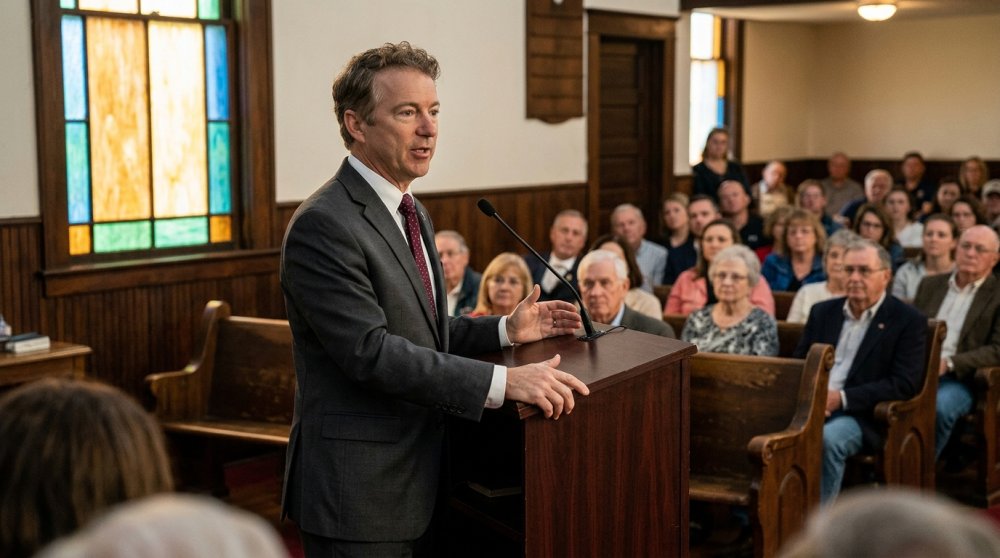
Senator Rand Paul of Kentucky is urging lawmakers to end federal welfare benefits for refugees and instead allow churches and family members to sponsor newcomers.
The Kentucky Republican says many refugees continue receiving taxpayer-funded assistance years after arrival, placing an ongoing burden on American taxpayers.
Paul argues that private sponsorship through churches and relatives would better align with America’s tradition of voluntary charity and personal responsibility.
“Churches and families should be the ones stepping up to help refugees, not the federal government,” Paul stated.
By shifting responsibility away from Washington, Paul believes communities of faith could provide more personal, accountable support while reducing federal spending.
The senator’s plan reflects a broader conservative view that government welfare programs often create dependency rather than genuine assistance.
Christian organizations already operate extensive refugee ministries, demonstrating that private groups can meet needs without taxpayer dollars.
Paul’s proposal would require legislative changes to current refugee resettlement policies, which currently rely heavily on federal funding.
Supporters say the change would strengthen family bonds and encourage local churches to expand their outreach ministries.
Let us know what you think, please share your thoughts in the comments below.

Faith Facts
- A new AEI report reveals graduate education programs are dominated by ideologically uniform professors promoting activist frameworks over practical teaching skills
- Teacher training curricula now emphasize ‘queer pedagogy’ and ‘anti-capitalist’ theories rather than classroom management and subject mastery
- Graduate schools maintain gatekeeping power over K-12 hiring, requiring teachers to complete ideologically-driven programs before entering classrooms
America’s teacher training programs have undergone a dramatic transformation that should concern every parent who values traditional education and academic excellence. A comprehensive report from the American Enterprise Institute exposes how graduate schools of education have abandoned their core mission of preparing effective classroom teachers in favor of producing social activists.
The research reveals a troubling pattern: education professors across the country share a remarkably uniform ideological perspective that prioritizes political activism over pedagogical competence. Instead of focusing on essential skills like lesson planning, classroom management, and subject matter expertise, these programs immerse future teachers in theoretical frameworks rooted in progressive social movements.
The curricula emphasize controversial concepts including “queer pedagogy” and “anti-capitalist” frameworks that have little connection to helping students master reading, mathematics, science, and history. This represents a fundamental betrayal of the teaching profession’s responsibility to parents and communities who entrust their children to public schools.
These graduate programs exercise enormous control over who can enter America’s classrooms. By requiring teachers to complete ideologically-driven coursework before receiving certification, education schools effectively function as gatekeepers who determine which perspectives will be represented in K-12 education. This monopoly on credentialing creates a pipeline that filters out teachers who prioritize academic achievement and traditional values.
The practical implications are significant for Christian families and communities across the nation. When teacher preparation programs emphasize social transformation over educational fundamentals, students suffer the consequences through declining academic performance and exposure to age-inappropriate ideological content.
The report suggests that breaking this gatekeeping power should be a priority for education reform. Alternative pathways to teacher certification could welcome talented professionals who possess subject matter expertise and share the values of the communities they serve, without requiring them to embrace the ideological uniformity that currently dominates graduate education programs.
Parents, school boards, and state legislators have a responsibility to examine what values and priorities are being instilled in those who teach America’s children. The evidence suggests that many teacher training programs have strayed far from their mission of preparing competent, professional educators focused on academic excellence.
As families increasingly seek educational options that align with their faith and values, understanding the ideological formation of teachers becomes essential. The gatekeeping function of graduate education schools represents a significant obstacle to restoring excellence and accountability in American public education.
Let us know what you think, please share your thoughts in the comments below.

Faith Facts
- Socialism has consistently failed to deliver prosperity wherever implemented, from Castro’s Cuba to post-war Britain
- Richard Land traces the common thread between socialist failures across different continents and time periods
- The pattern of economic decline under socialist policies contradicts the promises made by their proponents
The history of socialism tells a sobering story that Americans must heed today. From the Caribbean island of Cuba to the halls of power in post-war Britain, the socialist experiment has repeatedly delivered economic devastation rather than the prosperity it promised.
Richard Land, a respected Christian conservative voice, examines the stark reality behind socialism’s repeated failures. The evidence spans continents and decades, yet the pattern remains unmistakably consistent.
Castro’s Cuba transformed from a nation with potential into an economic prison where citizens risk their lives on makeshift rafts to escape. The revolution that promised equality delivered equal poverty instead, except for the ruling elite who maintained their privileges while the masses suffered.
Britain’s experiment with socialism after World War II provides another cautionary tale. A nation that had stood firm against Nazi tyranny nearly collapsed under the weight of socialist policies that stifled innovation, punished success, and created dependency rather than opportunity.
The common thread between these failures? Both nations embraced an ideology that runs counter to human nature and biblical principles of stewardship, personal responsibility, and the dignity of work.
Socialist systems inevitably concentrate power in the hands of government bureaucrats rather than trusting free citizens to make their own economic decisions. This centralization contradicts the Christian understanding of human dignity and the proper role of government.
The Bible teaches that those who work should eat and that good stewardship leads to blessing. Socialism, by contrast, punishes productivity and rewards dependency, creating a moral hazard that undermines the very foundations of a healthy society.
When governments seize control of the means of production or heavily regulate private enterprise, they remove the incentives that drive innovation and efficiency. The result is always the same: declining living standards, reduced freedom, and growing resentment.
Cuba remains trapped in a time warp, with crumbling infrastructure and an economy that cannot provide basic necessities for its people. Britain required the leadership of Margaret Thatcher to reverse course and restore market principles before the nation could recover.
These lessons from history carry urgent relevance for America today. As socialist ideas gain renewed popularity among some politicians and young people, we must remember what these policies actually produce when implemented.
The American system of limited government, free enterprise, and individual liberty has created more prosperity and lifted more people out of poverty than any other system in human history. This success flows directly from founding principles rooted in a biblical worldview.
Abandoning these principles in favor of socialist experimentation would betray both our heritage and our future generations. The evidence from Cuba, Britain, Venezuela, and countless other nations stands as an unmistakable warning.
True compassion doesn’t mean expanding government control and creating dependency. It means preserving the freedom and opportunity that allow individuals to flourish, support their families, and contribute to their communities according to their God-given talents.
Let us know what you think, please share your thoughts in the comments below.


-

 Self-Reliance1 year ago
Trump’s Bold Move Uncovers Massive Social Security Fraud
-

 Faith1 year ago
New Clues Emerge in Noah’s Ark Mystery
-

 News2 years ago
Governor Walz’s Rhetoric Sparks National Controversy
-

 News1 year ago
Mel Gibson’s ‘The Passion of the Christ’ Sequel Title Announced
-

 Family1 year ago
Texas Lawmaker Targets Furries in Schools
-

 Freedom2 years ago
Maine Lawmaker Challenges Sports Fairness Controversy
-

 Family1 year ago
Canada’s Controversial Policy Sparks Ethical Debate
-
Faith10 months ago
Congress Hears Pleas for Nigerian Christians