
News
Moral Integrity Challenged by Church Embezzlement Scandal


In a world where moral integrity and faith-based values are increasingly under siege, the recent case of a former Mississippi police officer embezzling funds from a church serves as a stark reminder of the importance of upholding Christian principles. Tonya Anne Laville, 48, who once served as a trusted member of the Gulfport Police Department and security personnel for St. James Catholic Church, has been sentenced for embezzling approximately $8,600 from the congregation.
Laville’s actions, which involved using Cash App to siphon funds for personal expenses such as rent and late fees, highlight a troubling trend in our society where financial misconduct is becoming alarmingly common. Her case was brought to light after the church staff discovered the missing funds and reported the matter to authorities. Laville’s subsequent arrest and the charges of wire fraud underscore the need for vigilance and accountability within our communities.
While Laville has acknowledged her wrongdoing and made restitution, her case is part of a larger issue affecting religious and secular institutions alike. A staggering $62 billion was lost to embezzlement and fraud in 2023 alone. This figure represents 6.6% of all funds given by Christians globally, a sobering statistic that calls for immediate action.
“Organizations that have means for reporting suspected embezzlement (such as hotlines) tend to catch cases of fraud before they become massive,” advised Todd Johnson, co-director of the Center for the Study of Global Christianity at Gordon-Conwell Theological Seminary. He further recommended proactive measures such as more frequent managerial reviews, internal financial audits, and stringent monitoring of employee actions. These steps are crucial in safeguarding the resources that are meant to further the mission of faith-based organizations.
Laville’s sentencing to a pretrial diversion, which allows her to avoid prison time if certain terms are met, serves as a reminder of the importance of redemption and forgiveness, core tenets of the Christian faith. However, it also emphasizes the need for justice and the protection of community resources. As Christians, we are called to be stewards of the blessings we receive, ensuring they are used to glorify God and serve the greater good.
In these challenging times, it is imperative that we reinforce traditional values and individual responsibility. By adhering to biblical principles and fostering a culture of integrity, we can protect our churches and communities from the corrosive effects of financial misconduct. Let us remain vigilant, committed to faith, family, and freedom, as we work together to build a society that honors God and upholds the moral fabric of our nation.
Let us know what you think, please share your thoughts in the comments below.


Faith Facts
- Wes Woodell, a ministry technology strategist and Ph.D. candidate at Talbot School of Theology, is developing AI tools to spread the Gospel globally through Connect My Church.
- Woodell believes AI is a complex math equation with no soul and cannot think or process genuine thought, only compute data.
- He warns churches against using AI to write sermons, calling it dangerous and unhealthy for a preacher’s heart and spiritual life.
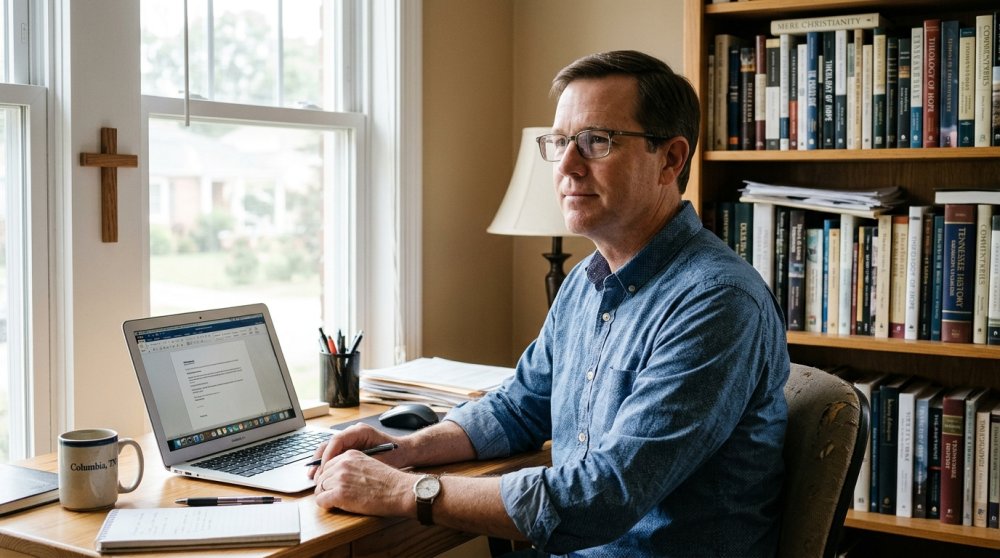
A Tennessee cybermissionary is offering biblical perspective on artificial intelligence as questions about its power and purpose continue to grow. Wes Woodell founded Connect My Church to create enclosed AI systems that can answer spiritual questions using trusted Christian resources.
Woodell spoke with Bobby Ross Jr. via Zoom this week from his home in Columbia, Tennessee. The 46-year-old Harding University graduate and former Church of Christ campus minister now pursues advanced theological studies at Biola University while building digital tools for global evangelism.
“So my question is, what if we could put something out like that which didn’t just play a recording?” said Woodell. “What if you could actually ask it questions, and it would give you answers? … You know, it’s not the open internet. It’s just an enclosed set of resources that we can put on there, and that’s essentially what we’re building.”
Woodell addressed concerns about AI’s potential dangers with measured clarity. He acknowledged real security risks but emphasized the need for America to lead in defensive technology rather than yield ground to hostile nations.
“There’s a lot of people afraid of that, and there are some real destructive capabilities when you think about security, when you think about where we’re going in the future with new technology,” said Woodell. “For instance, humanoid robots. If those things are deployed and successful, and now there are a million humanoid robots in 10 or 15 years, or maybe even sooner than that, what if something could hack all of those things at the same time?”
“What if a foreign, hostile government could take over those things and make them start karate-chopping people and kicking people in the head?”
Woodell also spoke directly to the spiritual question of whether AI possesses a soul. He rejected the notion outright, describing AI as nothing more than advanced computation without consciousness or divine image.
“I don’t think it can,” he replied. “This idea of supreme intelligence, I think, is a misnomer. When we’re talking about AI, we’re talking about a complex math equation. It doesn’t process thought. It doesn’t think. It processes. It’s a computer program.”
Woodell warned against the transhumanist vision popular in Silicon Valley, where some seek to merge human consciousness with machines in pursuit of immortality. He contrasted that humanist ambition with the Christian understanding that true eternal life comes only through faith in Jesus Christ.
While supporting the use of AI for administrative tasks like sermon optimization and social media scheduling, Woodell drew a firm line against allowing artificial intelligence to replace the preacher’s spiritual labor.
“What frightens me a little bit are preachers using AI to write their sermons for them,” Woodell said. “That has become a thing, and I don’t think that’s healthy.”
“AI can help give some feedback that’s helpful sometimes,” he added. “But I would not have it just draft the sermon for you. I think that’s very dangerous and also just not good for a preacher’s heart.”
Let us know what you think, please share your thoughts in the comments below.
Faith Facts
- Hillsong United worship leader Joel Houston has spoken openly about a season of deep personal reflection after facing significant challenges in recent years.
- The well-known worship artist revealed that he spent two to three years largely removed from regular church involvement during this difficult period.
- Houston’s experience highlights the reality that even prominent Christian leaders face seasons of testing and spiritual struggle.
Joel Houston, the frontman for Hillsong United, has been candid about navigating a challenging season marked by personal struggles and spiritual introspection.
The worship leader shared that this period led him to step back significantly from church involvement for an extended time.
“I spent two to three years largely away from church,” Houston stated regarding his time of soul-searching.
His honesty about this chapter in his life serves as a reminder that faith journeys are not always straightforward, even for those in leadership positions within the Christian community.
Let us know what you think, please share your thoughts in the comments below.
Faith Facts
- Christian teaching affirms the sanctity of human life from conception to natural death
- Scripture calls believers to defend the vulnerable and protect the dignity of every person
- Traditional values uphold family responsibility and compassionate care rather than state-sanctioned ending of life
A recent report on Australia’s assisted suicide practices is drawing fresh concern from pro-life organizations across the nation.
According to the findings, a required nine-day waiting period is frequently being bypassed, raising questions about whether adequate safeguards are in place.
“We are seeing people rushed through a process that was meant to include reflection and protection,”
one pro-life advocate stated.
Supporters of the current law argue that the waiting period can be waived in cases where death is imminent or where the patient is experiencing severe suffering. Critics, however, warn that such exceptions risk turning a carefully regulated system into one that can be fast-tracked without sufficient oversight.
“The data shows that the safeguards are not being consistently applied,”
another voice in the debate noted.
Pro-life groups emphasize that every life holds inherent value and that society should focus resources on palliative care and family support instead of hastening death. They point to Australia’s experience as a cautionary example for other nations considering similar legislation.
“We must stand for life at every stage and reject the notion that some lives are expendable,”
a statement from one organization declared.
The report is expected to intensify debate as lawmakers and faith communities examine the long-term implications of assisted suicide laws.
Let us know what you think, please share your thoughts in the comments below.


-

 Self-Reliance2 years ago
Trump’s Bold Move Uncovers Massive Social Security Fraud
-

 Faith2 years ago
New Clues Emerge in Noah’s Ark Mystery
-

 News2 years ago
Governor Walz’s Rhetoric Sparks National Controversy
-

 News2 years ago
Mel Gibson’s ‘The Passion of the Christ’ Sequel Title Announced
-

 Family2 years ago
Texas Lawmaker Targets Furries in Schools
-

 Freedom2 years ago
Maine Lawmaker Challenges Sports Fairness Controversy
-

 Family1 year ago
Canada’s Controversial Policy Sparks Ethical Debate
-
Faith11 months ago
Congress Hears Pleas for Nigerian Christians