
News
Liberal Megachurch Pastor Launches Senate Bid in Deep Red Kansas


Faith Facts
- United Methodist pastor Adam Hamilton of Church of the Resurrection in Kansas announced his candidacy for U.S. Senate as a Democrat
- Hamilton leads one of America’s largest Methodist congregations but holds progressive theological positions that diverge from traditional Christian teaching
- The pastor is running in deeply conservative Kansas, where Republicans hold significant electoral advantages
A prominent United Methodist pastor known for progressive theological stances has entered the political arena, announcing a Democratic Senate campaign in one of America’s most conservative states. Adam Hamilton, who leads the Church of the Resurrection megachurch in the Kansas City area, revealed his candidacy with messaging focused on what he calls “leading from the center.”
Hamilton’s church claims to be one of the largest United Methodist congregations in the United States, with significant influence in mainline Protestant circles. However, his theological positions have long raised concerns among traditional Christians, particularly regarding biblical authority and moral teaching.
The pastor’s decision to run as a Democrat in Kansas presents significant electoral challenges. The state has consistently supported Republican candidates in federal races, and conservative values remain deeply rooted in the electorate. Kansas voters have demonstrated strong preference for candidates who align with traditional family values and constitutional principles.
Hamilton’s platform emphasizes what he describes as moderate positions, though his campaign will likely face scrutiny from Kansas conservatives who value biblical fidelity and traditional moral teaching. His involvement in a denomination that has faced internal conflict over scriptural interpretation and sexual ethics adds another layer of complexity to his candidacy.
The race will test whether progressive religious messaging can gain traction in a state where evangelical Christians and traditional Catholics form a significant portion of the voting population. Kansas Republicans have maintained control of both Senate seats, and the state’s conservative infrastructure remains robust.
Political observers note that Hamilton’s pastoral role may create unique dynamics in the campaign. While some voters may appreciate religious leadership in politics, others will examine whether his theological positions align with orthodox Christian teaching and traditional American values.
The Democratic Party has struggled in recent election cycles to connect with religious voters who prioritize life, family, and religious freedom. Hamilton’s candidacy represents an attempt to bridge that gap, though his progressive theological record may complicate that effort among conservative Christians who view biblical authority as non-negotiable.
Kansas voters will ultimately decide whether they want representation that reflects the state’s conservative heritage or are open to the progressive vision Hamilton represents. The outcome will provide insight into the strength of traditional values in heartland America.
Let us know what you think, please share your thoughts in the comments below.

Faith Facts
- A Virginia church hosted a forum calling believers to vote according to Scripture on two proposed state constitutional amendments.
- The gathering focused on protecting unborn life and upholding traditional marriage as defined in the Bible.
- Leaders stressed that faithful citizenship requires applying biblical truth to public policy decisions.
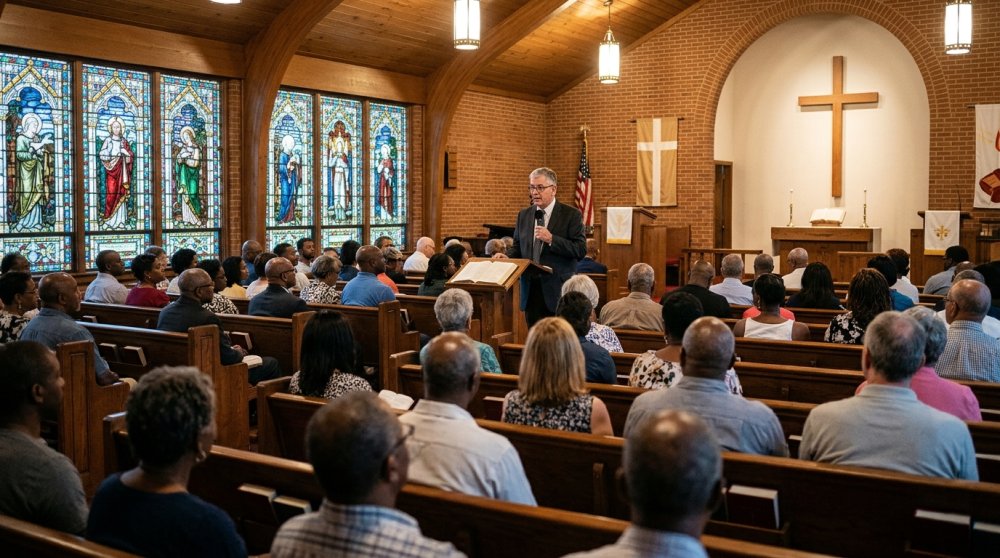
A Virginia church recently brought together believers to discuss two proposed state constitutional amendments that touch on deeply held convictions about life and marriage.
The forum highlighted the importance of voting in line with biblical principles rather than cultural trends.
“Vote your biblical values,” church leaders told attendees, emphasizing that Scripture offers clear guidance on both the sanctity of life and the definition of marriage.
The event comes as Virginia voters prepare to weigh in on amendments that would affect abortion policy and the legal status of same-sex marriage.
Speakers urged Christians to consider how their ballots reflect their commitment to the authority of God’s Word.
“We are called to be salt and light in every sphere of life, including the voting booth,” one pastor reminded the audience.
The church’s message aligns with a long-standing Christian conviction that government exists to uphold justice and protect the vulnerable.
By framing participation in the election as an act of discipleship, the forum encouraged believers to approach the ballot box with prayer and conviction.
Let us know what you think, please share your thoughts in the comments below.

Faith Facts
- Seth Dillon, founder of The Babylon Bee, addressed students at Liberty University about spiritual discernment in creative fields.
- Christians are called to engage culture with truth rather than retreat from it.
- Young believers must guard against voices that exploit feelings of oppression to advance unscriptural agendas.
Seth Dillon, founder of the satirical Christian outlet The Babylon Bee, spoke to students at Liberty University about the need to enter the creative world with biblical conviction. He urged young Christians to reject voices that seek to exploit their sense of cultural marginalization.
Dillon warned that certain radical conspiracists are actively targeting believers who already feel oppressed. He cautioned that these voices twist legitimate concerns into unbiblical narratives that can lead young Christians astray.
“Get into the creative world,” Dillon told the audience, stressing that believers must not abandon cultural influence to those who distort truth.
The Babylon Bee founder framed his remarks around the responsibility of Christians to engage media and the arts with clarity and courage. He emphasized that retreating from these spheres only cedes ground to those who oppose traditional values.
“Radical conspiracists” seek to exploit the feeling of oppression directed at Christians, Dillon said, urging students to discern truth from manipulation.
Liberty University students heard a clear call to remain rooted in Scripture while participating in creative fields. Dillon presented the challenge as both a spiritual duty and a practical opportunity for faithful witness.
Let us know what you think, please share your thoughts in the comments below.

Faith Facts
- Scripture calls believers to guard their hearts and minds against fear and darkness.
- Many Christians view Halloween as a celebration that glorifies the occult rather than Christ.
- Traditional American families are increasingly seeking faith-based alternatives to secular holidays.
Conservative commentator Allie Beth Stuckey touched off fresh discussion among believers this week by urging Christians to reconsider full participation in Halloween festivities and horror films. She framed the issue as one of spiritual discernment rather than mere personal preference.
Stuckey, host of the BlazeTV program “Relatable,” contends that engaging with fear-based entertainment can desensitize believers to the reality of evil. Her comments quickly circulated among Christian audiences who hold differing convictions about the holiday.
Allie deleted this and I need it for a video so I’m posting it for that. Hi people watching on YouTube! Make sure to subscribe and like the video! https://t.co/wuJyBMRDvg
— adrian (@SipsWithSerra) October 23, 2026
“Facilitating fear”
Critics within the faith community argued that Halloween can be redeemed through harvest festivals and gospel-centered outreach. Supporters of Stuckey’s position maintained that any celebration tied to witchcraft and death runs counter to biblical teaching on light and life.
Parents across the country are weighing how to shepherd their children through a holiday that has grown increasingly dark in popular culture. Many report turning instead to church-sponsored events that emphasize community and gratitude.
Let us know what you think, please share your thoughts in the comments below.


-

 Self-Reliance2 years ago
Trump’s Bold Move Uncovers Massive Social Security Fraud
-

 Faith2 years ago
New Clues Emerge in Noah’s Ark Mystery
-

 News2 years ago
Governor Walz’s Rhetoric Sparks National Controversy
-

 News2 years ago
Mel Gibson’s ‘The Passion of the Christ’ Sequel Title Announced
-

 Family2 years ago
Texas Lawmaker Targets Furries in Schools
-

 Freedom2 years ago
Maine Lawmaker Challenges Sports Fairness Controversy
-

 Family1 year ago
Canada’s Controversial Policy Sparks Ethical Debate
-
Faith11 months ago
Congress Hears Pleas for Nigerian Christians