
Faith
In-N-Out CEO Calls Employees to Faith After Tragic Idaho Shooting


Faith Facts
- In-N-Out Burger CEO Lynsi Snyder urged employees to turn to God following a shooting at an Idaho location that claimed the life of one of their workers.
- The Christian business leader has consistently used her platform to share her faith and encourage prayer in times of crisis.
- In-N-Out Burger has long been known for printing Bible verses on its packaging, reflecting the company’s Christian values and heritage.
In-N-Out Burger owner and CEO Lynsi Snyder has confirmed that one of the victims in a shooting at one of the fast food chain’s Idaho locations was an employee. The tragedy has prompted the Christian business leader to call on her workforce to seek comfort and strength in their faith during this difficult time.
Snyder, who has been open about her Christian faith throughout her tenure leading the beloved burger chain, issued a heartfelt response to the shooting. She encouraged employees across the company to turn to God for peace and healing in the wake of this senseless violence.
The incident serves as another reminder of the challenges facing American businesses and communities as violent crime continues to impact workplaces across the nation. For In-N-Out, a company that has built its reputation not only on quality food but also on Christian values, the tragedy hits particularly close to home.
In-N-Out Burger has distinguished itself in the fast food industry by maintaining its Christian foundation. The company famously prints Bible verse references on its cups and burger wrappers, a practice that dates back to the company’s founding family and continues under Snyder’s leadership.
The CEO’s call for employees to lean on their faith reflects the company’s long-standing commitment to integrating Christian principles into its corporate culture. This approach has resonated with customers and employees alike, many of whom appreciate the company’s willingness to stand for traditional values in an increasingly secular business environment.
As the In-N-Out family mourns the loss of one of their own, Snyder’s message of faith offers a beacon of hope. Her leadership demonstrates how Christian business owners can use their platforms to provide spiritual guidance and comfort during times of tragedy.
The shooting underscores the importance of prayer and community support in helping people cope with trauma and loss. For many Christians, turning to God in difficult times is not just a suggestion but a lifeline that provides peace beyond human understanding.
Let us know what you think, please share your thoughts in the comments below.


Faith Facts
- Modern Christian culture has become obsessed with immediate results and visible success, mirroring secular society’s demand for instant gratification
- Scripture consistently shows God’s timeline operates across generations, not quarterly reports or election cycles
- True biblical faithfulness often requires commitment to work whose rewards may not be seen in our lifetime
In an era defined by instant gratification and measurable outcomes, the church faces a crisis of patience. Derek Hughes challenges believers to reconsider whether our pursuit of quick wins has caused us to abandon one of Christianity’s most powerful disciplines: slow, generational faithfulness.
American Christianity has increasingly adopted the metrics of corporate culture and political campaigns. We measure success in attendance numbers, quarterly giving reports, and election results. But this obsession with immediate, visible outcomes may be causing us to miss God’s deeper work.
“We’ve forgotten how to plant trees under whose shade we’ll never sit,” Hughes observes. The wisdom of this perspective challenges the modern church’s tendency to prioritize programs that produce quick conversions over discipleship that shapes families for generations.
Throughout Scripture, God’s timeline consistently spans generations rather than news cycles. Abraham received promises he never saw fulfilled. Moses led a people to a land he could only glimpse from a distance. The prophets spoke of a Messiah they would never meet in their earthly lifetimes.
This biblical pattern stands in stark contrast to contemporary Christian culture’s demand for immediate validation. Social media has intensified this tendency, creating an environment where ministry success is measured in likes, shares, and viral moments rather than transformed lives and faithful obedience.
The consequences of this shift are profound. When churches focus exclusively on rapid growth and visible results, they often sacrifice depth for breadth. Discipleship programs give way to entertainment strategies. Formation of character becomes secondary to production of content.
“The question isn’t whether God is working,” Hughes notes. “The question is whether we have the patience to participate in work whose completion we may never witness.”
This challenge extends beyond individual congregations to the broader Christian witness in American culture. Conservative Christians often express frustration that cultural transformation doesn’t happen quickly enough, that elections don’t immediately reverse decades of secular drift.
But cultural renewal has never operated on election cycles. The great revivals of American history didn’t emerge from political campaigns but from faithful families, persistent prayer movements, and Christians committed to long-term presence in their communities.
Consider the abolitionist movement. Christians who opposed slavery in the early 1800s didn’t live to see emancipation. Those who laid the groundwork for the Civil Rights movement began their work generations before the 1960s victories. Lasting change required generational commitment.
The same principle applies to contemporary challenges facing Christian families and communities. Rebuilding a culture of life, strengthening marriage, protecting religious freedom—these battles won’t be won in a single election cycle or through one viral campaign.
Hughes points to the cathedral builders of medieval Europe as a model. These craftsmen dedicated their entire lives to structures they knew they wouldn’t see completed. Their children and grandchildren would continue the work. The cathedral wasn’t primarily about efficiency or immediate results—it was about offering their best work to God’s glory across generations.
This perspective doesn’t mean abandoning urgency or neglecting immediate needs. The gospel always demands present-tense obedience. But it does mean recognizing that some of God’s most important work happens slowly, beneath the surface, beyond the metrics we can measure.
For Christian parents, this means understanding that raising children in the faith isn’t about producing perfect teenagers or viral testimony videos. It’s about faithfully teaching, modeling, and praying—trusting that seeds planted today may bear fruit in their children’s children.
For churches, it means investing in discipleship processes that may not fill the sanctuary next month but will produce mature believers who can lead the next generation. It means valuing the faithful Sunday school teacher who has served for decades over the celebrity pastor who draws crowds but builds no lasting foundation.
The early church understood this principle. They planted churches knowing persecution might destroy them. They made disciples knowing many would face martyrdom. They preserved Scripture and doctrine for generations they would never meet. Their faithfulness wasn’t measured by quarterly growth but by covenant commitment.
“Perhaps the most counter-cultural witness Christians can offer today,” Hughes suggests, “is simply refusing to abandon commitments when results aren’t immediately visible.”
In a society that discards whatever doesn’t produce instant results, staying faithful to difficult work becomes itself a testimony. It demonstrates belief in a God whose timeline exceeds our comprehension, whose purposes outlast our plans.
This doesn’t mean being passive or fatalistic. Biblical faithfulness always involves active obedience, bold proclamation, and energetic service. But it means coupling that energy with patience, recognizing that we’re participants in a story much larger than our individual lifetimes.
The challenge for American Christians is whether we can resist our culture’s obsession with immediate results long enough to do work that matters for eternity. Can we commit to teaching our children truths they may not fully appreciate until they have children of their own? Can we build institutions and communities designed to serve generations we’ll never meet?
The answer to that question may determine whether the Christian witness in America continues to shallow itself through pursuit of quick wins or deepens through rediscovery of slow, faithful, generational commitment.
Let us know what you think, please share your thoughts in the comments below.

Faith Facts
- Church of England attendance has risen for five consecutive years, reversing decades of decline
- Digital ministry through online theology classes, social media Bible studies, and café conversations is reaching believers beyond traditional Sunday services
- Britain’s spiritual renewal is manifesting in unmeasured ways that traditional church statistics cannot capture
A remarkable transformation is unfolding across Britain as the Church of England reports its fifth consecutive year of attendance growth. But the real story of spiritual renewal extends far beyond what can be counted in pews on Sunday mornings.
For decades, declining church attendance in Britain seemed inevitable. Yet something has shifted. Traditional worship services are experiencing renewed interest, while an entirely new landscape of faith engagement is emerging in coffee shops, living rooms, and digital spaces across the nation.
Online theology classes are drawing seekers who might never have walked through church doors. WhatsApp Bible study groups connect believers throughout the week, fostering discipleship that transcends Sunday-only Christianity. Café conversations about faith are becoming commonplace as British Christians grow bolder in sharing their beliefs in everyday settings.
This multifaceted renewal reflects a hunger for spiritual truth that traditional metrics cannot fully measure. While official attendance figures provide encouraging evidence of growth, they capture only a fraction of the Holy Spirit’s work in British hearts and homes.
The digital age has democratized access to theological education and Christian community in unprecedented ways. Believers who once felt isolated in secular environments can now connect with fellow Christians instantly. Parents balancing young children, shift workers, and those with mobility challenges can engage with Scripture and Christian teaching on their own schedules.
This represents a return to early church patterns, where faith was lived out in homes and marketplaces, not just in dedicated worship spaces. The Book of Acts describes believers meeting “from house to house” and engaging their communities wherever they went.
The growth transcends denominational boundaries as well. While the Church of England’s statistics provide measurable evidence, anecdotal reports suggest similar renewal across various Christian traditions. Evangelical churches, charismatic fellowships, and traditional liturgical congregations are all witnessing fresh interest from seekers.
What’s driving this unexpected reversal? Many point to the spiritual bankruptcy of secular materialism becoming increasingly obvious to ordinary Britons. Decades of declining religious influence have not produced the enlightened, fulfilled society that secularists promised. Instead, loneliness, anxiety, and purposelessness have reached epidemic levels.
Young adults, in particular, are rediscovering Christianity as they search for meaning beyond career achievement and consumption. The shallow promises of self-help culture and therapeutic ideology are leaving millennials and Generation Z spiritually malnourished and hungry for transcendent truth.
Social media, often blamed for undermining traditional institutions, has paradoxically become a tool for evangelism and discipleship. Christians are using platforms that once seemed hostile to faith to share testimony, teach Scripture, and build community. The same technology that can spread godlessness can also spread the Gospel.
This renewal also reflects the faithful witness of believers who never stopped gathering, praying, and proclaiming truth even when cultural forces seemed overwhelmingly hostile. Their perseverance through difficult decades is now bearing fruit in ways both visible and invisible.
The challenge for church leaders is resisting the temptation to over-systematize or institutionalize what the Holy Spirit is doing organically. Not every expression of faith renewal needs to be brought under official structures or counted in statistical reports. Some of God’s most significant work happens in small, unmeasured moments of grace.
At the same time, the growth in traditional worship attendance demonstrates that reports of Christianity’s demise in Britain were premature. Many assumed younger generations would abandon faith entirely, but evidence suggests instead that they’re seeking authentic, substantive Christianity rather than watered-down religious formality.
The British church’s renewal offers encouragement for American believers facing their own cultural challenges. It demonstrates that faithfulness matters, that patient witness bears fruit, and that God’s Spirit moves in ways that surpass our ability to measure or predict.
As this spiritual awakening continues, the question is whether established churches will embrace the new forms of faith engagement emerging outside their walls. Will they see digital discipleship, weekday Bible studies, and café conversations as competition or as complementary expressions of the same Spirit-led renewal?
The most significant growth may ultimately be the kind that appears in changed hearts rather than attendance spreadsheets. When believers are studying Scripture daily via smartphone apps, discussing theology over coffee with coworkers, and sharing their faith naturally in everyday conversations, the Kingdom is advancing whether or not Sunday morning numbers reflect it.
Britain’s church growth reminds us that God’s work cannot be confined to institutional categories or statistical measurements. While the encouraging attendance trends provide tangible evidence of renewal, the fullest picture includes countless unmeasured moments where truth is spoken, Scripture is studied, and lives are transformed by the Gospel.
Let us know what you think, please share your thoughts in the comments below.
Faith Facts
- Rev. Khoda Tana was a founding figure of Christianity among the Nyishi, the largest indigenous tribal community in India’s northeastern state of Arunachal Pradesh
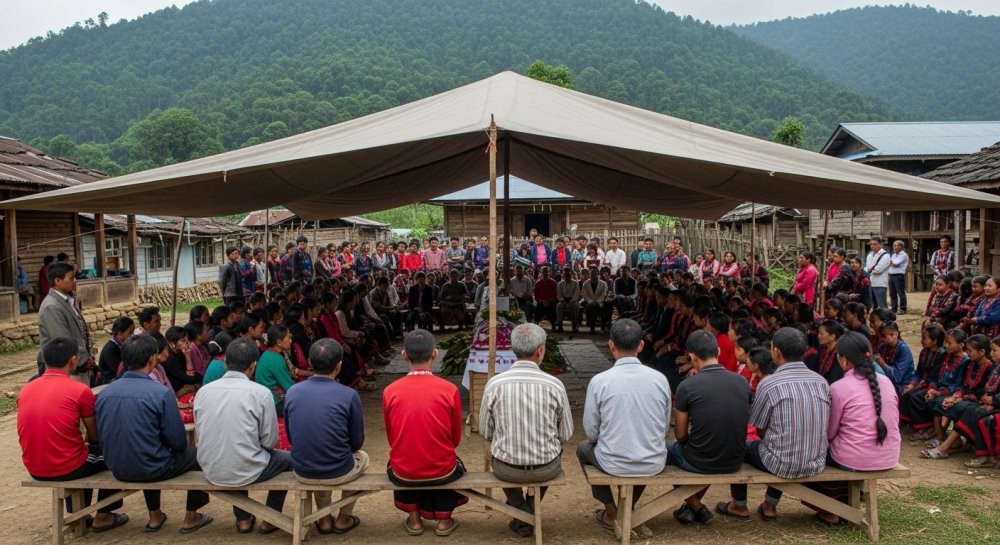
- Mourners gathered on July 13 at Nirjuli Village-I for the funeral of the pioneering Baptist minister who dedicated his life to sharing the Gospel
- His legacy represents decades of faithful Christian witness in one of India’s most remote border regions
A pioneering voice of Christian faith in one of India’s most remote regions has gone home to be with the Lord. Rev. Khoda Tana, who brought the Gospel to the Nyishi people of Arunachal Pradesh, passed away after a lifetime of faithful ministry that transformed an entire community.
Under a canopy at Nirjuli Village-I, district Papum Pare, mourners gathered on the morning of July 13 at the residence of Mrs. Jumshi Tana. They came to honor a man whose dedication to sharing Christ’s message reached the largest indigenous tribal community in India’s northeastern border state of Arunachal Pradesh.
Rev. Tana’s ministry represented more than just religious work—it was a testament to the power of one faithful servant answering God’s call in challenging circumstances. As a founding figure of Christianity among the Nyishi people, he laid a spiritual foundation that continues to bear fruit today.
The Nyishi community, living in one of India’s most geographically isolated regions near the border with China, had limited exposure to the Christian faith before pioneers like Rev. Tana committed their lives to missionary work. His efforts demonstrated the enduring truth that the Great Commission knows no boundaries—even in the most remote corners of the world.
Arunachal Pradesh, a state where Christianity has grown significantly despite challenges, now stands as evidence of the faithful work of ministers like Rev. Tana. His legacy serves as an inspiration to believers who understand that sharing the Gospel requires sacrifice, perseverance, and unwavering commitment to the truth.
The funeral gathering reflected the deep respect and love the community held for a man who devoted his life to serving others and spreading the message of salvation. His passing marks the end of an era for Baptist ministry in the region, but his spiritual impact will endure for generations.
Let us know what you think, please share your thoughts in the comments below.


-

 Self-Reliance1 year ago
Trump’s Bold Move Uncovers Massive Social Security Fraud
-

 Faith1 year ago
New Clues Emerge in Noah’s Ark Mystery
-

 News1 year ago
Governor Walz’s Rhetoric Sparks National Controversy
-

 News1 year ago
Mel Gibson’s ‘The Passion of the Christ’ Sequel Title Announced
-

 Family1 year ago
Texas Lawmaker Targets Furries in Schools
-

 Freedom1 year ago
Maine Lawmaker Challenges Sports Fairness Controversy
-

 Family1 year ago
Canada’s Controversial Policy Sparks Ethical Debate
-
Faith8 months ago
Congress Hears Pleas for Nigerian Christians