
Faith
Faith Leaders to Meet Prime Minister on Bold Christmas Mission for the Homeless

Faith Facts
- Church leaders are scheduled to meet with the Prime Minister to address homelessness ahead of Christmas
- The initiative aims to provide shelter and support for rough sleepers during the holiday season
- Faith communities across the nation are mobilizing resources to serve those experiencing homelessness
Christian leaders across the United Kingdom are preparing for a crucial meeting with the Prime Minister as part of an ambitious campaign to help rough sleepers find shelter before Christmas. The faith-based initiative represents a powerful example of the Church stepping forward to address one of society’s most pressing challenges.
Churches throughout the nation have been at the forefront of homeless outreach for decades, providing not just temporary shelter but long-term support, spiritual guidance, and practical assistance. This latest effort builds on that strong foundation of Christian compassion and service.
The Christmas season holds special significance for people of faith, making this initiative particularly meaningful. As Christians celebrate the birth of Christ—who himself had no place to lay his head—many believers feel a renewed calling to serve the least among us with dignity and love.
Faith communities have historically been the most reliable and effective providers of homeless services, often outperforming government programs through their combination of material assistance and spiritual care. These church-led efforts typically offer not just a bed for the night, but genuine relationship, accountability, and a path toward restoration.
The meeting with the Prime Minister could pave the way for increased collaboration between government and faith-based organizations. Such partnerships have proven successful in the past when they respect the religious character of ministries while providing necessary resources and support.
Many church leaders view this as an opportunity to demonstrate the transformative power of faith-based solutions to social problems. Rather than simply managing homelessness, Christian outreach programs often address root causes including addiction, mental health struggles, and broken family relationships through the hope found in the Gospel.
As the holiday season approaches, congregations across Britain are mobilizing volunteers, gathering donations, and preparing facilities to welcome those in need. This grassroots movement reflects the enduring American and British Christian tradition of caring for neighbors in practical, sacrificial ways.
The initiative also highlights the vital role that religious freedom and faith-based institutions play in civil society. When churches are empowered to serve according to their convictions, entire communities benefit from their compassionate outreach and proven track record of changing lives.
Let us know what you think, please share your thoughts in the comments below.


Faith Facts
- Christian leaders warn that humanity’s fascination with UFOs reflects ancient spiritual temptations rather than genuine scientific inquiry
- The desire to uncover hidden knowledge and cross divine boundaries mirrors the serpent’s temptation in Genesis
- Believers are urged to find certainty in Scripture and God’s revelation rather than in occult speculation and extraterrestrial phenomena
As government disclosures about unidentified aerial phenomena continue to make headlines, Christian leaders are sounding an alarm about spiritual dangers lurking beneath the surface. The renewed cultural fascination with UFOs and potential extraterrestrial life isn’t simply a matter of scientific curiosity—it may represent one of humanity’s oldest and most dangerous spiritual temptations.
Writer and Christian commentator James Cary argues that our modern preoccupation with UFOs and the unexplained echoes the very first temptation in the Garden of Eden. The serpent’s promise to Eve—”you will be like God, knowing good and evil”—represents humanity’s persistent desire to access hidden knowledge and cross boundaries that the Creator has established for our protection.
“This fascination is not new, but part of humanity’s oldest temptation: the desire to know what is hidden, cross boundaries God has set and seek certainty anywhere but in Him,” Cary explains.
The warning comes at a critical time when increasing numbers of Americans report belief in extraterrestrial visitation and government conspiracy theories surrounding UFO phenomena. Some Christian theologians express concern that major “disclosure” events could create confusion among believers who haven’t grounded their worldview firmly in biblical truth.
Throughout Church history, Christians have consistently faced the temptation to seek hidden or esoteric knowledge outside of God’s revealed Word. From Gnostic heresies in the early centuries to modern New Age movements, the pattern remains consistent: a rejection of God’s sufficient revelation in favor of secret wisdom available only to spiritual elites.
The UFO phenomenon carries particular spiritual risks because it blends scientific-sounding language with fundamentally occult themes. Many UFO encounters and alleged “alien abduction” experiences share striking similarities with demonic manifestations and occult spiritual experiences documented throughout history. Researchers have noted that many who claim contact with extraterrestrial beings report messages that contradict biblical teaching and promote spiritual deception.
Christian apologists emphasize that believers must exercise discernment when evaluating extraordinary claims. While God certainly could have created life elsewhere in the universe, the Bible’s redemptive narrative centers on Earth and humanity’s unique relationship with the Creator. Any phenomena that draw people away from Christ and biblical authority should be viewed with suspicion, regardless of how they present themselves.
The desire for certainty and control drives much of humanity’s fascination with the paranormal and unexplained. Rather than resting in faith and trusting God’s wisdom in revealing only what we need to know, modern people—including Christians—can become obsessed with uncovering every mystery and secret.
Scripture consistently warns against seeking forbidden knowledge through occult means, including divination, mediumship, and consorting with spiritual entities outside God’s authority. Deuteronomy 18:10-12 explicitly condemns these practices, and the New Testament confirms that spiritual forces of darkness actively work to deceive humanity.
Cary urges Christians to remember that God has given us everything we need for life and godliness through knowledge of Christ (2 Peter 1:3). While healthy curiosity about creation is natural and good, believers must guard against the pride that demands answers to every question and the anxiety that cannot rest without complete understanding.
The path forward for Christians requires balancing openness to genuine scientific discovery with spiritual wisdom and discernment. Believers should neither dismiss all unusual phenomena as necessarily demonic nor uncritically accept every extraordinary claim. Instead, we must test all things against Scripture and hold fast to what is good (1 Thessalonians 5:21).
As cultural fascination with UFOs and the paranormal continues to grow, the Church has an opportunity to point people toward the true source of hope and certainty. Rather than seeking hidden knowledge or spectacular signs, Christians find their confidence in the God who has revealed Himself fully in Jesus Christ—the same yesterday, today, and forever.
Let us know what you think, please share your thoughts in the comments below.
Faith Facts
- Pastor Derek Hughes discovered his church had become a machine running on exhausted volunteers who felt trapped by obligation rather than called by joy
- When he gave volunteers permission to step back, the church faced a critical decision: continue building programs or refocus on spiritual health and genuine community
- The transformation revealed how deeply churches can confuse activity with faithfulness, measuring success by busyness rather than spiritual vitality
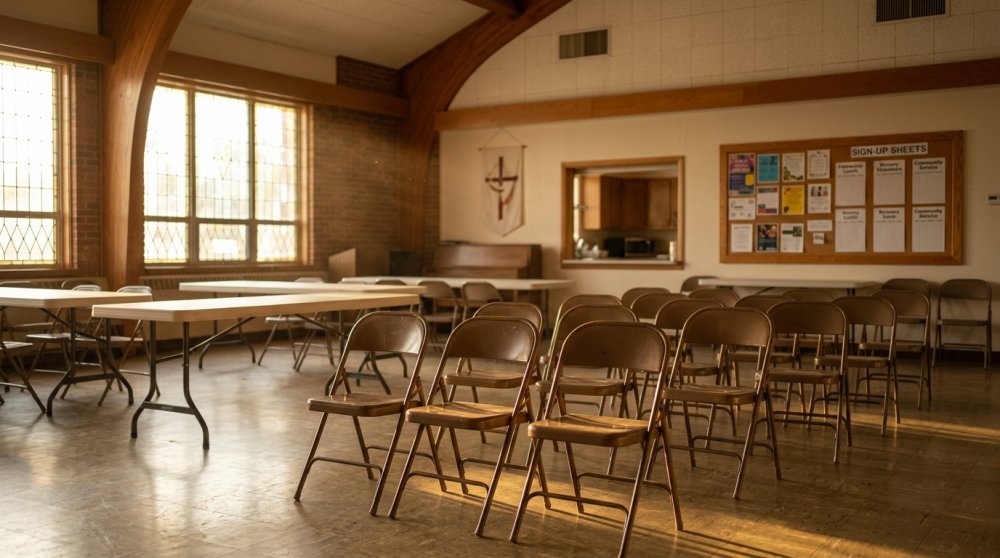
Derek Hughes stepped into a ministry that looked successful on the surface but was spiritually hollow underneath. The programs ran like clockwork, the calendar stayed full, and the volunteers showed up week after week. But beneath the veneer of activity, something had gone terribly wrong.
The volunteers were exhausted. They knew they needed rest, but guilt and obligation kept them locked in place. The unspoken message was clear: if you stop, everything falls apart.
Hughes made a radical decision. He gave them permission to step back.
“I inherited a ministry built on burnt-out volunteers who knew they needed to stop but did not believe they could,” Hughes reflects. The realization was sobering: the church had become a machine, and people had become its fuel.
What happened next challenged everything he thought he knew about ministry success. When volunteers began stepping away, the church faced a critical crossroads. They could scramble to replace workers and keep the programs running, or they could ask deeper questions about what they were really building.
Hughes chose the harder path. Instead of recruiting new volunteers to fill the gaps, he began examining why the church measured success by activity in the first place. The calendars, the programs, the constant motion—had any of it actually produced spiritual growth?
“How deeply I had come to measure church success by activity,” he admits. The confession cuts to the heart of a problem plaguing American churches: the confusion of busyness with faithfulness.
Scripture calls believers to bear fruit, but nowhere does it command them to burn out in the process. Christ offered rest to the weary, not another committee assignment. Yet countless churches operate as if exhaustion is the price of faithful service.
The transformation in Hughes’ church didn’t happen overnight. Some programs ended. Some events were cancelled. The calendar looked emptier, and to outside observers, it might have seemed like the church was shrinking.
But something else was growing. Volunteers who stepped back found time to pray, to rest, to reconnect with why they fell in love with Jesus in the first place. Relationships deepened when people weren’t rushing from one obligation to the next. Spiritual health began replacing spiritual exhaustion.
The lesson extends far beyond one congregation. Across America, churches are discovering that the relentless pursuit of more—more programs, more events, more activities—can actually crowd out the presence of God they’re meant to cultivate.
Traditional Christian wisdom has always recognized the importance of Sabbath rest and sustainable rhythms of service. The modern church’s addiction to activity represents a departure from this biblical foundation, not an expression of it.
When volunteers serve from obligation rather than joy, when exhaustion becomes a badge of honor, when saying no triggers guilt instead of wisdom—these are signs that something has gone wrong. The church was never meant to function as a machine that consumes its people.
Hughes’ experience offers a challenging word to church leaders everywhere: what if the programs that seem essential are actually obstacles? What if the activities filling your calendar are emptying your people spiritually?
The courage to stop, to create space, to prioritize spiritual health over organizational momentum—this is countercultural leadership in an age that worships productivity. It requires faith that God’s work doesn’t depend on human striving, and that sometimes the most faithful thing a church can do is rest.
For volunteers trapped in cycles of exhaustion, Hughes’ story offers hope. Stepping back isn’t failure; it’s wisdom. The church will survive without your burnt-out service, and you might discover that God was calling you to something different all along.
The challenge now is whether other churches will have the courage to follow this path. Will they continue measuring success by activity, or will they rediscover what it means to build communities marked by spiritual vitality rather than spiritual exhaustion?
The answer will determine not just the health of individual congregations, but the witness of the American church to a watching world. A church running on burnt-out volunteers proclaims a false gospel—one where God’s acceptance depends on our exhaustion rather than Christ’s finished work.
Let us know what you think, please share your thoughts in the comments below.
Faith Facts
- Christian relief agencies have delivered hundreds of thousands of pounds of essential supplies to Midwest flood survivors following historic flooding
- Faith-based organizations are providing both physical aid and spiritual support to devastated communities across multiple states
- Many survivors report that the spiritual comfort and prayer offered by Christian volunteers has been the most impactful element of their recovery
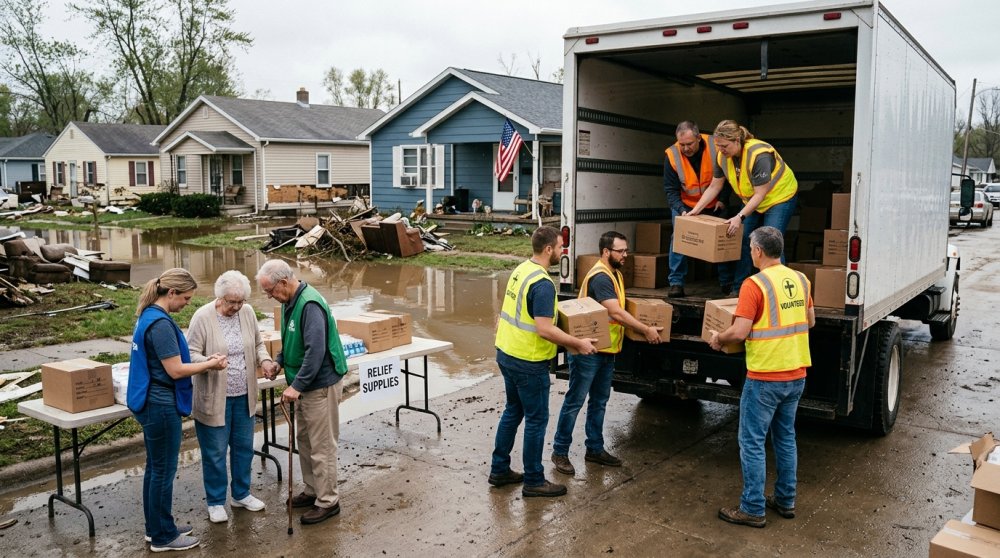
As communities across the Midwest begin the long road to recovery from last week’s historic flooding, Christian relief agencies are mobilizing on the ground with both material assistance and something far more powerful: the hope of the Gospel.
Faith-based organizations have delivered hundreds of thousands of pounds of essential aid items to survivors, including food, water, clothing, and emergency supplies. These organizations are working tirelessly to meet the immediate physical needs of families who lost everything in the devastating floods.
Yet for many survivors, the most meaningful support comes not in boxes or pallets, but in prayer and spiritual encouragement. Christian volunteers are ministering to shell-shocked families, offering comfort that only faith can provide in the midst of catastrophic loss.
The dual mission of Christian relief efforts — meeting both body and soul — sets these organizations apart. While secular agencies focus solely on material needs, faith-based responders understand that true recovery requires spiritual healing as well.
Across multiple Midwest states, survivors have expressed profound gratitude not just for the physical help, but for the presence of believers who pray with them, listen to their stories, and remind them that God has not abandoned them in their darkest hour. For many facing the overwhelming task of rebuilding their lives, this spiritual support has proven to be the foundation upon which all other recovery efforts rest.
The response from Christian organizations demonstrates once again how the Church steps up when disaster strikes, bringing not just relief supplies but the transforming power of Christ’s love to broken communities. As the floodwaters recede, the light of faith continues to shine brightest in America’s heartland.
Let us know what you think, please share your thoughts in the comments below.


-

 Self-Reliance1 year ago
Trump’s Bold Move Uncovers Massive Social Security Fraud
-

 Faith1 year ago
New Clues Emerge in Noah’s Ark Mystery
-

 News1 year ago
Governor Walz’s Rhetoric Sparks National Controversy
-

 News1 year ago
Mel Gibson’s ‘The Passion of the Christ’ Sequel Title Announced
-

 Family1 year ago
Texas Lawmaker Targets Furries in Schools
-

 Freedom1 year ago
Maine Lawmaker Challenges Sports Fairness Controversy
-

 Family1 year ago
Canada’s Controversial Policy Sparks Ethical Debate
-
Faith9 months ago
Congress Hears Pleas for Nigerian Christians