
Faith
Faith Leaders Respond After Gunfire Halts White House Correspondents’ Dinner

Faith Facts
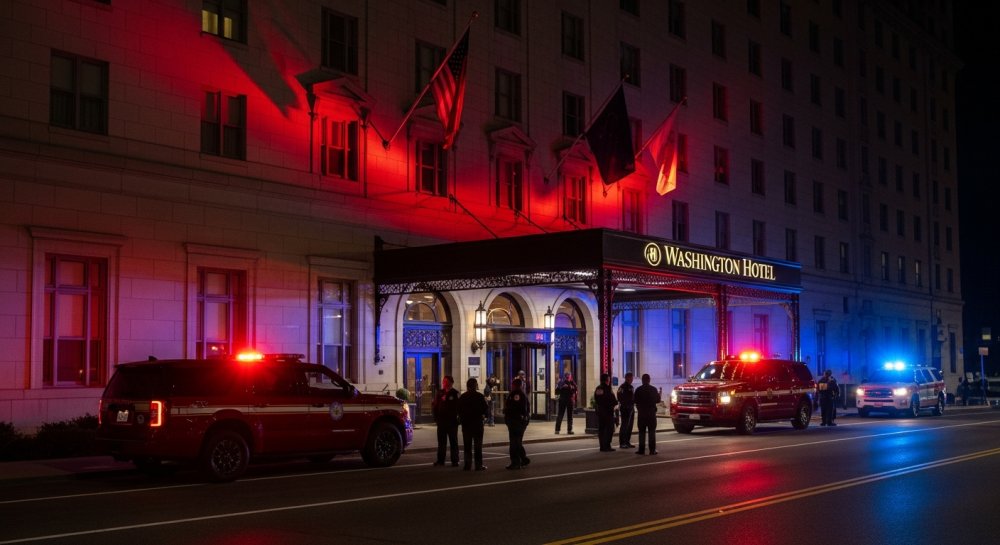
- The White House Correspondents’ Association dinner was abruptly interrupted by gunfire at the Washington Hilton Hotel on Saturday night
- Christian leaders across the nation are calling for prayer and spiritual discernment following the incident involving President Trump
- Prominent pastors and ministry leaders are urging Americans to recognize the spiritual warfare at play in our nation’s capital
The annual White House Correspondents’ Association dinner took a dramatic turn Saturday night when gunfire echoed through the Washington Hilton Hotel, where President Donald Trump, his administration officials, and members of the White House Press Corps had gathered. The incident marks what Christian leaders are calling the third brazen attempt on the president’s life, prompting calls for prayer and renewed vigilance across the faith community.
As news of the incident spread, Christian leaders quickly took to social media and public statements to address the shocking event. Their responses ranged from urgent calls for prayer to warnings about spiritual warfare facing the nation.
Franklin Graham, president and CEO of the Billy Graham Evangelistic Association and Samaritan’s Purse, issued a statement urging believers to intercede on behalf of the president and the nation. Graham has been a consistent voice calling Christians to pray for President Trump and all elected officials, regardless of political affiliation.
Pastor Robert Jeffress of First Baptist Church in Dallas also weighed in on the situation, emphasizing the need for Christians to understand the spiritual dimensions of current events. Jeffress has long maintained that believers must recognize when spiritual forces are at work in the political arena.
“Satan is on the move,” one Christian leader declared in response to the incident, capturing the sentiment shared by many in the faith community who see these events as evidence of a larger spiritual battle.
The response from Christian leaders reflects a growing awareness among believers that the challenges facing America extend beyond the physical and political realms. Many are calling on churches across the nation to dedicate time in their services to pray specifically for the protection of President Trump, his family, and all those in positions of leadership.
The incident at the Washington Hilton has reignited conversations within the Christian community about the role of prayer in national affairs and the responsibility of believers to stand watch over their leaders. Several ministry leaders have announced plans for special prayer gatherings and are encouraging Christians to commit to regular intercession for the nation’s leadership.
Christian conservatives have emphasized that regardless of one’s political views, the Bible calls believers to pray for those in authority. This principle, they note, becomes even more critical during times of heightened tension and apparent danger.
The White House Correspondents’ Association dinner, typically an evening of speeches and entertainment, became instead a sobering reminder of the serious threats facing those who serve in public office. For Christian leaders, it served as a wake-up call to the faithful about the urgency of the hour and the need for sustained prayer coverage.
As details continue to emerge about the incident, Christian leaders are urging their congregations not to give in to fear but to respond with faith and persistent prayer. They maintain that spiritual warfare requires spiritual weapons, and that the most powerful tool believers possess is their direct line of communication with God through prayer.
The faith community’s response demonstrates a unified commitment to upholding President Trump and all government officials in prayer, recognizing that the challenges they face are not merely human in origin. Christian leaders continue to call for wisdom, discernment, and divine protection over America’s leaders and the nation as a whole.
Let us know what you think, please share your thoughts in the comments below.

Faith Facts
- Sen. Darline Graham publicly thanked “the good Lord” and supporters who prayed for her after winning the special Republican primary runoff
- Graham will replace her late brother, Lindsey Graham, on the November general election ballot for U.S. Senate
- The senator’s open acknowledgment of faith and prayer highlights the role of Christian values in conservative politics
In a powerful display of faith-centered leadership, Sen. Darline Graham credited divine intervention and the prayers of supporters following her victory in the special Republican primary runoff election. The senator will now advance to the November general election ballot, seeking to fill the U.S. Senate seat previously held by her late brother, Lindsey Graham.
Graham’s public acknowledgment of God’s role in her political success stands as a refreshing reminder of the faith foundation that has historically guided American leadership. In an era when many politicians shy away from open expressions of Christianity, her willingness to thank “the good Lord” demonstrates the enduring connection between conservative values and biblical principles.
“The good Lord” and “everyone who prayed” for her received direct thanks from the senator, underscoring the critical role that prayer warriors play in supporting godly candidates. This recognition affirms what many Christian conservatives have long understood: that electoral outcomes are not merely the result of campaign strategies, but are ultimately in God’s hands.
The special election runoff represented more than just a political contest—it became a testament to the power of faith-driven civic engagement. Graham’s victory demonstrates that candidates who openly embrace their Christian faith can still succeed in American politics, despite increasing cultural pressure to privatize religious conviction.
As Graham prepares for the November general election, her faith-first approach to campaigning offers hope to Christians across the nation who long for leaders willing to acknowledge God’s sovereignty. Her willingness to publicly attribute success to divine providence rather than personal achievement reflects the humility that Scripture calls believers to demonstrate.
The senator’s triumph also carries particular significance given the family legacy she now carries forward. Stepping into the role previously held by her brother represents both a personal calling and a public responsibility—one that she has framed explicitly in terms of faith and service to others.
Christian conservatives watching this race understand that Graham’s commitment to thanking God first sends a powerful message about priorities and values. In a political landscape often dominated by self-promotion and personal ambition, her focus on gratitude and prayer marks a distinctive approach rooted in biblical wisdom.
Let us know what you think, please share your thoughts in the comments below.

Faith Facts
- Legendary singer-songwriter Dolly Parton has passed away at age 80, prompting an outpouring of grief from Christian artists and fans nationwide
- Parton’s career spanned decades, touching millions through her music, philanthropy, and unmistakable voice that became synonymous with American values
- Christian musicians and ministry leaders have taken to social media to honor her memory and celebrate her impact on faith and culture
The nation mourns the loss of a true American treasure. Dolly Parton, whose voice echoed through generations and whose heart touched countless lives, has passed away at 80. Her death marks the end of an era in American music and culture.
Christian artists across the country have responded with heartfelt tributes. Their messages reflect not only professional admiration but deep personal connection to a woman who embodied traditional values while reaching the highest pinnacles of success.
“We will miss you down here,” expressed one sentiment that captured the collective grief sweeping through the faith community.
Parton’s influence extended far beyond the stage. Her philanthropic work, particularly in literacy and education, demonstrated the kind of servant leadership that resonates deeply with Christian values. She gave generously, spoke kindly, and lived authentically—qualities that made her a role model for millions.
Her music bridged divides in ways few artists ever achieve. From country to gospel, pop to bluegrass, Parton’s versatility never compromised her authenticity. She remained true to her roots, her faith, and her values throughout a career that spanned more than six decades.
The outpouring of love on social media reveals the profound impact one life can have when lived with purpose and grace. Christian musicians, many of whom grew up listening to her songs or were inspired by her example, shared memories and expressed gratitude for her legacy.
Parton’s passing reminds us that even the brightest stars eventually return home. Yet her influence—through music, charity, and unwavering commitment to lifting others—will continue to inspire future generations. She lived a life that mattered, touching hearts and changing lives through talent given by God and used for good.
In an entertainment industry often marked by fleeting fame and compromised values, Parton stood as a beacon of consistency. She proved that success and integrity need not be mutually exclusive, that fame could be wielded for good, and that staying true to one’s roots was not a limitation but a strength.
Let us know what you think, please share your thoughts in the comments below.

Faith Facts
- Leading Bible scholar N.T. Wright argues that Paul’s letter to the Ephesians deserves the same sustained attention Christians give to Romans and Galatians
- The church is called to be a “small working model” of God’s promised new creation, serving as an advance sign of redeemed creation
- Paul describes believers as God’s “poetry” or artwork, meant to embody and enact the new creation here and now
At Crowley’s Ridge College in Paragould, Arkansas, where history professor Shannon Beasley teaches, each class begins with a verse of the day to encourage students and give them a grounding, reorienting start to the morning. Then they turn to the news of the day, the top stories shaping their world.
Beasley notes how often the verse of the day illuminates the news of the day. She is also struck by how frequently, when she asks students to name their favorite Bible verses, something from Ephesians appears — such as Ephesians 3:20.
While Romans and Galatians tend to dominate church conversations, leading Bible scholar N.T. Wright believes Ephesians deserves equally sustained attention. Wright, a senior research fellow at Wycliffe Hall, Oxford, has written “The Vision of Ephesians: The Task of the Church and the Glory of God.”
The letter to the Ephesians is generally accepted as having been written by the apostle Paul, a conclusion Wright defends while giving little weight to arguments against Pauline authorship. Importantly, Wright emphasizes that Ephesians was likely a circular letter — written not to address a single congregation’s local concerns, but to be read aloud among several house churches in and around Ephesus in modern-day western Turkey.
These were small communities — perhaps five to 30 people each — largely poor rather than wealthy, hearing this letter read while Paul himself was imprisoned.
Wright moves through the letter section by section rather than adhering rigidly to the chapter-and-verse divisions added to our Bibles some five centuries ago. Because the original Greek lacked punctuation, determining where sentences begin and end is an act of interpretation.
Wright’s remarkable facility with the language allows these interpretive decisions to yield fresh insights and renewed perspective. One striking example appears in Ephesians 2:10: “autou gar esmen poiēma.”
Wright renders “poiēma” not merely as “workmanship,” but as “poetry.”
“We are to be Renaissance-people, demonstrating the birth of the new world,”
Wright writes. We, the church, are God’s artwork — his sculpture, his poem.
This leads to the central theme of Wright’s reading of Ephesians: The church is called to be a small working model of God’s promised new creation — a heaven-and-earth community that serves as an advance sign of what redeemed creation looks like. The church is meant not only to announce this new creation, but to embody and enact it here and now.
What, then, does Paul call the Ephesian Christians — and us — to be? A people motivated by God’s glory as their goal; a praising people and a praying people; a peaceful and unified people; Spirit-filled, marked by self-giving love and clothed in the armor of God.
Read through this lens, “The Vision of Ephesians” offers rich insight for any teacher, student or reader of Scripture seeking to understand not only what the church believes but also what it is meant to be. In an age of cultural division and confusion about the church’s role in society, Paul’s letter provides a timeless blueprint for Christian community and witness.
Wright’s work stands as a reminder that Scripture speaks powerfully to contemporary challenges when we take the time to understand its original context and meaning. For Christians seeking to live out their faith authentically in today’s world, Ephesians offers a vision of the church as God’s masterpiece — a living demonstration of His transforming power.
Let us know what you think, please share your thoughts in the comments below.


-

 Self-Reliance1 year ago
Trump’s Bold Move Uncovers Massive Social Security Fraud
-

 Faith1 year ago
New Clues Emerge in Noah’s Ark Mystery
-

 News1 year ago
Governor Walz’s Rhetoric Sparks National Controversy
-

 News1 year ago
Mel Gibson’s ‘The Passion of the Christ’ Sequel Title Announced
-

 Family1 year ago
Texas Lawmaker Targets Furries in Schools
-

 Freedom1 year ago
Maine Lawmaker Challenges Sports Fairness Controversy
-

 Family1 year ago
Canada’s Controversial Policy Sparks Ethical Debate
-
Faith9 months ago
Congress Hears Pleas for Nigerian Christians