
Family
Court Denies Parental Rights to Sperm Donor Who Fathered 180 Children


Faith Facts
- A British sperm donor who claims to have fathered at least 180 children worldwide was denied legal recognition as a father by a U.K. family court.
- The donor received compensation including Amazon gift cards in exchange for his donations, operating outside of regulated fertility clinics.
- A High Court judge described the donor as a “shapeshifter” and “highly dangerous man” during proceedings involving parental rights disputes.
A British family court has rejected a sperm donor’s attempt to be legally recognized as the father of a child he helped conceive through an informal donation arrangement. The donor, who has not been publicly named due to U.K. privacy laws, claims to have fathered at least 180 children across the globe through both regulated and unregulated donation channels.
The case highlights growing concerns about the largely unregulated fertility industry and its implications for traditional family structures. According to court documents, the donor received various forms of compensation for his donations, including Amazon gift cards, raising questions about the commodification of human reproduction.
During the court proceedings, a High Court judge delivered a scathing assessment of the donor’s character and motivations. The judge described him as a “shapeshifter” and a “highly dangerous man,” expressing serious concerns about his intentions and behavior in seeking parental rights.
The case centered on the donor’s claim to legal parental status for one child conceived through his donation. The child’s mother had entered into an informal arrangement with the donor outside the framework of licensed fertility clinics, a practice that is becoming increasingly common but raises significant legal and ethical questions.
Traditional fertility laws in the United Kingdom generally do not recognize sperm donors as legal fathers when donations occur through licensed clinics. However, informal arrangements that bypass clinical oversight create legal gray areas that courts must navigate on a case-by-case basis.
The donor’s prolific activity — claiming to have fathered 180 children globally — raises profound questions about the long-term consequences of modern reproductive technology. From a Christian perspective, such practices challenge the biblical foundation of family as designed by God, where children are conceived within the covenant of marriage between one man and one woman.
The court’s decision to deny the donor’s parental claim protects the child and the mother from unwanted intrusion. Legal experts note that allowing such claims could open the door to ongoing custody battles and financial disputes that would serve neither the interests of children nor the stability of families.
Critics of the unregulated fertility industry argue that cases like this demonstrate the need for stronger oversight and clearer legal frameworks. The practice of compensating donors with gift cards and other payments particularly troubles advocates for traditional family values, who see it as reducing human reproduction to a commercial transaction.
The donor’s extensive global activity also raises concerns about the potential for inadvertent consanguinity — the risk that half-siblings conceived through the same donor might unknowingly enter into relationships with one another in the future. This risk multiplies exponentially when a single donor fathers dozens or hundreds of children.
The case serves as a reminder of the complex ethical and legal challenges that arise when reproductive technology operates outside traditional family structures. While fertility treatments can be a blessing for married couples struggling with infertility, the increasing commercialization and deregulation of the industry raises serious moral questions.
For Christian conservatives, the case underscores the importance of upholding God’s design for family and protecting children from the potential chaos created by arrangements that prioritize adult desires over children’s welfare. Every child deserves the security and stability of knowing their parentage and growing up in a committed family structure.
The court’s ruling affirms that financial transactions and biological contribution alone do not establish the sacred bond of parenthood. True fatherhood involves commitment, responsibility, and the willingness to put a child’s needs above one’s own interests — qualities the court found lacking in this case.
Let us know what you think, please share your thoughts in the comments below.

Faith Facts
- A Texas high school senior named Angie Gallegos found a forgotten purse at a Rangers game and tracked down the owner via Facebook
- Despite concerns from family and friends, the owner met Gallegos at a QuikTrip where everything was returned intact
- The young woman wore a St. Jude medallion and simply said she “wanted to do the right thing”
ARLINGTON, TEXAS — The Texas Rangers beat the New York Yankees, and Bobby Ross Jr. and I had met in Arlington to see it happen. Maybe that’s why I left my purse in the seat beside me when the game ended.
Absentminded joy. Said joy morphed into panic after I exited Globe Life Field and realized my bag was not on my shoulder.
That would be the bag with my wallet, my ID, my credit and debit cards, a couple of prescriptions and some much-loved and really expensive prescription sunglasses. And my car fob.
Yes, I had a spare — at home in Abilene, 165 miles away. Yes, I went back inside the stadium to look for the purse, checked with lost and found and file a loss report.
Yes, I immediately put a hold on the cards, berated myself repeatedly and was reallllly nice to Bobby, who was well on his way to Dallas when he had to return to Arlington to get me. Though editors generally have earned their gruff, green eyeshade reputation, he did not complain.
Because Bobby is a Rangers fan. The Rangers had just beaten the Yankees. No forgetful freelancer could diminish his joy.
And he’s a really good friend. The game was a side benefit to the real reason for the trip: The Christian Chronicle Board of Trustees retreat beginning the next morning, making Bobby’s patience that much more impressive.
So while he drove, I messaged my text groups: my family, the group euphemistically called “The Girls,” and HWC (as in “Hello, Win Column”), composed of six women who are ardent Rangers fans. Advice began pouring in.
At one point, I actually was booking a roundtrip flight to Abilene using American Airlines miles to pick up the key fob. Then Bobby reminded me I had no ID. I couldn’t get on a plane.
So friends in Abilene contrived a plan to retrieve the extra fob from my kitchen drawer and FedEx it to me. I have great friends.
Still, this meant the car would be unattended, in an Arlington parking lot for two days. A kind Arlington police officer couldn’t promise my vehicle wouldn’t be towed, but he didn’t expect that to happen. That was consoling. Sort of.
For those unfamiliar with the Dallas-Fort Worth Metroplex, it’s really big. As in 16,000 square miles.
As in 8.3 million people, one of whom was probably trying on my sunglasses at that very moment. Globe Life Field in Arlington is roughly in the middle of it.
The hotel where Chronicle staff and board were staying was 27 miles east of there. That’s where we were when my phone buzzed alerting me to a Facebook message from my new best friend, Angie Gallegos.
The lack of punctuation tipped me off that the sender was probably young. I didn’t care. She had found the purse and waited for someone to return.
When no one came, she took it with her and found me on Facebook. Who needs commas?
“I didn’t want it to go in the wrong hands, so I’m reaching out to let you know I have your bag!”
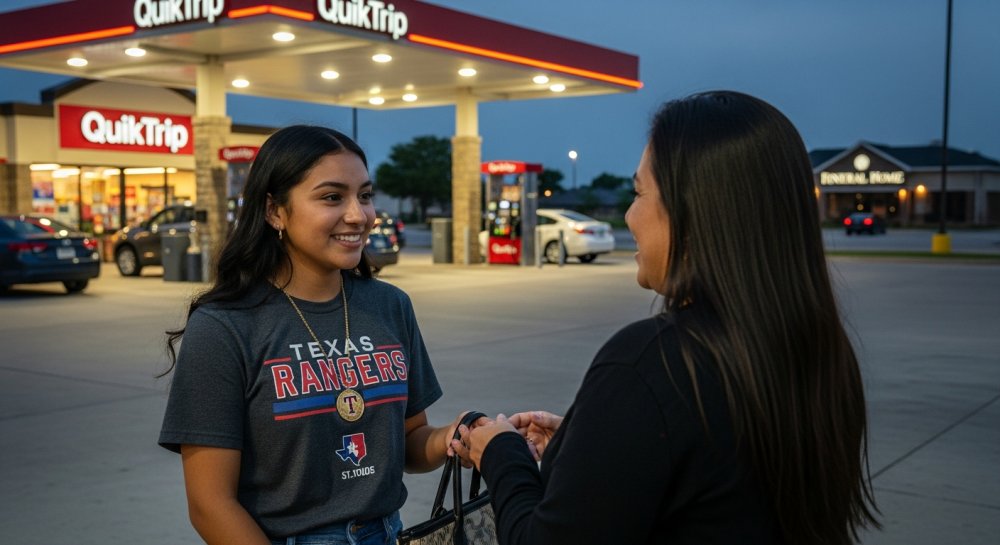
I asked where we could meet, and she sent me a link for a QuikTrip some 21 miles east of our hotel. I told her we could be there in 30 minutes.
While Bobby drove some more, I updated the text groups whose faith in humanity was not exactly devout.
“If the QuikTrip is sketchy call police to be nearby,” replied my attorney friend, Jane, just seconds after I had told Bobby, “Jane would probably call the police to meet her there.”
“Don’t go by yourself,” said my son.
We arrived at the QuikTrip, next door to a funeral home. A nice neighborhood.
Lots of customers around. I messaged Angie to alert her that we had arrived, and she said she’d be there in five minutes.
My daughter texted after seven minutes to check on me. In defense of my friends and family, I had agreed to meet a total stranger at a gas station.
But Angie Gallegos was no sketchy stranger. The high school senior was still grinning from the Rangers’ win when she walked up with my purse.
We chatted. I took a selfie. I asked her about the medallion on the gold chain she wore with her Rangers T-shirt — St. Jude, the patron saint of lost causes.
That seemed appropriate — for a Rangers fan and a retriever of lost purses. I told her I’d send her a reward, which she assured me wasn’t necessary.
“I just wanted to do the right thing.”
I sent one anyway. As Bobby navigated through a full-stop traffic jam that involved 11 police cars and no apparent cause, the text groups celebrated, more than one commenting that their faith in humanity was restored, a much-needed restoration.
My children were even a tad sarcastic. I don’t know where they get that.
“Did you offer to write her scholarship, job and college recommendation letters?” my daughter asked. I should do that.
I don’t know much more about Angie, but she made my life a whole lot better because she just wanted to do the right thing. That’s a great recommendation for all of us.
Let us know what you think, please share your thoughts in the comments below.

Faith Facts
- While 330,000 children in U.S. foster care need adoption, focusing solely on this statistic may obscure the deeper systemic issues plaguing the child welfare system.
- Christian families and faith-based organizations have long been at the forefront of adoption and foster care ministry, yet data-driven approaches must inform effective compassionate action.
- Experts warn that headline numbers, while alarming, can distract from targeted solutions that address root causes and regional disparities in the foster care crisis.
The statistic is repeated in churches, advocacy groups, and fundraising campaigns across America: 330,000 children in foster care are waiting for adoption. For many Christians committed to caring for the orphan and vulnerable, this number serves as a rallying cry. But what if the way we use this data is actually hindering our ability to serve these children effectively?
The reality behind the numbers is far more complex than a single statistic can convey. While the figure is technically accurate, it represents a snapshot of a deeply fragmented system with vastly different challenges from state to state, county to county.
Data alone cannot repair broken families or heal traumatized children. Yet the right data, properly understood and applied, can illuminate where resources are most desperately needed, which interventions actually work, and how faith communities can make the greatest kingdom impact in the lives of vulnerable children.
The foster care system in America is not a monolithic entity but a patchwork of state and local agencies, each operating under different laws, funding structures, and philosophies. A child in rural Oklahoma faces entirely different circumstances than one in urban Los Angeles. Grouping them all under one statistic obscures these critical distinctions.
Furthermore, not all of the 330,000 children counted are legally free for adoption. Many have parents working toward reunification. Others are teens who age out of the system before permanent homes are found. Still others have complex medical or behavioral needs that require specialized care beyond what most families can provide.
Christian families have consistently shown a willingness to step forward and open their homes. Studies have repeatedly demonstrated that people of faith are disproportionately represented among adoptive and foster families. This is the church living out its biblical mandate to care for the fatherless.
But good intentions must be paired with wise strategy. When churches mobilize around a single national statistic, they may inadvertently direct resources away from the areas of greatest need. Some regions have far more approved families than available children, while others face critical shortages.
The challenge is not simply recruiting more families, though that remains important. The challenge is matching the right families with the right children, providing adequate support and training, addressing systemic barriers that prevent reunification when appropriate, and tackling the upstream issues that bring children into care in the first place.
Poverty, addiction, mental illness, and domestic violence are the primary drivers of family separation. A truly pro-family, pro-life approach must address these root causes while simultaneously caring for children already in the system.
Data, when properly collected and analyzed, can help faith communities target their efforts with precision. It can reveal which counties have the longest wait times for home studies, which demographics of children are hardest to place, and which support services make the difference between adoption disruption and permanency.
Local churches are uniquely positioned to gather and respond to this granular data. They know their communities. They can identify specific needs and mobilize rapid response. But they must move beyond awareness of national statistics to engagement with local realities.
The danger of the 330,000 number is not that it’s inaccurate, but that it’s incomplete. It can inspire action, but without additional context, it may inspire action that misses the mark. It can generate compassion, but compassion uninformed by wisdom can lead to burnout, failed placements, and further trauma for already vulnerable children.
America’s foster care crisis is real and urgent. Children are waiting. Families are needed. But the path forward requires more than awareness; it requires understanding. It requires asking not just how many children need homes, but which children, where they are located, what they need, and how the body of Christ can most effectively respond.
The call to care for orphans and vulnerable children is not negotiable for followers of Jesus. But fulfilling that call in the 21st century demands both the heart of the Good Samaritan and the strategic wisdom of a faithful steward. Numbers matter, but only when they lead us to the right action in the right place at the right time.
Let us know what you think, please share your thoughts in the comments below.

Faith Facts
- Jonathan Lamb did not speak at his mother Joni Lamb’s memorial service, highlighting ongoing family tensions at Daystar Television Network.
- The absence underscores controversies that have surrounded the Christian broadcasting network and the Lamb family in recent years.
- The family division raises questions about leadership and future direction of one of America’s largest Christian television networks.
The memorial service for Joni Lamb, co-founder of Daystar Television Network, became a focal point for family tensions when her son Jonathan Lamb was notably absent from the speaker lineup. The omission has drawn attention to divisions that have affected the prominent Christian broadcasting family.
Joni Lamb built Daystar into one of the nation’s largest Christian television networks alongside her late husband Marcus Lamb, reaching millions of viewers worldwide with faith-based programming. Her passing marks a significant moment for the network and its future leadership.
The family tensions at Daystar reflect broader challenges facing Christian media organizations as they navigate succession planning and family dynamics. These situations require wisdom, grace, and a commitment to biblical principles of reconciliation.
The absence of Jonathan Lamb from such a significant family moment suggests unresolved conflicts that may impact the network’s operations and mission. Christian families in ministry face unique pressures, balancing public witness with private struggles.
Daystar Television Network has been a powerful voice for Christian values in media for decades. The current family situation calls for prayer and discernment as the ministry seeks to honor its founding mission while addressing internal challenges.
Scripture reminds believers of the importance of family unity and forgiveness, particularly among those in Christian leadership. The public nature of this family division serves as a reminder that even prominent Christian families face trials requiring supernatural grace and healing.
Let us know what you think, please share your thoughts in the comments below.


-

 Self-Reliance1 year ago
Trump’s Bold Move Uncovers Massive Social Security Fraud
-

 Faith1 year ago
New Clues Emerge in Noah’s Ark Mystery
-

 News1 year ago
Governor Walz’s Rhetoric Sparks National Controversy
-

 News1 year ago
Mel Gibson’s ‘The Passion of the Christ’ Sequel Title Announced
-

 Family1 year ago
Texas Lawmaker Targets Furries in Schools
-

 Freedom1 year ago
Maine Lawmaker Challenges Sports Fairness Controversy
-

 Family1 year ago
Canada’s Controversial Policy Sparks Ethical Debate
-
Faith6 months ago
Congress Hears Pleas for Nigerian Christians