
Faith
Christian Ministries in India Brace for Escalating Property Seizures Under New Regulations


Faith Facts
- The Foreign Contributions Act is being used as a pretext to target Christian-owned lands and institutions.
- Hindu nationalist groups are pushing for an identity that excludes the rights of the Christian minority.
- Many threatened properties provide essential services to Dalits and tribal communities in need.
The All India Christian Council is sounding the alarm as Hindu nationalist influences threaten the charitable mission of the Church.
Authorities are reportedly leveraging foreign donation regulations to seize properties dedicated to serving India’s most vulnerable citizens.
These assets are vital for the support of marginalized communities, yet they now face state-directed confiscation under the guise of legal oversight.
This coordinated effort appears driven by a nationalist agenda that equates national identity with a single religious faith.
The crackdown is linked to the RSS, a group closely tied to the ruling party that has faced accusations of sectarian hostility in the past.
This discriminatory application of the law undermines constitutional protections transitionaly afforded to religious minorities across the nation.
"This is a dangerous and deeply alarming crisis with immediate and potentially irreversible consequences,"
stated Dr. Joseph D’Souza, President of the AICC.
The AICC is calling for an immediate end to these unilateral decisions that threaten the survival of Christian outreach.
Believers are urged to pray for the protection of those serving on the front lines in India.



Faith Facts
- A Christian pastor was arrested while peacefully preaching the Gospel on a public street in Watford, England, during the weekend.
- Video footage of the arrest has circulated widely online, raising concerns about religious freedom and free speech protections in the United Kingdom.
- The incident adds to a growing pattern of Christian street preachers facing legal action for publicly sharing their faith in Britain.
A Christian pastor was arrested while street preaching in Watford, England, over the weekend, in an incident that has sparked renewed debate about religious liberty in the United Kingdom. Video footage of the arrest has spread rapidly across social media platforms, drawing attention from Christians and free speech advocates worldwide.
The pastor was reportedly sharing the Gospel message in a public area when police intervened and placed him under arrest. The exact charges or reasons given for the arrest remain unclear at this time.
The incident reflects a troubling trend in the United Kingdom, where Christian street preachers have increasingly faced police intervention and legal consequences for publicly expressing their faith. Many believers view these arrests as a direct assault on the freedom to preach the Gospel—a freedom that was once foundational to Western civilization and protected by law.
Religious freedom advocates have long warned that restrictions on public Christian speech represent a dangerous erosion of fundamental liberties. When governments begin policing the content of religious messages in public spaces, they set a precedent that threatens all forms of free expression.
For American Christians, this incident serves as a sobering reminder of how quickly freedoms can be lost when religious liberty is not vigorously defended. The First Amendment to the U.S. Constitution protects both free speech and the free exercise of religion, rights that our founders recognized as God-given and essential to a free society.
As the situation in Britain continues to develop, Christians on both sides of the Atlantic are called to pray for persecuted believers and to remain vigilant in defending the right to proclaim the Gospel without fear of government retaliation. The Great Commission commands believers to go into all the world and preach the Gospel—a calling that must not be surrendered to secular authorities.
Let us know what you think, please share your thoughts in the comments below.
Faith Facts
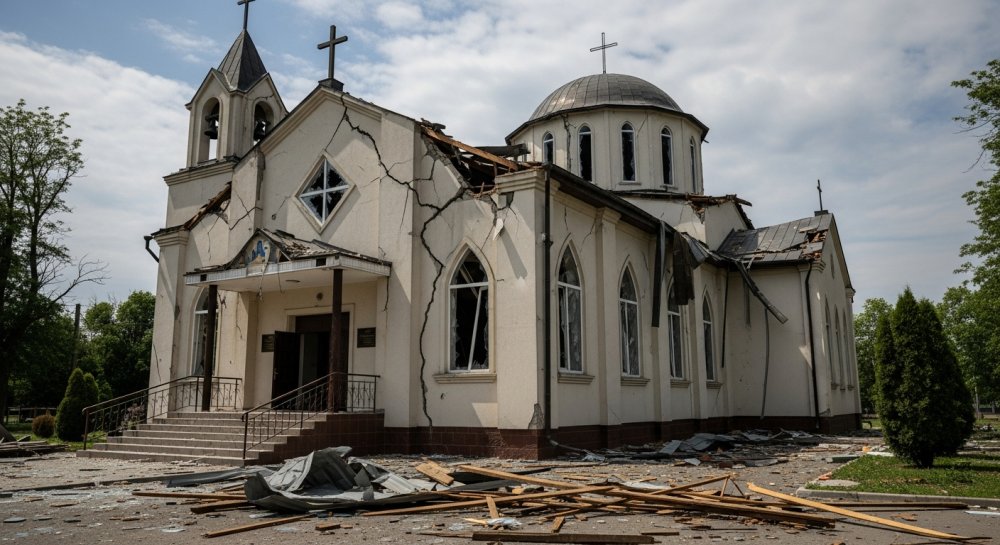
- A Russian strike hit a Baptist church in Zaporizhzhia, Ukraine, during a prayer meeting, killing a pastor and injuring at least eight believers
- The attack targeted Christians gathered in worship, representing continued assaults on religious freedom in the region
- The incident underscores the ongoing persecution of Christians in conflict zones around the world
A Russian military strike devastated a Baptist church in the southeastern Ukrainian city of Zaporizhzhia this week, claiming the life of a pastor and wounding at least eight other believers who had gathered for prayer. The attack occurred while the congregation was in the midst of worship, targeting Christians at their most vulnerable moment of communal faith.
The strike on the church building represents yet another assault on religious liberty in a region where believers continue to face threats simply for gathering to worship God. The pastor who was killed had been leading the prayer meeting when the strike hit, according to initial reports from the area.
At least eight other church members sustained injuries in the attack, though the full extent of casualties may not yet be known. The congregation had assembled for what should have been a peaceful time of prayer and fellowship, only to have their worship interrupted by violence.
This attack on a house of worship highlights the ongoing dangers faced by Christians in conflict zones, where the simple act of gathering to pray can become life-threatening. Baptist churches and other Christian congregations throughout Ukraine have continued to meet despite the risks, demonstrating remarkable faith and commitment to their communities.
The targeting of religious buildings and gatherings raises serious questions about the protection of religious freedom and the safety of civilians in areas affected by the conflict. Churches have historically been considered sanctuaries, places where even in times of war, people should be able to seek refuge and spiritual solace.
The Zaporizhzhia region has seen increased military activity in recent months, placing civilian populations and infrastructure at heightened risk. Yet believers in the area have maintained their commitment to corporate worship and prayer, even as dangers mount around them.
This tragedy serves as a stark reminder of the persecution and suffering endured by Christians around the world who refuse to abandon their faith despite physical threats. American Christians should remember to pray for their brothers and sisters facing violence and persecution for their commitment to Christ.
Let us know what you think, please share your thoughts in the comments below.

Faith Facts
- A researcher tested five major world religions using AI analysis to evaluate their internal consistency and rational coherence
- Christianity emerged as the most logically consistent faith system when examined through artificial intelligence reasoning
- The experiment demonstrates how AI technology can be used to defend and validate Christian truth claims rather than threaten them
Artificial intelligence doesn’t have to be viewed as an enemy of faith. In fact, when applied properly, it can serve as a powerful tool to validate what Christians have known all along — that our faith stands on solid ground.
A fascinating experiment recently put five major world religions through an AI analysis engine to test their internal consistency, logical coherence, and rational foundations. The results may surprise skeptics but will likely affirm what believers already understand in their hearts.
Rather than approaching AI with fear or suspicion, Christians should recognize it as another instrument that can be used for Kingdom purposes. Just as the printing press revolutionized the spread of Scripture, modern technology offers new ways to demonstrate the truth of the Gospel.
The experiment evaluated Christianity, Islam, Hinduism, Buddhism, and Judaism by examining their core doctrines, historical claims, and philosophical frameworks. The AI assessed each religion’s ability to maintain logical consistency across its teachings and to provide coherent answers to life’s fundamental questions.
Christianity stood out for its unified narrative from Genesis to Revelation, its historical verifiability through archaeological evidence, and its rational explanation for humanity’s moral consciousness and spiritual longing. The resurrection of Jesus Christ, in particular, emerged as a historically defensible event that anchors the entire Christian worldview.
This doesn’t mean we place our faith in machines or algorithms. Our confidence remains in the living God who reveals Himself through Scripture, creation, and the person of Jesus Christ. But it does demonstrate that Christianity welcomes scrutiny and rational examination.
The other religions showed various inconsistencies when analyzed through logical frameworks. Islam’s internal contradictions regarding free will and divine sovereignty presented challenges. Eastern religions struggled with their circular reasoning about reality and illusion. These aren’t attacks on sincere believers of other faiths, but honest observations about theological coherence.
For too long, secular culture has portrayed faith as the enemy of reason. This experiment flips that narrative on its head. Christianity doesn’t fear the light of logical analysis because truth has nothing to hide.
The Apostle Paul used the philosophical frameworks of his day to present the Gospel in Athens. He engaged with the intellectual currents of Greek thought while remaining firmly rooted in revealed truth. Today’s Christians can do the same with artificial intelligence and other modern tools.
This should encourage believers who sometimes feel outmatched in debates with skeptics. The evidence supports our faith. The logic aligns with Scripture. The historical record validates the Biblical account. AI analysis simply confirms what the Holy Spirit has already testified to our hearts.
Of course, salvation doesn’t come through intellectual assent alone. We are saved by grace through faith in Jesus Christ. But that faith is not blind or irrational — it’s grounded in the solid rock of God’s revealed truth and confirmed by both historical evidence and personal experience.
As we navigate an increasingly technological age, Christians should embrace these tools with wisdom and discernment. AI can help us study Scripture more deeply, reach people with the Gospel more effectively, and defend our faith more persuasively.
The experiment’s results remind us that Christianity isn’t just emotionally satisfying or culturally meaningful — it’s also intellectually robust and logically sound. Our faith engages both the heart and the mind because the God we serve created both.
Rather than retreating from technological advancement, the Church should lead the way in using these tools for God’s glory. We have nothing to fear from honest inquiry because we serve the God of truth who invites us to “come now, let us reason together.”
Let us know what you think, please share your thoughts in the comments below.


-

 Self-Reliance1 year ago
Trump’s Bold Move Uncovers Massive Social Security Fraud
-

 Faith1 year ago
New Clues Emerge in Noah’s Ark Mystery
-

 News1 year ago
Governor Walz’s Rhetoric Sparks National Controversy
-

 News1 year ago
Mel Gibson’s ‘The Passion of the Christ’ Sequel Title Announced
-

 Family1 year ago
Texas Lawmaker Targets Furries in Schools
-

 Freedom1 year ago
Maine Lawmaker Challenges Sports Fairness Controversy
-

 Family11 months ago
Canada’s Controversial Policy Sparks Ethical Debate
-
Faith5 months ago
Congress Hears Pleas for Nigerian Christians