
Faith
Boxing Legend’s Evangelism Challenge Sparks Debate Among Faithful


Faith Facts
- Former world champion boxer Manny Pacquiao has called on Christians to set annual soul-winning goals and track conversions
- Critics warn that numerical evangelism targets may reduce people to statistics and create performance anxiety among believers
- The debate highlights tensions between measurable ministry outcomes and relationship-focused gospel sharing
Boxing icon Manny Pacquiao, who transitioned from world champion fighter to Christian evangelist and politician, has issued a challenge to believers worldwide: set specific annual goals for winning souls to Christ. The call has sparked thoughtful discussion within Christian communities about the nature of evangelism and our responsibility to share the gospel.
Pacquiao’s approach reflects a business-minded strategy to the Great Commission, encouraging Christians to quantify their evangelistic efforts with concrete targets. For some, this represents accountability and intentionality in fulfilling Christ’s command to make disciples of all nations.
However, ministry leader Tim Yearsley raises important concerns about this metrics-driven approach to sharing faith. He questions whether numerical targets risk reducing precious souls to mere statistics and transforming the joy of evangelism into anxious performance.
The tension centers on a fundamental question: Can we measure kingdom work the same way we measure earthly success? While accountability certainly has biblical precedent, there’s wisdom in remembering that conversion is ultimately the work of the Holy Spirit, not human effort.
“We are called to be faithful witnesses, but we must remember that only God can change hearts,” notes one pastor who preferred to remain unnamed. “Our responsibility is to plant and water seeds, but God alone gives the growth.”
Pacquiao’s heart for evangelism is admirable and reflects his genuine transformation since accepting Christ. His platform as a global sports figure provides unprecedented opportunities to share the gospel with millions who might never enter a church building.
Yet the concern remains valid: when evangelism becomes primarily about hitting targets, we risk treating people as projects rather than precious souls created in God’s image. The gospel invitation should flow from love and relationship, not quota-driven urgency.
This doesn’t mean Christians shouldn’t be intentional about sharing their faith. Scripture clearly calls believers to be ready to give an answer for the hope within us and to go into all the world with the good news. The question is whether numerical goals help or hinder that mission.
Some argue that setting specific evangelism goals creates healthy accountability and prevents complacency. Others counter that it can lead to manipulation, pressure tactics, or superficial conversions that don’t produce lasting fruit.
The biblical model appears to emphasize faithfulness over results. Jesus told parables about sowers scattering seed broadly, knowing much would fall on hard ground. Paul planted, Apollos watered, but God gave the increase. Success was measured in obedience, not outcomes.
Perhaps the better approach combines intentionality with dependence on God’s sovereignty. Christians should actively seek opportunities to share the gospel while trusting the Holy Spirit to do the work only He can do in human hearts.
This also reminds us that evangelism isn’t separate from living out our faith authentically. The most powerful witness often comes through consistent Christian character, sacrificial love, and genuine relationships where the gospel naturally flows from our daily walk with Christ.
Pacquiao’s challenge, whatever its potential pitfalls, does highlight an important truth: too many Christians never share their faith at all. If numerical goals help some believers move from silence to speaking up about Jesus, that has value even if the approach isn’t perfect.
The key may be holding these twin truths in tension: be intentional about evangelism while avoiding the trap of treating souls as numbers. Set goals if helpful, but let those goals serve love rather than replace it.
As we navigate these questions, let’s remember that our ultimate accountability is to Christ Himself, who commissioned us to make disciples. Whether we track our evangelistic conversations or simply remain prayerfully attentive to divine appointments, the heart of the matter is faithful obedience motivated by love for God and others.
Let us know what you think, please share your thoughts in the comments below.

Faith Facts
- Younger churchgoers are twice as likely as older worshipers to desire more liturgy and structure in church services
- Lifeway Research findings reveal a generational shift toward traditional worship practices among evangelicals
- The trend suggests young believers are seeking deeper spiritual roots and time-tested forms of worship
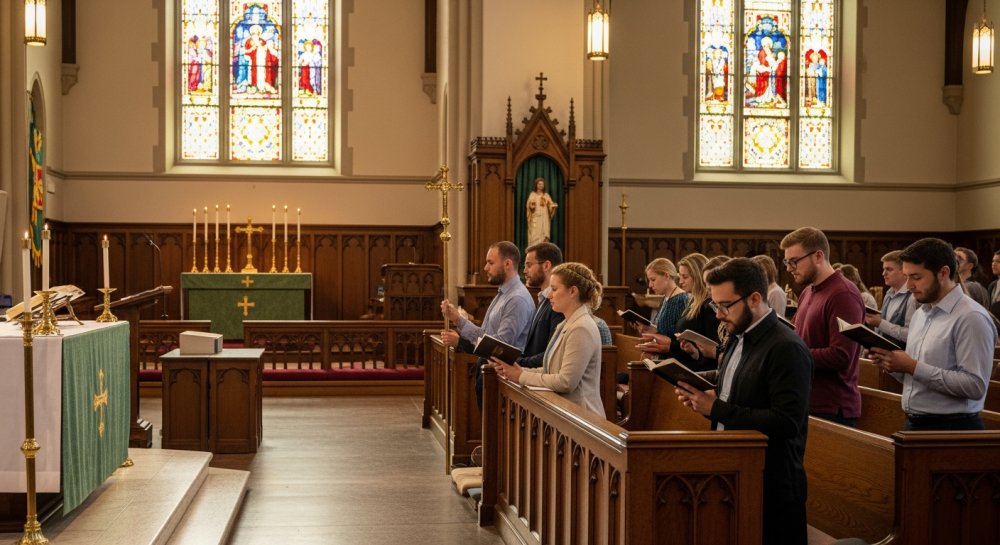
A striking new pattern is emerging in American churches that challenges conventional assumptions about what younger generations want from worship. According to research from Lifeway Research, a leading evangelical research organization, younger churchgoers are twice as likely as their older counterparts to desire more liturgy and structure in their worship services.
This finding marks a significant departure from the contemporary, casual worship style that has dominated many evangelical and non-denominational churches for the past several decades. The data suggests that millennials and Generation Z believers are increasingly drawn to the historic practices of the Christian faith rather than the informal approaches that characterized the church growth movement.
The research reveals a hunger among young Christians for something deeper and more substantive than what they’ve often experienced. Rather than seeking entertainment-focused services or the latest worship trends, these younger believers appear to be looking backward to the rich liturgical traditions that have sustained the Church for centuries.
This shift toward traditional forms of worship reflects a broader movement among younger evangelicals who are discovering the value of ancient creeds, written prayers, and structured liturgical calendars. Many are finding that these time-tested practices provide a spiritual anchor in an increasingly chaotic and uncertain world.
The trend also speaks to a desire for transcendence in worship. While contemporary services often emphasize personal expression and emotional experience, liturgical worship points beyond the individual to the majesty and holiness of God. For young people saturated with digital distractions and superficial social media interactions, this focus on the sacred and eternal holds particular appeal.
Church leaders would be wise to pay attention to these findings. The data suggests that assumptions about what younger generations want may be outdated. Rather than continuing to chase cultural relevance through casual atmospheres and entertainment-driven programming, churches might better serve young believers by offering them access to the deep wells of Christian tradition.
This doesn’t necessarily mean abandoning contemporary worship styles entirely, but it does suggest the need for greater balance and appreciation for liturgical elements. Incorporating elements like responsive readings, traditional hymns alongside modern songs, observance of the church calendar, and even periodic communion could resonate powerfully with younger worshipers seeking something more substantial.
The implications extend beyond worship style to questions of discipleship and spiritual formation. Young believers who are drawn to liturgy often are also seeking deeper theological education, meaningful community, and practices that connect them to the historic Christian faith that spans cultures and centuries.
This research offers hope for the future of the American church. It demonstrates that younger generations aren’t rejecting Christianity itself but are instead hungry for authentic, substantive faith expression. They want roots, not just relevance; they seek transcendence, not just entertainment; they desire connection to something larger than themselves and their contemporary moment.
As churches consider how to minister effectively to younger generations, this data from Lifeway Research provides valuable guidance. The path forward may involve looking backward to rediscover the riches of Christian tradition that have nourished believers throughout the ages.
Let us know what you think, please share your thoughts in the comments below.

Faith Facts
- Many common cultural sayings Americans accept as wisdom often contradict biblical teachings and can lead believers away from Christ-centered truth
- Popular phrases like “follow your heart” and “you do you” promote self-centered thinking that conflicts with Scripture’s call to deny ourselves and follow Jesus
- Christians must measure every piece of conventional wisdom against the unchanging standard of God’s Word to avoid being conformed to worldly thinking
American culture is saturated with catchy phrases and popular sayings that sound wise on the surface. From coffee mugs to social media posts, these mantras shape how millions of Americans think about life, relationships, and decision-making. But for believers committed to living according to biblical principles, these seemingly harmless expressions often contain dangerous half-truths that can subtly erode our Christian foundation.
The problem isn’t just that these sayings are wrong—it’s that they’re presented as self-evident truth. When an entire culture repeats the same messages over and over, they become normalized, accepted without question. Before we know it, we’re making decisions based on worldly wisdom rather than the timeless truth of Scripture.
Consider the popular phrase “follow your heart.” It sounds romantic and freeing, doesn’t it? But the Bible tells us something very different about the human heart. Jeremiah 17:9 warns us plainly: “The heart is deceitful above all things and beyond cure. Who can understand it?” Our hearts, apart from transformation by the Holy Spirit, lead us astray. They justify sin, rationalize selfishness, and pull us away from God’s best for our lives.
Then there’s the increasingly common “you do you,” which has become a rallying cry for radical individualism. This phrase elevates personal preference above all else and discourages any form of correction or accountability. Yet Christians are called to something entirely different—a life of mutual submission, bearing one another’s burdens, and speaking truth in love. We don’t “do us”—we die to ourselves and live for Christ.
The saying “God helps those who help themselves” is perhaps the most deceptive of all because it sounds vaguely biblical. Many Americans believe this phrase actually appears in Scripture. It doesn’t. In fact, it contradicts the gospel message entirely. Christianity teaches that God helps those who cannot help themselves—that’s the whole point of grace. We were helpless in our sin, and Christ saved us not because of our efforts but despite our inability.
What about “everything happens for a reason”? While Christians do believe in God’s sovereignty, this particular phrase is often used to minimize real suffering or avoid the hard work of lament and wrestling with difficult circumstances. Sometimes things happen because we live in a fallen world affected by sin, not because God orchestrated a specific tragedy for some hidden purpose we’ll discover later.
These cultural sayings gain traction because they appeal to our flesh—our desire for autonomy, comfort, and self-justification. They require nothing of us except affirming what we already want to believe. Biblical wisdom, on the other hand, often cuts against our natural inclinations. It calls us to forgive when we want revenge, to serve when we want to be served, to give when we want to accumulate, and to trust God when circumstances seem hopeless.
The Apostle Paul warned the Roman church, “Do not conform to the pattern of this world, but be transformed by the renewing of your mind.” This transformation requires intentionality. We must actively test every message we receive against Scripture, no matter how popular or widely accepted it may be.
For families raising children in today’s America, this vigilance is especially critical. Our kids are bombarded with worldly wisdom from every direction—schools, entertainment, peers, and social media. If we don’t equip them to recognize the difference between cultural platitudes and biblical truth, they’ll absorb these messages by default and build their lives on a faulty foundation.
The solution isn’t to become cynical about all wisdom or to reject common sense. Rather, it’s to develop discernment—the ability to distinguish between what sounds good and what is actually true. This discernment comes from immersing ourselves in God’s Word, praying for wisdom, and being part of a church community that values biblical truth over cultural acceptance.
When we encounter a popular saying, we should ask ourselves: Does this align with Scripture? Does it promote self or Christ? Does it encourage dependence on God or self-sufficiency? Does it lead toward holiness or compromise? These questions serve as filters, protecting our minds and hearts from the subtle deceptions of worldly wisdom.
America’s cultural moment is increasingly hostile to Christian values, making it all the more important that believers stand firm on the foundation of biblical truth. When everyone around us is repeating the same secular mantras, we must have the courage to say, “That’s not what Jesus taught.” Our allegiance is to Christ and His Word, not to whatever philosophy is currently trending.
True wisdom doesn’t come from popular consensus or cultural momentum. It comes from the fear of the Lord, as Proverbs repeatedly tells us. It’s found in Scripture, revealed by the Holy Spirit, and confirmed in the community of faith. Everything else, no matter how catchy or comforting, must be measured against this standard.
Let us know what you think, please share your thoughts in the comments below.

Faith Facts
- Bethel Church in Redding, California, has paused sales of The Passion Translation (TPT) amid growing concerns from the Christian community
- The Passion Translation is a paraphrase rather than a direct translation, raising theological accuracy questions among Bible scholars and pastors
- Critics have cited significant concerns about doctrinal integrity and fidelity to original Scripture in TPT
A prominent California megachurch has announced it will temporarily halt sales of a controversial Bible paraphrase following mounting criticism from Christians nationwide. Bethel Church in Redding issued a statement confirming the pause on The Passion Translation, commonly known as TPT.
The decision comes as numerous believers and theologians have raised substantive concerns about the accuracy and theological soundness of the paraphrase. The Passion Translation has been a subject of intense scrutiny within evangelical circles for its departure from traditional Bible translation methods.
Unlike standard Bible translations that aim for word-for-word or thought-for-thought accuracy from original Greek, Hebrew, and Aramaic texts, The Passion Translation is classified as a paraphrase. This distinction has sparked debate about whether it maintains sufficient fidelity to God’s inspired Word.
Christian scholars and pastors have pointed to specific passages where TPT’s rendering significantly differs from established translations like the English Standard Version, New International Version, and King James Version. These concerns center on whether the paraphrase adds interpretations that go beyond the original text’s meaning.
Bethel Church’s decision to pause sales represents a notable acknowledgment of the controversy surrounding TPT. The church has been a prominent supporter and distributor of the paraphrase, making this move particularly significant within charismatic and Pentecostal communities.
The pause allows for further evaluation of the concerns raised by fellow believers. Many Christians have emphasized the importance of maintaining biblical accuracy and doctrinal integrity in any version of Scripture made available to the church.
Questions about translation philosophy have long been important to Bible-believing Christians who hold Scripture as divinely inspired and authoritative. The debate over TPT highlights ongoing discussions about how best to make God’s Word accessible while preserving its truthfulness and meaning.
Critics of The Passion Translation argue that a paraphrase, by its very nature, introduces too much human interpretation into the sacred text. They contend that believers deserve translations that stick closely to what the original authors, inspired by the Holy Spirit, actually wrote.
Supporters of TPT have defended it as a devotional resource that helps readers connect emotionally with Scripture. However, even some who appreciate its devotional quality have cautioned against using it as a primary Bible for study or doctrinal formation.
The concerns raised about The Passion Translation underscore the responsibility churches and Christian leaders bear in recommending biblical resources to their congregations. Shepherding God’s people includes ensuring they have access to trustworthy, accurate presentations of His Word.
As Bethel Church pauses TPT sales, the broader Christian community continues to emphasize the importance of Bible translations that faithfully represent the original texts. This commitment to scriptural accuracy reflects a deep reverence for God’s revealed truth and a desire to handle His Word with care.
Let us know what you think, please share your thoughts in the comments below.


-

 Self-Reliance1 year ago
Trump’s Bold Move Uncovers Massive Social Security Fraud
-

 Faith1 year ago
New Clues Emerge in Noah’s Ark Mystery
-

 News1 year ago
Governor Walz’s Rhetoric Sparks National Controversy
-

 News1 year ago
Mel Gibson’s ‘The Passion of the Christ’ Sequel Title Announced
-

 Family1 year ago
Texas Lawmaker Targets Furries in Schools
-

 Freedom1 year ago
Maine Lawmaker Challenges Sports Fairness Controversy
-

 Family1 year ago
Canada’s Controversial Policy Sparks Ethical Debate
-
Faith9 months ago
Congress Hears Pleas for Nigerian Christians