
Faith
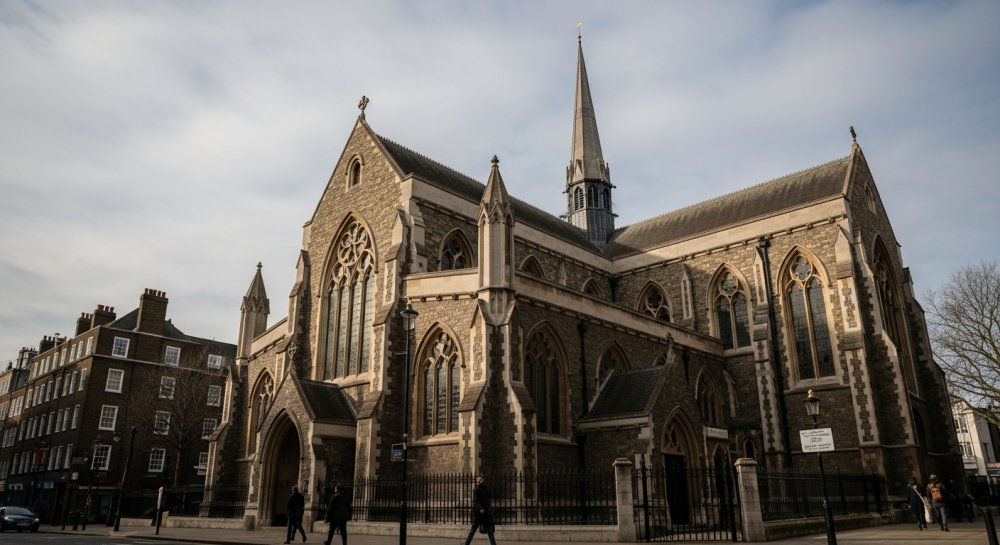
Billionaire’s Church Donation Sparks Unlikely Backlash

Faith Facts
- Sir Paul Marshall donated £28 million to Holy Trinity Brompton church in London
- Christian climate activists criticized the gift due to Marshall’s investments in energy sectors
- HTB is known for creating the Alpha Course, a global Christian evangelism program
When a wealthy businessman donates millions to spread the Gospel, one might expect universal celebration among Christians. Yet Sir Paul Marshall’s extraordinary £28 million gift to Holy Trinity Brompton has drawn unexpected fire from progressive Christian activists.
The GB News co-owner’s generosity represents one of the largest single donations to a church in British history. Holy Trinity Brompton, known for launching the Alpha Course that has introduced millions worldwide to Christianity, will use the funds to expand its evangelistic mission.
But some Christian climate campaigners have condemned the donation, citing Marshall’s business investments in energy sectors. The criticism reveals a troubling trend where political litmus tests are applied even to acts of Christian charity.
Reverend Ian Paul, who examined the details of the gift, found the criticism unfounded. The donation will directly support church planting, discipleship programs, and the Alpha Course’s global outreach efforts.
Holy Trinity Brompton has been instrumental in revitalizing Christianity across Britain and beyond. The Alpha Course alone has reached over 29 million people in 169 countries, offering a simple introduction to Christian faith that has brought countless individuals to Christ.
Marshall’s donation will enable HTB to plant new churches in communities where Christian witness has grown thin. In an era of declining church attendance across Western nations, such investment in evangelism deserves gratitude, not suspicion.
The backlash illustrates how some activists prioritize political alignment over the Great Commission. Rather than celebrating resources devoted to sharing the Gospel, critics focus on the donor’s business portfolio.
This approach threatens to discourage Christian philanthropy altogether. If every donation must pass ideological purity tests unrelated to its Kingdom purpose, wealthy believers may simply redirect their generosity elsewhere.
The Church has historically welcomed support from converts and donors of varied backgrounds. What matters is not the source of wealth, but its dedication to advancing God’s Kingdom and spreading the Good News of Jesus Christ.
Marshall’s gift will fund practical ministry—training pastors, supporting missionaries, producing evangelistic resources, and planting churches in underserved areas. These are precisely the activities that build up the Body of Christ and fulfill the biblical mandate to make disciples of all nations.
In a culture increasingly hostile to Christian values, believers should unite in supporting bold evangelism rather than fracturing over peripheral political disagreements. The harvest is plentiful, as Jesus taught, and workers and resources are desperately needed.
Holy Trinity Brompton’s track record speaks for itself. The church has consistently prioritized biblical teaching, prayer, and evangelism over trendy political causes. Its Alpha Course remains doctrinally sound and Christ-centered, focusing on essential Gospel truths rather than partisan agendas.
Those who would criticize this donation might better direct their energy toward similar generosity. The question facing every Christian isn’t whether to scrutinize others’ giving, but whether we ourselves are sacrificially supporting the spread of the Gospel.
Let us know what you think, please share your thoughts in the comments below.


Faith Facts
- Nearly 100 students at a Christian high school in Colorado have been baptized following athletic events this year.
- Five separate worship gatherings were organized after games, drawing students seeking faith commitments.
- The baptisms reflect a growing movement of young people responding to the Gospel in school settings.
High school athletic events have long been community gatherings, but one Colorado Christian school is seeing those moments turn into something far more eternal.
After five post-game worship services, nearly 100 students stepped forward for baptism, marking a powerful season of spiritual renewal.
School leaders say the response has been both unexpected and deeply encouraging, as students publicly declare their faith in Christ.
“It has been incredible to watch these young people take this step,” one administrator shared.
The gatherings combine prayer, worship, and testimony, creating a space where students feel welcomed to respond to the message of salvation.
Parents and faculty have noted a renewed sense of purpose and unity among the student body as a result.
“We are seeing the Holy Spirit move in powerful ways,” a staff member added.
Christian education advocates view the events as evidence that faith-based environments can shape hearts as well as minds.
The school plans to continue the post-game worship gatherings in the coming seasons, hoping to build on the momentum of spiritual awakening.
Let us know what you think, please share your thoughts in the comments below.

Faith Facts
- Matthew West releases new album titled ‘Jesus Is King’
- Album emphasizes surrender, vulnerability, and Scripture after nearly 30 years in Christian music
- West challenges the culture of self-empowerment with a message of Christ-centered living
Christian music artist Matthew West is calling believers to place Jesus above self in his latest album, ‘Jesus Is King.’ The project comes after nearly three decades of ministry and reflects a deeper commitment to Scripture and surrender.
West says the album confronts a culture obsessed with self-empowerment by lifting up the lordship of Christ instead. He believes true strength comes from laying down personal control and trusting God’s Word.
"The message of this album is that Jesus is King, and that changes everything."
Through honest lyrics and personal testimony, West hopes listeners will rediscover the power of vulnerability before God. He points to Scripture as the foundation for every song and every season of life.
"After nearly 30 years in Christian music, I am more convinced than ever that surrender is the doorway to real freedom."
Let us know what you think, please share your thoughts in the comments below.

Faith Facts
- Jordan Shipley called on the Lord during a life-threatening accident that left over 20% of his body with third-degree burns.
- More than eight months later, the former NFL wide receiver described his recovery as a miracle.
- Shipley publicly credits his faith in God for sustaining him through the ordeal.
Former NFL wide receiver Jordan Shipley is sharing a powerful testimony of survival and faith. More than eight months ago, Shipley endured a devastating accident on his Texas ranch that left him with third-degree burns across more than 20 percent of his body.
In the midst of the crisis, Shipley says he turned to God with desperate prayers for help. He now describes his recovery as nothing short of miraculous.
“I desperately called on the Lord for help during the life-threatening ordeal and experienced a ‘miracle.'”
Let us know what you think, please share your thoughts in the comments below.


-

 Self-Reliance1 year ago
Trump’s Bold Move Uncovers Massive Social Security Fraud
-

 Faith1 year ago
New Clues Emerge in Noah’s Ark Mystery
-

 News2 years ago
Governor Walz’s Rhetoric Sparks National Controversy
-

 News1 year ago
Mel Gibson’s ‘The Passion of the Christ’ Sequel Title Announced
-

 Family2 years ago
Texas Lawmaker Targets Furries in Schools
-

 Freedom2 years ago
Maine Lawmaker Challenges Sports Fairness Controversy
-

 Family1 year ago
Canada’s Controversial Policy Sparks Ethical Debate
-
Faith10 months ago
Congress Hears Pleas for Nigerian Christians