
News
African Evangelical Leaders Make Bold Move to Expand Biblical Training

Faith Facts
- The Association for Christian Theological Education in Africa (ACTEA) has restructured into three distinct language-based councils to better serve theological institutions across the continent.
- The reorganization addresses a historical gap in accreditation services for French- and Portuguese-speaking evangelical schools, which have been underserved compared to English-speaking institutions.
- This strategic change aims to strengthen biblical education and pastoral training throughout Africa by ensuring quality theological standards across all major language groups.
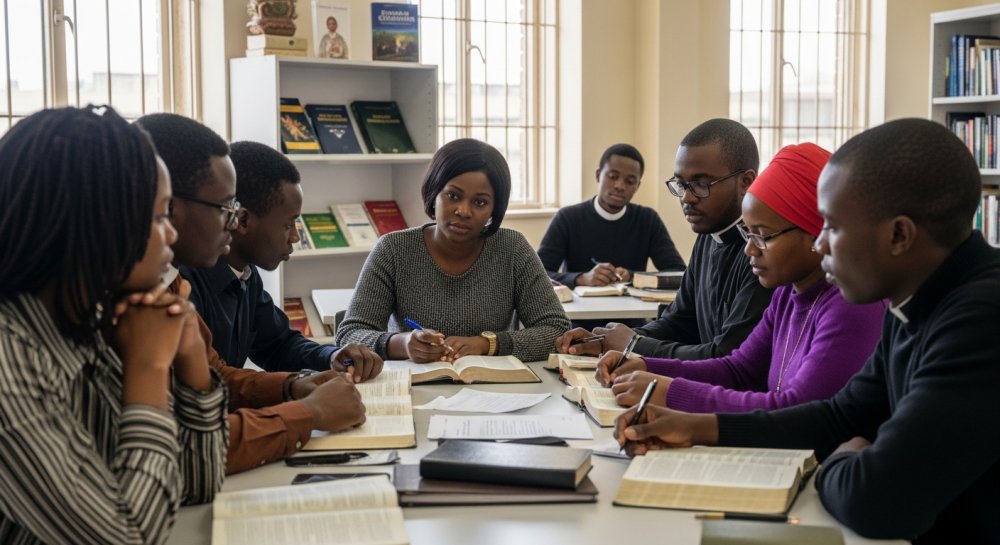
In a significant development for Christian education across Africa, the Association for Christian Theological Education in Africa (ACTEA) has undertaken a comprehensive restructuring to better serve theological institutions in multiple languages. The organization’s leadership has voted to divide its operations into three language-based councils, marking a new chapter in evangelical theological training on the continent.
This reorganization represents a strategic response to a long-standing challenge facing theological education in Africa. For years, French- and Portuguese-speaking evangelical institutions have faced barriers to quality accreditation and support services that their English-speaking counterparts have more readily accessed.
The new structure will establish dedicated councils for English, French, and Portuguese-speaking theological schools and seminaries. Each council will operate with cultural and linguistic sensitivity while maintaining consistent standards of biblical excellence and theological integrity.
ACTEA’s decision reflects a commitment to equipping pastors, missionaries, and Christian leaders across Africa’s diverse linguistic landscape. The continent’s rich tapestry of languages and cultures requires educational approaches that honor local contexts while upholding sound doctrine and biblical truth.
This restructuring comes at a crucial time for African Christianity, which continues to experience significant growth. Ensuring that theological training keeps pace with the expansion of the church has become increasingly important for maintaining doctrinal soundness and effective ministry leadership.
The move also demonstrates the maturation of African evangelical leadership, which is taking proactive steps to address institutional gaps and strengthen the foundation of Christian education. By creating language-specific councils, ACTEA can provide more targeted resources, culturally relevant assessments, and appropriate guidance to schools that previously struggled with language barriers in the accreditation process.
French-speaking regions of Africa, particularly in West and Central Africa, have historically faced challenges in accessing quality theological resources and accreditation support. Portuguese-speaking nations, including Mozambique and Angola, have encountered similar obstacles. The new council structure aims to remedy these disparities.
For Christian families and churches across Africa, this development means better-trained pastors and ministry leaders who can effectively teach Scripture and shepherd congregations. Quality theological education serves as a bulwark against false teaching and ensures that the next generation of African church leaders is grounded in biblical truth.
The restructuring also positions ACTEA to better serve the growing number of theological institutions being established across the continent. As African churches increasingly take ownership of their own theological training, the need for robust, linguistically appropriate accreditation becomes more pressing.
This organizational change underscores a broader principle: effective Christian ministry requires attention to both universal truth and local context. The gospel message remains unchanging, but its communication and the training of those who proclaim it must be adapted to serve diverse communities effectively.
Let us know what you think, please share your thoughts in the comments below.

Faith Facts
- The U.S. House of Representatives passed legislation threatening to suspend all aid to Nigeria over ongoing Christian killings
- The bill demands measurable progress in protecting Christians from religiously motivated violence in the West African nation
- This represents a potential major shift in U.S.-Nigeria relations, with American lawmakers taking a firm stand on Christian persecution
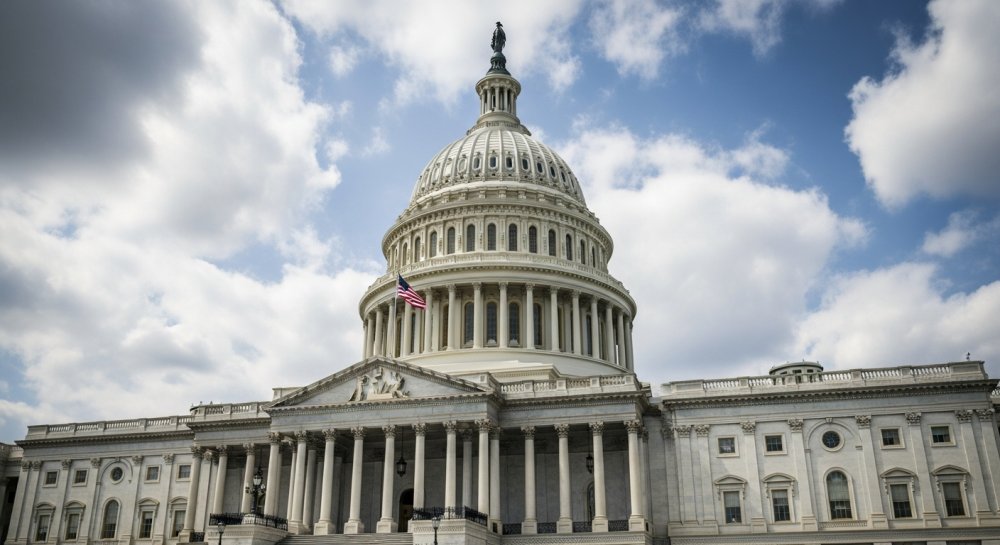
The United States House of Representatives has taken a bold stand for persecuted believers worldwide by approving legislation that puts Nigeria’s foreign aid on the line. The bill sends a clear message: protect Christian communities or lose American support.
This historic vote could suspend all U.S. assistance to Nigeria unless the West African nation demonstrates concrete, measurable progress in protecting Christians from religiously motivated violence. For years, faithful communities in Nigeria have faced brutal attacks, kidnappings, and systematic persecution while the international community largely remained silent.
The legislation represents one of the most consequential shifts in U.S.-Nigeria relations in years, signaling that America will no longer turn a blind eye to the persecution of Christians abroad. Nigerian believers have endured unimaginable suffering, with entire villages destroyed and thousands killed in attacks often tied to Islamic extremist groups and militant herdsmen.
This congressional action reflects a growing determination among American lawmakers to use foreign aid as leverage to protect religious freedom. The bill requires Nigeria to show tangible improvements in safeguarding Christian lives and prosecuting those responsible for faith-based violence.
For Christian conservatives who have long advocated for stronger U.S. action against global Christian persecution, this vote represents a significant victory. It demonstrates that America’s values and commitment to religious liberty can still guide our foreign policy decisions.
The legislation now moves forward in the legislative process, where it will face further scrutiny. However, the House vote sends an unmistakable signal that the safety of Nigerian Christians is a priority for the United States Congress.
Nigeria has become one of the deadliest places in the world to be a Christian, with estimates suggesting thousands have been killed in recent years. The violence has displaced countless families and devastated communities across the nation’s Middle Belt and northern regions.
Let us know what you think, please share your thoughts in the comments below.
Faith Facts
- A Pakistani court sentenced one Muslim man to 10 years in prison for his role in the August 2023 attacks on Christian communities in Jaranwala, marking the first conviction in this case.
- Thirteen other defendants were acquitted due to flawed police investigations, highlighting persistent challenges in protecting religious minorities in Pakistan.
- The Jaranwala attacks saw violent Muslim mobs destroy churches and Christian homes after false blasphemy accusations were made against local Christians.
A Pakistani court delivered its first conviction in connection with the brutal anti-Christian violence that rocked Jaranwala in August 2023, sentencing one Muslim man to 10 years in prison. The court on Monday handed down the sentence while simultaneously acquitting 13 other defendants, a decision that underscores the ongoing difficulties Pakistani Christians face in securing justice.
The acquittals came as a direct result of flawed police investigations that failed to properly document evidence and identify perpetrators. Sources familiar with the case indicate that investigative shortcomings have plagued efforts to hold accountable those responsible for the widespread destruction of Christian property and places of worship.
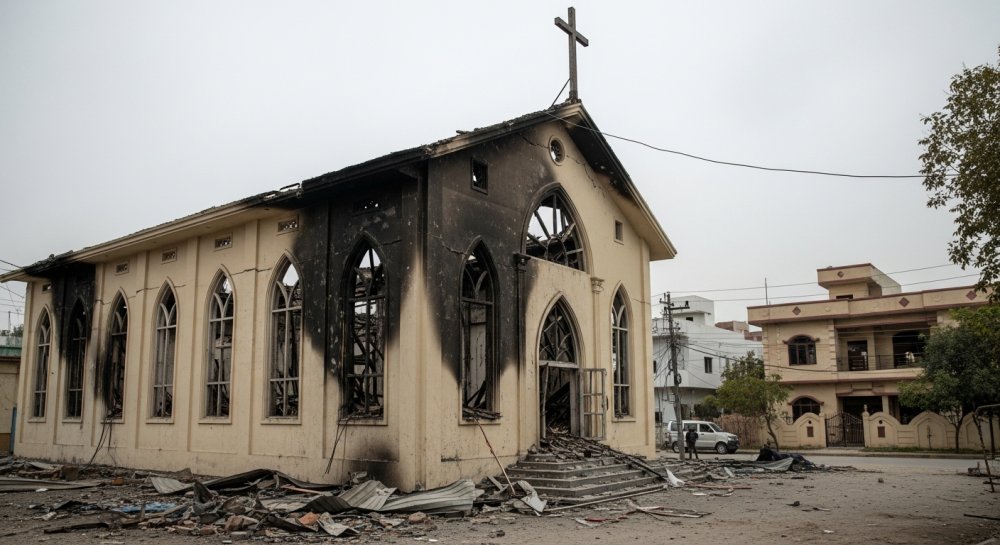
The August 2023 Jaranwala attacks represented one of the most severe instances of religious persecution against Pakistan’s Christian minority in recent years. Violent mobs, incited by false blasphemy accusations, descended on Christian neighborhoods with devastating force.
Churches were burned, homes were ransacked, and Christian families were forced to flee for their lives as law enforcement struggled to contain the violence. The attacks sent shockwaves through Pakistan’s already vulnerable Christian community, which comprises less than two percent of the nation’s population.
Pakistan’s blasphemy laws continue to serve as a weapon against religious minorities, with mere accusations often triggering mob violence before any judicial process can unfold. Christians in Pakistan live under constant threat of false accusations that can result in vigilante justice, property destruction, and even death.
While this first conviction represents a small step toward accountability, the acquittal of 13 defendants highlights the systemic challenges facing Christians seeking justice in Pakistan’s legal system. Advocacy groups have long called for reforms to protect religious minorities and ensure proper investigation of crimes committed against them.
The international community has repeatedly expressed concern over Pakistan’s treatment of religious minorities, particularly the use of blasphemy laws to target Christians and other non-Muslim populations. Religious freedom advocates continue to pressure Pakistani authorities to address the climate of impunity that allows such violence to occur.
Let us know what you think, please share your thoughts in the comments below.
Faith Facts
- Flash floods struck Kurung Kumey district in Arunachal Pradesh, India, washing away a Catholic church and devastating multiple Christian congregations.
- The remote border town lost all road connectivity to district headquarters, leaving believers and residents stranded.
- The flooding highlights ongoing challenges Christians face in India’s remote regions where infrastructure remains vulnerable and support limited.
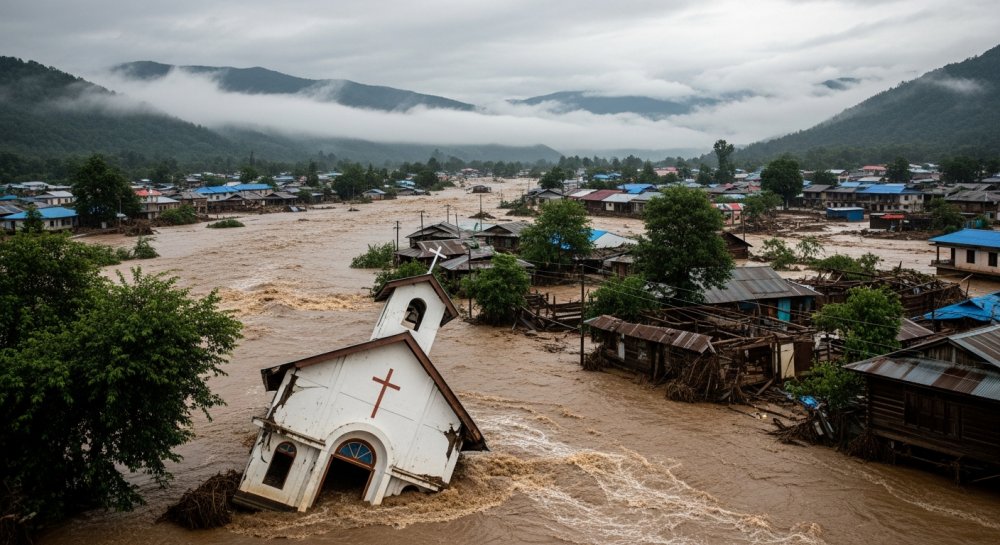
A devastating flood struck the Kurung Kumey district of Arunachal Pradesh, India, on Monday, leaving a trail of destruction in its wake. The flash floods proved particularly catastrophic for the Christian community in this remote border region.
Among the structures lost to the raging waters was an entire Catholic church, swept away by the torrential force of the flood. Multiple other churches throughout the district sustained significant damage, representing a severe blow to the faithful in an area where Christian congregations often serve as vital centers of community life.
The flooding didn’t just claim houses of worship—it severed the lifeline connecting this remote town to the outside world. Road connectivity to the district headquarters was completely cut off, isolating residents and making rescue and relief efforts extraordinarily difficult.
Arunachal Pradesh sits in India’s far northeastern corner, bordering China, Bhutan, and Myanmar. The region’s mountainous terrain and heavy monsoon patterns make it particularly vulnerable to flash flooding, but Monday’s deluge proved exceptionally destructive.
For Christians in this border district, the loss extends beyond physical structures. Churches in remote Indian regions often function as more than places of worship—they serve as educational centers, community gathering points, and anchors of social support in areas where government services remain limited.
The Christian community in India faces growing challenges, from increasing religious persecution in some areas to the practical difficulties of maintaining congregations in geographically isolated regions. Natural disasters like this flood compound those existing struggles, destroying years of ministry investment in moments.
As floodwaters recede, the work of assessment and rebuilding will begin. For believers in Kurung Kumey, that process will require not just reconstruction of physical buildings, but restoration of community infrastructure that serves the spiritual and practical needs of the faithful in one of India’s most remote corners.
The situation calls attention to the vulnerability of Christian communities in India’s border regions, where geographic isolation, limited infrastructure, and environmental hazards create ongoing challenges for those seeking to maintain their faith and way of life.
Let us know what you think, please share your thoughts in the comments below.


-

 Self-Reliance1 year ago
Trump’s Bold Move Uncovers Massive Social Security Fraud
-

 Faith1 year ago
New Clues Emerge in Noah’s Ark Mystery
-

 News1 year ago
Governor Walz’s Rhetoric Sparks National Controversy
-

 News1 year ago
Mel Gibson’s ‘The Passion of the Christ’ Sequel Title Announced
-

 Family1 year ago
Texas Lawmaker Targets Furries in Schools
-

 Freedom1 year ago
Maine Lawmaker Challenges Sports Fairness Controversy
-

 Family1 year ago
Canada’s Controversial Policy Sparks Ethical Debate
-
Faith8 months ago
Congress Hears Pleas for Nigerian Christians