
Faith
The Dangerous Illusion of the Spiritual Buffet


Faith Facts
- Modern culture encourages picking and choosing spiritual elements from different religions like items from a menu
- Colossians teaches that Christ cannot be reduced to one option among many philosophical choices
- True Christianity requires complete surrender to Jesus Christ, not selective adoption of convenient teachings
In today’s relativistic culture, faith has become a buffet. Many Americans treat spirituality like a custom meal plan — take mindfulness from Buddhism, borrow virtue ethics from Stoicism, add a dash of meaning from Christianity. It sounds enlightened, even humble. But this approach hides a fundamental problem: someone still has to play god and decide which pieces make the cut.
The Bible’s book of Colossians directly confronts this exact issue. Written to believers facing pressure to blend Christianity with popular philosophies of their day, Paul’s letter delivers a clear message: Christ is not a choice among options. He is the choice that defines all reality.
When we treat Jesus as one ingredient in our personalized spiritual recipe, we fundamentally misunderstand who He claimed to be. Christ didn’t present Himself as a helpful teacher offering useful tips alongside Buddha, Confucius, or Marcus Aurelius. He declared Himself as the image of the invisible God, the one in whom all things hold together, the fullness of deity in bodily form.
The spiritual buffet approach reveals something troubling about our hearts. We want the comfort of religion without the cost of surrender. We desire the benefits of faith without bowing to a King. We seek purpose and peace, but only on our own terms.
Colossians dismantles this illusion. If Christ truly is who He says He is — the Creator and Sustainer of all things — then He cannot be reduced to a helpful philosophy or a comforting perspective. He is either Lord of all, or not Lord at all.
The modern marketplace of ideas promotes tolerance and personal choice as the highest virtues. But Christianity has never fit comfortably in that framework. Jesus Himself said He is the way, the truth, and the life — not “a way” among many valid paths. That exclusivity offends contemporary sensibilities, but it remains central to authentic Christian faith.
When we pick and choose from various spiritual traditions, we’re not being open-minded. We’re being our own ultimate authority. We’re placing ourselves above these traditions, judging which parts align with our preferences and which we’ll discard. That’s not humility — it’s the oldest sin in the book, the desire to be like God, determining good and evil for ourselves.
Colossians calls believers to recognize the supremacy of Christ in all things. This means submitting our intellect, our will, our choices to Him — not selecting which of His teachings we’ll accept. It means recognizing that we don’t stand above Scripture, editing it to match our cultural moment. Instead, we stand under it, allowing God’s Word to edit us.
America was founded on principles of religious freedom, and that freedom remains precious. But freedom to choose our beliefs doesn’t mean all choices lead to truth. We’re free to believe the earth is flat, but that doesn’t make it so. Similarly, we’re free to construct our own customized spirituality, but that doesn’t make it true or salvific.
The Gospel offers something far better than a customizable spirituality. It offers rescue from our slavery to self and sin. It offers forgiveness we could never earn. It offers a relationship with the God who made us and knows us completely. But these gifts come as a package deal with the Giver — we cannot separate Christ’s benefits from His lordship.
For Christian families navigating this cultural moment, Colossians provides essential guidance. Our children are growing up in a world that treats all beliefs as equally valid personal preferences. We must teach them that Christianity makes exclusive truth claims because Christ makes exclusive truth claims. We’re not offering one lifestyle brand among many — we’re proclaiming the truth about reality itself.
This doesn’t mean Christians should be arrogant or dismissive toward other worldviews. We should engage respectfully with different perspectives, understanding them accurately before responding. But respect for people doesn’t require treating all ideas as equally true. Love means offering people the truth that can actually set them free, not affirming them in bondage to lies.
The spiritual buffet promises freedom and fulfillment, but it delivers neither. It leaves us as our own ultimate authority, which is a crushing burden. It provides no objective truth to ground our lives, no external standard to guide our choices, no hope that extends beyond our own limited perspectives and temporary existence.
Christ offers something infinitely better. He offers Himself — not as one option among many, but as the source and summit of all truth, beauty, and goodness. He invites us not to sample Him alongside other options, but to surrender everything to Him and discover that in losing our lives, we find them. That’s not on the menu of customizable spirituality. That’s the feast that satisfies forever.
Let us know what you think, please share your thoughts in the comments below.


Faith Facts
- The Restoration Movement produced three distinct fellowships by 1906, with Churches of Christ emerging as a conservative, Bible-focused body
- Early 20th-century leaders in Indiana, Tennessee, and Texas held differing convictions on the Holy Spirit, millennial teaching, and church institutions
- The conservative Texas tradition ultimately shaped the doctrinal identity that guided Churches of Christ for much of the twentieth century
A new book from Abilene Christian University Press offers a detailed look at the doctrinal battles that forged the identity of Churches of Christ in the decades after 1906. The volume, the first of three planned works, draws on essays by eight authors who trace how congregations navigated questions of Scripture, worship, and church order.
By the early twentieth century, the Restoration Movement had separated into three distinct groups. Churches of Christ stood apart for their commitment to congregational autonomy and a plain reading of the New Testament.
The collection opens with Daniel Sommer’s 1889 Address and Declaration, which set the tone for separation from the Disciples of Christ. Subsequent chapters highlight the contributions of David Lipscomb and respected African-American leaders such as Preston Taylor, S.W. Womack, and Marshall Keeble.
“Allen and Hicks are to be commended for editing a splendid and illuminating volume. Readers interested in the history of Churches of Christ will eagerly anticipate the next installment in the series.”
Three regional traditions emerged, each with its own convictions. Leaders in Tennessee upheld belief in miraculous divine action and a future millennial kingdom, while Indiana voices favored noninstitutional simplicity and resisted Bible colleges. The Texas tradition, emphasizing the Word alone and strict obedience to positive commands, gradually gained dominance.
Through influential publications like R.L. Whiteside and C.R. Nichol’s Sound Doctrine series and N.B. Hardeman’s Tabernacle Sermons, the Texas perspective reached congregations across the nation. By the 1930s, the Gospel Advocate had become its leading voice.
The book closes with primary source excerpts that allow readers to hear the founders in their own words. Christian families and church libraries will find this careful history both instructive and encouraging for the challenges of today.
Let us know what you think, please share your thoughts in the comments below.

Faith Facts
- Bank of America closed a Christian ministry’s account in 2020 citing internal policies against certain business types.
- Multiple ministries and faith-based organizations have reported similar account closures from major financial institutions.
- Faith-based groups are increasingly facing challenges accessing traditional banking services across the United States.
In 2020, Bank of America informed a Christian ministry that its account was being closed because the institution had chosen not to service certain types of businesses. The ministry initially believed this decision was isolated to their organization alone.
Further investigation revealed that other faith-based groups had encountered the same treatment from the same financial institution. The pattern suggests a broader policy affecting religious organizations seeking banking services.
“I thought we were the only ones. We weren’t.”
This experience highlights growing concerns among Christian ministries about access to essential financial services. Many traditional banks appear to be reevaluating their relationships with faith-based organizations.
The closure of accounts for religious ministries raises questions about religious liberty and equal access to financial services. Christian organizations across the country are exploring alternative banking options that align with their values and mission.
Let us know what you think, please share your thoughts in the comments below.
Faith Facts
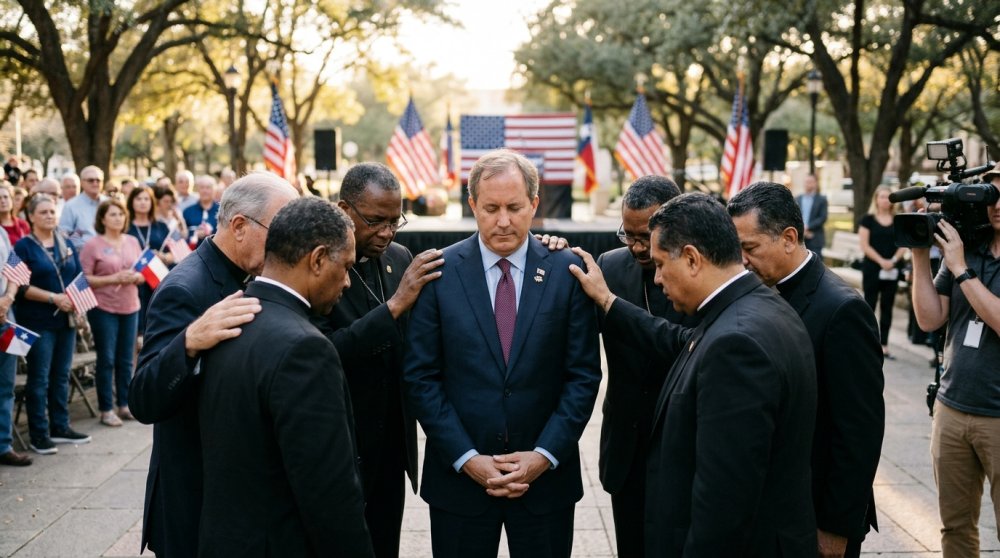
- A group of pastors gathered to pray over Texas Attorney General Ken Paxton at a campaign rally, calling on God for supernatural favor in the final weeks before the Senate election.
- The clergy specifically invoked Romans 13, urging divine support for Paxton as he seeks to represent Texas in the United States Senate.
- The public prayer event reflects a growing trend of faith leaders openly supporting conservative candidates who align with traditional Christian values.
A group of Texas pastors publicly prayed over Republican Attorney General Ken Paxton at a campaign rally this week, asking God to grant him favor with voters in the final stretch of his Senate bid.
The clergy cited Romans 13 during the prayer, reminding supporters that governing authorities are called to serve as ministers of God for justice and order.
Pastors for Paxton gathered to pray over @KenPaxtonTX at his rally today in Conroe. Pastors @Steve_Riggle and @BuntrockJames led us in asking God to grant him wisdom, strength, and protection as he serves Texas. ???? https://t.co/8GQVrU5zxO
— Pastors For Paxton (@pastors4paxton) October 20, 2026
“Give him favor with voters.”
Paxton, who has long positioned himself as a defender of biblical values on issues like life, marriage, and religious liberty, welcomed the spiritual covering from the pastors in attendance.
The event underscores the deep connection many conservative voters in Texas feel between their faith and their political choices.
Let us know what you think, please share your thoughts in the comments below.


-

 Self-Reliance2 years ago
Trump’s Bold Move Uncovers Massive Social Security Fraud
-

 Faith2 years ago
New Clues Emerge in Noah’s Ark Mystery
-

 News2 years ago
Governor Walz’s Rhetoric Sparks National Controversy
-

 News2 years ago
Mel Gibson’s ‘The Passion of the Christ’ Sequel Title Announced
-

 Family2 years ago
Texas Lawmaker Targets Furries in Schools
-

 Freedom2 years ago
Maine Lawmaker Challenges Sports Fairness Controversy
-

 Family1 year ago
Canada’s Controversial Policy Sparks Ethical Debate
-
Faith11 months ago
Congress Hears Pleas for Nigerian Christians