
Faith
Why Traditional Seminary May Not Be the Answer for Global Church Leaders

Faith Facts
- Small church pastors worldwide are being shaped through lived experience, prayer, and suffering rather than formal theological degrees
- Character formation through faithful discipleship and biblical mentoring often proves more valuable than academic credentials
- Responsibility, failure, and even persecution are proving to be powerful teachers in global Christian leadership development
Across India and throughout the developing world, a quiet revolution in Christian leadership is taking place—one that challenges Western assumptions about what truly prepares a pastor to shepherd God’s people.
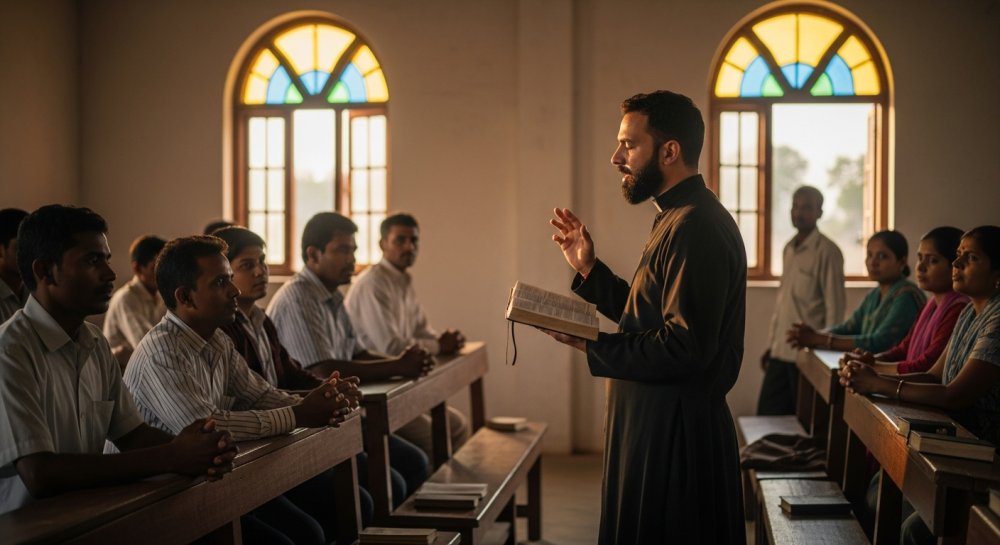
Thousands of faithful pastors leading small congregations lack the formal theological education that many in the West consider essential. Yet these men and women are being profoundly shaped by forces that no classroom can replicate.
Responsibility molds them as they care for their flocks with limited resources. Failure refines them as they learn to depend on God’s grace rather than their own competence. Suffering deepens them in ways that academic study alone never could.
Prayer becomes their seminary, persecution their crucible of faith. Character formation occurs not through curriculum but through walking faithfully with Jesus, guided by the Bible and trustworthy mentors who have traveled the same difficult road.
This form of education doesn’t result in a diploma suitable for framing. It produces no measurable outcomes that satisfy institutional assessment requirements. Yet its value in preparing shepherds for Christ’s church may exceed what many formal programs deliver.
The distinction matters profoundly as Western mission organizations and denominations consider how to support the global church. Programs designed to replicate Western seminary models may miss what’s already happening—the Holy Spirit forming leaders through the ancient pattern of discipleship, testing, and faithful endurance.
This doesn’t diminish the value of theological education. Sound doctrine matters immensely, and formal training provides irreplaceable benefits when done well. But it does challenge the assumption that credentialed education must precede or validate ministry effectiveness.
The early church operated without seminaries for centuries, relying instead on mentorship, apprenticeship, and the school of hard experience. Today’s global church is rediscovering that model by necessity—and often finding it produces leaders of deep faith, biblical wisdom, and proven character.
As the center of Christianity continues shifting to the Global South, Western believers might learn from brothers and sisters who understand that formation cannot be measured by the metrics we’ve grown comfortable with. Sometimes the best education comes not from what can be programmed, but from what can only be lived.
Let us know what you think, please share your thoughts in the comments below.


Faith Facts
- Isaac Watts, one of Britain’s most celebrated hymnwriters, authored over 750 hymns including beloved classics still sung in churches today
- Contemporary scholars suggest Watts may have conflated Old Testament promises to Israel with modern nation-states in some of his writings
- This theological debate remains highly relevant as Christians today navigate the relationship between faith, patriotism, and biblical interpretation
Isaac Watts stands as a towering figure in Christian hymnody, his words having shaped worship services for generations of believers. Yet a closer examination of his theological writings reveals a complex relationship with scripture that deserves careful consideration by today’s faithful.
The question at hand is whether Watts, in his zeal for his nation, misunderstood God’s covenant promises. According to Daniel Johnson, the issue centers on whether Watts confused the specific promises God made to the children of Israel with broader applications to modern nation-states.
This isn’t merely an academic debate confined to dusty theology books. The conversation strikes at the heart of how Christians today should understand their dual citizenship—one in the kingdom of heaven, and one in their earthly nation.
Watts’ hymns continue to resonate in evangelical churches across America, with songs like “When I Survey the Wondrous Cross” and “Joy to the World” forming the backbone of Christian worship. His theological influence extends far beyond his musical contributions, making this examination of his scriptural interpretation particularly significant.
The tension between loving one’s country and maintaining proper biblical perspective remains as relevant today as it was in Watts’ era. Christians must carefully distinguish between the unique covenant relationship God established with Israel and the role of faith in contemporary civic life.
This doesn’t diminish Watts’ extraordinary contribution to Christian worship or his deep love for God. Rather, it serves as a reminder that even the most gifted servants of Christ benefit from careful biblical interpretation and humble submission to scripture’s actual teaching.
Understanding this nuance helps believers today navigate similar challenges. We can love our nation, pray for its leaders, and work for its flourishing while recognizing that God’s redemptive plan transcends national boundaries and political systems.
The legacy of Isaac Watts remains secure as one of Christianity’s greatest hymnwriters. Yet his example also teaches us the importance of rightly dividing the word of truth, ensuring our patriotism remains properly ordered under our ultimate allegiance to Christ and His kingdom.
Let us know what you think, please share your thoughts in the comments below.

Faith Facts
- Jordan’s Cabinet approved amendments allowing Christians to bypass mandatory Sharia inheritance laws for the first time
- The reforms permit Christian families to use wills to distribute inheritance according to their faith and values
- The legislation also grants Christians legal rights to adopt children, previously restricted under Islamic law
In a significant development for religious freedom in the Middle East, Jordan has taken steps to protect the rights of its Christian minority. The Jordanian Cabinet approved groundbreaking amendments that will allow Christians to opt out of male-based Sharia inheritance laws and establish their own inheritance arrangements through legally recognized wills.
For decades, Christians in Jordan have been subject to Islamic inheritance rules that favor male heirs and distribute estates according to Sharia principles, often conflicting with Christian beliefs about family and property rights. Under the traditional system, daughters typically receive half the inheritance of sons, and certain relatives are automatically entitled to fixed shares regardless of the deceased’s wishes.
The new legislation represents a major victory for religious liberty, affirming that Christian families should have the freedom to organize their affairs according to their own faith traditions. By allowing wills to supersede mandatory Sharia rules, the amendments respect the conscience rights of believers who follow Biblical principles rather than Islamic jurisprudence.
Equally important, the reforms grant Christians the legal right to adopt children. Adoption has been largely prohibited under traditional Islamic law, which emphasizes biological lineage and does not recognize adoptive relationships in the same manner as Western legal systems. This restriction has prevented many Christian families from providing homes to orphaned and vulnerable children, despite the strong Biblical mandate to care for the fatherless.
The changes come as Christians throughout the Middle East face increasing pressure and persecution. Jordan has historically been more tolerant of religious minorities than many of its neighbors, and these reforms demonstrate a continued commitment to protecting the rights of its Christian citizens. Christians comprise approximately 2-3% of Jordan’s population, with many belonging to ancient communities that predate Islam in the region.
Religious freedom advocates have welcomed the amendments as an important recognition that religious minorities should not be forced to conform to Islamic legal principles that violate their deeply held beliefs. The ability to write wills according to Christian values and to adopt children are fundamental rights that strengthen families and protect vulnerable members of society.
While the reforms are limited to Christians and do not extend to Muslims or other religious groups in Jordan, they represent a meaningful step toward greater religious tolerance and legal pluralism in a region where such freedoms are often restricted. The amendments acknowledge that in a diverse society, different faith communities should have the ability to govern family matters according to their own traditions.
The Cabinet’s approval marks the first stage in the legislative process. The amendments will now move forward for further consideration and implementation, giving hope to Christian families who have long sought the freedom to organize their estates and families according to their faith.
Let us know what you think, please share your thoughts in the comments below.

Faith Facts
- God uses trials and difficulties as a refining process to mature believers into Christ-likeness
- Christians are called to trust God’s purposes during hardship rather than resist the transformation process
- Spiritual refinement through fire is a biblical principle designed to produce positive change in believers
As American Christians face increasing cultural challenges and personal hardships, understanding God’s purpose in our trials has never been more critical. The refining process—though painful—stands at the heart of how our Creator molds us into the image of His Son.
Too many believers today view their difficulties as obstacles to avoid rather than opportunities for growth. Yet Scripture consistently reveals that God permits and even orchestrates trials to burn away impurities in our faith and character.
The refining fire serves a divine purpose: transforming ordinary believers into extraordinary disciples who reflect the full and complete standard of Christ. This maturation process cannot be rushed or bypassed—it requires endurance through seasons of testing.
During fiery trials, our natural instinct is to flee or fight against the discomfort. But spiritual wisdom calls us to lean into God’s presence, trusting that His purposes transcend our immediate pain and will produce lasting transformation.
Just as gold must pass through intense heat to remove impurities and reveal its true value, Christians must embrace the refining fires that purify our faith. The temporary suffering produces eternal weight of glory that far exceeds our present troubles.
This biblical truth offers profound hope for believers navigating difficult circumstances. Whether facing persecution for our values, struggling with personal loss, or enduring cultural opposition to our faith, we can rest assured that God wastes nothing in the lives of His children.
The key to spiritual maturity lies not in avoiding hardship but in responding rightly when it comes. Those who surrender to God’s refining work emerge stronger, purer, and more effective in advancing His kingdom.
As our nation faces moral decline and attacks on traditional values, refined believers become essential witnesses to God’s transforming power. The church needs Christians who have been tested and proven through the fires of life.
Let us know what you think, please share your thoughts in the comments below.


-

 Self-Reliance1 year ago
Trump’s Bold Move Uncovers Massive Social Security Fraud
-

 Faith1 year ago
New Clues Emerge in Noah’s Ark Mystery
-

 News1 year ago
Governor Walz’s Rhetoric Sparks National Controversy
-

 News1 year ago
Mel Gibson’s ‘The Passion of the Christ’ Sequel Title Announced
-

 Family1 year ago
Texas Lawmaker Targets Furries in Schools
-

 Freedom1 year ago
Maine Lawmaker Challenges Sports Fairness Controversy
-

 Family1 year ago
Canada’s Controversial Policy Sparks Ethical Debate
-
Faith7 months ago
Congress Hears Pleas for Nigerian Christians