
Faith
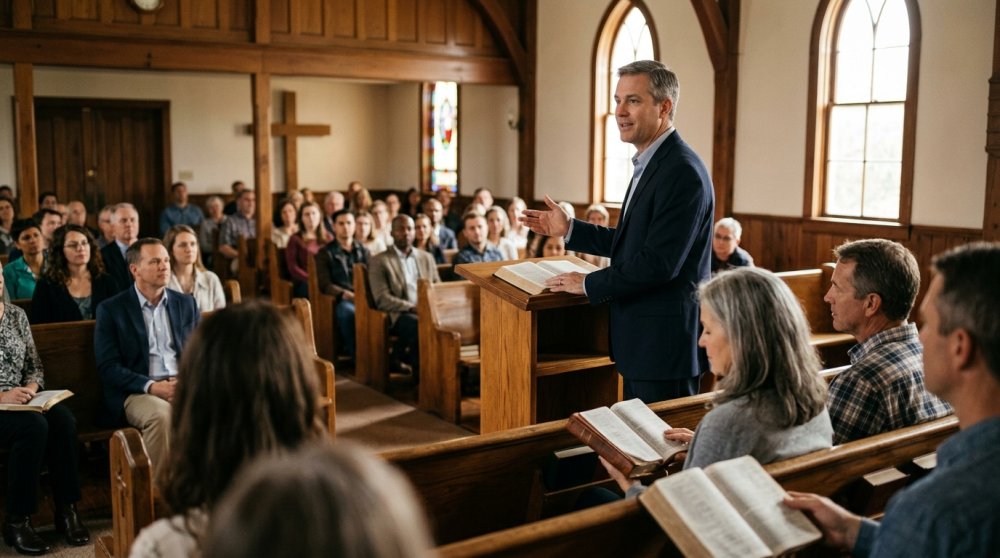
Why This Pastor Says Pulpit Volume May Be Drowning Out the Message

Faith Facts
- Jesus preached with passion and conviction, sometimes offending listeners, yet scripture provides no evidence He shouted during His teachings
- Modern preaching styles increasingly emphasize volume and intensity, raising questions about effective communication of the Gospel
- Church leaders are re-examining whether passionate delivery requires raised voices or if quieter conviction can reach hearts more effectively
A growing conversation among Christian leaders is challenging long-held assumptions about how the Gospel should be delivered from the pulpit. The question isn’t about passion or conviction—it’s about volume.
Dr. Claire Williams, a respected voice in pastoral studies, has raised an intriguing observation that’s resonating across denominational lines. While Jesus clearly preached with passion and wasn’t afraid to offend when truth demanded it, there’s a conspicuous absence in Scripture of any indication He shouted His sermons.
The distinction matters more than many realize. In an age where megachurch pastors often employ theatrical delivery and amplification systems that can shake the rafters, Williams suggests we may be confusing volume with power, intensity with impact.
“Jesus preached passionately, and even offended people,” Williams notes, acknowledging the Savior’s uncompromising approach to truth-telling. But the method of delivery—the actual volume and tone—deserves closer examination by today’s church leaders.
The American church has long embraced passionate preaching as a cornerstone of effective ministry. From the Great Awakening’s fire-and-brimstone sermons to modern stadium-filling evangelists, raised voices have been synonymous with spiritual fervor. Yet this cultural norm may not reflect biblical precedent as clearly as we’ve assumed.
Consider the teaching style of Jesus as recorded in the Gospels. He spoke in parables to curious crowds on hillsides. He engaged in intense theological debates with religious leaders. He confronted hypocrisy and called out sin without hesitation. But nowhere do we find descriptions of Him shouting, yelling, or raising His voice to make His point.
In fact, Scripture tells us Jesus often withdrew to quiet places to pray. His most profound teachings—the Sermon on the Mount, His final discourse with the disciples—are presented as measured, thoughtful communications, not shouted proclamations.
This observation challenges contemporary assumptions about what makes preaching effective. Many pastors believe volume conveys urgency, that raising one’s voice demonstrates conviction about eternal matters. Williams questions whether this approach actually enhances communication or potentially hinders it.
The human response to shouting is complex. While it can command attention initially, sustained volume often triggers psychological defensiveness. Listeners may focus more on the delivery than the message itself, or worse, feel assaulted rather than invited into truth.
Quiet conviction, by contrast, can be profoundly powerful. A pastor who speaks with controlled intensity, allowing the weight of Scripture itself to carry the message, may actually create more space for the Holy Spirit to work in hearts.
This doesn’t mean preaching should be boring or emotionless. Jesus was neither. He wept over Jerusalem. He overturned tables in the temple. He spoke with authority that astonished listeners. Passion and conviction are non-negotiable elements of faithful Gospel proclamation.
The question is whether that passion must be loud to be legitimate. Williams suggests the answer is no—and that discovering alternative modes of powerful communication might actually strengthen the church’s witness.
For congregations accustomed to high-volume preaching, this shift might feel uncomfortable at first. We’ve been culturally conditioned to associate loud with important, quiet with weak. Breaking that association requires intentionality from both pulpit and pew.
Some of the most effective communicators in Christian history—including Billy Graham in his later years—demonstrated that you can hold massive audiences spellbound without shouting. Their secret was substance over style, allowing the gravity of the Gospel itself to do the heavy lifting.
Modern worship services often feature loud music, dramatic lighting, and high-energy elements designed to engage contemporary audiences. In that context, a shouting preacher might seem consistent with the overall experience. But Williams asks whether we’re inadvertently training believers to equate spiritual depth with sensory stimulation.
The early church met in homes, sharing meals and teaching in intimate settings. The Reformers emphasized careful exposition of Scripture. Puritan preachers were known for hour-long sermons delivered with intellectual rigor, not theatrical flair. Throughout church history, faithful Gospel proclamation has taken many forms—not all of them loud.
For pastors willing to reconsider their delivery, the adjustment isn’t about becoming timid or compromising conviction. It’s about exploring whether the same passion that currently expresses itself through volume might be channeled differently—with equal or greater effect.
This conversation also touches on pastoral health. Chronic shouting can damage vocal cords, leading to medical issues that shorten ministry careers. More importantly, it can create an unsustainable model where perceived anointing depends on physical capacity rather than spiritual depth.
Williams’ observation invites all believers to think more carefully about how we communicate truth. In our personal evangelism, our family devotions, our small group discussions—do we default to volume when we want to emphasize importance? Or can we trust that truth spoken in love, regardless of decibel level, carries its own power?
The Holy Spirit doesn’t need amplification. He convicted the world of sin, righteousness, and judgment long before microphones existed. He can work through a whisper as easily as a shout—perhaps more easily, since whispers require listeners to lean in rather than recoil.
None of this diminishes the prophetic tradition of bold proclamation. There remains a vital place for preachers who will courageously confront cultural decay, call out compromise, and declare unpopular truths regardless of consequence. The question is simply whether that boldness requires volume or whether it can be delivered with quiet strength.
As the American church faces increasing cultural marginalization, our witness may benefit from reconsidering not just what we say, but how we say it. A faith that speaks with confident conviction, grounded in Scripture and empowered by the Spirit, doesn’t need to shout to be heard. It needs to be true.
Jesus offended people not through volume but through truth. He challenged assumptions, exposed hypocrisy, and demanded decisions. His words cut to the heart not because they were loud, but because they were accurate, authoritative, and spoken in love.
That’s a model worth emulating—passionate without being aggressive, convicting without being combative, powerful without being loud. It’s preaching that trusts the Gospel itself to do what only the Gospel can do: transform hearts and save souls.
Let us know what you think, please share your thoughts in the comments below.

Faith Facts
- The Moulton Church of Christ in Alabama recently celebrated its 200th anniversary of gospel preaching and worship.
- Church records trace the congregation’s roots to the early 19th century Restoration Movement led by Barton W. Stone and evangelist Benjamin F. Hall.
- Five generations of the Hardin family continue to worship and serve together, preserving a legacy of faith and community leadership.
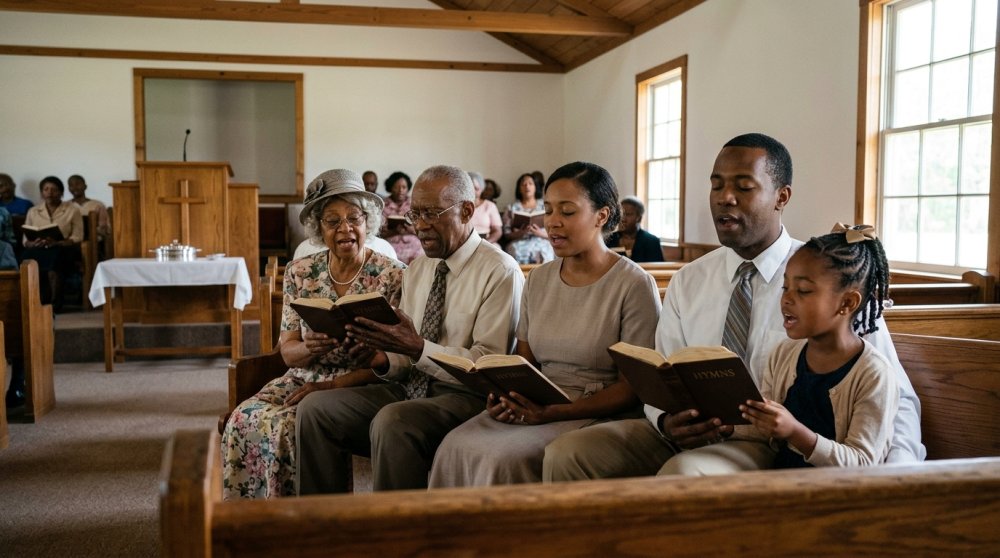
Two hundred years ago, evangelist Benjamin F. Hall planted a congregation of the Lord’s church in rural Moulton, Alabama. The congregation recently gathered to thank God for His faithfulness and to look forward with hope.
Church records credit Hall, influenced by Restoration Movement leader Barton W. Stone, with establishing the Moulton Church of Christ in 1826. Other historical sources mention Tolbert Fanning’s involvement in 1830 or a 1843 debate that brought twenty-two baptisms.
“I rejoice in such triumphs no little myself; but oh Lord, to Thee, and thy precious word, I am indebted for all that I have witnessed in Moulton,” the evangelist wrote of the church. “The brethren are strong in numbers, talent and influence, and I pray God they may be kept humble.”
Local deacon and historian Michael Strickland returned to his childhood congregation to teach its chronology and preach on the importance of remembrance. Two hundred ten members and guests attended the bicentennial worship service.
“Our mission, brothers and sisters, is to show the love of God to everyone,” Strickland told the congregation. “I want to suggest that God has been showing his love in this congregation for 200 years. And I pray he gives us 200 years more.”
Third-generation member Cindy Henry traveled from Hope Hull, Alabama, to celebrate with her family. Her grandfather and father served as elders, and her son Mitchell now serves as a deacon.
“This is still home in a lot of ways,” Henry said. “There’s new faces, but there’s still people that helped raise me.”
Her father, 88-year-old Clint Hardin, has worshiped at Moulton for most of his life. He recalls godly Sunday school teachers and parents who passed on their dedication to the word of God.
“We’ve had good preachers, and we’ve had good leadership,” Hardin said. “Really good leadership carried us through the problems I guess that all churches have.”
Young mother Ashley Nelson joined the church ten years ago through her husband Ross, whose grandfather once preached at Moulton. She now helps lead the children’s ministry known as the Sun Shiners.
“We have so many young kids now,” Nelson said. “We have a big, strong little kids group. And so, anytime we have an event, we usually have about 20 to 30 kids at those events.”
Through every season of growth and challenge, the Moulton Church of Christ has remained rooted in Scripture and committed to passing the faith to the next generation.
Let us know what you think, please share your thoughts in the comments below.

Faith Facts
- Christians in Essex are taking legal action to defend their right to share the Gospel in public spaces.
- A local council has banned the use of loudspeakers and prohibited street preaching about Hell.
- The church maintains that sharing the Gospel belongs on the streets and is a core expression of faith.
Christians at a church in Essex are fighting in court for the right to share the Gospel on British streets after a city council banned their use of loudspeakers and ordered them to stop warning people about Hell.
The case highlights growing tensions between traditional Christian witness and local government restrictions on public preaching.
“The Gospel belongs on the streets,” church leaders declared in their legal challenge.
Faithful believers see this as part of a broader pattern of restrictions aimed at silencing biblical truth in the public square.
“We will not be silenced from proclaiming the truth that saves,” a church spokesperson stated.
Let us know what you think, please share your thoughts in the comments below.

Faith Facts
- A Colombian pastor was murdered in Cartagena for refusing to allow gang members he had evangelized to use his motorcycle.
- The pastor’s death highlights the dangers faced by Christians boldly sharing the Gospel in violent urban areas.
- His sacrifice serves as a sobering reminder of the cost of faithfulness to Christ in regions controlled by criminal gangs.
A Colombian pastor was beaten to death by members of a criminal gang he had been evangelizing in the city of Cartagena.
The gang members attacked the pastor after he refused to allow them to use his motorcycle, according to a report.
Let us know what you think, please share your thoughts in the comments below.


-

 Self-Reliance2 years ago
Trump’s Bold Move Uncovers Massive Social Security Fraud
-

 Faith2 years ago
New Clues Emerge in Noah’s Ark Mystery
-

 News2 years ago
Governor Walz’s Rhetoric Sparks National Controversy
-

 News2 years ago
Mel Gibson’s ‘The Passion of the Christ’ Sequel Title Announced
-

 Family2 years ago
Texas Lawmaker Targets Furries in Schools
-

 Freedom2 years ago
Maine Lawmaker Challenges Sports Fairness Controversy
-

 Family1 year ago
Canada’s Controversial Policy Sparks Ethical Debate
-
Faith11 months ago
Congress Hears Pleas for Nigerian Christians