
Faith
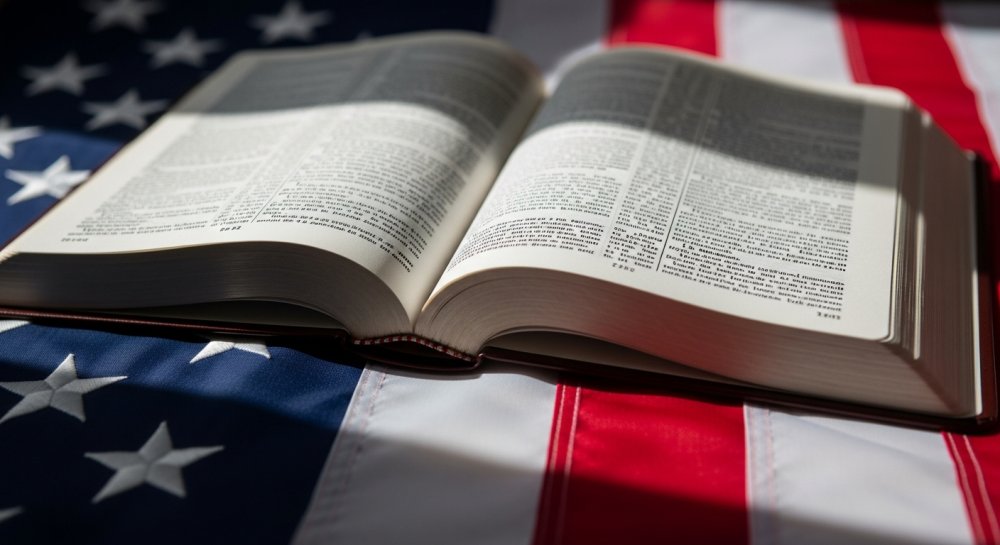
Why Southern Poverty Law Center’s Collapse Points America Back to Scripture

Faith Facts
- The Southern Poverty Law Center faces mounting credibility issues as its ideological agenda becomes increasingly apparent to mainstream Americans
- The ‘America Reads the Bible’ initiative represents a return to the foundational moral principles that built our nation
- Biblical truth provides the objective standard of justice that partisan organizations cannot offer
As controversies swirl around the Southern Poverty Law Center, a timely reminder emerges: America’s foundation rests not on the shifting sands of political agendas, but on the unchanging truths of Scripture. The exposure of ideological bias within organizations claiming to champion justice underscores why our nation desperately needs a return to biblical principles.
The SPLC, once regarded as a civil rights watchdog, has faced growing criticism for labeling mainstream Christian organizations as “hate groups” while ignoring actual threats. This misuse of moral authority demonstrates what happens when human judgment replaces divine wisdom. Without the objective standard that Scripture provides, justice becomes whatever those in power declare it to be.
This is precisely why initiatives like “America Reads the Bible” matter now more than ever. When Speaker Mike Johnson and others call Americans back to Scripture, they’re not promoting religion for religion’s sake—they’re pointing to the only reliable foundation for true justice, compassion, and equality.
The Bible offers what no human organization can: an unchanging standard of right and wrong that transcends political parties, cultural moments, and personal agendas. It teaches that all people are created in God’s image, that justice must be impartial, and that truth matters more than ideology.
Throughout American history, genuine civil rights progress came not from abandoning biblical principles, but from applying them. Leaders like Martin Luther King Jr. rooted their calls for justice in Scripture, not secular philosophy. They understood that lasting change requires a moral foundation that cannot be shifted by political winds.
Today’s polarized climate shows what happens when that foundation erodes. Organizations weaponize labels like “hate” and “extremism” against those who simply hold traditional Christian views on marriage, family, and human dignity. Meanwhile, actual injustices often go unaddressed because they don’t fit predetermined narratives.
The answer isn’t found in creating more watchdog groups or passing more legislation. It’s found in the same place America’s Founders discovered it: in the Word of God. When citizens read Scripture, they encounter principles that have guided civilization toward justice for millennia.
Biblical literacy provides the discernment Americans need to recognize when organizations claiming moral authority have actually abandoned moral truth. It equips believers to stand firm on principle while extending genuine love to all people. It offers hope that transcends political victories or defeats.
As the credibility of secular institutions continues to crumble under the weight of their own bias, the call to “America Reads the Bible” becomes increasingly prophetic. Our nation doesn’t need more organizations telling us what to think. We need the wisdom that comes from above—wisdom available to anyone who opens Scripture with a humble heart.
The contrast couldn’t be clearer: human institutions fail, political movements fade, and cultural trends shift like sand. But God’s Word remains forever, offering the truth, justice, and hope that every generation desperately needs.
Let us know what you think, please share your thoughts in the comments below.


Faith Facts
- The Evangelical Confederation of Colombia (CEDECOL) received formal recognition from government authorities for their peace-building work in Bogotá
- The recognition came during the first Interfaith Meeting on Peace and Security, bringing together religious organizations and government institutions
- The event highlights increasing collaboration between evangelicals and civic authorities in promoting social harmony in Colombia
The Evangelical Confederation of Colombia (CEDECOL) was honored by the Bogotá Metropolitan Police and the Ministry of the Interior during a significant interfaith gathering focused on peace and security. The recognition underscores the vital role evangelical Christians play in promoting stability and reconciliation in Colombian society.
The first Interfaith Meeting on Peace and Security brought together religious organizations and government institutions with the stated goal of strengthening collaboration to build social harmony. The event marks a growing trend of government entities partnering with faith-based organizations to address community challenges.
CEDECOL’s recognition at this gathering highlights the practical contributions evangelical Christians are making in Colombia’s ongoing efforts to heal from decades of internal conflict. The confederation has been active in community outreach, reconciliation efforts, and supporting families affected by violence.
The participation of the Bogotá Metropolitan Police and the Ministry of the Interior signals government acknowledgment of the influence religious communities hold in promoting peace at the grassroots level. For evangelicals, this represents an opportunity to demonstrate Christian values of forgiveness, reconciliation, and service in the public square.
While interfaith dialogue can raise questions among some conservative Christians about doctrinal compromise, CEDECOL’s involvement reflects a commitment to being salt and light in society while maintaining biblical integrity. The evangelical body has consistently advocated for religious freedom and the protection of traditional Christian values in Colombia.
Colombia has faced significant security challenges in recent years, making the collaboration between faith communities and law enforcement particularly relevant. Evangelical churches have often served as stabilizing forces in neighborhoods affected by crime and gang activity.
The recognition of CEDECOL demonstrates how faithful Christian witness can earn respect and create opportunities for influence even in pluralistic settings. As evangelical Christianity continues to grow across Latin America, such partnerships between churches and government may become increasingly common.
Let us know what you think, please share your thoughts in the comments below.

Faith Facts
- A Christian leader discovered that unsuccessful fasting can teach deeper spiritual truths than breakthrough moments
- Biblical fasting is about aligning our hearts with God’s purposes, not manipulating outcomes through spiritual discipline
- True worship emerges not from spiritual success but from humble dependence on God’s grace
Derek Hughes entered his fast with high expectations. Alongside his small group, he anticipated spiritual breakthrough, clear direction, and renewed passion for ministry. Instead, what he experienced was hunger, distraction, and prayers that felt hollow.
The disappointment was real. The physical discomfort seemed pointless without the spiritual payoff he’d anticipated.
But in the aftermath of what felt like failure, Hughes returned to Scripture with fresh eyes. A familiar passage challenged everything he thought he knew about worship, fasting, and what God actually desires from His people.
The revelation came from an unexpected place: recognizing that worship deemed unsuccessful by human standards may actually be worship in its truest form. When we strip away the expectation of results, breakthrough, and spiritual highs, what remains is the raw offering of our hearts to a God who desires relationship over performance.
This mirrors the heart of Isaiah 58, where God corrects His people’s understanding of fasting. They complained that their fasts went unnoticed by God, but the Lord revealed their hearts were focused on their own interests rather than on justice, mercy, and humble dependence on Him.
The modern American church often approaches spiritual disciplines with a transactional mindset. We fast to get breakthrough. We pray to receive answers. We worship to experience God’s presence. But what if the disciplines themselves—stripped of guaranteed outcomes—are the point?
Hughes discovered that his “failed” fast taught him more about God’s character than a dozen successful ones. In his weakness and disappointment, he encountered a God who doesn’t need our spiritual performance but invites us into genuine relationship.
This counterintuitive truth runs throughout Scripture. God chose the foolish things to shame the wise. He displays His power in our weakness. He exalts the humble and resists the proud.
For Christians navigating a culture that measures everything by results and metrics, this lesson cuts deep. Our faith isn’t validated by spiritual successes or breakthrough moments but by our willingness to come before God with empty hands and honest hearts.
The hunger Hughes experienced wasn’t just physical—it was spiritual. And perhaps that acknowledgment of need, that inability to manufacture spiritual experience through discipline alone, was precisely the posture God desired all along.
True worship, it turns out, isn’t about our ability to perform spiritual exercises correctly. It’s about recognizing our complete dependence on a God who meets us in our weakness, sustains us in our hunger, and transforms even our failures into opportunities for deeper faith.
This perspective challenges the prosperity-tinged spirituality that has crept into many corners of American Christianity. Not every prayer is answered the way we hope. Not every fast brings clarity. Not every season of seeking results in breakthrough.
But every honest offering—even the seemingly unsuccessful ones—brings us closer to the heart of a God who values authenticity over achievement, relationship over results, and broken dependence over confident self-sufficiency.
Let us know what you think, please share your thoughts in the comments below.


Renowned Christian vocalist Nicole C. Mullen is opening up about her journey through domestic abuse and marital betrayal. Through her new book, she testifies that even the most broken chapters of our lives can be restored by the power of the Gospel.
Mullen emphasizes that her story is a testament to the fact that God is a master of resurrection. She encourages others to remain faithful to the Word of God, noting that trials serve as a refining fire to purify the believer’s heart.
Faith Facts
- Nicole C. Mullen has earned nine Dove Awards and two Grammy nominations for her anthems of faith.
- Her latest book uses the lives of biblical women like Abigail and Jochebed to illustrate God’s faithfulness in trials.
- Mullen stresses that God never directs His children to act in ways that contradict His eternal Word.
“The wrong is still hurtful. But it’s easier to talk about it because I’ve seen the Lord give me victory.”
By choosing obedience in the darkest seasons, we allow the Lord to work all things together for our good.
Let us draw near to Him, trusting that He will respond with His grace and provide the discernment needed for every battle.


-

 Self-Reliance1 year ago
Trump’s Bold Move Uncovers Massive Social Security Fraud
-

 Faith1 year ago
New Clues Emerge in Noah’s Ark Mystery
-

 News1 year ago
Governor Walz’s Rhetoric Sparks National Controversy
-

 News1 year ago
Mel Gibson’s ‘The Passion of the Christ’ Sequel Title Announced
-

 Family1 year ago
Texas Lawmaker Targets Furries in Schools
-

 Freedom1 year ago
Maine Lawmaker Challenges Sports Fairness Controversy
-

 Family11 months ago
Canada’s Controversial Policy Sparks Ethical Debate
-
Faith5 months ago
Congress Hears Pleas for Nigerian Christians