
Faith
What Astronaut Victor Glover Discovered About God 252,000 Miles from Earth


Faith Facts
- NASA Artemis II pilot Victor Glover, a member of the Southeast Church of Christ in Friendswood, Texas, just completed humanity’s first lunar mission in 53 years, traveling a record-breaking 252,756 miles around the moon.
- The Christian astronaut says grace was essential for survival in the minivan-sized capsule, with the crew constantly giving and receiving grace during their 10-day journey.
- During a 40-minute communications blackout behind the moon, Glover’s spontaneous first response was to pray, describing prayer as both a planned ritual and an organic response to witnessing God’s creation.
After looping around the moon on NASA’s first lunar mission in 53 years, Artemis II pilot Victor Glover shared his remarkable story of faith, prayer, and exploration with an exclusive audience. Glover and his crewmates — Americans Reid Wiseman and Christina Koch and Canadian Jeremy Hansen — traveled 252,756 miles, a new record for human spaceflight.
The 50-year-old Christian astronaut, a member of the Southeast Church of Christ in Friendswood, Texas, spoke candidly about how his faith shaped and was shaped by the life-changing mission. Drawing from the unique perspective of his 10-day journey, Glover offered insights that reveal how deeply God’s presence can be felt even in the farthest reaches of space.
Here are three powerful takeaways from this faithful explorer’s reflections on his historic mission:
1. Grace shapes life on Earth and in deep space.
Inside the Orion capsule — roughly the size of a minivan — four astronauts lived and worked in a confined space, where success depended on character just as much as skill. Over three years, the four members of the Artemis II crew worked with specialized NASA operational psychologists in preparation for life in orbit.
Their training extended beyond spaceflight, ranging from learning from British historians about the moon’s historical and religious significance to studying creative language with an English professor. This holistic preparation reveals a recognition that human excellence requires more than technical prowess — it requires wisdom, perspective, and the ability to work together in trying circumstances.

“We worked as hard at all the facets of this, and we still probably forgot something, but we did it intentionally — that is the point,” Glover said.
“We were willing and intentional, and we went and reached out to the people who could help us.”
The preparation shaped not only his readiness to manage tasks on the mission but also, in Glover’s case, personal faith practices, including reading the Bible and focusing on prayer. One theme remained consistent among the crew throughout the years of preparation and eventual execution: grace.
“There was a heaping of grace in that capsule. We had to give and receive grace continually.”
Although the crew named the capsule “Integrity,” Glover noted that it also could have been called “Grace,” mirroring the dependence required for living in close quarters. This acknowledgment of mutual dependence and the need for continual forgiveness reflects biblical wisdom that applies whether we’re on Earth or orbiting the moon.
2. Prayer in orbit was planned — and unplanned.
From hundreds of thousands of miles away, Earth appeared small from the window of the Orion capsule — “about the size of your thumb,” Glover said. That perspective shift brought with it profound spiritual moments.
Prayer during the mission, he said, became both structured and spontaneous. Before launch, it was intentional, part of a ritual that included preparation, speaking to his family and grounding himself. But once in orbit, prayer also emerged unexpectedly through the awe of exploring space.

“Your natural response is to call on God,” Glover said.
“The number of times that I heard, ‘Oh, my God,’ and it was truly the only thing that made sense.”
At one point during the Artemis II mission, the crew lost communication with Earth for about 40 minutes as the moon blocked radio signals. In the blackout, with no anchor point for orientation or contact with mission control, Glover paused his geological observations of the lunar surface.
For several moments, only the sounds of the capsule systems and the crew’s voices filled the cabin. With his headset still on, Glover’s first response was to pray to God.
“It welled up inside of me,” he said of the prayer, “and that’s something I’m actually going to spend more time thinking about. It’s kind of the ritual versus the response, what was just truly authentic and organic — and was a response to what we were seeing and experiencing.”
This distinction between ritualistic prayer and spontaneous communion with God speaks to the authentic relationship believers can have with their Creator. In moments of isolation and awe, prayer became not just a practice but a natural expression of the human soul reaching toward its Maker.
3. Landing on Earth brought a new perspective for Glover.
The farther Glover and the Artemis II mission traveled from Earth, the more he began to consider what it means, as Christians, to bring faith into unexplored places — and what it means that God is always present. This is a powerful reminder that there is nowhere in creation where God is not sovereign.
“We need to appreciate God in that new place,” he said.
“The weak link coming into that circumstance is us. It’s not that beautiful creation that we’re surrounded by.”
Having served aboard the International Space Station in 2020 and 2021, Glover already carried a perspective on Earth that few had experienced. But the moon mission further developed his view of how to share his experiences with others.

As the spacecraft splashed down April 10 near San Diego, one defining moment came in the medical bay as crewmate Wiseman wept with a chaplain. The scene reminded Glover that exploration reveals human dependence through the lens of achievement. Even in humanity’s greatest technological triumphs, we remain vulnerable creatures in need of God and one another.
“I have a commitment to share this experience in a way that isn’t me telling you about this one once-in-a-lifetime experience I’ve had,” Glover said.
“It’s to give it to you.”
From that view 252,756 miles away, Glover’s mission to the far side of the moon deepened his belief that exploration should draw people to God — and to each other. His journey reminds us that the heavens truly do declare the glory of God, and that scientific achievement need not be divorced from spiritual wonder.
“When I say you’re more like me than you think, or I am more like you, or we are more like one another — we’re all weak mortal beings that won’t be here forever, and we need help,” he said.
“We need God’s help, and we need each other’s help.”
This profound admission from a man who has achieved what only a handful of humans in history have accomplished speaks volumes. At our core, whether we’re standing on Earth or floating 250,000 miles above it, we remain God’s creation — finite, dependent, and in need of grace.
Let us know what you think, please share your thoughts in the comments below.


Faith Facts
- Jordan Shipley called on the Lord during a life-threatening accident that left over 20% of his body with third-degree burns.
- More than eight months later, the former NFL wide receiver described his recovery as a miracle.
- Shipley publicly credits his faith in God for sustaining him through the ordeal.
Former NFL wide receiver Jordan Shipley is sharing a powerful testimony of survival and faith. More than eight months ago, Shipley endured a devastating accident on his Texas ranch that left him with third-degree burns across more than 20 percent of his body.
In the midst of the crisis, Shipley says he turned to God with desperate prayers for help. He now describes his recovery as nothing short of miraculous.
“I desperately called on the Lord for help during the life-threatening ordeal and experienced a ‘miracle.'”
Let us know what you think, please share your thoughts in the comments below.
Faith Facts
- Dr Michael Tang relocated from London to Yorkshire to serve rural believers after observing urban church trends.
- Smaller rural churches often rely on older faithful members who continue to uphold traditional worship and community.
- The focus on headline-grabbing urban growth can overlook the steady witness of countryside congregations.
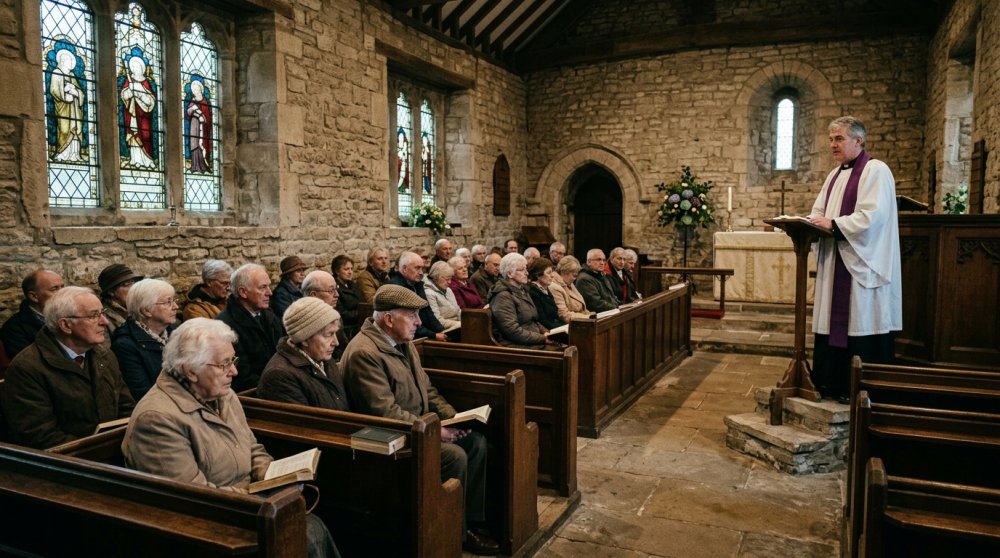
Big city churches full of young people are great, says Dr Michael Tang. But what about smaller rural ones, with their faithful older congregations?
After moving from London to Yorkshire, he’s learning to listen to the wisdom of age, not just the headline-grabbing reports of church growth.
“Big city churches full of young people are great, says Dr Michael Tang. But what about smaller rural ones, with their faithful older congregations?”
“After moving from London to Yorkshire, he’s learning to listen to the wisdom of age, not just the headline-grabbing reports of church growth.”
Let us know what you think, please share your thoughts in the comments below.

Faith Facts
- Eric Metaxas emphasizes the biblical foundation of American self-government.
- Nathan Hale, executed by the British at age 21, exemplifies early American faithfulness and courage.
- Remembering heroic figures like Hale strengthens national resolve rooted in biblical truth.
Author Eric Metaxas recently spoke with The Christian Post about the urgent need to recall the biblical principles that shaped American self-government.
Metaxas pointed to the story of Nathan Hale, the 21-year-old patriot who was hanged by British forces 250 years ago this week, as a powerful example of sacrificial courage.
“We need to remember these heroic figures who laid down their lives for the cause of liberty,” he said.
The author stressed that such stories are not mere historical footnotes but living reminders of the Christian virtues that once defined the American experiment.
“Without these examples, we lose the moral imagination required to sustain freedom,” Metaxas added.
He urged believers and citizens alike to recover the memory of those who stood firm in faith and principle during the nation’s founding era.
Let us know what you think, please share your thoughts in the comments below.


-

 Self-Reliance1 year ago
Trump’s Bold Move Uncovers Massive Social Security Fraud
-

 Faith1 year ago
New Clues Emerge in Noah’s Ark Mystery
-

 News2 years ago
Governor Walz’s Rhetoric Sparks National Controversy
-

 News1 year ago
Mel Gibson’s ‘The Passion of the Christ’ Sequel Title Announced
-

 Family2 years ago
Texas Lawmaker Targets Furries in Schools
-

 Freedom2 years ago
Maine Lawmaker Challenges Sports Fairness Controversy
-

 Family1 year ago
Canada’s Controversial Policy Sparks Ethical Debate
-
Faith10 months ago
Congress Hears Pleas for Nigerian Christians