
Family
The Word America Wouldn’t Say Is Now Everywhere


Faith Facts
- The F-word has transitioned from culturally taboo to commonplace in modern American discourse across workplaces, entertainment, and casual conversation.
- The normalization of vulgar language reflects broader cultural shifts away from traditional standards of decency and respect.
- Christians are called to elevate their speech as a reflection of faith, choosing words that honor God and build up others.
There was a time in America when certain words were simply not spoken in polite company. The boundaries were clear, the standards understood. That world seems increasingly distant.
The F-word, once relegated to the margins of acceptable discourse, has become ubiquitous. It saturates our entertainment, punctuates workplace conversations, and fills everyday exchanges that would have shocked previous generations.
This dramatic transformation didn’t happen overnight. It represents a decades-long erosion of standards that once protected the dignity of public discourse and reflected shared values about decency and respect.
Hollywood led the charge, gradually pushing boundaries in film and television. What began as occasional transgressions for shock value became routine, then expected. Today, profanity-laced dialogue is considered authentic, even artistic.
The workplace followed suit. Professional environments that once maintained strict decorum now tolerate language that would have ended careers a generation ago. The justification is often framed as authenticity or stress relief, but the result is a coarsening of our shared spaces.
Social media accelerated the trend, removing traditional gatekeepers and normalizing shock value as engagement strategy. Algorithms reward provocation, and vulgarity proves effective at capturing attention in an oversaturated information landscape.
But what do we lose when vulgarity becomes ordinary? Language shapes thought, and thought shapes character. When we abandon standards for speech, we signal something deeper about our values and our vision for community.
The Christian understanding of speech has always been clear. Words matter because they reflect the heart. Scripture repeatedly calls believers to choose language that builds up rather than tears down, that honors God rather than debases His image in ourselves and others.
“Let no corrupting talk come out of your mouths, but only such as is good for building up, as fits the occasion, that it may give grace to those who hear,” Paul writes in Ephesians 4:29. This isn’t legalistic restriction but recognition that our words carry weight and consequence.
The normalization of the F-word and similar profanity represents more than changing linguistic preferences. It reflects a culture that has lost confidence in the value of restraint, the wisdom of boundaries, and the importance of protecting spaces where dignity and respect prevail.
When everything is permissible, nothing is sacred. When all language is acceptable, no language is special. The flattening of distinctions between profane and elevated speech diminishes our ability to mark important moments and communicate profound truths.
Parents face particular challenges navigating this landscape. Children absorb the language they encounter, and the ubiquity of profanity makes protection increasingly difficult. Yet the calling remains unchanged: to model better speech and explain why standards matter.
The corporate world’s embrace of casual profanity also creates pressure for Christians who maintain different standards. Refusing to participate can mark one as uptight or inauthentic, yet compromising personal convictions for workplace acceptance carries its own cost.
Recovery of better speech habits won’t come through legislation or top-down mandates. It requires individuals choosing to speak differently, families establishing their own standards, and communities celebrating rather than mocking those who maintain traditional boundaries.
This isn’t about prudishness or arbitrary rules. It’s about recognizing that how we speak reflects who we are and shapes who we become. Language disciplines thought, and thought directs life.
The widespread acceptance of vulgarity signals cultural exhaustion with restraint itself. We live in an age that mistakes boundary-breaking for authenticity and constraint for hypocrisy. But true freedom isn’t found in the absence of all limits.
Christians have an opportunity to model an alternative. Not through judgment or condemnation, but through the simple practice of choosing words that reflect faith, convey respect, and build rather than destroy.
The question isn’t whether American culture will reverse course on profanity tomorrow. It won’t. The question is whether believers will maintain distinctive speech that points to something higher, or whether we’ll be swept along by the coarsening tide.
What we say matters because of who we represent. Our speech is witness, whether we intend it or not. In a culture drowning in vulgarity, the choice to speak differently becomes its own form of testimony.
The normalization of the F-word tells us something important about where we are as a nation. We’ve traded shared standards for individual autonomy, boundaries for authenticity, elevation for crude realism. The cost of that trade is only beginning to become clear.
Let us know what you think, please share your thoughts in the comments below.


Faith Facts
- Children raised in stable two-parent married households are statistically more likely to succeed in life
- The Institute for Family Studies found marriages concentrated in wealthier predominantly white suburbs
- Many urban predominantly black neighborhoods have become what researchers call “marriage deserts”
Despite extensive research showing that children raised in stable, two-parent married households are statistically more likely to succeed, a new report from the Institute for Family Studies found that marriages are concentrated in wealthier, predominantly white suburbs but are so scarce in many urban, often predominantly black neighborhoods that researchers have dubbed them “marriage deserts.”
Marriage is one of the most important institutions for passing on faith, values, and stability to the next generation. The findings highlight how traditional family structures remain stronger in communities that uphold these principles.
Let us know what you think, please share your thoughts in the comments below.

Faith Facts
- God commands His people to “be fruitful and multiply” as a foundational instruction for human flourishing.
- Britain’s collapsing birth rate threatens the future of families and the strength of the nation.
- Churches are called to support young families and restore a culture that values children as blessings from God.
God tells us to “be fruitful and multiply”, yet birth rates are falling and starting a family is becoming increasingly difficult for many people.
Lois McLatchie-Miller explains why she believes the Church has a vital role to play in helping families flourish.
Christian families are facing mounting pressures that make raising children feel overwhelming. Economic uncertainty, housing costs, and shifting cultural attitudes all contribute to delayed marriage and fewer births.
The decline in birth rates is not just a statistic. It reflects a deeper spiritual and cultural crisis that affects the future of the Church and the nation.
“The Church has a vital role to play in helping families flourish.”
When families struggle, the ripple effects reach every corner of society. Strong churches and communities depend on the next generation being raised in faith and values.
Christian teaching offers a countercultural message that children are blessings rather than burdens. This perspective encourages couples to embrace the gift of life even amid challenges.
“God tells us to be fruitful and multiply.”
Local congregations can provide practical support through mentoring, childcare assistance, and encouragement for young parents. Such efforts strengthen both families and the witness of the Church.
Let us know what you think, please share your thoughts in the comments below.
Faith Facts
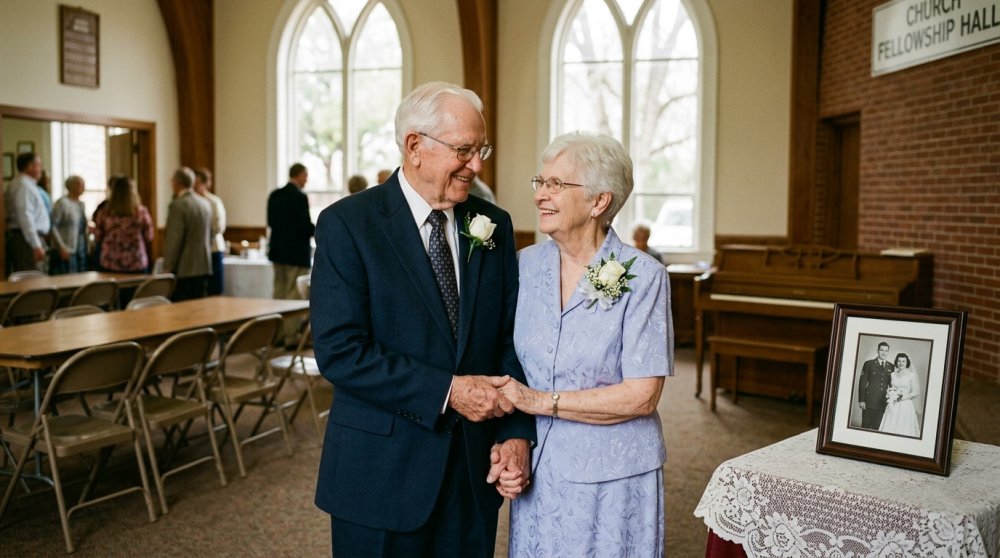
- Clyde and Gwen Antwine celebrated 70 years of marriage rooted in Christian service and missionary work across Europe and the United States.
- The couple met at a youth camp in Texas and built their relationship on shared faith, mission trips, and a commitment to mentoring young Christians.
- They helped establish a healthy church in Zurich, Switzerland, and continued to serve faithfully at Memorial Road Church of Christ in Oklahoma.
The Antwines first met as teenagers at a two-week encampment at Abilene Christian University. Clyde was 15 years old and sold his FFA prize-winning steer for $40 to attend. That is where he first saw Gwen, then 14, and asked to take her picture.
He carried that photograph in his wallet for five years before they reunited at Abilene Christian during his sophomore year. They married six months later.
“The last day of camp, I worked up the courage to ask her if I could take her picture, and she posed. And I put that picture in my wallet. I didn’t even know her name. I just knew she was pretty.”
After Clyde graduated, the couple boarded a boat for Europe in 1959. They served seven years in Zurich, helping to strengthen a young congregation of the Church of Christ. Their work laid a foundation that still bears fruit today.
Later the Antwines served in the German cities of Augsburg and Munich. After nearly two decades overseas, they returned to the United States. Clyde became missionary in residence at Oklahoma Christian University while Gwen served as office manager for The Christian Chronicle.
“Gwen would get you laughing and see the positive side when things got tough, and Clyde, in his quiet voice, would somehow say the exact words you needed to hear to keep you spiritually grounded.”
Their legacy continues through the many students they mentored for mission work. The Antwines never sought recognition. Their only goal was to prepare others for Kingdom service.
Today, Clyde still carries that original photograph of Gwen from their teenage years. Their story stands as a clear testimony of enduring love, steadfast faith, and lifelong commitment to the Lord’s work.
Let us know what you think, please share your thoughts in the comments below.


-

 Self-Reliance2 years ago
Trump’s Bold Move Uncovers Massive Social Security Fraud
-

 Faith2 years ago
New Clues Emerge in Noah’s Ark Mystery
-

 News2 years ago
Governor Walz’s Rhetoric Sparks National Controversy
-

 News2 years ago
Mel Gibson’s ‘The Passion of the Christ’ Sequel Title Announced
-

 Family2 years ago
Texas Lawmaker Targets Furries in Schools
-

 Freedom2 years ago
Maine Lawmaker Challenges Sports Fairness Controversy
-

 Family1 year ago
Canada’s Controversial Policy Sparks Ethical Debate
-
Faith11 months ago
Congress Hears Pleas for Nigerian Christians