
Self-Reliance
The Hard Leadership Truth That Transforms Organizations


Faith Facts
- Effective leadership requires creating environments where truth can be spoken without fear of retaliation
- Biblical wisdom teaches that ‘faithful are the wounds of a friend’ and encourages honest counsel among believers
- Organizations thrive when leaders practice humility and actively seek feedback rather than demanding compliance
In boardrooms and ministry offices across America, a critical question confronts every person in authority: Are we building places where truth can be spoken, or are we silencing the very voices that could save us?
The answer to this question often determines whether an organization flourishes or fails. It separates leaders who build lasting legacies from those who preside over slow decline.
One executive recalls receiving advice that initially stung but ultimately transformed their approach to leadership. The counsel was direct and uncomfortable, delivered by a mentor who cared more about effectiveness than politeness.
The message was clear: sometimes the most powerful thing a leader can do is listen rather than speak.
This runs counter to our cultural expectations of leadership. We’ve been conditioned to believe that authority means having all the answers, that decisiveness requires immediate responses, and that silence equals weakness. But Scripture offers a different model.
Proverbs 18:13 warns, “He who answers before listening—that is his folly and his shame.” The wisdom literature of the Bible consistently elevates listening as a core leadership competency, not a sign of indecision.
When leaders create cultures of fear—where questioning is viewed as disloyalty and candor is punished—they cut themselves off from the very information they need most. Problems fester in darkness. Mistakes compound. Eventually, reality asserts itself, often catastrophically.
The alternative requires courage of a different kind. It means welcoming hard truths, even when they reflect poorly on our own decisions. It means surrounding ourselves with people who will tell us what we need to hear, not what we want to hear.
This approach aligns with the Christian understanding of community and accountability. Believers are called to “speak the truth in love” (Ephesians 4:15), creating relationships where honest feedback strengthens rather than destroys.
In practical terms, this means establishing clear channels for input, asking questions before offering answers, and responding to criticism with curiosity rather than defensiveness. It means recognizing that the people closest to the work often see things leadership cannot.
Organizations that embrace this principle develop resilience. They identify problems early, when solutions are still manageable. They tap into the collective wisdom of their teams rather than relying solely on the perspective of one person at the top.
The brutal advice that changed one leader’s career wasn’t really about staying silent. It was about recognizing that effective leadership requires humility—the willingness to be wrong, to learn, and to value truth over ego.
This principle applies whether you’re leading a family, a small business, a church, or a large organization. The scale changes, but the fundamental truth remains: people will only bring you difficult information if they trust you’ll receive it well.
Building that trust takes time and consistency. It requires demonstrating through actions, not just words, that feedback is valued. It means thanking people for raising concerns, even when those concerns are uncomfortable. It means acting on input when appropriate and explaining decisions when you choose a different path.
For Christian leaders, this approach reflects the character of Christ, who consistently valued people over protocol and truth over appearances. Jesus created space for honest questions, even from those who doubted. He didn’t demand blind obedience but invited his followers into genuine relationship.
The choice before every leader is simple but not easy: Will we create environments where truth can flourish, or will we build echo chambers that reflect only what we want to see?
The answer to that question will determine not only our effectiveness but our legacy. Organizations led by those who welcome truth will adapt, grow, and endure. Those led by leaders who demand only agreement will eventually face a reckoning with reality they could have avoided.
In the end, the most brutal leadership advice may also be the most liberating: You don’t have to have all the answers. But you do need to create space for the truth to emerge.
Let us know what you think, please share your thoughts in the comments below.


Faith Facts
- Scripture teaches that the church is the body of believers called to worship, discipleship, and the Great Commission, not a venue for commercial entertainment.
- Christian parents have a biblical duty to raise children in the fear and admonition of the Lord, a responsibility that begins in the home and is supported by the local church.
- Traditional church buildings have historically served as houses of prayer, community outreach, and doctrinal instruction, reflecting the values of faith, family, and freedom.
A church in Dorset has drawn sharp criticism after converting part of its building into a soft-play area for local families. Critics argue the move blurs the line between sacred space and secular recreation.
Jonty Langley contends that far more questionable activities are already taking place in church buildings across the country. He points out that many congregations have quietly allowed their facilities to host events and programs that stray from historic Christian purpose.
“The church is called to be a house of prayer, not a playground for profit,” one concerned pastor remarked.
Langley lists five examples that have raised eyebrows among traditional believers. Some churches now rent space for yoga classes that incorporate Eastern spiritual practices, while others have turned sanctuaries into nightclubs for youth outreach events.
“We must remember that our buildings are set apart for the gospel, not for whatever trend passes through town,” Langley wrote.
Still other congregations have hosted political fundraisers and corporate conferences that treat the church as little more than rentable real estate. These uses, Langley argues, erode the distinct witness of the local church.
“When the church looks just like the world, it loses its power to change the world,” a longtime deacon observed.
Let us know what you think, please share your thoughts in the comments below.

Faith Facts
- Christian believers are called to guard their hearts and minds against worldly influences that compete with Scripture.
- God’s Word remains the unchanging standard for truth and morality in every generation.
- Outsourcing moral reasoning to machines undermines the God-given responsibility of human conscience and accountability.
Anthropic recently invited religious leaders to advise on the moral programming of its AI systems. The effort highlights a deeper question: can artificial intelligence ever be trusted to carry the weight of ethical discernment?
The company’s request for input from faith communities shows recognition that moral questions still matter. Yet the invitation itself raises concern about how much authority believers should grant to any technology.
In spite of training on morality, the actual morality of AI models like Claude remains deeply uncertain.
Scripture teaches that wisdom begins with the fear of the Lord, not with algorithms. When machines are asked to shape or reflect human values, Christians must remember that truth originates from God, not from data sets.
We cannot afford to outsource our thinking to these machines.
Believers are called to renew their minds through the Word of God and the work of the Holy Spirit. Handing that responsibility to artificial systems risks dulling the very conscience God designed to guide His people.
Churches and families must continue teaching biblical discernment so the next generation can recognize truth from error. Technology may assist daily tasks, but it can never replace the moral reasoning rooted in faith.
Let us know what you think, please share your thoughts in the comments below.
Faith Facts
- The Bible describes angels in striking and mysterious ways that challenge modern expectations.
- Early glimpses of The Chosen season six have prompted discussion about how angels should be portrayed on screen.
- Christian writer Andy Kind argues that creative depictions can deepen believers’ awe toward holy mystery.
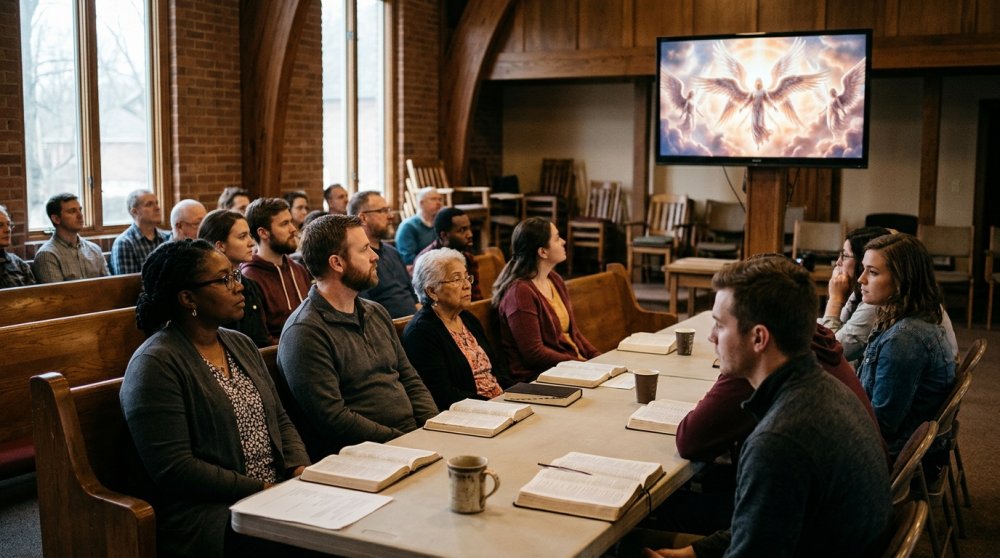
Some Christians have voiced concern after seeing a brief teaser for The Chosen season six. The clip features angels rendered in a way that departs from the traditional halo-and-wings image many grew up with. Critics worry the unusual look may confuse or even offend viewers who hold a more conventional picture of heavenly messengers.
Andy Kind, a Christian commentator, pushes back against that reaction. He points out that Scripture itself presents angels in startling forms. Ezekiel describes living creatures with four faces and wheels full of eyes, while Isaiah speaks of seraphim with six wings covering their faces and feet.
Kind believes these vivid biblical portraits remind believers that God’s messengers often exceed human categories. He argues that discomfort with new imagery may reveal a need for greater comfort with holy mystery rather than a problem with the show itself.
“The Bible itself offers wild descriptions of heavenly beings.”
Kind encourages Christians to allow their imaginations to be stretched by faithful art. He suggests that creative portrayals, when grounded in Scripture, can stir fresh reverence instead of diminishing it.
“Christians need to become more comfortable with holy mystery.”
The debate highlights a broader conversation within the church about art, imagination, and biblical truth. As The Chosen continues to reach millions, its creative choices invite believers to revisit the wonder already present in God’s Word.
Let us know what you think, please share your thoughts in the comments below.


-

 Self-Reliance2 years ago
Trump’s Bold Move Uncovers Massive Social Security Fraud
-

 Faith2 years ago
New Clues Emerge in Noah’s Ark Mystery
-

 News2 years ago
Governor Walz’s Rhetoric Sparks National Controversy
-

 News2 years ago
Mel Gibson’s ‘The Passion of the Christ’ Sequel Title Announced
-

 Family2 years ago
Texas Lawmaker Targets Furries in Schools
-

 Freedom2 years ago
Maine Lawmaker Challenges Sports Fairness Controversy
-

 Family1 year ago
Canada’s Controversial Policy Sparks Ethical Debate
-
Faith12 months ago
Congress Hears Pleas for Nigerian Christians