
Faith
The Gospel Truth About Our Obsession With Mars

Faith Facts
- SpaceX’s recent stock market flotation has sparked widespread cultural excitement about Mars colonization
- Christians are called to prioritize stewardship of Earth over escapist fantasies of planetary abandonment
- The Gospel teaches us to invest in our God-given responsibilities on this planet rather than chasing technological distractions
The race to Mars has captured America’s imagination like few things in recent memory. With SpaceX’s historic stock market flotation making headlines, millions of Americans are swept up in the dream of humanity becoming a multi-planetary species. But should Christians be joining this chorus of excitement?
The answer requires us to step back and examine what the Bible actually teaches about our calling on this Earth. Our mission isn’t to abandon the planet God entrusted to us—it’s to faithfully steward it.
The cultural fascination with Mars reflects something deeper than scientific curiosity. It reveals a society increasingly captivated by wealth accumulation, technological salvation, and the fantasy of escape. When we strip away the glossy marketing and futuristic promises, the Mars obsession represents a fundamental misunderstanding of the Christian calling.
God placed humanity on Earth with clear instructions: to tend it, to care for it, to be fruitful and multiply here. Genesis establishes that this world—broken though it may be by sin—remains our God-given assignment. The Great Commission wasn’t a call to evangelize Mars; it was a mandate to make disciples on the planet where God placed us.
The billions of dollars being poured into Mars missions could transform countless lives right here on Earth. Clean water systems in impoverished nations. Medical care for the vulnerable. Support for struggling families. Education that builds strong communities rooted in faith and character.
Instead, we’re watching resources flow toward what amounts to an expensive escape plan for the wealthy elite. This isn’t stewardship—it’s abandonment dressed up in the language of progress.
There’s nothing inherently wrong with scientific exploration or technological advancement. God gave humanity the gift of curiosity and the capacity for innovation. But when that innovation becomes an idol, when it replaces our core biblical responsibilities, we’ve lost our way.
The Mars dream also reveals a troubling lack of faith in God’s sovereignty. The implicit message is that Earth is beyond saving, that we need a backup plan because God’s plan has somehow failed. This pessimism contradicts the biblical narrative of redemption and restoration.
Scripture promises that God will make all things new. That promise doesn’t require us to flee to another planet—it calls us to faithful presence and work where we are.
Christians should be the most hopeful people on Earth, not because we’re naive about the world’s brokenness, but because we serve a God who redeems and restores. The Mars obsession, by contrast, reeks of despair disguised as optimism.
Our culture worships at the altar of endless growth and expansion. But the Gospel offers a different vision: one of sacrificial service, humble stewardship, and investment in eternal rather than temporal treasures. A Mars colony won’t save humanity from its fundamental problem—sin and separation from God.
The real frontier isn’t 140 million miles away in space. It’s in the hearts and souls of people right here on Earth. It’s in broken families that need restoration, communities that need healing, and individuals who need the transforming power of the Gospel.
This isn’t a call to reject science or innovation. It’s a call to maintain proper priorities. When Christians get more excited about Mars than about the Great Commission, when we invest more energy in futuristic fantasies than in present-day faithfulness, we’ve traded our birthright for a mess of space-age pottage.
The stewardship principle runs throughout Scripture. We will all give an account for how we used the resources, time, and opportunities God entrusted to us. How will we answer when asked why we prioritized escape over engagement, abandonment over stewardship?
God didn’t make a mistake when He placed humanity on Earth. This planet, with all its beauty and brokenness, is exactly where He wants us—for now. Our job is to be salt and light here, to work for flourishing in our communities, and to point people to the hope found only in Christ.
The Mars mission represents the ultimate expression of human pride: the belief that we can engineer our way out of every problem, that technology will save us from the consequences of our choices. But Christians know better. Our hope isn’t in rockets or colonies on distant planets.
Our hope is in the One who spoke the universe into existence and who promises to return and make His dwelling with humanity. That future isn’t on Mars—it’s right here, on a renewed and restored Earth.
So while the world celebrates SpaceX and dreams of Martian cities, let Christians keep our feet planted firmly on the ground God gave us. Let’s invest in the mission that matters: loving our neighbors, serving our communities, caring for creation, and proclaiming the Gospel to every creature on this planet.
The race to Mars may capture headlines and imaginations. But the race that matters is the one Paul described: running with perseverance toward the prize of our high calling in Christ Jesus. And that race has always been, and will always be, right here on Earth.
Let us know what you think, please share your thoughts in the comments below.


Faith Facts
- Christians are called to redeem every tool for God’s glory and the spread of the Gospel.
- Artificial intelligence is a human creation and remains under God’s sovereign authority.
- Believers must approach emerging technologies with wisdom rooted in Scripture.
Christians around the world are asking an important question as artificial intelligence grows more powerful. How can this technology be captured for the glory of God and the advancement of the Gospel?
Scripture teaches that every good gift comes from above. Technology itself is not evil, but its use must be directed by truth and righteousness.
AI systems are built by people and trained on data created by people. They reflect human choices and remain limited by the boundaries God has established.
Believers have a responsibility to guide these tools toward purposes that honor Christ and serve others. That includes sharing the Gospel, protecting life, and strengthening families.
“Whether therefore ye eat, or drink, or whatsoever ye do, do all to the glory of God,” 1 Corinthians 10:31 reminds us.
Churches and ministries are already exploring ways to use AI for translation, accessibility, and discipleship resources. These efforts must stay anchored in sound doctrine and prayerful discernment.
At the same time, Christians are right to raise concerns about privacy, truth, and the temptation to place ultimate trust in machines rather than in the Lord.
“Trust in the Lord with all thine heart; and lean not unto thine own understanding,” Proverbs 3:5 declares.
Ultimately, the future belongs to the One who created all things, not to any algorithm or invention of man. AI will never have the final word over humanity.
Let us know what you think, please share your thoughts in the comments below.

Faith Facts
- The little log church has stood along the historic Oregon Trail route, serving as a steadfast reminder of Christian faith amid the rugged American frontier.
- U.S. Highway 191 passes near this enduring structure, connecting modern travelers to the spiritual legacy of pioneer families who settled the West.
- The church continues to bear witness to the traditional values of faith, family, and freedom that shaped our nation’s westward expansion.
Along U.S. Highway 191 stands a little log church that looks as though it has occupied this windswept landscape since the days of wagon trains.
The humble structure serves as a tangible link to the pioneer families who carried their Bibles and their faith across the plains in search of new beginnings.
Its weathered logs and simple steeple rise against the vast Western sky, a quiet testament to the enduring strength of Christian witness in America.
Travelers passing by are reminded that the values of hard work, self-reliance, and devotion to God helped build this nation from the ground up.
Let us know what you think, please share your thoughts in the comments below.
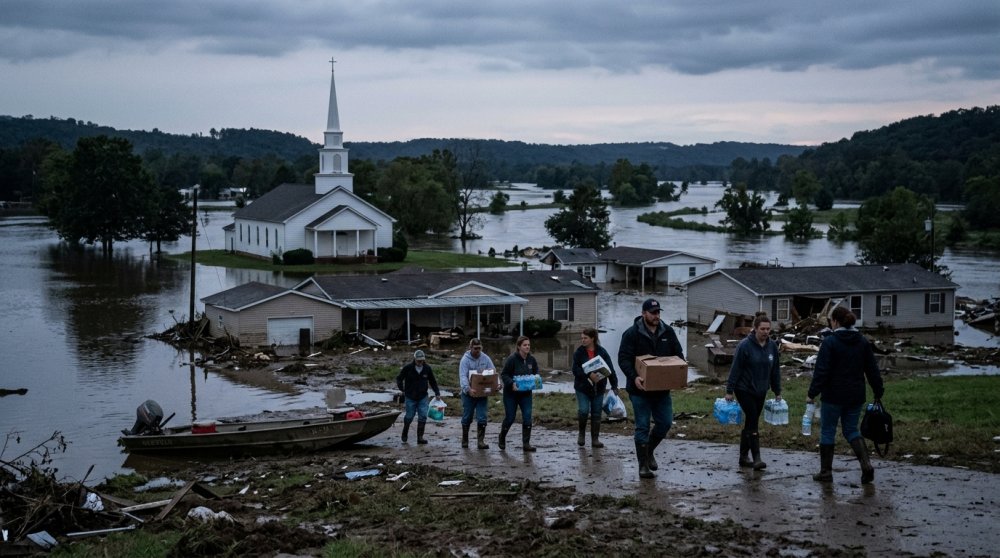
Faith Facts
- Scripture teaches that creation groans under the weight of sin and awaits redemption
- Christian teaching holds that believers are called to reflect God’s compassion through practical help
- History shows the church has long been first on the scene after floods, fires, and storms
Every natural disaster reminds us that we live in a fallen world — that mankind’s sin irreparably marred the world’s original perfection.
We call these events “natural disasters,” but the reality is that these tragedies are anything but “natural.”
Let us know what you think, please share your thoughts in the comments below.


-

 Self-Reliance1 year ago
Trump’s Bold Move Uncovers Massive Social Security Fraud
-

 Faith1 year ago
New Clues Emerge in Noah’s Ark Mystery
-

 News2 years ago
Governor Walz’s Rhetoric Sparks National Controversy
-

 News1 year ago
Mel Gibson’s ‘The Passion of the Christ’ Sequel Title Announced
-

 Family1 year ago
Texas Lawmaker Targets Furries in Schools
-

 Freedom1 year ago
Maine Lawmaker Challenges Sports Fairness Controversy
-

 Family1 year ago
Canada’s Controversial Policy Sparks Ethical Debate
-
Faith10 months ago
Congress Hears Pleas for Nigerian Christians