
News
Texas Democrat Wants Federal Control Over AI Infrastructure as National Security Concerns Mount


Faith Facts
- Democratic Senate candidate James Talarico is pushing new federal regulations on AI data centers in Texas, raising concerns about government overreach and economic competitiveness
- Attorney General Ken Paxton and President Donald Trump are focused on keeping America ahead of China in the AI race, viewing excessive regulation as a threat to national security
- The regulatory push comes as Texans face rising utility costs, creating tension between local concerns and national strategic interests
As America races to maintain technological dominance over China, a key Senate race in Texas has emerged as a battleground over the future of artificial intelligence infrastructure. Democratic candidate James Talarico is advocating for increased federal oversight of AI data centers, a position that puts him at odds with conservatives who view such regulations as harmful to both economic growth and national security.
The tension reflects a deeper divide in how Americans should respond to the challenges posed by rapid AI development. While Talarico frames his regulatory push around local concerns about utility bills and water usage, conservative leaders including Texas Attorney General Ken Paxton and President Donald Trump are emphasizing the critical importance of winning the global AI competition against Communist China.
Data centers, which power the artificial intelligence systems increasingly vital to everything from national defense to medical research, require substantial electricity and cooling resources. Talarico’s campaign has seized on voter frustration over these infrastructure demands, particularly the lack of community input in where these facilities are built. However, critics argue that piling on regulations will only benefit America’s adversaries who face no such restrictions.
The conservative approach, championed by leaders like Paxton and Trump, prioritizes maintaining America’s technological edge while addressing legitimate local concerns through market-based solutions and state-level governance rather than heavy-handed federal mandates. This philosophy recognizes that the nation leading in AI development will shape the future of global security, economic prosperity, and even the values embedded in these powerful technologies.
Texas has become a hotbed for AI data center development, thanks to its business-friendly climate, abundant energy resources, and lack of burdensome regulations that plague states like California. The Lone Star State’s approach has attracted billions in investment and created thousands of high-paying jobs, demonstrating how free-market principles can drive innovation while generating prosperity for local communities.
Talarico’s regulatory framework proposal arrives at a critical juncture when China is investing heavily in AI technology with the explicit goal of surpassing the United States. Chinese companies operate under far fewer environmental and community consultation requirements, giving them a speed advantage that additional American regulations would only magnify. National security experts have repeatedly warned that losing the AI race to an authoritarian regime poses existential risks to American freedom and global stability.
The debate also touches on fundamental questions about the proper role of government in technological advancement. Conservatives have long argued that innovation flourishes when entrepreneurs and businesses are free to operate with minimal interference, while Democrats often favor preemptive regulation to address potential problems before they emerge. The AI data center question exemplifies this divide, with one side seeing opportunity and the other seeing threats requiring government management.
For Texas voters, the choice represents more than just utility bills and water usage. It’s about whether the state will continue its tradition of limited government and economic freedom, or adopt the regulatory approach that has driven businesses and jobs away from other states. It’s also about whether America will maintain the technological leadership that has underwritten our prosperity and security for generations.
Attorney General Paxton has been vocal about keeping Texas competitive in the technology sector while ensuring that any necessary oversight remains at the state level, where officials are more accountable to local voters and better understand regional needs. This federalist approach respects both community concerns and the urgent national interest in AI development, without empowering distant bureaucrats in Washington to micromanage Texas infrastructure.
President Trump’s focus on beating China in the AI race reflects a broader understanding that technological supremacy is now inseparable from national power. His administration prioritized reducing regulatory barriers to innovation while investing in American research and development, a strategy that kept the United States at the forefront of emerging technologies despite aggressive competition from Beijing.
As the Senate race unfolds, Texas voters will decide whether they want a senator who sees AI development primarily through the lens of regulation and restriction, or one who understands that American technological leadership serves both our economic interests and our security imperatives. The outcome will have implications far beyond the Lone Star State, potentially influencing how other states approach the balance between innovation and regulation in this critical sector.
Let us know what you think, please share your thoughts in the comments below.


Faith Facts
- Salisbury Cathedral contributes £35 million annually to the British economy through tourism and heritage activities.
- The historic cathedral requires £22,000 each day to maintain its operations and ministry.
- Christian heritage sites like Salisbury Cathedral continue to serve as vital economic anchors for surrounding communities.
Britain’s ancient cathedrals stand as living testimonies to the enduring power of faith and craftsmanship. Salisbury Cathedral continues that witness today, bringing millions of pounds into the local economy while preserving centuries of Christian tradition.
Each day the cathedral faces significant operating costs that reach £22,000. Those expenses support staff, conservation work, and the daily rhythm of prayer and worship that draws visitors from around the world.
Tourism linked to the cathedral generates substantial revenue for nearby businesses, hotels, and restaurants. This economic activity flows directly from the cathedral’s role as a center of Christian worship and architectural excellence.
The £35 million annual contribution underscores how historic places of worship remain vital to national life. Communities that invest in preserving their Christian heritage reap both spiritual and material rewards.
Let us know what you think, please share your thoughts in the comments below.

Faith Facts
- Scripture teaches that life is sacred from conception, as God forms each person in the womb according to Psalm 139.
- Christian teaching affirms the inherent dignity of every human life as created in the image of God.
- Traditional family values uphold the protection of the unborn as a cornerstone of a moral society.
Pro-life campaigners have urged Scottish ministers to reject calls from the Scottish Greens to decriminalise abortion and remove the requirement for two doctors to approve the procedure.
The proposal has sparked concern among faith leaders and traditional values advocates who see it as a troubling step away from protecting unborn children.
Critics argue that such changes would weaken longstanding legal safeguards and further erode respect for human life.
“We must stand firm in defense of the most vulnerable among us,” one pro-life advocate stated.
Let us know what you think, please share your thoughts in the comments below.
Faith Facts
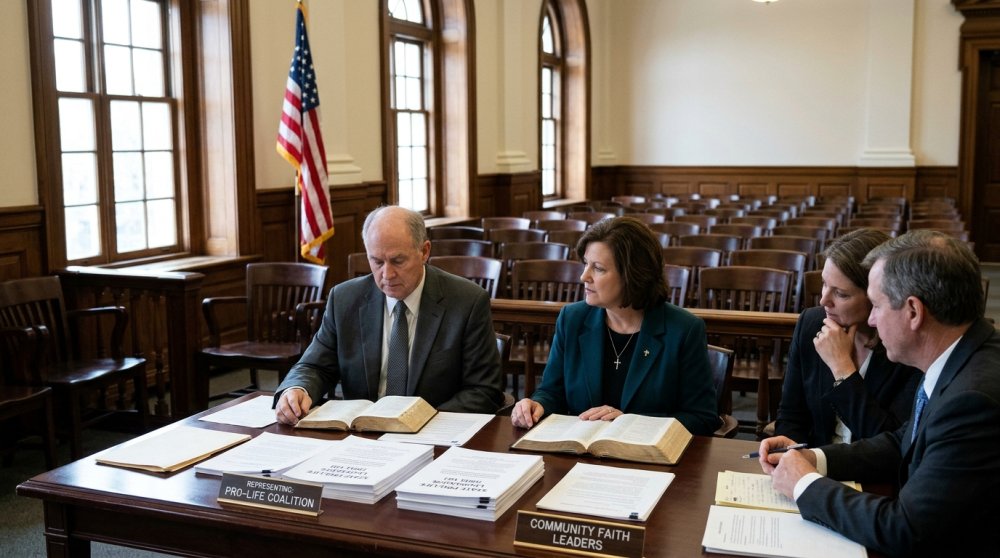
- Every child is fearfully and wonderfully made by God from conception, carrying inherent dignity that no label can erase.
- Scripture commands believers to speak truth in love rather than rely on name-calling or political branding.
- Christian voters are called to protect the most vulnerable among us with both courage and wisdom.
Seth Gruber’s accusation that pro-life advocates who disagree with immediate abolition are “feminists” misses the point entirely.
The debate centers on the most practical question: how do we save the greatest number of babies right now?
“You’re a feminist and don’t know it,” Gruber reportedly told a fellow pro-life Christian during a recent exchange.
Throwing labels at brothers and sisters who share the same ultimate goal does nothing to rescue children scheduled for abortion today.
“That exchange is the whole abolition debate in miniature: an argument about votes and babies saved, answered with a label.”
Faithful Christians can and do differ on legislative strategy while remaining united in the conviction that every life is sacred.
The priority remains protecting unborn children through whatever lawful means will actually move hearts, change laws, and save lives.
Let us know what you think, please share your thoughts in the comments below.


-

 Self-Reliance2 years ago
Trump’s Bold Move Uncovers Massive Social Security Fraud
-

 Faith2 years ago
New Clues Emerge in Noah’s Ark Mystery
-

 News2 years ago
Governor Walz’s Rhetoric Sparks National Controversy
-

 News2 years ago
Mel Gibson’s ‘The Passion of the Christ’ Sequel Title Announced
-

 Family2 years ago
Texas Lawmaker Targets Furries in Schools
-

 Freedom2 years ago
Maine Lawmaker Challenges Sports Fairness Controversy
-

 Family2 years ago
Canada’s Controversial Policy Sparks Ethical Debate
-
Faith1 year ago
Congress Hears Pleas for Nigerian Christians