
Faith
Pakistani Lawmaker Moves to Replace Colonial Christian Marriage Law


Faith Facts
- A Pakistani lawmaker has introduced legislation to replace a 154-year-old Christian marriage law in Khyber Pakhtunkhwa Province.
- The proposed bill aims to strengthen legal protections for Christian families in the predominantly Muslim region.
- The current law dates back to the British colonial era and requires significant modernization to serve today’s Christian community.
In a significant move affecting the Christian minority in Pakistan, a woman member of the Khyber Pakhtunkhwa Provincial Assembly has put forward a private member’s bill targeting outdated marriage legislation. The proposed reform would replace a colonial-era law that has governed Christian marriages in the province for more than 150 years.
The existing Christian marriage law, established during British rule in 1870, has long been criticized for failing to address the contemporary needs of Pakistan’s Christian population. The new legislation seeks to provide enhanced legal safeguards for Christian families in a region where they constitute a small religious minority.
Pakistan’s Christian community, representing approximately 2% of the nation’s population, has faced ongoing challenges in securing adequate legal protections for family matters including marriage, divorce, and inheritance. The Khyber Pakhtunkhwa Province, located in the northwest region of Pakistan bordering Afghanistan, has been particularly challenging for religious minorities.
The introduction of this bill represents a rare legislative effort to address the concerns of Pakistan’s Christian community at the provincial level. Advocates for religious freedom have long called for updated legal frameworks that reflect modern realities while respecting the faith traditions of minority communities.
The proposed legislation would modernize registration procedures, clarify spousal rights, and establish clearer guidelines for Christian marriages performed in the province. These reforms are seen as essential steps toward ensuring that Christian families receive equal treatment under Pakistani law.
While the bill faces an uncertain path through a legislature dominated by Muslim lawmakers, its introduction signals growing recognition of the need to protect minority religious rights in Pakistan. The Christian community has expressed cautious optimism that the measure could lead to meaningful improvements in their legal standing.
Religious freedom advocates both within Pakistan and internationally have noted the importance of such legislative initiatives. They argue that protecting the rights of religious minorities, including Christians, is essential to maintaining social stability and demonstrating Pakistan’s commitment to pluralism.
The outcome of this legislative proposal will be closely watched by Christian communities throughout Pakistan and by international observers monitoring religious freedom in the region. Success could provide a template for similar reforms in other Pakistani provinces.
Let us know what you think, please share your thoughts in the comments below.

Faith Facts
- Two Christians were killed and seven kidnapped in coordinated raids on Christian villages in Kaduna state, Nigeria
- Suspected Fulani herdsmen attacked the communities, leaving dozens injured
- The violence against Nigerian Christians continues a disturbing pattern of persecution in the region
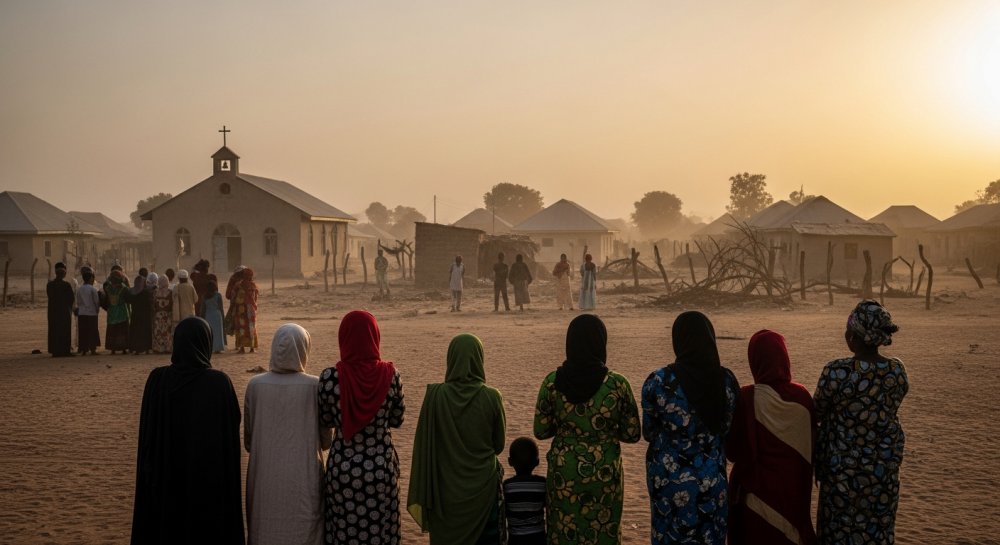
Suspected Fulani herdsmen launched coordinated attacks on two Christian villages in Kaduna state, Nigeria, resulting in tragic loss of life and multiple abductions. The raids, which occurred on Thursday, June 25, left two Christians dead, seven kidnapped, and dozens injured, according to local residents.
The attacks targeted Christian communities in the same region, marking another chapter in the ongoing persecution of believers in northern Nigeria. Kaduna state has become a focal point for violence against Christians, with radical militants increasingly targeting villages and churches.
The coordinated nature of the raids suggests a level of planning and organization by the attackers, who struck both communities in quick succession. Families have been torn apart by the kidnappings, while the injured are receiving medical treatment for their wounds.
This incident highlights the ongoing crisis facing Christians in Nigeria, where believers continue to face violence, displacement, and death at the hands of extremist groups. The international community has increasingly called attention to the systematic targeting of Christians in the region, yet attacks continue with alarming frequency.
Local authorities are investigating the attacks, but many Christian communities feel abandoned and vulnerable to future violence. The situation demands urgent attention from both Nigerian officials and international observers concerned with religious freedom and human rights.
Let us know what you think, please share your thoughts in the comments below.
Faith Facts
- Pastor Matthew Olson preached the entire Bible from Genesis to Revelation over 96 consecutive hours in a record-breaking marathon event.
- When his voice began to fail midway through, fellow pastors gathered to pray for him, and he experienced what he called a miraculous restoration.
- The marathon sermon drew thousands of viewers online and raised awareness about the power of God’s Word and intercessory prayer.
In an extraordinary display of endurance and faith, Pastor Matthew Olson embarked on what many would consider impossible: preaching through every book of the Bible without stopping for four full days. The ambitious undertaking pushed him to the very edge of human capability, testing not just his physical stamina but his spiritual resolve.
Olson’s marathon sermon began with enthusiasm and energy, drawing viewers from across the country who tuned in online to witness this remarkable feat. The goal was clear: to honor God’s Word by proclaiming it from cover to cover, demonstrating that Scripture remains living and active in our modern age.
But somewhere in the middle of this grueling journey, disaster struck. Olson’s voice, strained beyond its natural limits, began to fail him. For a preacher attempting to deliver God’s Word continuously for 96 hours, losing his voice could have meant the end of the entire endeavor.
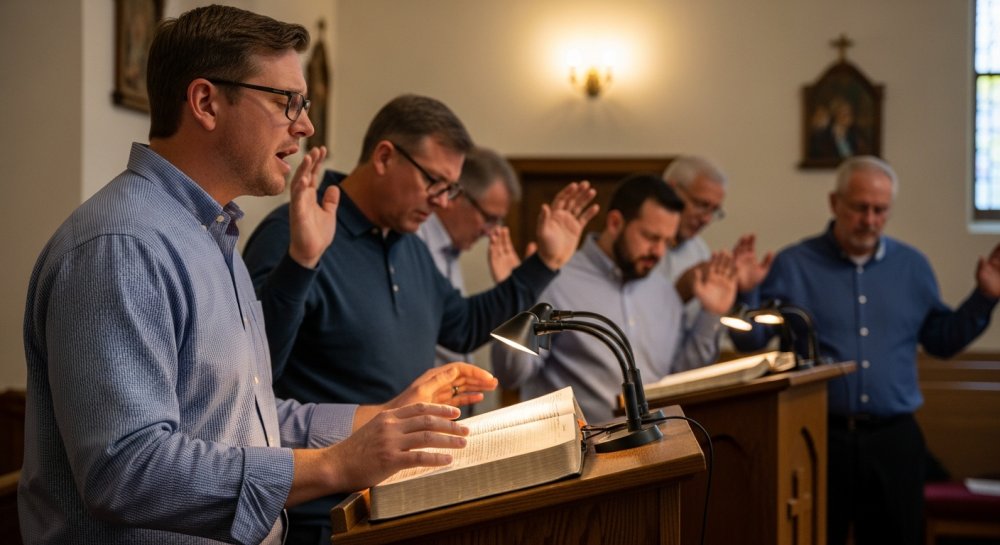
What happened next has become a testimony to the power of corporate prayer and God’s faithfulness. When word spread that Olson was struggling, fellow pastors and believers gathered around him to lay hands and pray for healing and strength.
The response was immediate and undeniable. Witnesses reported that Olson’s voice returned with renewed strength, allowing him to continue his mission. Many who watched described the moment as nothing short of miraculous — a modern-day demonstration of God responding to the prayers of His people.
This remarkable event serves as a powerful reminder that God still works through His servants today. In an era when many question the relevance of Scripture or the power of prayer, Olson’s experience stands as compelling evidence that both remain central to the Christian life.
The 96-hour sermon marathon also highlights the enduring value of God’s Word. From the creation account in Genesis to the apocalyptic visions in Revelation, the Bible contains God’s revealed truth for humanity. Olson’s dedication to proclaiming all of it demonstrates a reverence for Scripture that our culture desperately needs to reclaim.
For believers watching from home, the event became more than entertainment or spectacle. It transformed into a shared spiritual journey, reminding Christians of the depth and breadth of the biblical narrative. Many reported being encouraged in their own faith walk by witnessing such dedication to preaching the Gospel.
The prayer intervention that restored Olson’s voice also speaks to the importance of Christian community and mutual support. When one member of the Body of Christ struggles, others step in to bear the burden. This biblical principle came alive in real time as pastors gathered to intercede for their brother in ministry.
Olson’s accomplishment now stands as a testament to what God can do through those willing to push beyond normal limits for His glory. The record-breaking sermon demonstrates that with faith, determination, and the support of fellow believers, Christians can achieve what seems impossible.
This event also challenges believers to consider their own commitment to Scripture. If one pastor could dedicate 96 hours to preaching the entire Bible, how much time are we dedicating to reading and studying God’s Word in our daily lives?
As news of this remarkable achievement spreads throughout the Christian community, it serves as an encouraging reminder that God is still at work in powerful ways. The combination of human dedication and divine intervention created a moment that will inspire believers for years to come.
Let us know what you think, please share your thoughts in the comments below.
Faith Facts
- The United Methodist Church recently adopted progressive stances on sexuality and gender that contradict traditional Methodist doctrine and Scripture
- Over 7,600 conservative congregations representing more than 2 million members have disaffiliated from the UMC since 2019
- The departing churches are maintaining John Wesley’s original teachings while the UMC hierarchy embraces secular cultural trends
The ongoing split within the United Methodist Church has prompted many to ask a fundamental question: Who is actually abandoning the faith John Wesley established centuries ago?
The answer may surprise those who only follow mainstream media narratives.
When the UMC officially removed restrictions on same-sex marriage and ordination of non-celibate LGBTQ clergy in 2024, denominational leaders celebrated it as progress. But for millions of faithful Methodists, it represented a complete departure from biblical Christianity and the theology that defined their movement for generations.
The departing congregations aren’t leaving Methodism—they’re preserving it. These churches continue to uphold Wesley’s commitment to scriptural authority, orthodox Christian teaching, and the transformative power of the Gospel. They maintain the theological distinctives that made Methodism a powerful force for spiritual renewal in America and around the world.
Meanwhile, the institutional UMC has embraced the very cultural accommodation that Wesley himself warned against. The founder of Methodism emphasized personal holiness, biblical fidelity, and resistance to worldly compromise. Today’s UMC leadership promotes positions that would be unrecognizable to Wesley and the early Methodist pioneers.
The numbers tell the story. Thousands of churches representing some of the most vibrant, evangelistic, and missions-focused congregations in American Methodism have chosen to disaffiliate. These aren’t peripheral communities—they’re often the churches with the strongest youth ministries, the most active mission programs, and the deepest commitment to biblical preaching.
What remains in the UMC increasingly resembles mainline Protestant denominations that have been in numerical and spiritual decline for decades. When churches prioritize cultural relevance over biblical faithfulness, history shows the inevitable result: empty pews and theological confusion.
The conservative Methodist denominations emerging from this split—including the Global Methodist Church—are experiencing growth and renewed mission focus. They’re attracting not only disaffiliating UMC congregations but also new church plants led by younger pastors committed to orthodox Christianity.
This pattern repeats throughout church history. When institutional bodies drift from their theological foundations, faithful remnants preserve the original vision. The Reformation itself began when church leaders prioritized institutional power over biblical truth.
The irony is profound: those accused of leaving Methodism are actually the ones staying faithful to Methodist teaching. They hold to the same doctrines, embrace the same scriptural commitments, and pursue the same mission that defined Methodism from the beginning. The institutional UMC, by contrast, has adopted positions that explicitly contradict Methodist historical teaching and the clear witness of Scripture.
For conservative Christians watching this unfold, the lesson is clear. Denominations and institutions are only valuable insofar as they remain faithful to biblical truth. When leadership abandons that foundation, the truly faithful response isn’t blind institutional loyalty—it’s preserving authentic Christianity, even if that means forming new structures.
The exodus from the UMC also highlights a broader reality in American Christianity. Millions of believers are tired of churches that sound more like the culture than like Scripture. They’re hungry for leaders who will teach biblical truth without apology, even when that truth conflicts with popular opinion.
As this realignment continues, one thing becomes increasingly evident: the future of vibrant, growing Christianity in America belongs to those who refuse to compromise biblical teaching for cultural acceptance. The churches departing the UMC understand this. They’re not abandoning Methodism—they’re fighting to preserve it for future generations.
Let us know what you think, please share your thoughts in the comments below.


-

 Self-Reliance1 year ago
Trump’s Bold Move Uncovers Massive Social Security Fraud
-

 Faith1 year ago
New Clues Emerge in Noah’s Ark Mystery
-

 News1 year ago
Governor Walz’s Rhetoric Sparks National Controversy
-

 News1 year ago
Mel Gibson’s ‘The Passion of the Christ’ Sequel Title Announced
-

 Family1 year ago
Texas Lawmaker Targets Furries in Schools
-

 Freedom1 year ago
Maine Lawmaker Challenges Sports Fairness Controversy
-

 Family1 year ago
Canada’s Controversial Policy Sparks Ethical Debate
-
Faith7 months ago
Congress Hears Pleas for Nigerian Christians