
Faith
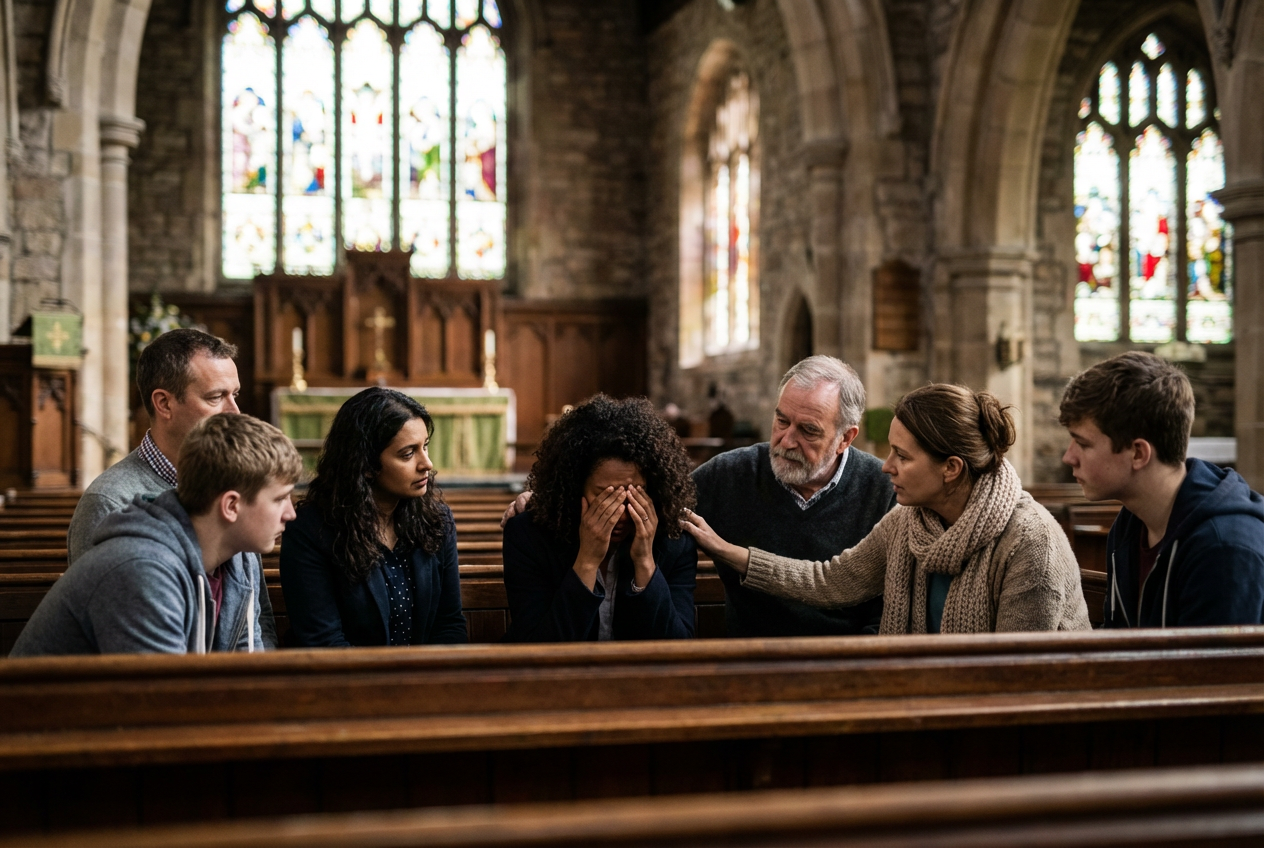
Mournful Hearts Find Space in God’s Embracing Grace and Scripture

Faith Facts
- Christ Jesus wept at the tomb of Lazarus, showing that sorrow is a holy and expected response to death.
- The promise of God wiping away all tears in Revelation 21:4 refers to the eternal kingdom, not necessarily our current life.
- Believers are called to grieve with hope, yet this hope does not negate the need for time to mourn.
True Christian fellowship requires standing with the brokenhearted rather than rushing them toward a forced sense of victory. While believers hold a blessed hope in Christ, the Bible never suggests that our earthly journey will be free from deep sorrow and lamentation.
We must reject a sanitized version of faith that views grief as a lack of spiritual maturity or an embarrassment to the Gospel. Scriptural victory involves the presence of God in our pain, not the absence of the pain itself.
The Church should be the primary sanctuary where the hurting feel safe to express their loss without judgment or pressure to move on. By listening and crying with those in need, we reflect the heart of a Savior who is near to the brokenhearted.
May we cultivate a biblical worldview that honors the sanctity of life and the reality of loss until we reach our eternal home.



Faith Facts
- Christians and Jews share the same foundational Scriptures and worship the God of Abraham, Isaac, and Jacob
- Jesus Christ was Jewish, making antisemitism fundamentally incompatible with Christian faith
- Biblical prophecy ties the fate of nations directly to how they treat the Jewish people
The rise of antisemitism across America and the world isn’t just a Jewish problem—it’s a direct assault on the Christian faith itself. Believers who understand Scripture recognize that hatred of the Jewish people contradicts the very foundation of Christianity.
First, Christians worship a Jewish Messiah. Jesus Christ was born a Jew, lived as a Jew, and fulfilled Jewish prophecy. Every Christian prayer, every Scripture reading, and every worship service connects directly to the Jewish roots of our faith. To hate Jews while claiming to follow a Jewish Savior reveals a profound spiritual contradiction that cannot be reconciled with genuine faith.
Second, the Bible Christians cherish was written primarily by Jewish authors under divine inspiration. From Moses to the prophets, from the Psalms to the Gospels, God chose the Jewish people as the vessel through which His Word came to the world. The apostles who spread the Gospel were Jewish men who risked everything to share the message of salvation. Rejecting or hating the Jewish people means rejecting the very instruments God used to bring us His truth.
Third, Scripture is crystal clear about God’s eternal covenant with the Jewish people. In Genesis 12:3, God promises Abraham, “I will bless those who bless you, and whoever curses you I will curse.” This wasn’t a temporary arrangement or a conditional promise—it remains in effect today. Nations and individuals who stand with Israel and the Jewish people align themselves with God’s purposes, while those who oppose them place themselves in opposition to the Almighty.
Fourth, the spiritual battle against antisemitism is ultimately a battle against God’s plan for human redemption. Satan has always sought to destroy the Jewish people because through them came the Messiah, the Scriptures, and God’s revelation to mankind. From Pharaoh to Haman to Hitler, the enemy has used Jew-hatred as a weapon against God’s purposes. Christians who understand spiritual warfare recognize antisemitism as demonic in origin and antithetical to the Kingdom of God.
The connection between Christianity and Judaism isn’t merely historical—it’s theological, spiritual, and eternal. The roots of Christian faith run deep into Jewish soil, watered by the same God who chose Abraham and sent His Son to save the world.
As antisemitism surges in universities, city streets, and even some churches, Christians face a defining moment. Will we stand with our Jewish brothers and sisters, or will we remain silent? Will we defend the people through whom God gave us everything, or will we turn away when they need allies most?
The answer for faithful Christians should be obvious. We cannot claim to love God while hating those He called His chosen people. We cannot honor Christ while dishonoring His heritage. We cannot read our Bibles with gratitude while harboring animosity toward those who wrote it.
Christian support for the Jewish people isn’t about politics—it’s about faithfulness to Scripture and obedience to God. It’s about recognizing that the same demonic hatred that filled concentration camps now masquerades as political activism on college campuses and city streets.
Every generation of Christians faces tests of faith and courage. This is ours. Standing against antisemitism isn’t optional for believers—it’s commanded by Scripture, modeled by Christ, and essential to authentic Christian witness.
The God we serve doesn’t change, and His promises to the Jewish people haven’t been revoked. Christians who understand this truth will not hesitate to condemn antisemitism wherever it appears, whether in the political left’s anti-Israel activism or in fringe movements claiming Christian identity while preaching hatred.
Let us know what you think, please share your thoughts in the comments below.

Faith Facts
- Christians in Bangladesh are facing increased sectarian violence, particularly in regions dominated by the Islamist Jamaat-e-Islami party
- Believers are living in heightened fear following recent elections, as extremist elements have intensified their targeting of religious minorities
- The attacks represent a troubling escalation of religious persecution against the Christian community in this Muslim-majority nation
Faithful Christians in Bangladesh find themselves navigating a landscape of mounting danger as Islamist extremists ramp up their campaign of intimidation and violence. The situation has become particularly dire in areas where the radical Jamaat-e-Islami party holds significant influence, leaving believers to worship under the shadow of persecution.
The Christian community, though small in this predominantly Muslim nation, has long maintained a quiet presence focused on worship, service, and family. Now, however, that peaceful existence is under direct assault from those who would deny the fundamental human right to practice one’s faith freely.
This escalating persecution serves as a stark reminder of the cost of discipleship in regions hostile to the Gospel. While many American Christians enjoy constitutional protections and religious liberty, their brothers and sisters in Bangladesh face real threats to their safety, their livelihoods, and even their lives simply for following Christ.
The timing of these attacks—coinciding with the electoral period—suggests a calculated effort by extremist elements to exploit political transitions for sectarian purposes. Such violence contradicts the principles of freedom and human dignity that form the bedrock of civilized society and Christian teaching.
For believers committed to the Great Commission and the global body of Christ, the plight of Bangladeshi Christians demands both prayer and advocacy. Religious freedom is not merely a political preference but a God-given right that transcends borders and cultures.
As persecution intensifies, the faith and resilience of these believers stands as a powerful testimony. Their willingness to remain steadfast despite mounting pressure exemplifies the courage that has characterized the Church throughout its history, from the Roman catacombs to modern-day restricted nations.
The international community, particularly nations founded on Judeo-Christian principles like the United States, bears a moral responsibility to shine a light on such persecution and to support policies that protect religious minorities worldwide. Faith is not a crime, and those who practice it peacefully deserve protection, not persecution.
Let us know what you think, please share your thoughts in the comments below.

Faith Facts
- Matthew Rothert Sr., a small-town Arkansas man, led the successful campaign to put ‘In God We Trust’ on U.S. paper currency
- His children credit their father’s accomplishment entirely to God’s providence and guidance
- The story demonstrates how one faithful person can make a lasting impact on American culture and heritage
The children of the man responsible for ensuring “In God We Trust” appears on American paper currency say their father’s remarkable achievement proves that ordinary citizens, empowered by faith, can change the course of history.
Matthew Rothert Sr., a humble Arkansas resident, spearheaded the campaign that resulted in the national motto being printed on U.S. bills. His family told The Christian Post that the story of how this came to be is nothing short of providential.
“One person, with the Lord’s help, can make a difference,” Rothert’s children explained, emphasizing that their father’s success was rooted in divine guidance rather than political connections or personal ambition.
The placement of “In God We Trust” on American currency stands as a testament to the nation’s Christian heritage and foundational values. What many Americans handle daily without a second thought represents one man’s determination to honor God in the public square.
Rothert Sr.’s children made clear that their father deserves no personal glory for the accomplishment. Instead, they direct all credit to the Lord, whose hand they believe guided their father’s efforts from beginning to end.
The story serves as an encouragement to Christians today who may feel powerless to influence culture or government. The Rothert family’s testimony demonstrates that God can use anyone—regardless of their social standing, geographic location, or political influence—to accomplish His purposes.
This small-town success story reminds believers that faithfulness matters more than prominence. Matthew Rothert Sr. wasn’t a Washington insider or a wealthy donor, yet his faith-driven initiative left an indelible mark on American society that continues to this day.
Every time Americans handle paper money, they encounter a reminder of the nation’s acknowledgment of God—a legacy that one faithful Arkansas man helped secure for future generations.
Let us know what you think, please share your thoughts in the comments below.


-

 Self-Reliance1 year ago
Trump’s Bold Move Uncovers Massive Social Security Fraud
-

 Faith1 year ago
New Clues Emerge in Noah’s Ark Mystery
-

 News1 year ago
Governor Walz’s Rhetoric Sparks National Controversy
-

 News1 year ago
Mel Gibson’s ‘The Passion of the Christ’ Sequel Title Announced
-

 Family1 year ago
Texas Lawmaker Targets Furries in Schools
-

 Freedom1 year ago
Maine Lawmaker Challenges Sports Fairness Controversy
-

 Family1 year ago
Canada’s Controversial Policy Sparks Ethical Debate
-
Faith6 months ago
Congress Hears Pleas for Nigerian Christians