
Faith
Mel Gibson Unveils Surprising New Direction for Passion Sequel


Faith Facts
- Mel Gibson’s long-awaited sequel to ‘The Passion of the Christ’ will be filmed in English, a departure from the original’s Aramaic and Latin dialogue
- The follow-up will be structured as two parts with a non-linear storytelling approach, diverging from the 2004 film’s chronological narrative
- The original ‘Passion of the Christ’ became one of the highest-grossing faith-based films in history, profoundly impacting Christian audiences worldwide
After nearly two decades of anticipation, filmmaker Mel Gibson has revealed key details about his planned sequel to the groundbreaking biblical epic that moved millions of believers in 2004. The new project represents a significant creative evolution while maintaining the spiritual foundation that made the original so powerful.
According to Gibson, the upcoming continuation of Christianity’s central story will depart from the original film’s format in several meaningful ways. Most notably, the dialogue will be presented in English rather than the ancient Aramaic and Latin that gave the first film its authentic historical atmosphere.
The filmmaker has also confirmed that the sequel will span two parts and utilize a non-linear narrative structure. This approach marks a stark contrast to the 2004 release, which followed a straightforward chronological path through Christ’s final hours.
Gibson’s original “The Passion of the Christ” sparked a cultural phenomenon upon its release, becoming a touchstone for Christian communities across America and around the globe. The film’s unflinching portrayal of Christ’s sacrifice resonated deeply with audiences seeking authentic biblical storytelling in an increasingly secular entertainment landscape.
The decision to film the sequel in English suggests Gibson aims to reach an even broader audience while maintaining the spiritual integrity that defined his first effort. Many faith-based filmmakers have struggled to balance accessibility with authenticity, but Gibson’s proven track record gives believers reason for optimism.
While specific plot details remain under wraps, the two-part structure indicates an ambitious scope for the project. The non-linear approach could allow for creative exploration of the Resurrection and its aftermath, potentially weaving together multiple timelines and perspectives from Scripture.
The original film faced significant opposition from secular critics but found overwhelming support among Christian audiences who had long waited for Hollywood to treat their faith with seriousness and respect. Its commercial success demonstrated the enormous appetite for quality faith-based content in American culture.
As production details continue to emerge, Christian moviegoers across the nation are watching with great interest. The sequel represents an opportunity to once again bring the greatest story ever told to the big screen with the reverence and artistic excellence it deserves.
Let us know what you think, please share your thoughts in the comments below.


Faith Facts
- Church elder Greg Sutton wrote a book exploring biblical topics he believes have been neglected by modern churches
- Sutton’s motivation stemmed from a desire to clarify his own beliefs and strengthen fellow Christians’ faith
- The work addresses doctrinal subjects the author says are being overlooked in contemporary Christian teaching
A devoted church elder and lay preacher is calling attention to what he sees as a troubling trend in American Christianity: the abandonment of foundational biblical teachings that once anchored the faith.
Greg Sutton never planned to become an author. His journey into writing began with a more personal mission—to examine and solidify what he truly believes as a Christian, and in doing so, to help strengthen the faith of others walking the same path.
What emerged from that spiritual quest is a book that tackles subjects Sutton believes have been pushed to the margins of modern church life. In an era when many congregations focus on cultural relevance and feel-good messages, he argues that essential biblical truths are being left behind—forgotten doctrines that previous generations held as central to Christian identity.
Sutton’s work represents a growing concern among faithful believers that the church has drifted from its theological moorings. As entertainment-driven worship and therapeutic sermons become the norm, the deep wells of Scripture risk running dry in the lives of ordinary Christians.
For Sutton, the issue is not merely academic. It’s about equipping believers with the solid foundation they need to stand firm in an increasingly hostile culture.
His book serves as both a personal testimony and a challenge to the broader Christian community: Are we preserving the full counsel of God’s Word, or are we allowing convenience and comfort to dictate what gets taught from the pulpit?
The lay preacher’s efforts reflect a hunger among many American Christians for substantive biblical teaching—a return to the doctrines that have sustained the church through centuries of trials and triumphs. In a time when truth itself is under assault, Sutton’s work offers a reminder that some things are too important to be forgotten.
Let us know what you think, please share your thoughts in the comments below.
Faith Facts
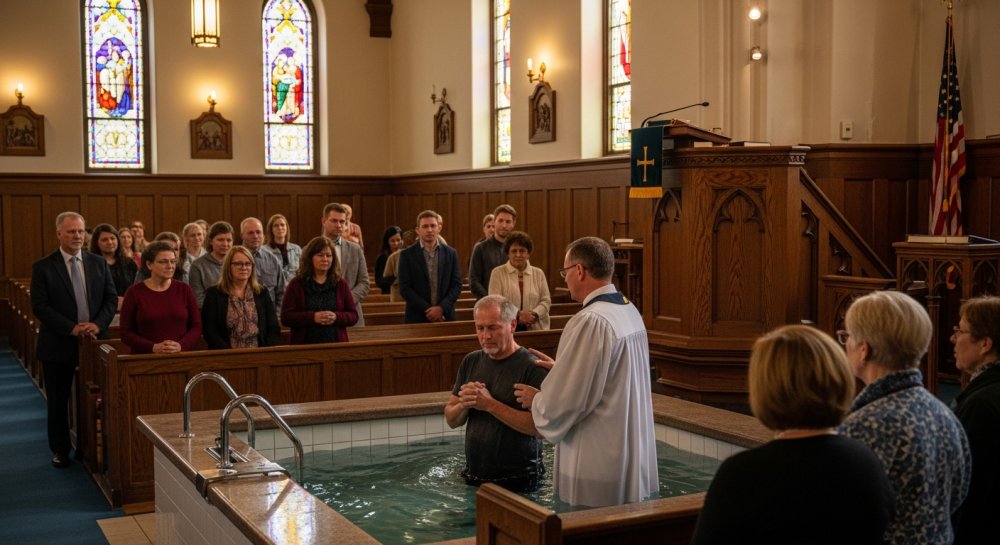
- Adults comprised more than half of all 263,000 baptisms in Southern Baptist Convention churches last year, marking a significant demographic shift
- Lifeway Research analysis reveals changing patterns in who is responding to the Gospel message in America’s largest Protestant denomination
- The data suggests a growing spiritual hunger among adults seeking Christ in traditional church settings
America’s largest Protestant denomination is witnessing a remarkable change in who is coming to faith in Jesus Christ. For the first time in recent memory, adults are responding to the Gospel in numbers that exceed younger converts, according to new research from Lifeway Research analyzing Southern Baptist Convention baptism data.
The Southern Baptist Convention reported more than 263,000 baptisms across its churches last year. What makes this figure particularly noteworthy is that adults accounted for the majority of these professions of faith—a shift that signals changing spiritual dynamics across the nation.
This demographic transformation in baptisms reflects a broader cultural moment where adults are increasingly seeking answers to life’s deepest questions. In an era marked by social upheaval, economic uncertainty, and cultural confusion, many Americans are turning to the timeless truths of Scripture and the hope found only in Christ.
The increase in adult baptisms also validates the faithful witness of Christian families, friends, and church communities who have been praying for and sharing the Gospel with those around them. It demonstrates that the message of salvation remains as powerful and relevant today as it was 2,000 years ago.
Southern Baptist churches have long been known for their commitment to evangelism and discipleship. This data suggests that their consistent Gospel witness is bearing fruit among adults who may have previously been unreached or resistant to the Christian message.
The shift toward adult conversions also carries significant implications for church ministry and discipleship. Adult believers often bring unique life experiences, questions, and challenges that require thoughtful biblical instruction and supportive Christian community as they grow in their newfound faith.
As our nation continues to grapple with moral and spiritual questions, these baptism statistics offer a glimmer of hope. They remind us that God is still at work in hearts and lives, drawing men and women to Himself through the power of the Gospel and the faithful witness of His people.
Let us know what you think, please share your thoughts in the comments below.

Faith Facts
- A comprehensive new report warns that Christians in Afghanistan face a credible risk of genocide five years after the Taliban returned to power
- Afghanistan ranks as the most dangerous nation on earth for Christians according to persecution watchdog organizations
- The Afghan Christian community practices their faith in complete secrecy due to the severe threat of execution under Taliban rule
Five years have passed since the Taliban reclaimed control of Afghanistan, and a disturbing new analysis reveals that believers in Christ living under their regime face conditions that meet the legal threshold for genocide. The findings paint a grim picture of what has become the world’s most perilous environment for practicing Christianity.
Dr. Martin Parsons, who authored the detailed report, explains that Afghan Christians exist in a state of complete concealment. The consequences for openly professing faith in Jesus Christ are severe and often fatal under the Taliban’s strict interpretation of Islamic law.
“Christians in Afghanistan live in absolute secrecy,” the report states. “Discovery of their faith can result in immediate execution, torture, or forced marriage of Christian women to Taliban fighters.”
The situation represents a humanitarian crisis that has received insufficient attention from Western nations and international bodies. While Afghanistan once hosted small communities of believers, the Taliban’s return has driven the faithful completely underground.
According to multiple persecution monitoring organizations, Afghanistan now holds the distinction of being the single most dangerous country globally for Christians. This ranking reflects not just restrictions on religious freedom, but active persecution that includes violence, imprisonment, and death.
The report documents systematic patterns of persecution that align with international legal definitions of genocide. These include the deliberate infliction of conditions calculated to bring about the physical destruction of the Christian community, prevention of births within the group through forced conversions and marriages, and the forcible transfer of children from Christian families.
Dr. Parsons emphasizes that the threat extends beyond individual acts of violence to a coordinated effort to eliminate Christianity from Afghan society entirely. The Taliban views conversion from Islam to Christianity as apostasy, a crime punishable by death under their interpretation of Sharia law.
“The systematic nature of this persecution, combined with the intent to destroy the Christian community, meets the criteria established by international law for genocide,” the report concludes.
Afghan believers face not only government persecution but also threats from family members and neighbors who view conversion to Christianity as a betrayal worthy of death. This creates an environment where practicing the faith requires extraordinary courage and constant vigilance.
The report calls on Western governments and Christian organizations to recognize the severity of the crisis and take concrete action to protect vulnerable believers. This includes expanding refugee programs specifically for Afghan Christians and increasing diplomatic pressure on the Taliban regime.
For American Christians, the findings serve as a sobering reminder of the precious nature of religious liberty and the urgent need to advocate for persecuted brothers and sisters around the world. The situation in Afghanistan demonstrates what happens when radical Islamic ideology gains unchecked power over a population.
The release of this report comes at a critical moment when international attention on Afghanistan has waned since the chaotic American withdrawal in 2021. The findings demand renewed focus on the human rights catastrophe unfolding under Taliban rule, particularly for religious minorities who lack any legal protection.
Prayer, advocacy, and support for organizations working to aid Afghan Christians remain essential responses from the global Church. The report makes clear that without sustained international pressure and assistance, the small community of Afghan believers faces the very real possibility of complete eradication.
Let us know what you think, please share your thoughts in the comments below.


-

 Self-Reliance1 year ago
Trump’s Bold Move Uncovers Massive Social Security Fraud
-

 Faith1 year ago
New Clues Emerge in Noah’s Ark Mystery
-

 News1 year ago
Governor Walz’s Rhetoric Sparks National Controversy
-

 News1 year ago
Mel Gibson’s ‘The Passion of the Christ’ Sequel Title Announced
-

 Family1 year ago
Texas Lawmaker Targets Furries in Schools
-

 Freedom1 year ago
Maine Lawmaker Challenges Sports Fairness Controversy
-

 Family1 year ago
Canada’s Controversial Policy Sparks Ethical Debate
-
Faith9 months ago
Congress Hears Pleas for Nigerian Christians