
Faith
Major UK Christian Conference Announces Powerful Voice for Church Leadership Event


Faith Facts
- Evangelist J.John will keynote the newly launched Church Leaders Conference at CRE 2026 in England this October
- The Church Resources Exhibition (CRE), formerly the Christian Resources Exhibition, is bringing focused leadership training to UK church leaders
- The conference represents a strategic investment in equipping Christian leaders for effective ministry in challenging times
A prominent voice in Christian evangelism is set to address church leaders across the United Kingdom as they gather for a major new conference this fall. The announcement signals a renewed focus on strengthening pastoral leadership in an era when churches face mounting cultural and spiritual challenges.
The Church Resources Exhibition (CRE), a well-established gathering for Christian ministry professionals, has announced that evangelist J.John will serve as a keynote speaker for its newly launched Church Leaders Conference. The event will take place in England this October, bringing together pastors, ministry leaders, and church staff for focused training and encouragement.
J.John has built a reputation for clear, accessible presentations of biblical truth combined with practical application for everyday Christian living. His ministry has reached audiences across denominational lines, making him a fitting choice for a conference designed to serve the broader church community in the United Kingdom.
The Church Resources Exhibition has operated under various names over its history, previously known as the Christian Resources Exhibition. The organization serves as a hub for churches seeking practical resources, ministry tools, and professional development opportunities for their leadership teams.
The introduction of a dedicated Church Leaders Conference represents an expansion of CRE’s mission. Rather than focusing solely on resources and materials, the new conference component addresses the personal and professional development needs of those shepherding congregations in an increasingly secular society.
Church leaders in the UK face distinctive pressures as Christianity’s cultural influence continues to decline across Western Europe. Attendance trends, generational gaps, and hostile social attitudes toward traditional Christian teaching create an environment where pastoral encouragement and strategic training carry heightened importance.
By bringing together leaders from various streams of British Christianity, the conference creates opportunities for collaboration, mutual support, and shared learning. Such gatherings can help combat the isolation that many pastors experience, particularly those serving smaller congregations without extensive staff support.
The selection of J.John as a keynote speaker suggests the conference will emphasize evangelistic zeal alongside practical ministry skills. His track record includes major public evangelistic campaigns that have drawn thousands, as well as more intimate teaching settings focused on discipleship and spiritual formation.
October’s conference will provide an opportunity for British church leaders to refocus on core mission priorities while gaining fresh tools for effective ministry. In a cultural climate that increasingly marginalizes Christian voices, such gatherings offer crucial support for those called to proclaim truth without compromise.
The expansion from a resource exhibition to include a dedicated leadership conference reflects growing recognition that churches need more than materials and programs—they need leaders equipped with vision, biblical grounding, and practical wisdom for navigating complex ministry challenges.
Let us know what you think, please share your thoughts in the comments below.

Faith Facts
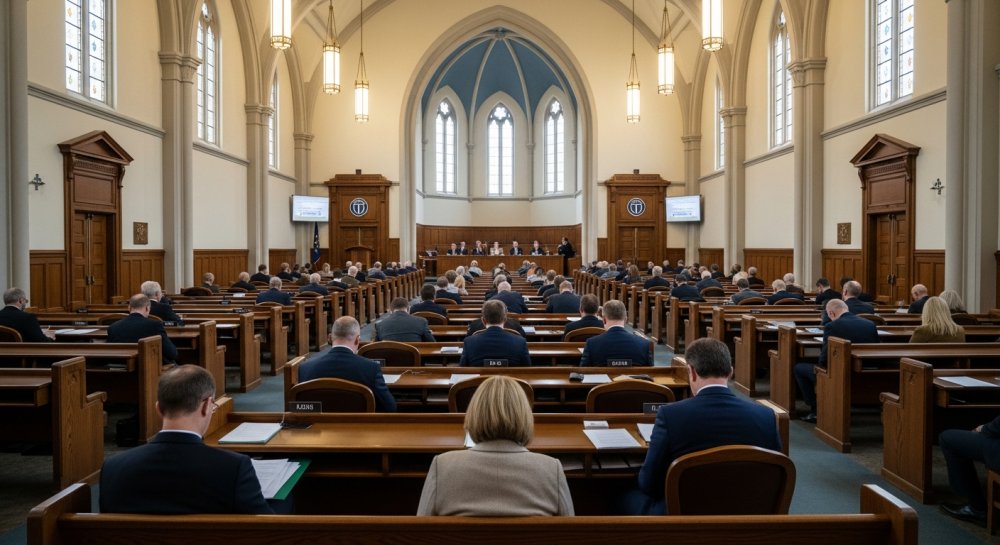
- Presbyterian Church in America General Assembly voted against ordaining women as deacons at its annual meeting in Louisville, Kentucky
- The decision maintains the denomination’s traditional understanding of biblical church leadership and ordained offices
- The assembly also advanced a report examining Christian nationalism during this week’s proceedings
The Presbyterian Church in America has reaffirmed its commitment to traditional biblical leadership structures. During its General Assembly meeting in Louisville, Kentucky this week, the denomination voted decisively against an overture that would have opened the office of ordained deacon to women.
The decision reflects the PCA’s continued adherence to complementarian theology, which holds that men and women have distinct, God-given roles in the church. This theological position interprets Scripture as reserving ordained church offices for qualified men while honoring the vital contributions women make in other ministry capacities.
The PCA just crushed Overture 37, which would have allowed women to serve as deacons. With barely any support, which can be heard in the resounding ‘Yeas’ and whimpering ‘Nays,’ it was dead on arrival. #pcagapic.twitter.com/2voo3noFMC
— Protestia (@Protestia) June 25, 2026
For many conservative Presbyterian believers, the vote represents a faithful stand on biblical authority in an era when many mainline denominations have abandoned traditional interpretations of Scripture on leadership and gender roles. The PCA, which separated from the more liberal Presbyterian Church (USA) in 1973, has consistently maintained conservative positions on doctrinal matters.
The assembly’s decision comes as American Christianity faces increasing pressure to conform to cultural trends that often conflict with historic Christian teaching. Denominations that have embraced progressive positions on gender and sexuality have frequently experienced declining membership and theological drift.
In addition to the deacon question, the General Assembly advanced a report addressing Christian nationalism. The examination of this topic reflects ongoing discussions within conservative Christian circles about the proper relationship between faith and civic engagement, particularly as believers seek to maintain religious liberty and biblical values in the public square.
The PCA’s actions this week demonstrate the denomination’s commitment to deliberative decision-making on matters of church practice and doctrine. With approximately 1,500 congregations and 380,000 members, the PCA remains one of the largest conservative Presbyterian bodies in the United States.
As various Christian denominations navigate questions of biblical interpretation and cultural engagement, the PCA’s votes highlight the ongoing importance that many believers place on maintaining theological consistency with Scripture and historic Christian orthodoxy.
Let us know what you think, please share your thoughts in the comments below.

Faith Facts
- Pope Paul VI’s coronation in 1963 was the last papal coronation in Catholic Church history, ending a tradition spanning over a millennium
- Gospel music legend Andraé Crouch was born this week in 1942, going on to shape contemporary Christian worship music for generations
- Anglican missionaries arrived in Borneo during this week in church history, bringing the Gospel to Southeast Asia
This week marks several pivotal moments in Christian history that continue to shape the faith today. From the end of an ancient papal tradition to the birth of a gospel music pioneer, these events remind us of how God works through both institutional change and individual gifts to advance His kingdom.
On June 30, 1963, Pope Paul VI received the papal tiara in what would become the final coronation ceremony in Roman Catholic history. The elaborate ritual, which had crowned popes for over a thousand years, featured the ornate triple crown symbolizing the pontiff’s authority. Pope Paul VI later chose to set aside the practice, signaling a shift toward humility and simplicity in papal leadership that continues to this day.
In a very different corner of Christendom, July 1, 1942, marked the birth of Andraé Crouch in Los Angeles, California. The son of a pastor, Crouch would grow to become one of the most influential figures in gospel and contemporary Christian music. His songs, including “My Tribute (To God Be the Glory)” and “The Blood Will Never Lose Its Power,” have been sung in churches across denominational lines for decades.
Crouch’s musical ministry broke down barriers between traditional gospel and contemporary worship, helping to usher in a new era of praise music that emphasized both musical excellence and biblical truth. His work earned him seven Grammy Awards and an Academy Award nomination, demonstrating that music rooted in Christian faith could achieve both spiritual impact and artistic recognition.
Also this week in Christian history, Anglican missionaries arrived in Borneo, bringing the message of salvation to indigenous populations in Southeast Asia. Their arrival represented the ongoing fulfillment of the Great Commission, as faithful believers carried the Gospel to distant shores where Christ’s name had not yet been proclaimed.
These diverse events—spanning continents, denominations, and centuries—illustrate the multifaceted nature of Christian witness. Whether through institutional reform, artistic expression, or missionary zeal, believers throughout history have found different ways to honor Christ and spread His truth.
The end of papal coronations reflected a broader movement within Catholicism toward evangelical simplicity. The birth of Andraé Crouch gave the church a voice that would inspire millions to worship with joy and authenticity. And the arrival of missionaries in Borneo demonstrated the enduring call to take the Gospel to every nation.
Each of these moments reminds us that Christian history is not merely a record of the past, but a living testimony to God’s ongoing work in His church. As we remember these events, we are called to consider how we, too, might faithfully serve in our own generation.
Let us know what you think, please share your thoughts in the comments below.

Faith Facts
- Christian author Linda Condolora offers practical guidance for believers who feel spiritually stagnant in their walk with Christ
- “Bold Devotion” uses an acrostic structure to help readers reignite the fervor they experienced at their conversion
- The book emphasizes sacrificing worldly distractions, diving deeper into Scripture, and living intentionally for the Lord
We all know about the rut — the one that we who have been Christians for quite some time can get into. The one where our spiritual fervor is depleted and our autopilot kicks on to keep us moving forward.
This is where going through the motions becomes our normal, and we don’t even realize we have slipped into the rut until a book like “Bold Devotion” shakes us and pulls us out.
Linda Condolora, a member of the Wetzel Road Church of Christ in Liverpool, N.Y., provides practical advice on how to regain that zeal we had when we first arose from the watery grave of baptism!
Her book invites readers to assess their lives and do some house cleaning where necessary. The chapters revolve around topics that will help us to achieve this by using an acrostic of the book’s title.
She begins with our reflection of Jesus and how we need to refocus our lenses on him, not letting worldly distractions blur our vision. Others are sure to detect whether we have been spending time with the Lord, and how we represent Christ to the world is of utmost importance.
Condolora consistently urges us to sacrifice our wants and desires and to dive deeper into the depth of God’s Word — focusing on the meaty morsels and not simply on the milk.
Next, we are called to not be ignorant of God’s expectations clearly laid out by the measuring stick standard — his Holy Writ. By doing so, we gain a greater understanding of who we once were and where God has brought us through the death of his son.
This helps us with our attitudes toward the lost because we realize we were once in the same situation! Our rut can sometimes look like spending all of our time with the church and not seeing the opportunities that God is setting before us to reach souls.
The remainder of the book centers on aligning with God’s will, living inconveniently and whole-heartedly for the Lord, and tying ourselves to truth as we worship and serve him accordingly.
Condolora’s thoughts on being prepared and intentional about how we can influence others to live the abundant life stuck with me as I earnestly jotted down notes and highlighted passages. A final note on the Holy Spirit and prayer wraps up the book’s desire for us to utilize these powerful tools and gifts in our lives.
One of the things I enjoyed most about this book was how the author incorporated personal stories and experiences that gave real world examples to the messages she was trying to paint in the reader’s mind. I can almost feel her passion flowing from the words, and I love that she has embraced the boldness that she encourages others to share in.
While my views may not align exactly with hers on subjects such as social drinking and the Holy Spirit’s specific role in our lives today, this was certainly a book that sparked my interest and awoke me from somewhat of a spiritual slumber. If you find yourself in the rut, pick up this book and remember what it was like to have that fire burning within you. Then go out and live boldly devoted to the Lord!
Let us know what you think, please share your thoughts in the comments below.


-

 Self-Reliance1 year ago
Trump’s Bold Move Uncovers Massive Social Security Fraud
-

 Faith1 year ago
New Clues Emerge in Noah’s Ark Mystery
-

 News1 year ago
Governor Walz’s Rhetoric Sparks National Controversy
-

 News1 year ago
Mel Gibson’s ‘The Passion of the Christ’ Sequel Title Announced
-

 Family1 year ago
Texas Lawmaker Targets Furries in Schools
-

 Freedom1 year ago
Maine Lawmaker Challenges Sports Fairness Controversy
-

 Family1 year ago
Canada’s Controversial Policy Sparks Ethical Debate
-
Faith7 months ago
Congress Hears Pleas for Nigerian Christians