Faith
Lessons from Simon of Cyrene Who Carried Christ’s Cross
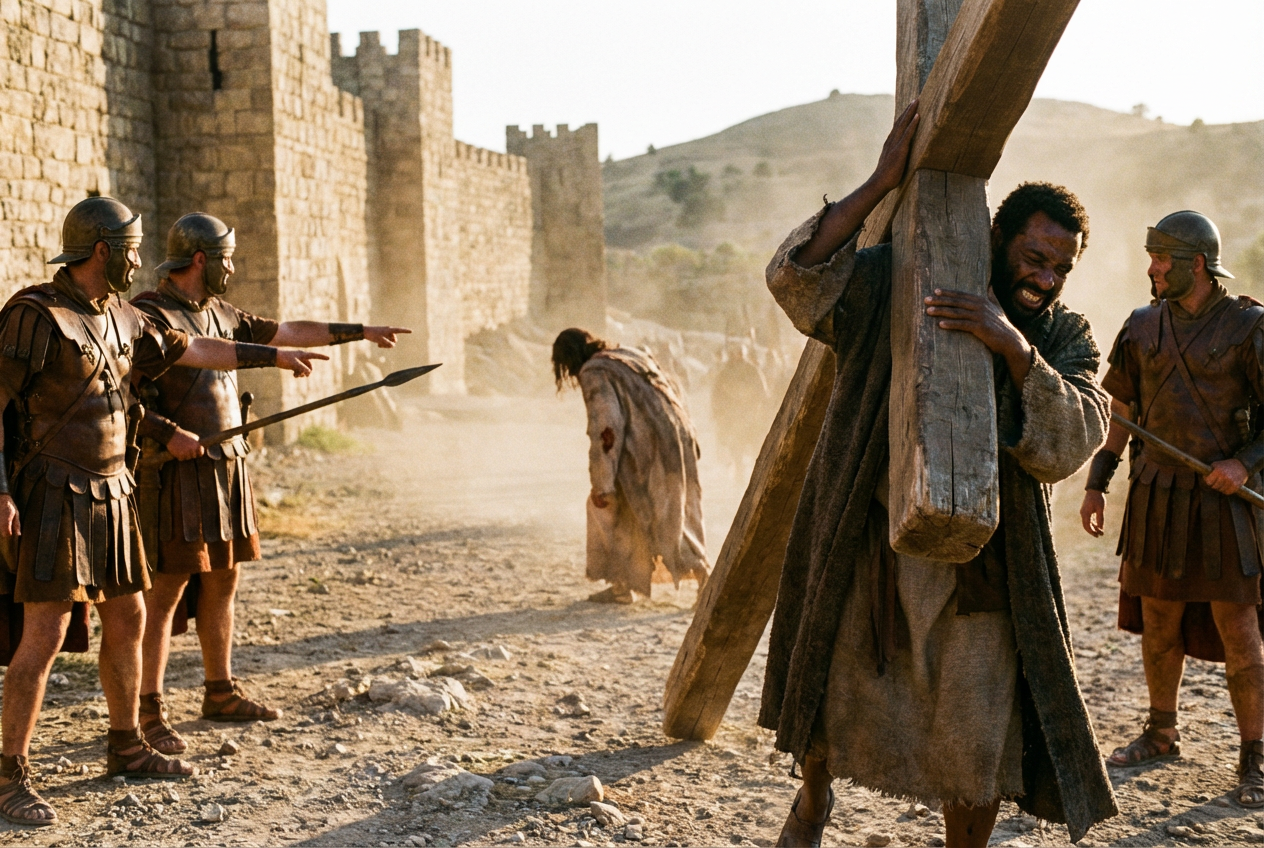
Scripture reveals Simon of Cyrene as a man whose life was forever changed by a divine interruption on the road to Calvary.
As he entered Jerusalem from the country, Roman soldiers compelled this foreigner to shoulder the weight of the cross when our Savior’s physical strength was nearly exhausted.
Simon’s presence reminds us that the Gospel is a global message meant for every nation and people.
By carrying the instrument of execution behind Jesus, he became a living embodiment of the biblical mandate to take up one’s cross and follow the Lord daily.
Faith Facts
- Simon was the father of Alexander and Rufus, suggesting his family became well-known within the early Christian community after the resurrection.
- He was a native of Cyrene, a city in modern-day Libya, highlighting that the burden of the cross was shared by a man from outside Judea.
- The Gospel of Luke notes that Simon carried the cross behind Jesus, visually fulfilling the requirements of true discipleship and obedience.
The story of Simon teaches that obedience often begins with an unwanted interruption rather than a willing step.
We are called to remain faithful when the path of service involves sacrifice, humility, and burdens we did not choose for ourselves.
Ultimately, Jesus’ willingness to accept help from His creation underscores the profound humility of the King of Kings.
Just as Simon stood in the gap during Christ’s hour of need, we must be ready to serve the Kingdom whenever the Lord calls.
Faith
Church Leaders Unveil Bold Strategy to Reach Asia’s Next Generation
Faith Facts
- Asia Conference on Church & Mission (ACCM) 2026 convened church leaders in Metro Manila to chart the future of Christian discipleship across the continent
- Three strategic fronts emerged: leveraging artificial intelligence for outreach, mobilizing marketplace Christians, and empowering youth leaders
- The conference represents a coordinated effort to accelerate the Great Commission in the world’s most populous region
Christian leaders from across Asia gathered at GCF South Metro in Alabang, Metro Manila on June 10 for the Asia Conference on Church & Mission (ACCM) 2026, where they outlined an ambitious vision for expanding disciple-making across the continent. The second day of the conference featured a pivotal afternoon panel discussion that identified three major strategic priorities for the future of Asian Christianity.
The panel highlighted artificial intelligence as an emerging tool for gospel outreach, recognizing that technological innovation can serve the timeless mission of making disciples. Church leaders discussed how AI platforms and digital tools could extend the reach of Christian witness into communities that remain unreached by traditional methods.
Marketplace outreach emerged as a second critical emphasis, affirming the biblical principle that every Christian is called to ministry in their sphere of influence. The discussion centered on equipping believers to live out their faith authentically in business, education, healthcare, and other professional settings where they spend most of their waking hours.
The empowerment of young leaders represented the third pillar of the strategy. Conference participants recognized that reaching Asia’s vast youth population requires raising up a new generation of Christian leaders who understand contemporary culture while remaining firmly rooted in biblical truth and traditional Christian values.
The Asia Conference on Church & Mission brings together pastors, missionaries, and lay leaders to coordinate evangelistic and discipleship efforts across a region that contains more than half the world’s population. The gathering reflects a commitment to fulfilling the Great Commission in nations where Christianity often exists as a minority faith facing significant cultural and sometimes legal obstacles.
By focusing on technology, workplace witness, and youth engagement, the conference demonstrated that faithful Christianity adapts its methods while never compromising its timeless message. These strategic priorities recognize both the unique challenges and unprecedented opportunities facing believers in modern Asia.
Let us know what you think, please share your thoughts in the comments below.

Faith
VP Vance Opens Up About Lost Years Away From Faith
Faith Facts
- Vice President JD Vance revealed that a lack of Christian friendships contributed to him drifting from his faith during his younger years
- Vance described the period as one where he ‘kind of just lost it’ spiritually
- The Vice President’s candid admission highlights the vital importance of Christian community in maintaining a strong faith walk
Vice President JD Vance made a deeply personal revelation this week about his faith journey, acknowledging that the absence of strong Christian friendships played a significant role in drawing him away from the Christian beliefs he held in his youth. His honest testimony serves as a powerful reminder of the essential role that fellowship plays in the life of every believer.
Speaking openly about his spiritual struggles, Vance described a period in his life when his connection to God weakened considerably.
“I kind of just lost it,” Vance admitted, reflecting on the time when he drifted from his Christian roots.
The Vice President’s candid acknowledgment underscores a challenge many Christians face: maintaining faith without the support and accountability of a believing community. In an increasingly secular culture that often marginalizes traditional Christian values, the importance of surrounding oneself with fellow believers cannot be overstated.
Vance’s experience resonates with countless Americans who have struggled to maintain their faith commitments while navigating career pressures, educational environments, and social circles that may be indifferent or even hostile to Christianity. His willingness to speak transparently about this season of spiritual wandering demonstrates both humility and an understanding of how common such struggles are.
The testimony also highlights a critical truth found throughout Scripture: believers are not meant to walk their faith journey alone. From the early church described in Acts to the New Testament letters emphasizing community, the Bible consistently points to the necessity of Christian fellowship for spiritual growth and perseverance.
For many young people leaving home for college or entering the workforce, the lack of established Christian relationships can create a vulnerability that leads to gradual spiritual drift. Vance’s story serves as both a warning and an encouragement—a warning about the dangers of spiritual isolation and an encouragement that restoration is possible.
The Vice President’s openness about his faith journey may encourage other believers to examine their own spiritual friendships and community connections. It also serves as a call to churches and Christian organizations to prioritize creating environments where meaningful, authentic relationships can flourish.
In a political climate where faith is often either weaponized or dismissed, Vance’s vulnerability about his spiritual struggles stands out as refreshingly authentic. His testimony reminds Christians that even those in positions of prominence and power face real spiritual battles and need the support of fellow believers.
Let us know what you think, please share your thoughts in the comments below.

Faith
The Worldview Battle Behind Pride Month Conversations
Faith Facts
- Christians are called to engage Pride month discussions with both truth and grace, understanding the worldview differences at stake
- Expert Andrew Bunt emphasizes the importance of recognizing foundational beliefs that shape views on sexuality
- Biblical clarity combined with compassion offers believers a path to meaningful conversations during cultural conflict
As Pride month returns each June, Christians across America face renewed cultural pressure and challenging conversations about sexuality, identity, and values. Rather than retreating into silence or reacting with hostility, believers have an opportunity to engage with both conviction and compassion—but only if they understand what’s really at stake.
Andrew Bunt, a thoughtful Christian voice on these issues, challenges believers to move beyond surface-level reactions. He invites Christians to examine the deeper worldview foundations that shape contemporary conversations about sexuality and identity.
The heart of the matter isn’t simply about specific behaviors or political positions. It’s about fundamentally different understandings of truth, human nature, and purpose. Secular culture increasingly embraces a worldview where individual self-definition reigns supreme and personal feelings determine reality. In contrast, biblical Christianity holds that God’s design and revelation define truth about human identity and flourishing.
Understanding this worldview divide equips Christians to have more substantive, loving conversations. When believers recognize that disagreements about sexuality stem from deeper philosophical differences, they can address root issues rather than just symptoms.
Bunt emphasizes that effective engagement requires both clarity and humility. Clarity means knowing what Scripture actually teaches and why those teachings reflect God’s good design for humanity. Humility means recognizing our own brokenness, listening well to others’ experiences, and speaking truth with genuine love rather than condemnation.
For many Christians, Pride month feels overwhelming—a month-long cultural celebration of values that conflict with biblical teaching. The pressure to either enthusiastically affirm or aggressively oppose can leave believers uncertain about how to respond faithfully.
The path forward involves neither compromise nor cruelty. Christians are called to hold fast to biblical truth about God’s design for sexuality and marriage while demonstrating Christ-like love toward all people, including those who identify as LGBTQ.
This means being equipped to explain why Christian sexual ethics aren’t arbitrary rules but reflections of God’s loving design. It means understanding that identity runs deeper than feelings or attractions—that our true identity is found in being image-bearers of God and, for believers, children of God through Christ.
Practical engagement during Pride month might involve conversations with neighbors, coworkers, or family members. These discussions become more fruitful when Christians avoid caricatures and genuinely seek to understand how others think and why they hold their views.
At the same time, love doesn’t require agreeing with falsehood. Christians can respect people while disagreeing with their choices and worldview. This balance—conviction without harshness, truth without compromise—reflects the character of Christ himself.
Churches have a vital role in preparing believers for these conversations. Rather than avoiding difficult topics, congregations should equip members with biblical teaching, thoughtful responses to common objections, and pastoral wisdom for navigating relationships with grace.
Parents especially need support as they guide children through a culture that often contradicts Christian values. Teaching children to think critically about worldview assumptions, not just react emotionally to cultural messages, prepares them for lifelong faithfulness.
Bunt’s call to think more deeply about worldview foundations serves as a reminder that cultural engagement requires intellectual preparation. Christians should understand not only what the Bible teaches but also how secular ideologies differ and why those differences matter.
This deeper engagement ultimately serves both truth and love. When believers understand the worldview battle at hand, they can speak with greater wisdom, answer objections more effectively, and demonstrate that Christian teaching offers true human flourishing.
The challenge of Pride month presents an opportunity for the church to demonstrate what it means to be salt and light in a confused culture. By combining biblical conviction with Christlike compassion, Christians can offer a compelling alternative to both harsh condemnation and affirming compromise.
Let us know what you think, please share your thoughts in the comments below.
-
Self-Reliance1 year agoTrump’s Bold Move Uncovers Massive Social Security Fraud
-

Faith1 year agoNew Clues Emerge in Noah’s Ark Mystery
-

News1 year agoGovernor Walz’s Rhetoric Sparks National Controversy
-

News1 year agoMel Gibson’s ‘The Passion of the Christ’ Sequel Title Announced
-

Family1 year agoTexas Lawmaker Targets Furries in Schools
-

Freedom1 year agoMaine Lawmaker Challenges Sports Fairness Controversy
-

Family1 year agoCanada’s Controversial Policy Sparks Ethical Debate
-
Faith7 months ago
Congress Hears Pleas for Nigerian Christians