
Self-Reliance
Finding Purpose in Work God Has Given You


Faith Facts
- God designed work as a meaningful calling, not a curse to endure
- Scripture teaches that believers can find joy and purpose in their labor regardless of circumstances
- Hard seasons at work may be preparation for future assignments God has planned
Work can feel exhausting, monotonous, and discouraging. But Scripture offers a surprising perspective: God wants us to enjoy our labor, even in hard seasons, while He prepares us for what’s next.
Many Christians struggle to see their jobs as anything more than a paycheck. Yet the Bible reminds us that our daily labor has eternal significance when done for the Lord.
“Whatever you do, work at it with all your heart, as working for the Lord, not for human masters.”
This truth shifts our perspective from simply surviving the workday to honoring God through excellence and faithfulness. When we approach our tasks with this mindset, even mundane responsibilities gain deeper meaning.
God often uses difficult seasons at work to build character and prepare us for future opportunities. The challenges we face today may be training ground for greater responsibilities tomorrow.
“And we know that in all things God works for the good of those who love him, who have been called according to his purpose.”
Rather than resenting our current position, we can trust that God is using it to shape us. Our attitude during these times often determines what He can entrust to us later.
Believers are called to be salt and light in every workplace. This means our conduct, integrity, and work ethic should reflect our faith in tangible ways.
When we view our jobs through the lens of eternity, we discover purpose that transcends our circumstances. God can use any position to advance His kingdom and refine His people.
Let us know what you think, please share your thoughts in the comments below.

Faith Facts
- Christians are called to pursue unity in the Spirit and the bond of peace as Scripture commands.
- The greatest commandments remain unchanged: to love God with all our heart, soul, and mind and to love our neighbor as ourselves.
- Pure and faultless religion involves caring for orphans and widows while remaining unpolluted by the world.
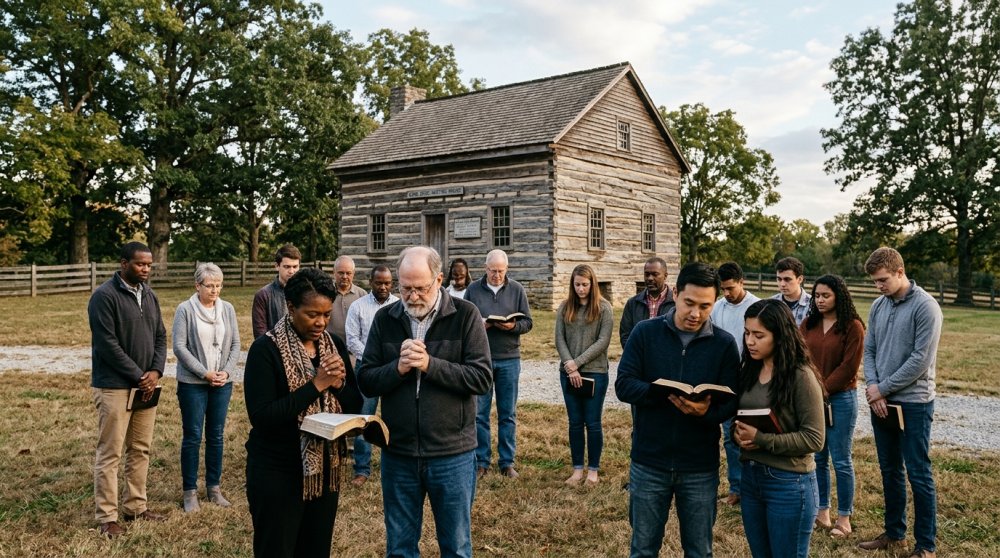
Throughout history, moments have come when people of God arose to say, “It is time.”
They departed for the Promised Land. They marched around Jericho. They gathered on the shores of Galilee and in Jerusalem on Pentecost. They stood unbent in the colosseum.
They heard the echo of Martin Luther’s hammer and began a Reformation. They left for distant lands in search of religious freedom. They gathered at Cane Ridge and began, yet again, a Restoration of the fellowship of believers.
They opened a door to welcome brothers and sisters of color. Not overnight. Not without difficulty or debate. But over and over, they listened to the still, small voice that told them, “It is time.” Time to do something hard.
We believe that again it is time to listen to God’s voice and do hard things. For several years, in different stories and series, different voices and places, we have heard that call. It arrives at a time when secularism is burgeoning, when culture does not support devotion, when division marks our society, our politics, our churches.
None of that should stop us. Because it’s time to find ways to maintain the unity of the Spirit and the bond of peace, even or especially when it challenges our preferences.
It’s time to open our arms of fellowship more broadly. It’s time to recall the greatest commandment and the one like unto it: You shall love the Lord your God with all your heart and with all your soul and with all your mind and you shall love your neighbor as yourself.
It’s time to recall the meaning of “true religion,” which inherently says something about what it’s not: “Religion that God our Father accepts as pure and faultless is this: to look after orphans and widows in their distress and to keep oneself from being polluted by the world.”
Does the church down the block or across town share your history but not your fellowship? It’s time for a conversation.
Is the history of division so dusty and old that no one remembers exactly why it takes two buildings, or more, to house the people of God in a city with just one high school? Have hackles risen so high they conceal the wounds of the Savior? The fellowship that flowed from Cane Ridge diverged into three long ago. And divisions within our own stream have multiplied in ways that should embarrass us all.
We have divided over Bible classes and kitchens, over water fountains and orphanages, over pianos and clapping and whether a woman can stand to pass the tray or must remain seated. We do not make light of those matters. These can be hard conversations. But are these issues central to that greatest commandment or to religion that the Father accepts as pure and faultless?
It’s time to ask if our divisions are helping us care for the downtrodden. Time to work together to love God and our neighbors. Time to share a cup of coffee and join hands in prayerful conversation.
This is a hard thing. But it’s time.
Let us know what you think, please share your thoughts in the comments below.

Faith Facts
- God calls believers to be good stewards of both time and treasure, as both are gifts from Him.
- Scripture teaches that those who are faithful in little things will be trusted with greater responsibilities.
- Christian families who manage their hours wisely often find greater peace and financial stability.
When you wonder where your money went, ask where your time went. Chuck explains why the way you spend your hours shapes the way you manage your money.
Time is one of the most valuable resources God has entrusted to us. Every hour spent idly or without purpose can quietly slip into wasted dollars, missed opportunities, and unnecessary expenses. Faithful stewardship begins with recognizing that each moment carries eternal weight and practical consequences.
Many Americans find themselves surprised by mounting bills and shrinking savings, yet the root cause often traces back to how their days are ordered. Distractions, poor planning, and a lack of discipline erode both time and finances in equal measure. The habits formed in the quiet hours of the morning set the course for the entire household budget.
“The plans of the diligent lead surely to abundance, but everyone who is hasty comes only to poverty.”
Chuck highlights six common ways that careless time use drains a family’s resources. Late fees pile up when bills are forgotten. Impulse purchases happen during rushed errands. Productivity at work slips when mornings begin without direction, leading to lost raises or missed promotions. Families that fail to schedule meals often spend far more on takeout. Even simple tasks like oil changes or home maintenance get delayed until they become costly repairs.
These patterns rarely appear dramatic in a single day, yet over months and years they quietly undermine financial security. Christian households that bring order to their calendars often discover unexpected margin in their budgets. The discipline of rising early, planning the day, and guarding against distraction yields both spiritual and material fruit.
“Commit your work to the Lord, and your plans will be established.”
Reclaiming time is not merely a financial strategy but an act of worship. When believers order their days under God’s wisdom, they position their families for blessing rather than burden. The choice to manage hours faithfully today plants seeds of provision for tomorrow.
Let us know what you think, please share your thoughts in the comments below.

Faith Facts
- The rose, bud, and thorn reflection invites believers to examine life through a biblical lens of gratitude, hope, and endurance.
- Scripture calls Christians to give thanks in all circumstances and to trust God’s timing for future blessings.
- Recognizing both blessings and challenges strengthens faith and deepens dependence on the Lord.
Christians are often encouraged to pause and take stock of their spiritual journey. One simple yet powerful way is to consider the roses, buds, and thorns in daily life.
The rose represents what is deeply pleasing right now—the answered prayers, the joy of family, and the peace that comes from walking with Christ. These moments remind believers of God’s faithful provision.
The bud symbolizes opportunities and growth still waiting to unfold. Whether it is a new ministry, a restored relationship, or a door opening in unexpected ways, the bud points to God’s ongoing work.
The thorn speaks of present difficulties and trials. Pain, uncertainty, and spiritual warfare are part of the Christian walk, yet Scripture assures that God uses even thorns to shape character and draw hearts closer to Him.
“Give thanks in all circumstances; for this is God’s will for you in Christ Jesus.”
“And we know that in all things God works for the good of those who love him, who have been called according to his purpose.”
Reflecting on roses, buds, and thorns helps believers maintain an eternal perspective. Gratitude for today’s blessings fuels hope for tomorrow’s promises and strengthens perseverance through present trials.
Let us know what you think, please share your thoughts in the comments below.


-

 Self-Reliance2 years ago
Trump’s Bold Move Uncovers Massive Social Security Fraud
-

 Faith2 years ago
New Clues Emerge in Noah’s Ark Mystery
-

 News2 years ago
Governor Walz’s Rhetoric Sparks National Controversy
-

 News2 years ago
Mel Gibson’s ‘The Passion of the Christ’ Sequel Title Announced
-

 Family2 years ago
Texas Lawmaker Targets Furries in Schools
-

 Freedom2 years ago
Maine Lawmaker Challenges Sports Fairness Controversy
-

 Family1 year ago
Canada’s Controversial Policy Sparks Ethical Debate
-
Faith11 months ago
Congress Hears Pleas for Nigerian Christians