
Faith
Faith Sustains Gaza Christians Amid Crisis

Faith Facts
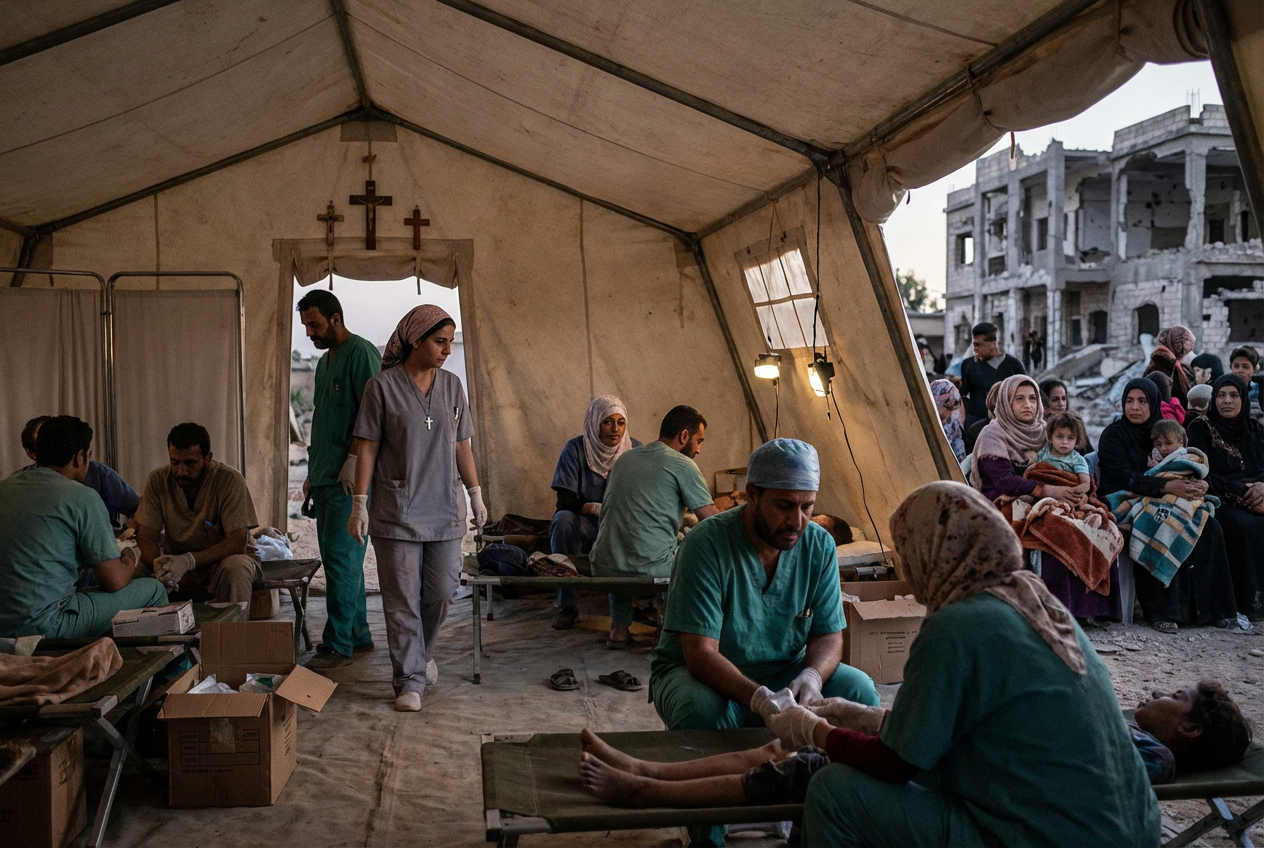
- Episcopal Diocese of Jerusalem’s health institutions endure extreme violence, shortages, and economic collapse in Gaza, East Jerusalem, and West Bank, serving all with compassion.
- Biblical promises like Romans 8:28 and Psalm 23 fortify healthcare workers, teachers, and clergy amid devastation.
- Al Ahli Arab Hospital persists as a lifeline despite airstrikes, using tents for emergency care and treating hundreds daily.
Christian workers in Gaza face immense suffering from restricted aid, spreading diseases, malnutrition, and amputations, especially impacting vulnerable children and their future.
St. Luke’s Hospital in Nablus aids uninsured patients amid West Bank violence and unemployment, viewing surging needs as a divine calling to preserve dignity.
Tourism collapse in East Jerusalem and Bethlehem strains schools and hospitals as families emigrate, shrinking the Christian population below one percent.
Global Church must rally with prayers, advocacy, and support to protect civilians, sustain missions, and nurture hope in the Holy Land.
Join in prayer for peace, donate to diocesan efforts, and advocate for justice to uphold Christian witness rooted in biblical truth.


Faith Facts
- The Church in Wales has voted to make same-sex blessings a permanent fixture, moving away from biblical teaching on marriage.
- Evangelical members within the denomination are facing a crisis of conscience, with many considering departure or seeking alternative oversight.
- The decision follows a pattern of mainline denominations prioritizing cultural acceptance over scriptural authority.
The Church in Wales has officially voted to enshrine same-sex blessings as a permanent part of its liturgical practice, marking a definitive break from traditional Christian teaching on marriage. The decision has left faithful evangelical members in a difficult position, prompting many to consider leaving the denomination entirely or seeking oversight from bishops who hold to biblical orthodoxy.
This landmark vote represents more than just a policy change—it reflects a fundamental theological divide within the denomination. For centuries, Christians have understood marriage as a covenant between one man and one woman, rooted in the Creation account and affirmed throughout Scripture. The Church in Wales’ decision to permanently authorize blessings for same-sex unions contradicts this historic Christian consensus.
Evangelical leaders within the denomination have expressed deep concern and are calling for prayer during this tumultuous time. Many faithful members feel betrayed by leadership that has chosen to conform to secular cultural pressures rather than remain anchored in biblical truth. The decision forces believers into an agonizing choice: remain in a church that has abandoned scriptural authority on marriage, or seek a new spiritual home.
Alternative episcopal oversight—where orthodox believers submit to the authority of biblically faithful bishops outside their geographic region—has emerged as one potential solution. This model has been employed in other Anglican provinces facing similar divisions, allowing traditionalists to remain nominally within the denomination while maintaining theological integrity.
However, many evangelicals view departure as the only viable option. The Church in Wales’ decision is not an isolated incident but part of a broader pattern among mainline Protestant denominations that have steadily drifted from biblical moorings. From the Episcopal Church in the United States to the Church of England itself, liberal theological trends have led to empty pews and fractured communions.
The consequences of abandoning biblical teaching on marriage extend beyond theology. Churches that embrace revisionist sexual ethics often experience declining membership, as faithful believers seek congregations that uphold Scripture. Meanwhile, the promised influx of new members attracted by progressive stances rarely materializes, leaving these denominations diminished and divided.
For the evangelicals remaining in the Church in Wales, the path forward is fraught with difficulty. They face pressure to accept teachings they believe contradict God’s Word, or risk being marginalized within their own church. Many are now wrestling with when accommodation becomes compromise, and when remaining in fellowship enables error.
This situation underscores a critical truth: when churches prioritize cultural approval over biblical fidelity, they inevitably lose their prophetic voice and distinctive witness. The call to love all people—which Christians absolutely must do—does not require affirming behaviors that Scripture clearly prohibits. True compassion involves speaking truth, even when that truth is unpopular.
As the Church in Wales implements this decision, American Christians should take note. The trajectory of theological liberalism is predictable: first comes reinterpretation of Scripture on sexual ethics, followed by declining authority of the Bible on other matters, and ultimately a gospel emptied of its transformative power. Churches that hold firm to biblical authority, by contrast, tend to grow and thrive.
The evangelicals in the Church in Wales need more than sympathy—they need prayers, support, and solidarity from believers worldwide who understand that this fight concerns the very nature of Christian truth. Will the church submit to Scripture, or will Scripture be made to submit to the church? That fundamental question now confronts faithful Welsh Christians in urgent and personal terms.
Let us know what you think, please share your thoughts in the comments below.

Faith Facts
- Financial stewardship through staycations allows families to avoid debt while still creating meaningful memories together
- Prioritizing family time at home strengthens relationships and provides opportunities for spiritual growth without the stress of expensive travel
- Exploring local attractions and creating intentional experiences can teach children gratitude and contentment, key Christian virtues
Many American families face the same dilemma every year: the desire to create special memories with their children while navigating the reality of tight budgets and rising costs. The pressure to provide elaborate vacations can feel overwhelming, especially when social media shows seemingly perfect family getaways.
But there’s wisdom in recognizing financial limits and choosing stewardship over debt. A staycation—spending vacation time at home or exploring local areas—offers benefits that many families overlook in their pursuit of expensive trips.
First, staycations eliminate the financial stress that often accompanies traditional vacations. Between airfare, hotels, dining out, and entertainment, a typical family vacation can cost thousands of dollars. By staying home, families can allocate those funds toward debt reduction, savings, or other pressing needs. This demonstrates biblical stewardship and teaches children that contentment doesn’t require extravagant spending.
Second, staycations provide deeper rest and relaxation. Travel often involves exhausting schedules, long drives or flights, and the stress of navigating unfamiliar places. Staying home allows families to truly rest, recharge, and enjoy unhurried time together without the pressure of squeezing in every tourist attraction.
Third, exploring local attractions often reveals hidden treasures in your own community. Many families discover museums, parks, hiking trails, historical sites, and other activities they’ve never experienced despite living nearby for years. This fosters appreciation for God’s blessings in your own backyard and builds community connection.
Fourth, staycations create opportunities for intentional family bonding. Without the distractions of travel logistics, families can focus on meaningful activities: game nights, backyard camping, cooking together, serving at a local ministry, or simply having extended conversations. These moments often create stronger memories than expensive theme parks.
When explaining the decision to children, honesty combined with enthusiasm works best. Frame it as an adventure rather than a disappointment. Involve them in planning activities, and create special traditions that make home feel like a destination.
Financial peace and family connection matter more than Instagram-worthy vacation photos. A staycation honors both biblical stewardship and the true purpose of family time: strengthening relationships and creating memories rooted in love, not debt.
Let us know what you think, please share your thoughts in the comments below.
Faith Facts
- A social media post portraying a political leader in messianic terms sparked immediate controversy and was subsequently deleted
- Christian ethics demand a clear distinction between earthly leaders and divine authority
- The incident serves as a crucial reminder for believers to guard against idolatry in political engagement
A recent social media controversy has reignited an essential conversation within the American Church about the boundaries between political support and spiritual devotion. When a post describing a political figure in explicitly messianic language appeared and was later removed, it crossed a line that every believer must recognize and reject.
The incident raises fundamental questions about how Christians engage with political leaders. While supporting elected officials and advocating for policies aligned with biblical values remains both appropriate and necessary, the language we use matters profoundly.
Throughout Scripture, believers are commanded to honor governing authorities while reserving worship for God alone. The Apostle Paul instructed the early Church to pray for kings and those in authority, yet never suggested they possessed divine qualities or messianic roles.
This moment serves as a critical warning for American Christians navigating an increasingly polarized political landscape. Our faith must never become subordinate to our politics, nor should our political preferences blur the distinction between earthly power and heavenly sovereignty.
The Church has witnessed throughout history what happens when political leaders are elevated to quasi-divine status. From ancient Rome to modern totalitarian regimes, the conflation of political power with spiritual authority has consistently led believers astray and damaged the Gospel witness.
Christian voters can and should evaluate leaders based on their policies, character, and commitment to protecting religious liberty and traditional values. Support for candidates who defend faith, family, and freedom represents faithful civic engagement.
However, that support must never cross into language or attitudes that attribute messianic qualities to any human leader. Only Jesus Christ holds the title of Savior, Redeemer, and Great Physician of souls.
The swift deletion of the controversial post suggests an awareness that the language had overstepped appropriate bounds. This recognition provides an opportunity for the broader Christian community to reaffirm proper biblical priorities.
Believers must remain vigilant against the subtle idolatry that can emerge when political passions run high. Our ultimate hope rests not in Washington, D.C., but in the Kingdom of God.
The American Church has a prophetic responsibility to speak truth to power, regardless of which party holds office. This includes calling out language and imagery that elevates any political figure to a status reserved for Christ alone.
As we approach future elections and navigate ongoing political debates, may Christians demonstrate wisdom in distinguishing between legitimate political support and inappropriate spiritual devotion. Our witness depends on maintaining this crucial boundary.
Let us know what you think, please share your thoughts in the comments below.


-

 Self-Reliance1 year ago
Trump’s Bold Move Uncovers Massive Social Security Fraud
-

 Faith1 year ago
New Clues Emerge in Noah’s Ark Mystery
-

 News1 year ago
Governor Walz’s Rhetoric Sparks National Controversy
-

 News1 year ago
Mel Gibson’s ‘The Passion of the Christ’ Sequel Title Announced
-

 Family1 year ago
Texas Lawmaker Targets Furries in Schools
-

 Freedom1 year ago
Maine Lawmaker Challenges Sports Fairness Controversy
-

 Family11 months ago
Canada’s Controversial Policy Sparks Ethical Debate
-
Faith5 months ago
Congress Hears Pleas for Nigerian Christians