
Faith
Comedian Theo Von Turns to God in Moment of Personal Struggle


Faith Facts
- Podcast host Theo Von publicly shared his prayer for God to give him ‘a new story’ during a recent episode of ‘This Past Weekend’
- The comedian opened up about personal struggles and expressed a genuine desire for transformation through faith
- Von’s candid moment of vulnerability highlights a growing trend of public figures turning to God during difficult times
Popular comedian and podcast host Theo Von is turning to God amid personal challenges, sharing an intimate prayer request with his audience. During a recent episode of his widely-followed podcast “This Past Weekend,” Von made a heartfelt plea for divine intervention in his life.
The comedian, known for his distinctive Southern humor and candid storytelling, stepped away from his usual comedic tone to share something deeply personal with his listeners. Von revealed that he’s been asking God for fundamental change in his life.
“Please help me,” Von said, expressing his desire for “a new story” as he navigates current struggles.
The moment of transparency from the entertainer resonates with many Americans who face their own battles and seek God’s guidance during difficult seasons. Von’s willingness to publicly acknowledge his need for spiritual help demonstrates a refreshing honesty often absent in entertainment culture.
This candid discussion about faith and personal struggle marks a departure from the typical celebrity narrative that often portrays public figures as having everything together. Instead, Von’s openness about turning to prayer reflects traditional American values of humility, faith, and the recognition that we all need God’s help.
Von has built a substantial following through his podcast, which regularly features long-form conversations on a variety of topics. His decision to share this vulnerable moment with his audience may encourage others who are struggling to similarly turn to faith for answers.
The comedian’s public prayer request also reflects a broader cultural moment where more Americans, particularly younger generations, are rediscovering the importance of faith during times of personal crisis. In an era of increasing uncertainty, many are finding that material success and fame don’t fulfill the deeper longings of the human heart.
Von’s honest admission that he needs God’s help to write “a new story” for his life speaks to the biblical truth that transformation comes through divine power, not human effort alone. His testimony may serve as an encouragement to others facing their own struggles to seek God’s guidance and healing.
Let us know what you think, please share your thoughts in the comments below.

Faith Facts
- Churches are increasingly focusing youth ministry resources while overlooking millions of spiritually hungry older adults
- Senior Christians represent a wealth of wisdom, experience, and spiritual depth that remains largely untapped in modern congregations
- A growing generation gap in church programming threatens to alienate the very believers who built and sustained these faith communities
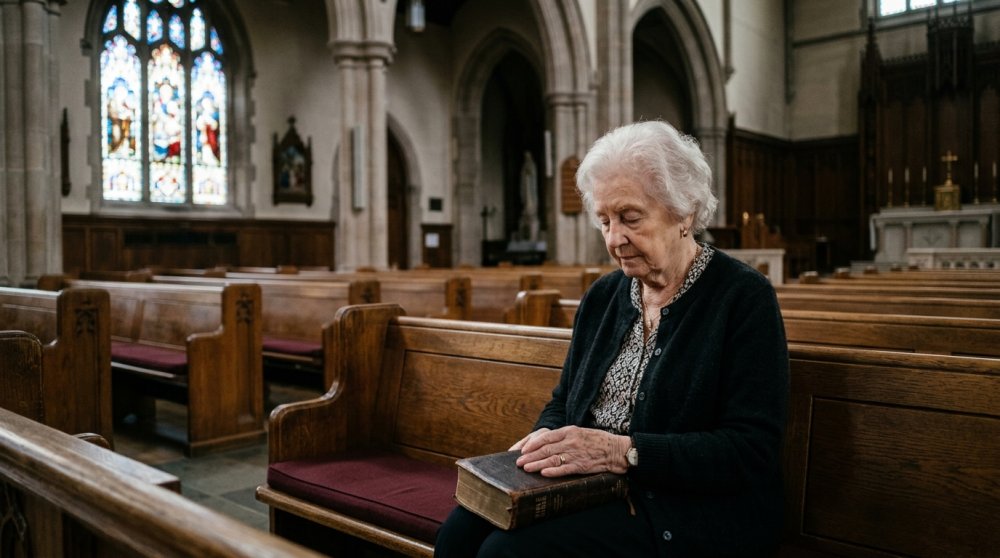
While many churches celebrate renewed spiritual interest among young people, a quiet crisis is unfolding in the pews. Millions of older adults—faithful believers who have served their churches for decades—are being overlooked and underserved by congregations increasingly focused on youth engagement.
The trend reflects a troubling shift in church priorities. As ministries pour resources into attracting younger generations, the spiritual needs of seniors often go unaddressed, creating a generation gap that threatens the very fabric of Christian community.
Alexandra Huggins highlights this critical oversight, pointing to a demographic reality churches can no longer afford to ignore. Older adults represent not just a growing segment of the population, but a treasure trove of spiritual wisdom, life experience, and faithful commitment that could strengthen entire congregations.
The irony is stark: the generation that built church buildings, sustained ministries through difficult times, and passed down the faith now finds itself on the margins of church life. Many seniors report feeling invisible in worship services designed for younger tastes, isolated in small group structures that don’t account for their stage of life, and overlooked in sermon applications that rarely address their unique challenges.
This oversight carries spiritual consequences. Older believers face profound questions about purpose, legacy, suffering, and mortality—themes that demand biblical wisdom and pastoral care. Yet these topics often receive minimal attention compared to marriage prep, parenting classes, and career guidance aimed at younger demographics.
The solution isn’t abandoning youth ministry, but recognizing that faithful stewardship requires serving all generations. Churches that honor their elders create spaces where wisdom flows between generations, where young and old worship together, and where every stage of life receives biblical guidance.
Scripture consistently calls believers to honor the elderly and learn from their experience. Leviticus 19:32 commands, “Rise in the presence of the aged, show respect for the elderly and revere your God.” Proverbs repeatedly points to the value of wisdom that comes with years. Titus 2 envisions older men and women actively mentoring younger believers—a pattern that requires intentional integration across age groups.
The demographic reality makes this even more urgent. As populations age across America, churches that fail to minister effectively to seniors will increasingly struggle to maintain vitality and relevance. More importantly, they will fail in their biblical mandate to shepherd the whole flock.
What would faithful ministry to older adults look like? It starts with recognition—acknowledging seniors in worship, seeking their counsel in church decisions, and celebrating their contributions. It continues with programming that addresses their real needs: Bible studies on suffering and hope, fellowship opportunities that combat isolation, and service projects that channel their gifts and experience.
Most importantly, it requires viewing seniors not as a problem to manage but as a blessing to receive. Their prayers sustain churches. Their giving funds ministries. Their stories testify to God’s faithfulness across decades. Their presence connects younger believers to a heritage of faith that transcends contemporary culture.
Churches that integrate all generations reflect the full body of Christ. They create communities where children learn from grandparents in the faith, where young adults gain perspective from those who’ve walked longer with God, and where seniors find purpose in investing their remaining years in eternal things.
The call to minister faithfully to older adults isn’t about political correctness or demographic strategy. It’s about biblical fidelity. It’s about recognizing that every person, at every age, bears God’s image and deserves care, dignity, and spiritual nourishment.
As churches navigate cultural changes and seek to reach new generations, they must not abandon the faithful who came before. The same Gospel that speaks to searching teenagers offers hope to aging saints facing mortality. The same Spirit that energizes youth groups sustains believers in their final decades. The same Church that welcomes new converts must honor those who’ve served for a lifetime.
Let us know what you think, please share your thoughts in the comments below.
Faith Facts
- A young woman was given a double mastectomy at age 15 after doctors told her parents to affirm her transition or prepare for her funeral
- Years later, she realized that medical intervention could not heal the underlying spiritual and emotional pain she was experiencing
- Her story of detransition reveals the manipulative practices used by medical institutions to push irreversible procedures on vulnerable children
When families turn to medical professionals for help with their children’s distress, they expect compassionate care rooted in truth and healing. Instead, many are being confronted with ultimatums that exploit parental fear and love. One young woman’s journey through gender transition and back reveals the devastating consequences of an ideology that has infiltrated American medicine.
Her parents sought help when she was struggling with profound emotional pain as a child. The response they received was chilling: affirm the transition or prepare to bury their daughter.
Faced with this manipulative choice, the family—like thousands across our nation—made the decision they thought would save their child’s life. At just 15 years old, she underwent a double mastectomy, a permanent surgical procedure that removed healthy tissue based on the promise that it would resolve her inner turmoil.
Years passed before the truth became clear. The surgery hadn’t fixed anything.
The young woman came to understand that no medical intervention, no matter how radical, could address the spiritual emptiness and loneliness she had been experiencing. The answers she needed weren’t found in an operating room or a prescription bottle—they were found in accepting the truth of her God-given identity.
Her story is a powerful testimony to the resilience of the human spirit and the transformative power of faith. It also exposes the dangerous practices that have become standard protocol in gender medicine, where vulnerable children are fast-tracked toward irreversible treatments with little regard for long-term consequences.
The medical establishment’s willingness to perform life-altering surgeries on minors—based on feelings rather than biological reality—represents a fundamental betrayal of the Hippocratic Oath. These institutions are profiting from confusion and pain, offering false hope through procedures that cannot deliver on their promises.
Detransitioners like this brave young woman are increasingly speaking out, sharing their stories of regret and warning others about the path they were led down. Their voices challenge the dominant narrative that transition is always the answer and that questioning this approach is somehow hateful or harmful.
The reality is that true compassion requires honesty. Children struggling with gender confusion need authentic support, mental health care, and patience—not experimental hormones and irreversible surgeries. They need to hear that they are fearfully and wonderfully made, created with purpose and dignity exactly as they are.
This woman’s journey from despair to faith offers hope to countless families facing similar pressures today. Her decision to accept her created identity represents not a rejection of herself, but an embrace of truth—a truth that has the power to set us free.
As more detransitioners come forward, their testimonies serve as a urgent warning to parents, policymakers, and medical professionals. The affirmation-only model is failing our children, leaving broken bodies and shattered lives in its wake.
The path to healing doesn’t run through operating rooms and hormone clinics. It runs through truth, faith, and the courage to stand against an ideology that denies biological reality and God’s design for humanity.
Let us know what you think, please share your thoughts in the comments below.

Faith Facts
- Jesus lost most of His followers after preaching hard truth in John 6, refusing to soften His message to retain the crowd
- Modern metrics of ministry success—attendance numbers, engagement, and growth—would label Christ’s sermon a failure
- Today’s pastors face pressure to compromise biblical teaching to maintain popularity and avoid losing congregants
By nearly every contemporary standard used to measure successful ministry, Jesus Christ’s teaching in John 6 would be classified as a complete failure. He stood before thousands of devoted followers, delivered uncompromising truth, and watched as the masses turned and walked away. Yet He never chased after them, never softened His words, never apologized for the offense His message caused.
The question this raises for the modern American church is profound and urgent. In an era dominated by metrics—attendance figures, social media engagement, giving trends, and numerical growth—how many of today’s spiritual leaders would have the courage to preach the same sermon Jesus did?
The Lord had attracted a massive following. These weren’t casual observers; they were people who had witnessed His miracles, experienced His compassion, and sought His presence. But when Christ began teaching about spiritual matters that challenged their comfort and demanded true commitment, the crowd dwindled rapidly.
Scripture records that many of His disciples turned back and no longer walked with Him. They didn’t leave because of scandal or hypocrisy. They left because the truth He spoke was hard to accept, requiring a level of surrender they weren’t willing to give.
Jesus didn’t respond with damage control. He didn’t form a committee to study why people were leaving or hire consultants to make His message more palatable. Instead, He turned to the twelve disciples and asked if they, too, wanted to go.
This stands in stark contrast to much of what passes for ministry leadership today. Pastors are often pressured—by boards, by budgets, by building campaigns—to keep the seats filled and the numbers climbing. The temptation to smooth over difficult biblical teachings, to avoid controversial topics, or to reframe Scripture in ways that won’t offend becomes nearly irresistible.
But faithfulness to God’s Word has never been measured by crowd size. The call to shepherd God’s people isn’t a call to entertainment or to cultural relevance at the expense of truth. It’s a call to proclaim the whole counsel of God, regardless of the cost.
When truth is compromised to preserve popularity, what remains is no longer the Gospel. It becomes a message crafted by human hands to serve human ends—a message that may fill pews but will never transform hearts.
The American church is at a crossroads. Will it follow the example of Christ, who was willing to lose the crowd rather than dilute the truth? Or will it continue down a path where success is defined by numbers on a spreadsheet rather than faithfulness to Scripture?
Pastors who stand firm on biblical teaching today may face criticism, declining attendance, and financial pressure. But they stand in good company—the company of the prophets, the apostles, and Jesus Himself, who knew that genuine ministry is measured not by applause but by obedience to God.
The challenge for every believer is to examine what kind of message we’re willing to hear. Are we following Christ because He affirms our preferences, or because He is the Way, the Truth, and the Life? Are we seeking a comfortable religion, or are we ready to embrace the narrow path that leads to eternal life?
Jesus proved that faithful preaching doesn’t guarantee a full house. But it does guarantee something far more important: the approval of the Father and the transformation of those who have ears to hear.
Let us know what you think, please share your thoughts in the comments below.


-

 Self-Reliance1 year ago
Trump’s Bold Move Uncovers Massive Social Security Fraud
-

 Faith1 year ago
New Clues Emerge in Noah’s Ark Mystery
-

 News1 year ago
Governor Walz’s Rhetoric Sparks National Controversy
-

 News1 year ago
Mel Gibson’s ‘The Passion of the Christ’ Sequel Title Announced
-

 Family1 year ago
Texas Lawmaker Targets Furries in Schools
-

 Freedom1 year ago
Maine Lawmaker Challenges Sports Fairness Controversy
-

 Family1 year ago
Canada’s Controversial Policy Sparks Ethical Debate
-
Faith9 months ago
Congress Hears Pleas for Nigerian Christians