
Faith
Church Leaders Call for AI Debate

Faith Facts
- Church of England voices concern over AI’s impact on human dignity and equality.
- Synod urges technology to serve the common good, not just profit.
- Christian scholars stress biblically grounded values in shaping the future of work.
Faith leaders are urging national dialogue about artificial intelligence’s growing role in the workplace, warning that unregulated advancement could deepen inequality and threaten human dignity.
The Church of England’s General Synod recognizes technology’s far-reaching influence and emphasizes that all work should uphold purpose and dignity, guided by Christian values.
The Crucible journal’s new edition offers thoughtful, theological discussion on how AI-driven automation and data oversight are transforming employment, while exploring responses rooted in biblical teachings.
“Work is neither who we are, nor can it be dismissed as irrelevant to our identity. Without meaningful work we risk losing a sense of purpose and belonging.”
Rev Dr Simon Cross challenges believers to demand justice-focused approaches for workers within the gig economy and reminds us that technology always reflects moral choices shaped by society and faith.
He said: “Technology is not value-neutral. The ways tools are invented, adopted and exploited are all shaped socially – and that includes the gig economy.
If we want the gig economy to reflect the values of good and meaningful employment as the Bible helps us understand them, there is plenty of work still to do.”
Rev Dr Kathryn Pritchard’s analysis warns that AI systems must recognize and reflect women’s contributions, cautioning against algorithms that reinforce bias and overlook biblical justice.
“If women’s contributions to work are absent from the datasets on which AI systems are built, those same technologies risk reproducing that invisibility,” she cautioned.
She continued: “Passivity in the face of such rapid technological change is not theologically justifiable. The future of women’s work in an AI age is not yet written.”
Co-editor Will Fremont-Brown urges both church and society to thoughtfully engage with AI, balancing wise caution with hope for faithful stewardship.
Pope Leo XIV recently described AI as “one of the defining issues of our time,” underscoring the need to safeguard dignity and justice in every aspect of work.
Dr Pritchard highlighted the importance of Christian citizens and communities in this debate. “The way work and AI overlap is a subject of interest from kitchen tables to lecture halls. We cannot sit on the sidelines, but have a responsibility to engage, point to signs of hope, and do all we can to ensure that the fundamental dignity of every person is upheld.”
As AI becomes increasingly influential, believers are called to advocate for ethical, humane technology, ensuring the dignity and value of every worker is protected under God’s truth.



Faith Facts
- Jubilee+ is releasing a fresh resource to help local congregations unite evangelism with practical help for the poor.
- The initiative emphasizes that sharing the gospel and meeting material needs belong together in faithful Christian witness.
- Churches are encouraged to see both spiritual and social ministry as essential parts of the same mission.
The Christian charity Jubilee+ has launched a new resource aimed at helping churches weave together their efforts to serve those in need and to share the good news of Jesus Christ.
The material is designed to show congregations that caring for the poor and proclaiming the gospel are not separate tasks, but two sides of the same calling rooted in Scripture.
Leaders behind the project hope the guide will equip pastors and ministry teams to move beyond simply meeting physical needs, reminding them that lasting transformation comes through the power of the gospel.
“We want churches to see that evangelism and social action are not in competition, but flow naturally from the same heart of compassion,”
“When the church serves the vulnerable while clearly pointing people to Christ, both the body and the soul are cared for,”
Supporters say the new resource will give practical steps for integrating gospel conversations into food banks, debt counseling, and other mercy ministries already operating in many congregations.
Let us know what you think, please share your thoughts in the comments below.
Faith Facts
- Scripture teaches that no sin is beyond the reach of God’s grace when true repentance is present.
- Many women in church pews every Sunday silently carry the weight of past abortions without hearing explicit assurance of forgiveness.
- Christian teaching holds that silence from the pulpit on abortion can be misinterpreted as ongoing condemnation rather than an invitation to healing.
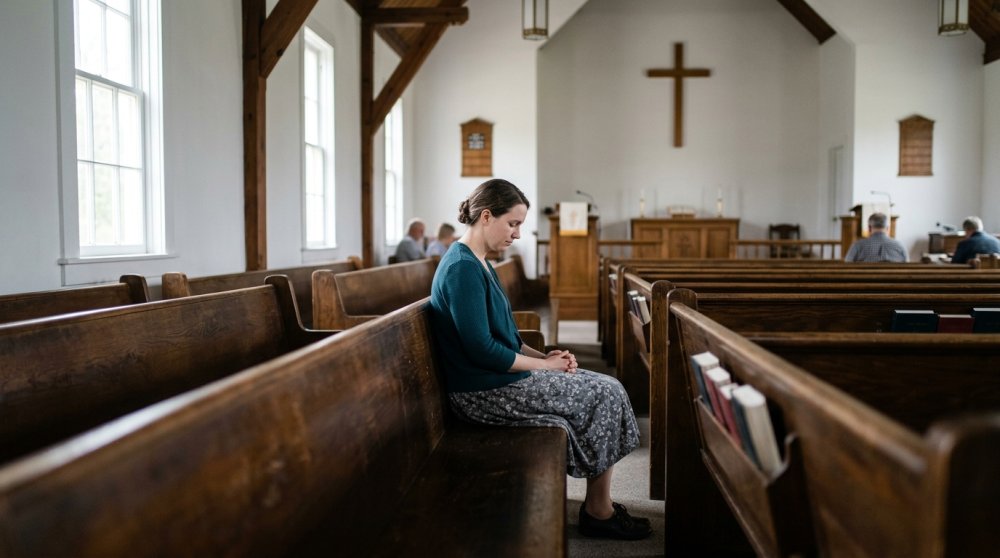
Every Sunday, women who have had abortions sit in church and hear that God forgives sin. But when abortion is never named, many conclude that the promise doesn’t include them, and they take the pastor’s silence as judgment.
Local congregations across the country are beginning to recognize this gap in ministry. Pastors are being urged to speak clearly about the forgiveness available through Christ for every sin, including abortion, so that women burdened by guilt may find hope rather than hidden condemnation.
“The blood of Jesus covers every sin that is confessed and forsaken,”
“Our churches must become places where women can bring their deepest regrets to the foot of the cross without fear.”
Let us know what you think, please share your thoughts in the comments below.

Faith Facts
- Numbers 33 warns that tolerated issues become persistent thorns that trouble future generations.
- Scripture teaches that small financial problems grow into major burdens when left unaddressed.
- Christian stewardship calls believers to confront money challenges with faith and discipline rather than avoidance.
Small financial problems rarely stay small when ignored. They quietly expand until they disrupt peace, relationships, and even spiritual focus.
Numbers 33 delivers a direct warning about the dangers of leaving problems in place. The passage speaks of tolerating what should be removed, describing the result as “thorns in your sides.”
“What we tolerate today may trouble us tomorrow,” the teaching reminds readers who are tempted to delay action on debt, overspending, or poor financial habits.
The principle applies directly to household budgets and personal finances. A single unpaid bill or unexamined expense can grow into long-term strain if left unchecked.
Christian teaching emphasizes honest assessment of resources as an act of faithful stewardship. Avoiding the numbers does not make the problems disappear.
Believers are encouraged to seek wisdom through prayer and practical steps rather than hoping difficulties resolve on their own. Scripture consistently links diligence with blessing and avoidance with loss.
Let us know what you think, please share your thoughts in the comments below.


-

 Self-Reliance1 year ago
Trump’s Bold Move Uncovers Massive Social Security Fraud
-

 Faith1 year ago
New Clues Emerge in Noah’s Ark Mystery
-

 News2 years ago
Governor Walz’s Rhetoric Sparks National Controversy
-

 News2 years ago
Mel Gibson’s ‘The Passion of the Christ’ Sequel Title Announced
-

 Family2 years ago
Texas Lawmaker Targets Furries in Schools
-

 Freedom2 years ago
Maine Lawmaker Challenges Sports Fairness Controversy
-

 Family1 year ago
Canada’s Controversial Policy Sparks Ethical Debate
-
Faith10 months ago
Congress Hears Pleas for Nigerian Christians