
Freedom
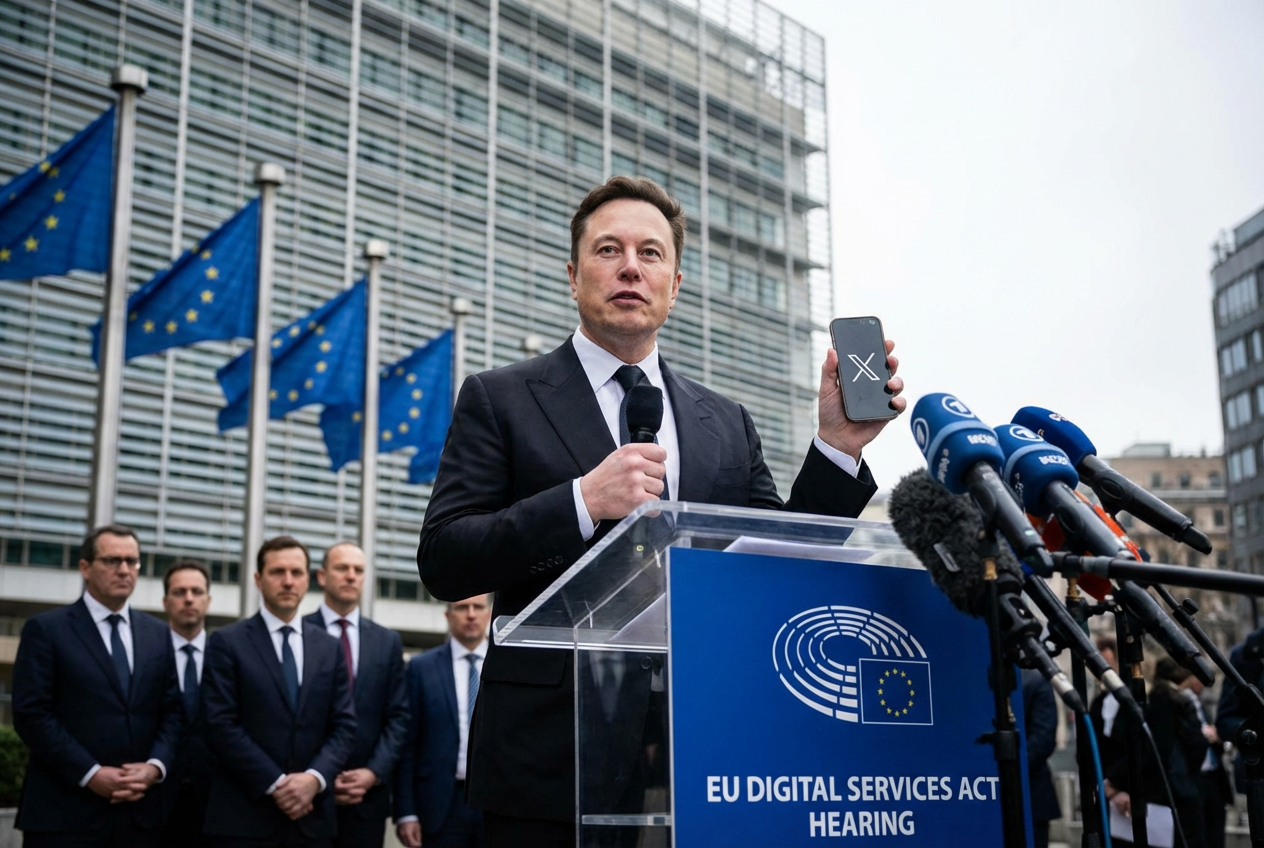
Christians Defend X Against EU Censorship Fine

Faith Facts
- ADF International champions X’s appeal against a 120 million euro EU Digital Services Act fine for transparency issues.
- EU probes X for not curbing “illegal content,” like Germany’s politician insult laws carrying up to three years in prison.
- X claims denied due process and prosecutorial bias in first-ever DSA fine challenge, protecting God-given free speech.
Elon Musk’s X platform fights a massive EU penalty from December 5, upholding transparency while facing probes over alleged false information.
Christian advocates highlight how DSA’s vague rules enable speech suppression, echoing Biblical calls to speak truth boldly against tyrannical control.
Dr Adina Portaru, senior counsel for ADF International in Europe, said,
“X is being targeted by the European Commission because it is a free speech platform.”
“Social media platforms are today’s public square, and the DSA threatens speech in that public square.”
“X is where millions of people go to freely express their views. This is a crackdown on X by authorities who view a free speech platform as a serious threat to their total control of online narratives.”
“By targeting X, they are targeting the free speech of individuals across the world who simply want to share ideas online free from censorship.”
She added,
“If the Commission’s concentration of power goes unchallenged, it will further cement a highly problematic standard for speech control across the EU and beyond.”
In a statement, X declared,
“This EU Decision resulted from an incomplete and superficial investigation, grave procedural errors, a tortured interpretation of the obligations under the DSA, and systematic breaches of rights of defence and basic due process requirements suggesting prosecutorial bias.”
“This landmark case is the first judicial challenge to a DSA fine and could set important precedents for enforcement, penalty calculations, and fundamental rights protections under the 2022 regulation. X remains committed to user safety and transparency while defending our users’ access to the only global town square.”
Patriotic Americans and believers must rally against EU overreach exporting censorship, safeguarding faith-driven discourse in the digital public square.


Faith Facts
- The progressive left has achieved significant cultural victories through strategic institutional control over decades
- Conservative movements often adopt tactics that mirror leftist approaches, undermining their own foundational principles
- True conservative success requires grounding in timeless Christian values rather than reactionary political posturing
Conservatives across America have watched with growing frustration as progressive forces seem to notch victory after victory in our cultural and political landscape. From corporate boardrooms to public schools, from entertainment to academia, the left’s influence appears pervasive and entrenched. Meanwhile, conservative efforts to counter this tide often sputter and fail, leaving many to wonder why.
The answer may be more troubling than many want to acknowledge: conservatives are losing because they’re fighting the wrong war with the wrong weapons.
The progressive left didn’t capture American institutions overnight. Their success came through patient, methodical work over generations. They built power bases in universities, trained activists, created networks of organizations, and developed clear messaging that resonated with their core constituencies. Most importantly, they maintained ideological consistency even when it meant short-term losses.
In contrast, what some call the “woke right” has emerged as a reactionary force that often mirrors the very tactics it claims to oppose. Rather than standing firm on timeless principles rooted in Scripture and constitutional governance, these movements frequently embrace outrage culture, cancel culture, and identity politics—just with different targets.
This approach represents a fundamental misunderstanding of what makes conservatism powerful. Traditional American conservatism draws strength from unchanging truths: the dignity of every human life created in God’s image, the importance of family as the building block of society, individual liberty balanced with personal responsibility, and limited government that respects the proper spheres of church, family, and civic institutions.
When conservatives abandon these foundations to engage in mere political tribalism, they lose their distinctive voice. They become just another interest group fighting for power rather than advocates for principle. And principles, rooted in eternal truth, ultimately prove more durable than political expediency.
The left succeeded because they believed in their vision and built institutions to advance it systematically. They didn’t just complain about conservative control of society—they worked to change it, school board by school board, newsroom by newsroom, one HR department at a time.
For believers and conservatives who want to see genuine renewal in America, the path forward isn’t imitation of leftist tactics. It’s a return to first principles: proclaiming truth with courage, building strong families and communities, engaging civic institutions with wisdom and persistence, and trusting that God honors faithfulness more than political cleverness.
Victory in the culture war won’t come from out-woking the woke. It will come from Christians and conservatives who refuse to compromise their values, who build rather than simply tear down, and who understand that lasting change flows from changed hearts, not just changed policies.
The choice before American conservatives is clear: continue down the path of reactive political theater that mimics the opposition, or return to the solid ground of faith, family, and freedom that made this nation strong in the first place.
Let us know what you think, please share your thoughts in the comments below.

Faith Facts
- The European Court of Human Rights issued a landmark ruling protecting the right of Jehovah’s Witnesses to engage in door-to-door evangelism in Bulgaria
- Government authorities had attempted to ban religious groups from knocking on doors based on claims of public annoyance
- The decision reinforces fundamental religious liberty protections that apply to all faiths, including Christians seeking to share the Gospel
Religious freedom faces mounting challenges across the globe, and a recent European court case brings this battle into sharp focus. At stake is a question that transcends denominational boundaries: Can the state silence religious expression simply because some find it inconvenient?
The European Court of Human Rights recently ruled on a case involving Jehovah’s Witnesses in Bulgaria, where government officials sought to prohibit door-to-door religious outreach. While many Christians may disagree with the theology of Jehovah’s Witnesses, the principle at the heart of this case affects every believer who takes seriously the Great Commission to share their faith.
Bulgaria had moved to restrict religious groups from engaging in what authorities characterized as unwanted solicitation. The government argued that door-to-door visits constituted a form of harassment that justified state intervention. This reasoning, however dangerous, reflects a growing trend in secular societies to prioritize comfort over constitutional liberties.
The court ultimately sided with religious freedom, recognizing that a polite knock on a door — however unwelcome it may be to some — does not rise to the level of harm that warrants government censorship. This distinction matters immensely for Christians of all denominations who believe they have a biblical mandate to evangelize.
Throughout the Book of Acts, believers spread the Gospel from house to house, often facing far worse than mere annoyance. The Apostle Paul wrote of going from home to home teaching both publicly and privately. Early Christians understood that sharing their faith required personal interaction, even when it proved uncomfortable for both parties.
Today’s secular governments increasingly view religious conviction as a private matter that should remain confined to church buildings and personal homes. This case in Bulgaria represents a broader ideological shift that threatens to marginalize Christian witness in the public square. When evangelism becomes classified as a nuisance rather than a fundamental right, all believers should take notice.
The right to knock on a door and share one’s faith is not merely about Jehovah’s Witnesses or any single group. It encompasses the broader freedom to proclaim religious truth in a respectful manner. If the state can prohibit door-to-door evangelism on grounds of annoyance, what prevents it from banning street preaching, public prayer, or other forms of witness that some might find objectionable?
Religious liberty thrives when protected even for those with whom we disagree. A faithful Christian may reject the teachings of Jehovah’s Witnesses as unbiblical, yet still recognize their right to spread their message peacefully. This principle of tolerance doesn’t require agreement — it requires a commitment to freedom that transcends our own preferences.
The Bulgarian case serves as a warning to Americans who value the First Amendment. While the United States enjoys stronger constitutional protections for religious expression than most European nations, these freedoms require constant vigilance. Courts and legislatures can erode liberty incrementally, using seemingly reasonable justifications that ultimately undermine foundational rights.
For Christians who believe in the exclusive claims of Jesus Christ, the freedom to evangelize represents more than a legal right — it is a sacred duty. When governments begin categorizing religious outreach as a form of harassment, they strike at the heart of what it means to live out one’s faith publicly.
The standard of “annoyance” proves particularly troubling because it relies on subjective feelings rather than objective harm. What one person finds annoying, another may find life-changing. History records countless conversions that began with an unexpected knock or an uninvited conversation about eternal matters.
Christians in America should draw courage from this European ruling while remaining alert to threats against religious freedom at home. Local ordinances, homeowner association rules, and corporate policies increasingly restrict religious expression under the guise of maintaining peace or avoiding offense. Each restriction, however small, contributes to a culture that views faith as a private hobby rather than a public truth claim.
The right to share one’s faith door-to-door may seem quaint in an age of digital communication and social media outreach. Yet this traditional form of evangelism remains remarkably effective precisely because it involves personal encounter. A knock on the door invites conversation in ways that online messaging cannot replicate.
Defending religious liberty for all groups, even those we consider theologically mistaken, strengthens the protections available to orthodox Christians. When believers unite around the principle of free expression, they build coalitions capable of resisting government overreach. The alternative — seeking restrictions only for groups we oppose — ultimately backfires when those same restrictions get applied to our own evangelistic efforts.
This Bulgarian case reminds us that religious freedom exists not to protect popular speech, but to safeguard unpopular truth claims. The Gospel itself proved deeply offensive to Roman authorities and Jewish leaders in the first century. If modern governments can silence religious messages on grounds of causing discomfort, they wield a power that directly contradicts biblical commands to preach the Word in season and out of season.
American Christians should monitor similar cases developing in state and federal courts, recognizing that today’s restriction on one group may become tomorrow’s prohibition affecting evangelical outreach. The principle of religious liberty applies universally or it applies not at all. Selective protection based on doctrinal preference undermines the very foundation of constitutional freedom.
Let us know what you think, please share your thoughts in the comments below.
Faith Facts
- America’s national debt has reached unprecedented levels as the nation marks 250 years of independence, raising serious concerns about fiscal sustainability
- Biblical principles emphasize wise stewardship and warn against the dangers of excessive debt, as stated in Proverbs 22:7: “The borrower is slave to the lender”
- Conservative economists and faith leaders are calling for renewed commitment to fiscal responsibility and traditional American values of living within our means
As America approaches its 250th anniversary, a troubling shadow looms over the celebration: a national debt that has spiraled beyond sustainable levels. For many Christians and conservative Americans, this fiscal crisis represents more than just numbers on a ledger—it reflects a departure from the biblical principles of stewardship and the foundational values our nation was built upon.
The concern is valid and deeply felt across communities that cherish both faith and fiscal responsibility. Our federal government’s spending has reached levels that previous generations would have found unthinkable, raising legitimate questions about the burden we’re placing on our children and grandchildren.
The Bible speaks clearly about the dangers of debt. Proverbs 22:7 warns that “the rich rule over the poor, and the borrower is slave to the lender.” This wisdom applies to nations just as it does to individuals. When a country becomes enslaved to debt, it loses its freedom to make sovereign decisions and risks compromising its values and security.
Can this be fixed? The answer is yes—but it requires what our founders would have recognized as virtues essential to a free republic: discipline, sacrifice, and a return to constitutional principles. The path forward demands that our leaders prioritize spending cuts, eliminate wasteful programs, and return to the limited government envisioned by our Constitution.
History shows that nations can recover from fiscal crisis through determined leadership and citizen engagement. But it requires political courage to make difficult choices—reducing the size and scope of government, reforming entitlement programs, and resisting the temptation to buy votes with borrowed money.
For Christian conservatives, this isn’t merely an economic issue—it’s a moral one. We have a sacred obligation to be good stewards of what God has entrusted to us, including the legacy we leave for future generations. The current trajectory violates this principle of intergenerational responsibility.
The solution begins with holding elected officials accountable. We must demand that they honor their oaths to uphold the Constitution and make the hard choices necessary to restore fiscal sanity. This means supporting candidates who demonstrate genuine commitment to spending restraint, even when it’s politically unpopular.
Additionally, we must recognize that government cannot solve every problem. Many functions currently performed by federal agencies could be better handled by states, local communities, churches, and families—as was originally intended. A return to federalism and subsidiarity would reduce both spending and the concentration of power in Washington.
The challenge before us is significant, but not insurmountable. With prayer, principled leadership, and citizen engagement rooted in traditional American values, we can chart a course back to fiscal responsibility. Our children and grandchildren deserve nothing less than a nation that honors its obligations, lives within its means, and preserves the freedom that has made America exceptional.
The question isn’t whether America can fix its debt crisis—it’s whether we have the courage and conviction to do what’s necessary. The answer will define what kind of nation we pass on to the next generation.
Let us know what you think, please share your thoughts in the comments below.


-

 Self-Reliance1 year ago
Trump’s Bold Move Uncovers Massive Social Security Fraud
-

 Faith1 year ago
New Clues Emerge in Noah’s Ark Mystery
-

 News1 year ago
Governor Walz’s Rhetoric Sparks National Controversy
-

 News1 year ago
Mel Gibson’s ‘The Passion of the Christ’ Sequel Title Announced
-

 Family1 year ago
Texas Lawmaker Targets Furries in Schools
-

 Freedom1 year ago
Maine Lawmaker Challenges Sports Fairness Controversy
-

 Family1 year ago
Canada’s Controversial Policy Sparks Ethical Debate
-
Faith7 months ago
Congress Hears Pleas for Nigerian Christians