
Faith
Danish Mission Groups Weigh Merger Amid Challenges

Faith Facts
- Talks continue between the Danish Mission Council and Center for Church Development Cooperation, with further negotiations planned for 2026.
- Financial and theological concerns have delayed the potential reunion of organizations that split in 1986.
- Both sides seek stronger cooperation in mission and development, rooted in a faith-centered vision for serving others.
The Danish Mission Council and the Center for Church Development Cooperation are considering reuniting, as discussions on merging continue into 2026. Their journey reflects a prayerful effort to blend faith-based mission work with practical support for communities, despite facing logistical and ideological challenges.
The mission bodies previously worked together as one until 1986, and supporters believe renewed unity would combine theology and outreach more effectively in Denmark and abroad. However, differences over funding structures and church–state boundaries have slowed progress, as government policies call for clear distinctions between aid and evangelism.
“This involves reuniting what had been united until 1986, when the CKU was established as a ‘project department,’” the DMR explained.
DMR seeks to sustain its calling as a connecting force among Christian organizations, while CKU, although financially secure, desires a more visible church identity. Recent meetings revealed both optimism about cooperation and real concerns about costs, administrative changes, and theological clarity in governing documents.
Ultimately, council members remain hopeful that God’s guidance will enable a solution anchored in faith and a shared mission to serve others in Christ’s name.



Faith Facts
- Mitchell Boles, a 17-year-old autistic teen from Middle Tennessee, was diagnosed with aggressive bone cancer in June 2025, just two months after being baptized
- Despite the cancer spreading to his lungs and a grim prognosis, Mitchell maintains unwavering faith, stating: “I don’t care if I die — I know I’ll be in heaven”
- His church and community rallied around the Boles family, raising $20,000 and demonstrating the power of Christian fellowship during trials
“We love Mitchell.”
That phrase has echoed through the pews of Beech Bethany Church of Christ, across group texts and hospital rooms, since 17-year-old Mitchell Boles was diagnosed last summer with a rare, aggressive bone cancer. Boles, who’s grown up in the Middle Tennessee church in Celina, is known for his humor, friendliness and die-hard college football fandom.
“People keep telling me how much they love him,” said Mitchell’s mother, Hanna.
“He’s always made people smile.”
Whether it’s the teenager’s love for fishing or long debates about the rivalry between his Auburn Tigers and the Alabama Crimson Tide, those close to him say his personality has always set him apart. Boles, who is autistic, often describes his faith in simple terms: “Shine your light, do what’s right.”
After weeks of discussion with his parents, Boles was baptized in April 2025. Just two months later, life took an abrupt turn as doctors diagnosed him with osteosarcoma.
What followed was a sudden shift into hospital visits, surgeries and chemotherapy treatments that became daily life — but also marked the widening circle of support from the church and the Celina community.
“The outpouring from the local community and church has been unreal,” said Mitchell’s father, Ray Boles.
“It’s not just money — it’s the fact that people care and love has been shown.”
The Diagnosis That Changed Everything
On June 24, 2025, Mitchell Boles noticed a large bump near his left knee and showed it to his parents. In the days after the discovery, the family scheduled an appointment at the Clay County Family Wellness Center.
An X-ray and follow-up testing led to a diagnosis of osteosarcoma, a bone cancer that typically develops in the legs and arms. Further scans revealed that the cancer had already spread to his lungs. His mother, a nurse, cried when she heard the news.
“I didn’t think too much of it at first,” she said. “Then the doctor told us it was osteosarcoma. I was shocked. I knew treatment wasn’t going to be easy.”
Mitchell said the reality of the diagnosis began to set in shortly after.
“I couldn’t believe I had cancer,” he said, looking at his mother.
“A couple of hours later, I was mad.”
Treatment began with aggressive chemotherapy in July 2025 in an attempt to shrink the cancer in his knee and lungs. As Mitchell spent time undergoing treatment at the Monroe Carell Jr. Children’s Hospital at Vanderbilt in Nashville, the effects of the radiation and related medication took a toll on his body. He often remained in the hospital for two to four days at a time, resting for weeks in between treatments, Ray Boles recalls.
In late October, doctors determined that the cancer’s worsening — especially in Mitchell’s knee — required radical resection surgery to remove the affected bone while preserving as much of the leg as possible. The operation was a success, with metal plates helping to stabilize his knee. After several weeks of recovery, chemotherapy resumed for another two months.
A Community United in Christian Love
News of Mitchell’s diagnosis quickly reached the Beech Bethany congregation after Ray Boles called minister Kenny Westmoreland, who stood before the church during a Wednesday night service and asked for prayers. Westmoreland said the church body’s response was immediate. Church members quickly organized a range of events, from a pickleball tournament at Clay County High School to a benefit meal, with proceeds going directly to the Boles family.
The church even dedicated a service to Mitchell, with many members of the congregation wearing T-shirts he designed. The shirts featured Auburn’s navy-and-orange color scheme and the phrase “shine your light, do what’s right,” a nod to his interpretation of Matthew 5:16.
As Mitchell began chemotherapy treatments in Nashville, donations continued to pour in to the point where the family had to decline additional financial contributions, with approximately $20,000 raised, the Beech Bethany minister estimated.
“The outpouring from the local community and church has been unreal,” Hanna Boles said.
“We never had to worry about anything through all this.”
What remained constant was the steady presence of prayer from the congregation and the Celina community. That same support included Mitchell’s friends and teachers at Clay County High School, who continued to support him as he missed school for treatment.
“Everybody was stunned and heartbroken,” said CCHS football coach and teacher Brian Lamb.
“When you hear the ‘C-word’ (cancer), you always think the worst.”
Lamb said the reaction within the school spread quickly, with staff and students looking for ways to assist the Boles family because “everyone loves Mitchell.” At one point during the school year, the Clay County football team presented Mitchell with a poster signed with words of encouragement from the entire team and a personalized Bulldogs jersey, a gesture for the football-loving teen. Alongside the gift, the team made sure to mention him before the pregame meal every Thursday night.
For Mitchell, the moments of support often intersected with three things he cares deeply about: his faith, his family and his Auburn Tigers. Through a family friend at Vanderbilt Children’s Hospital, Mitchell and his family secured sideline passes to watch the Tigers take on the Vanderbilt Commodores inside FirstBank Stadium in Nashville — a memory the die-hard Auburn fan says he will never forget.
Faith Unshaken Despite the Valley
But in January 2026 — just 10 days before a scheduled lung surgery — a preceding scan brought devastating news. The cancer in Mitchell’s lungs had grown extensively, with tumors multiplying beyond what doctors could reliably count on imaging. With this discovery, it became evident that chemotherapy was no longer effectively slowing the disease.
Without a realistic chance that treatment would improve his condition, the Boles family and their son made the difficult decision after prayer to stop chemotherapy and cancel the planned surgery.
“I didn’t want to do more chemo because I just wanted to feel better,” Mitchell said.
Instead, he focuses on at-home medical treatment, including new medication and preserving the quality of his life. The 5-year survival rate for Mitchell’s stage of osteosarcoma falls to 5-30 percent according to the American Cancer Society.
“My wife’s a nurse, and she knows — and I know — that it’s going to get bad eventually,” Ray Boles said.
“We don’t know when, but we know God is in control.”
With options exhausted, the Beech Bethany Church of Christ and the Celina community, which had donated money and been present from the initial diagnosis, surrounded the family with support. The same teenager whose face lights up with a smile while reciting decade-old stats about Auburn football speaks with unwavering certainty about his future. While cancer has changed much of Mitchell’s life, it has not shaken his faith.
“I don’t care if I die — I know I’ll be in heaven,” he said.
“I got baptized, and my name is written in the Book of Life.”
Today, while still continuing medication slowing the progression of his cancer, Mitchell finds joy in time spent with his family and the church community that has surrounded the Boles with support. In Celina, it is not uncommon to see a blue shirt with the phrase “shine your light, do what’s right,” a nod to a teenager whose faith and kindness have left a mark on a small community.
Let us know what you think, please share your thoughts in the comments below.
Faith Facts
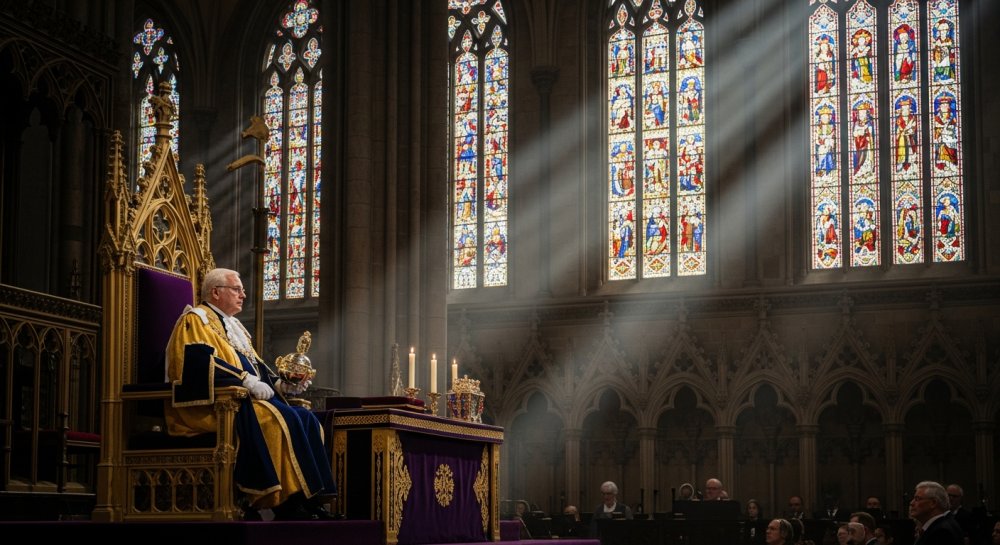
- King Charles III has quietly altered the description of his coronation oath on official royal accounts, removing reference to defending “the Christian faith”
- The revised language now simply states he will “defend the faith” without specific reference to Christianity
- Former Chaplain to Queen Elizabeth II warns this subtle change represents a significant departure from centuries of royal tradition
In a move that has largely escaped public scrutiny, King Charles III has modified the wording describing his sacred coronation oath on official royal social media accounts. The change, though appearing minor at first glance, carries profound implications for the relationship between the British Crown and Christianity.
The original coronation oath, sworn by British monarchs for centuries, includes an explicit promise to defend “the Christian faith.” This commitment has been a cornerstone of the monarchy’s identity since the Reformation. However, the King’s official accounts now describe his pledge more broadly as defending “the faith,” omitting the specific reference to Christianity.
Gavin Ashenden, who served as Chaplain to Queen Elizabeth II, has raised concerns about this revision. The former chaplain suggests this change reflects a broader trend of distancing Britain’s institutions from their Christian foundations. For a nation whose identity and legal system were built upon Christian principles, such modifications to royal commitments deserve serious attention from believers and citizens alike.
The coronation oath itself remains unchanged in the official ceremony, but the way the monarchy now presents this commitment to the public has shifted. This distinction between the formal oath and its public description raises questions about how future generations will understand the Crown’s relationship with Christianity.
The British monarchy has served as “Defender of the Faith” since King Henry VIII received the title from Pope Leo X in 1521. While the title’s meaning evolved after England’s break with Rome, it has consistently represented the Crown’s special responsibility toward Christianity and the Church of England specifically.
King Charles has previously spoken about his desire to be seen as a defender of “faith” in a more inclusive sense, reflecting Britain’s increasing religious diversity. While respect for all citizens is certainly appropriate, critics argue that abandoning the specific Christian commitment diminishes the historical and spiritual foundation that has sustained British society for centuries.
The change also comes at a time when Christianity faces increasing marginalization in public life across the Western world. From restrictions on public prayer to the removal of Christian symbols from public spaces, believers have watched their faith steadily pushed to the margins of societies it helped build.
For American Christians observing these developments, the situation in Britain serves as a cautionary tale. When a nation’s leaders begin to distance themselves from explicit Christian commitments, it often signals a broader cultural shift away from the values and principles that made that nation great in the first place.
The question facing Britain now is whether a monarchy that no longer explicitly defends the Christian faith can maintain the moral authority and purpose that has sustained it through centuries of change. History suggests that institutions which abandon their founding principles rarely survive in any meaningful form.
As people of faith on both sides of the Atlantic, we must remain vigilant about subtle changes that erode Christian influence in public life. What begins as inclusive language often ends with the complete exclusion of Christian voices and values from the public square.
Let us know what you think, please share your thoughts in the comments below.
Faith Facts
- America’s founders established the nation on biblical principles and Christian values that created unprecedented prosperity and freedom
- The current cultural crisis stems from abandoning spiritual foundations rather than embracing any particular political ideology
- Restoring America’s biblical heritage is essential to preserving freedom and prosperity for future generations
America stands at a crossroads. While political debates dominate headlines and social media feeds, a deeper crisis threatens the very foundation of our republic. The real danger facing our nation isn’t found in any political movement or economic system—it’s the spiritual decline that has steadily eroded the Christian values upon which this country was built.
Our Founding Fathers understood something that modern society has forgotten: a nation’s strength flows from its moral character, not its government programs. They established America on biblical principles, recognizing that rights come from God, not from man. This spiritual foundation created the freest, most prosperous nation in human history.
Yet today, we’ve witnessed a systematic removal of God from public life. Prayer has been banned from schools. The Ten Commandments have been stripped from courthouses. Biblical values are mocked in popular culture. This isn’t progress—it’s regression to a time when might made right and human dignity meant nothing.
The evidence of spiritual decline surrounds us. Family breakdown, rampant drug abuse, epidemic levels of depression and anxiety, rising suicide rates—these aren’t just statistics. They’re symptoms of a society that has lost its moral compass. When people abandon God, they don’t find freedom; they find chaos.
Our founders knew this truth intimately. John Adams declared that our Constitution was made only for a moral and religious people, warning it was wholly inadequate for any other. George Washington insisted that religion and morality were indispensable supports for political prosperity. Benjamin Franklin opened the Constitutional Convention with a call to prayer, recognizing divine providence as essential to their success.
These weren’t throwaway platitudes. They were fundamental convictions that shaped every aspect of American government and society. The separation of powers, checks and balances, individual rights—all reflected a biblical understanding of human nature and divine law.
Today’s problems require yesterday’s solutions. We don’t need more government programs or political reforms as much as we need spiritual renewal. America’s greatest need is a return to God—in our homes, our churches, our schools, and our public square.
This means rejecting the false gospel of secularism that promises fulfillment apart from God. It means embracing biblical truth about marriage, family, human dignity, and personal responsibility. It means teaching our children that their rights come from their Creator, not from government bureaucrats.
The path forward isn’t complicated, but it requires courage. Christians must reclaim their voice in the public square, speaking truth with love and conviction. Parents must prioritize their children’s spiritual formation over academic achievement or athletic success. Churches must preach the full counsel of God’s Word, not watered-down messages designed to avoid offense.
History proves that nations cannot survive without moral foundations. Rome fell not to barbarian armies but to internal moral decay. Every civilization that abandoned its spiritual roots eventually collapsed into tyranny or chaos. America will be no exception unless we change course.
The good news is that spiritual renewal is possible. Throughout history, God has sent revival to restore and rebuild fallen societies. America has experienced such awakenings before—powerful movements of prayer and repentance that transformed entire communities and shaped the nation’s direction.
We can experience another Great Awakening, but it must begin with individual repentance and commitment. Every Christian must ask: Am I living according to biblical values? Am I raising my children in the fear and admonition of the Lord? Am I speaking truth in my sphere of influence?
America’s future hangs in the balance. The choice before us isn’t between political parties or economic systems. It’s between the God who made us and the idols we’ve created. Between the wisdom of ages and the foolishness of the moment. Between freedom rooted in biblical truth and bondage disguised as liberation.
Our founders pledged their lives, fortunes, and sacred honor to establish a nation under God. That legacy calls us to similar commitment today. Not with muskets and minutemen, but with prayer and proclamation. Not on battlefield, but in boardrooms, classrooms, and living rooms across America.
The real problem facing America isn’t socialism, capitalism, or any other political ideology. It’s spiritual decline—the abandonment of the biblical principles that made this nation great. Until we address that fundamental issue, no political solution will provide lasting answers.
Reclaiming America’s past means returning to its spiritual roots. It means acknowledging God as the source of our rights and our hope. It means living according to His Word and teaching our children to do the same. It means putting faith first, family second, and political ideologies far behind.
Is this America’s future? That depends on whether we’re willing to reclaim our past—not a nostalgic return to some imagined golden age, but a genuine restoration of the biblical principles that made America exceptional. The choice is ours. The time is now.
Let us know what you think, please share your thoughts in the comments below.


-

 Self-Reliance1 year ago
Trump’s Bold Move Uncovers Massive Social Security Fraud
-

 Faith1 year ago
New Clues Emerge in Noah’s Ark Mystery
-

 News1 year ago
Governor Walz’s Rhetoric Sparks National Controversy
-

 News1 year ago
Mel Gibson’s ‘The Passion of the Christ’ Sequel Title Announced
-

 Family1 year ago
Texas Lawmaker Targets Furries in Schools
-

 Freedom1 year ago
Maine Lawmaker Challenges Sports Fairness Controversy
-

 Family1 year ago
Canada’s Controversial Policy Sparks Ethical Debate
-
Faith7 months ago
Congress Hears Pleas for Nigerian Christians