
Faith
Why Fire Still Stirs the Soul of Humanity


Faith Facts
- The controlled use of fire catalyzed the development of human civilization and spiritual gathering
- Fire enabled humans to extend productive and spiritual activities into nighttime hours, transforming culture and learning
- The gathering of families and communities around fire became a foundational metaphor for inspiration, knowledge, and the human spirit
From the earliest days of human history, fire has held a sacred place in the story of mankind. It is more than a chemical reaction—it is a gift that shaped our families, our faith, and our very humanity.
The controlled use of fire marked a turning point in human development. Our ancestors gathered around its warmth not merely for survival, but for communion.
Around those flames, stories were told, songs were sung, wisdom was passed from generation to generation, and spiritual rituals brought families and communities closer to their Creator. Fire became a living symbol of inspiration, spirit, and divine knowledge—a light in the darkness that pointed beyond itself.
As fire extended human activity into the night, it transformed civilization in profound ways. With light came learning.
With warmth came the freedom to teach, to create, and to worship without the constraints of daylight. Productivity grew, but so did culture and tradition—the things that bind a people together and give life meaning.
In a world that often seems cold and chaotic, fire reminds us of what truly matters: family gathered together, faith passed down through the generations, and the eternal flame of hope that burns in the human heart. It is, indeed, worthy of awe—a testament to God’s provision and the ingenious spirit He placed within us.
Let us know what you think, please share your thoughts in the comments below.


Faith Facts
- Most American Christians view artificial intelligence as useful but morally suspect, treating it with caution rather than engagement
- A Christian writer argues believers should actively share their faith values with AI systems rather than avoiding them
- The approach reflects a broader debate over whether Christians should withdraw from or influence emerging technologies
American Christians have developed an uneasy relationship with artificial intelligence. They use it, but they don’t quite trust it. One commentator captured the tension perfectly: these tools are like buying tasty baked goods from someone you wouldn’t trust to babysit your kids.
The comparison resonates because it reflects how many believers approach AI technology today. They recognize its practical benefits while harboring deep reservations about its moral framework and long-term implications for society.
But one Christian writer is challenging this cautious approach with a provocative suggestion. Instead of keeping AI at arm’s length, believers should actively engage these systems with Christian truth and values.
The argument represents a fundamentally different philosophy about how Christians should interact with cultural and technological developments. Rather than retreating into isolation, this perspective calls for intentional influence and engagement.
The debate touches on longstanding questions about Christian engagement with secular culture. Throughout American history, believers have wrestled with when to separate from worldly influences and when to actively shape them.
Some Christians have adopted a protective stance toward new technologies, emphasizing the need to guard their families from ungodly influences. This approach prioritizes caution and boundaries, viewing withdrawal as wisdom.
Others argue that cultural retreat inevitably leads to cultural irrelevance. If Christians abandon emerging spaces and technologies, they forfeit any opportunity to influence how these tools develop and function in society.
The rise of AI has made this debate more urgent. These systems increasingly shape how information is organized, how questions are answered, and how people understand the world around them.
When someone asks an AI assistant about moral questions, meaning, or purpose, what perspective will shape the response? If Christians remain silent or absent from these conversations, secular worldviews will fill the vacuum by default.
The call to “evangelize” AI systems reflects a broader Christian mandate to engage every area of culture with gospel truth. Rather than viewing technology as neutral or inherently dangerous, this approach sees it as another mission field.
This doesn’t mean treating AI as if it has a soul or can experience genuine conversion. Rather, it means intentionally shaping how these systems understand and communicate Christian concepts, values, and perspectives.
The practical implications are significant. As AI becomes more integrated into education, healthcare, government, and daily life, the worldview assumptions embedded in these systems will increasingly influence American society.
Christians who engage thoughtfully with AI development can help ensure these systems reflect truth about human dignity, moral reality, and ultimate purpose. Those who remain distant will have no voice in shaping these crucial conversations.
The challenge requires both wisdom and boldness. Believers must understand the technology well enough to engage it effectively while maintaining clear biblical convictions that aren’t compromised by technological pragmatism.
It also requires recognizing that influence comes through presence and participation, not absence and criticism from the sidelines. The most effective Christian witness in any cultural space comes from those who understand it deeply and engage it skillfully.
As artificial intelligence continues its rapid development, American Christians face a choice. They can treat these tools as suspicious strangers to be avoided, or as opportunities for gospel influence to be embraced.
The writer’s provocative call to evangelize AI systems challenges believers to move beyond comfortable caution toward courageous engagement. In a rapidly changing technological landscape, Christian influence requires Christian presence.
Let us know what you think, please share your thoughts in the comments below.
Faith Facts
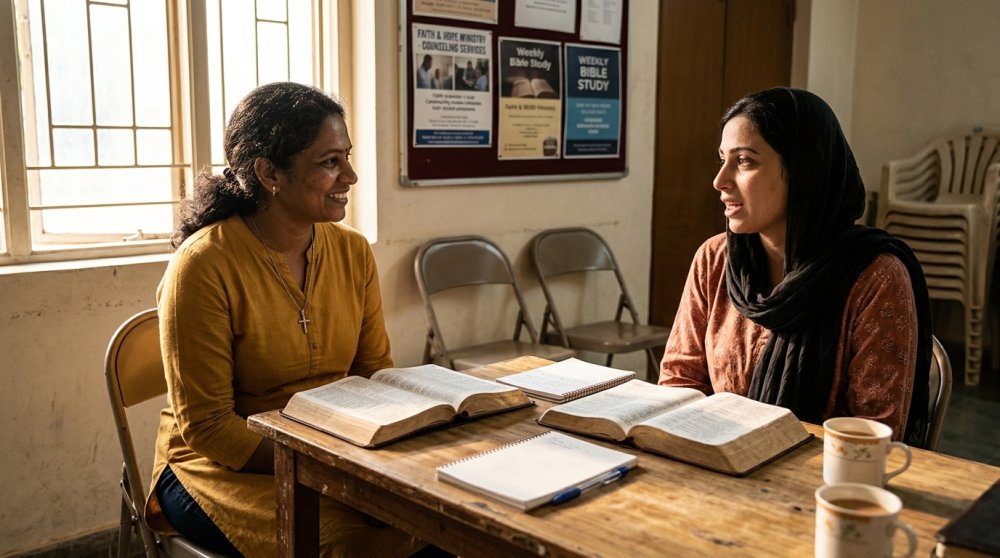
- Zeeneta grew up in a family persecuted for their Christian faith, facing circumstances most Americans can’t imagine
- Her parents’ unwavering faith and resilience became the foundation for her own spiritual strength
- She now ministers to women, helping them develop the same trust in Jesus that sustained her family through persecution
Zeeneta’s story is a powerful testament to the strength of faith under fire. As a young girl growing up in a household targeted for their Christian beliefs, she witnessed persecution that would shake many to their core. Yet through it all, her parents never wavered in their commitment to Jesus Christ.
The experiences that once filled her with fear about her future have become the very foundation of her ministry today. What could have destroyed her faith instead deepened it, proving once again that God works all things together for good for those who love Him.
Her parents modeled a resilience that went beyond human strength—a resilience that could only come from complete trust in the Lord. They showed Zeeneta that even in the darkest circumstances, faith in Jesus Christ provides an anchor that cannot be moved.
Now, Zeeneta dedicates her life to passing on this powerful legacy. She works especially with women, encouraging them to develop the same unshakeable trust in Jesus that carried her family through their trials. Her ministry transforms lives by showing others that no persecution, no hardship, and no circumstance is greater than God’s faithfulness.
The young girl who once worried she had no future now helps others see that their future is secure in Christ. Her testimony serves as a reminder to American Christians that faith under pressure produces perseverance, and perseverance produces hope that does not disappoint.
In a time when religious freedom faces increasing challenges even in America, Zeeneta’s story offers both warning and encouragement. It reminds us to stand firm in our faith, to model resilience for the next generation, and to trust that God’s purposes will prevail no matter what opposition we face.
Let us know what you think, please share your thoughts in the comments below.
Faith
Himalayan Floods Leave Hundreds Dead as Christian Mountain Bikers Bring Hope to Remote Valleys

Faith Facts
- Christian relief teams deployed mountain bikes to reach isolated Himalayan valleys after deadly floods killed hundreds and left over 1,400 missing
- Nepali churches mobilized immediately following the August 26 disaster that devastated northern Nepal and Tibet
- Flooding caused by water, mud, rock and ice swept through remote river settlements, cutting off access to vulnerable communities
In a remarkable demonstration of faith in action, Christian relief teams have begun navigating treacherous mountain terrain on bicycles to reach survivors of a catastrophic flood that struck the Himalayan region on August 26. The disaster, which unleashed a devastating torrent of water, mud, rock and ice through remote river settlements, has claimed hundreds of lives and left more than 1,400 people missing across Nepal and China’s Tibet region.
Local churches in Nepal responded swiftly to the crisis, recognizing that traditional vehicles could not access many of the hardest-hit areas. By utilizing mountain bikes, these faithful servants have been able to traverse damaged roads and narrow mountain paths to deliver critical aid and spiritual comfort to isolated communities.
The flooding represents one of the deadliest natural disasters to strike the Himalayan region in recent years. The sheer force of the water, combined with debris from higher elevations, transformed peaceful valleys into scenes of devastation within minutes.
Remote communities in northern Nepal now face the dual challenge of recovering from immediate losses while preparing for the onset of harsh winter conditions in the high-altitude region. Access to these areas remains severely limited, making the work of Christian relief teams even more vital.
The deployment of mountain bikes as a relief tool showcases the innovative and sacrificial spirit of believers committed to serving the most vulnerable. Where modern vehicles cannot go, faith-driven volunteers on two wheels are bringing hope, supplies, and the message of God’s love to those who might otherwise be forgotten.
The international Christian community has begun mobilizing support for relief efforts, recognizing that recovery will require sustained commitment and resources. Churches across Nepal continue coordinating with relief organizations to ensure that aid reaches even the most isolated mountain communities.
Let us know what you think, please share your thoughts in the comments below.


-

 Self-Reliance1 year ago
Trump’s Bold Move Uncovers Massive Social Security Fraud
-

 Faith1 year ago
New Clues Emerge in Noah’s Ark Mystery
-

 News1 year ago
Governor Walz’s Rhetoric Sparks National Controversy
-

 News1 year ago
Mel Gibson’s ‘The Passion of the Christ’ Sequel Title Announced
-

 Family1 year ago
Texas Lawmaker Targets Furries in Schools
-

 Freedom1 year ago
Maine Lawmaker Challenges Sports Fairness Controversy
-

 Family1 year ago
Canada’s Controversial Policy Sparks Ethical Debate
-
Faith9 months ago
Congress Hears Pleas for Nigerian Christians