
Faith
How One Mission Is Changing Mexico After 60 Years of Faithful Service


Faith Facts
- The Bible Society of Mexico marks 60 years of making Scripture accessible across the nation in multiple languages and formats
- The organization serves diverse communities by providing the Bible in indigenous languages and modern formats for new generations
- Mexico’s religious landscape continues to evolve as Christian organizations adapt their outreach methods to reach more people with God’s Word
A Christian organization dedicated to bringing the Bible to the people of Mexico is celebrating a remarkable milestone. The Bible Society of Mexico has reached its 60th anniversary, six decades of faithful service making Scripture accessible to everyone across the nation.
The mission remains clear and unwavering: to ensure that every person in Mexico can access God’s Word in their own language and in formats that meet their needs. This commitment has driven the organization’s work for six decades, adapting to changing times while holding fast to the timeless message of Scripture.
As Mexico’s religious landscape continues to shift and evolve, the Bible Society’s work has become increasingly vital. The organization recognizes that reaching new generations requires meeting them where they are, offering Scripture in both traditional and modern formats.
The ministry’s approach reflects a deep understanding that God’s Word transcends cultural and linguistic barriers. By providing Bibles in indigenous languages alongside Spanish editions, the Society ensures that no community is left behind in accessing the life-changing message of the Gospel.
This 60-year journey demonstrates the power of faithful, consistent ministry. What began as a vision to make the Bible available to all Mexicans has grown into a nationwide movement that continues to bear fruit in countless lives transformed by Scripture.
The anniversary celebration marks not just past achievements, but a renewed commitment to the future. As technology advances and communication methods change, the Bible Society remains dedicated to finding new and creative ways to share God’s eternal truth with each generation.
For Christian organizations across America, the Bible Society of Mexico’s six-decade legacy offers an inspiring example. It shows what can be accomplished when believers commit to the long-term work of making Scripture accessible, relevant, and life-changing for every person, regardless of their background or circumstances.
Let us know what you think, please share your thoughts in the comments below.

Faith Facts
- In 1801, thousands of pioneer settlers traveled to rural Kentucky for a weeklong camp meeting that became known as the Cane Ridge Revival, marking a pivotal moment in American Christian history.
- About 200 believers from Churches of Christ, independent Christian Churches, and the Christian Church (Disciples of Christ) gathered to commemorate the 225th anniversary of the revival that gave birth to the Restoration Movement.
- The 1801 revival emphasized Christian unity over denominational divisions, with ministers from different traditions preaching simple gospel salvation and sharing communion together in remarkable spiritual unity.
BOURBON COUNTY, KY. — By the thousands, the believers came — Baptists, Methodists and Presbyterians among them.
In covered wagons and carriages, pioneer settlers traveled to the backwoods of Kentucky for a weeklong camp meeting orchestrated by a 28-year-old Presbyterian clergyman named Barton W. Stone.
The Cane Ridge Revival of 1801 — dubbed “America’s Pentecost” by the late historian Paul Conkin — emerged as a pivotal moment in the birth of the Restoration Movement.
In the second week of August, Stone and other ministers who spoke at Cane Ridge, about 20 miles east of Lexington, endeavored to put aside confessions and creeds and simply preach Christ.
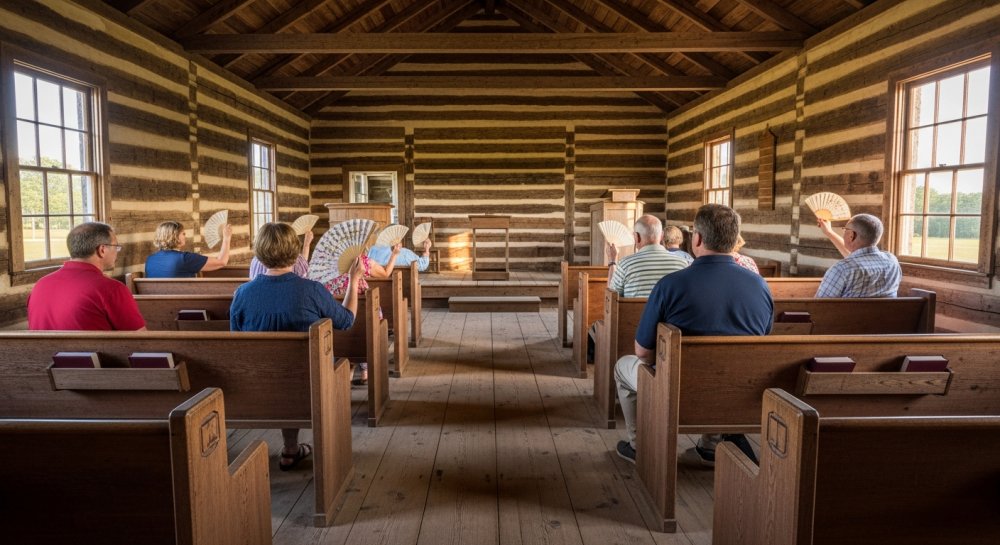
To celebrate the revival’s 225th anniversary, a crowd of about 200 filled the Cane Ridge Meeting House, where the Stone Memorial Building now encases the restored one-room log church originally built in 1791. Attendees parked in the grass alongside State Highway 537, surrounded by tobacco, soybean and corn fields.
The gathering this past Saturday drew members of a cappella Churches of Christ, independent Christian Churches and the Christian Church (Disciples of Christ). All three groups trace their modern-day roots to the Restoration Movement, also known as the Stone-Campbell Movement.
“We are so glad that you have made the journey here, where 225 years ago … on this very ground, something happened that changed the shape of American religious life and gave birth to the movement that many of us in this room call our faith home,” said Joel Brown, president of the Disciples of Christ Historical Society in Bethany, W.Va., the event’s organizer.
“We are here today to remember that moment, to learn from it and to let it speak to us again.”
The a cappella Churches of Christ and the independent Christian Churches each comprise roughly 1 million baptized members in the U.S., according to national surveys. Precise numbers are difficult to ascertain because of the autonomous nature of the individual congregations.
The Christian Church (Disciples of Christ) denomination claims 600,000 members in the U.S. and Canada, according to its website.
Kentucky Gov. Andy Beshear, who has served as a deacon for the Beargrass Christian Church, a Disciples of Christ congregation in Louisville, sent a video message on Cane Ridge’s significance.
“This was an event that crossed denominational lines, uniting different groups in shared worship and communion, and it happened in a rural community just outside of Paris, Ky. That unity of the revival is just as important now as it was in 1801.”
‘Our original sense of unity’
A quarter-century after the Cane Ridge Revival, Stone reflected on it in an 1827 article in the Christian Messenger, a magazine he started.
“The doctrine preached by all was simple, and nearly the same,” wrote Stone, who in 1832 fused his Christian unity movement with that of another reform-minded minister, Alexander Campbell.
“Free and full salvation to every creature was proclaimed. All urged faith in the gospel, and obedience to it, as the way of life. All appeared deeply impressed with the ruined state of sinners, and were anxious for their salvation. The spirit of partyism, and party distinctions, were apparently forgotten. . . The spirit of love, peace, and union, were revived. You might have seen the various sects engaged in the same spirit, praying, praising, and communing together, and the preachers in the lead. Happy days!”
Scholars representing all three major branches of the Restoration Movement spoke at the 225th anniversary event.
The two from Churches of Christ were John Mark Hicks, a retired theology professor at Lipscomb University in Nashville, Tenn., and James L. Gorman, director of the Center for Restoration Studies at Abilene Christian University in Texas.
“The event formed our original sense of unity that transcends partyism, provides an alternative vision of the Holy Spirit’s work than what came to dominate Churches of Christ in the 20th century and reminds us of the constant need for evangelistic revival and renewal among disciples of Jesus,” Hicks said.
By partyism, Hicks explained that he meant “a sectarian denominationalism, allegiance to the party (specific denomination) that draws lines of fellowship and communion table as hard boundaries.”
Mac Ice, director of special collections and archives at ACU, put it this way in an email:
“It is not too much to say there is no Restoration Movement without Cane Ridge.”
Differences and connections
Inside the Cane Ridge Meeting House, the anniversary crowd waved handheld fans in the steamy old church, which has no air conditioning.
At lunchtime, attendees enjoyed box lunches in the 89-degree heat — in the shadow of Stone’s gravestone — and perused the artifacts and exhibits in the nearby Barton Warren Stone Museum.
Roughly three-quarters of the participants came from the Christian Church (Disciples of Christ), but a few from Churches of Christ made it a point to attend.
Greg and Kathy Pauley met at Harding University in Searcy, Ark., over a half-century ago and attend the Southside Church of Christ in Lexington.
“I literally do not know when I started reading about the Cane Ridge encampment and all the things that flowed from that,” said Kathy Pauley, 76, a grandmother of 11. “I don’t remember any particular professor at Harding bringing it up. … But I always knew that it was important.”
Despite living in Kentucky for 24 years, she’d never made it to Cane Ridge.
“I knew it was right down the road, but this is our first time, and my husband is here because I said, ‘Honey, I signed us up.'”
Greg Pauley said he welcomed learning more about Cane Ridge and gathering with fellow believers, even those with whom he has theological differences.
“It’s just so important to me to understand both sides, and these presentations today, it was just like, ‘This is good.'”
Two ministers from the Canadian province of Ontario — Murray Hibbard of the Guelph Church of Christ and Glen Robins of the Stoney Creek Church of Christ — drove roughly 550 miles to attend.
Hibbard picked up Robins that Friday afternoon at Camp Omagh, where Hibbard had taught children’s Bible classes all week. Then the ministry friends returned home in time for each to preach Sunday morning.
“I’ve just always loved our history,” Robins said of why he wanted to mark the Cane Ridge anniversary.
“It’s been great. I appreciate that they were intentional about representing all three major streams.”
Hibbard echoed his fellow Canadian’s sentiments.
“I kind of wish our own had more attendance, but it is what it is.”
For what it’s worth, connections among those of the differing streams often overlap.
Brown, the Disciples of Christ Historical Society president, grew up in the a cappella Vancouver Church of Christ in Washington state, where his father, Craig, served as the preaching minister for 20 years.
The younger Brown attended Columbia Christian School in Portland, Ore., across the Columbia River from Vancouver, and later earned undergraduate and graduate degrees at ACU.
“I think in my experience, having been in Churches of Christ and the Disciples, the Disciples who have been Disciples for a long time have more of a recognition of a place like Cane Ridge. But I will say that … there is a much more robust group of scholars who are studying Stone-Campbell history in Churches of Christ than there is in Disciples of Christ,” Joel Brown said.
Let us know what you think, please share your thoughts in the comments below.

Faith Facts
- Alexandra Ashcroft, known as ‘Alex Reads Tarot,’ abandoned her nearly one million TikTok followers after encountering Jesus Christ
- A growing number of former witches and tarot readers are publicly converting to Christianity and sharing their testimonies online
- The conversion stories are sparking intense debate across social media platforms about spiritual warfare and redemption
A dramatic spiritual awakening is sweeping through an unexpected corner of social media. Former practitioners of witchcraft and tarot are turning away from the occult and embracing Christianity in numbers that have caught the attention of believers and skeptics alike.
Alexandra Ashcroft built a massive following on TikTok under the name ‘Alex Reads Tarot,’ offering spiritual guidance through tarot card readings to nearly one million followers. But her life took an unexpected turn when she encountered Jesus Christ. Her conversion has been nothing short of dramatic, and she’s now sharing her testimony with the same audience that once sought her occult services.
Laura Maxwell, who has been tracking this phenomenon, notes that Ashcroft’s story is far from isolated. A wider trend is emerging of individuals who once practiced witchcraft, offered tarot readings, or engaged in other occult practices now finding salvation through Christ.
The conversions have sparked fierce debate online. Some celebrate these testimonies as proof of God’s transformative power and His ability to reach anyone, regardless of their past. Others question the authenticity of such dramatic turnarounds, while some in the occult community have responded with hostility to those they view as abandoning their former spiritual path.
For Christians, these stories represent a powerful reminder of the spiritual battle described in Scripture. The Apostle Paul wrote about wrestling “not against flesh and blood, but against principalities, against powers, against the rulers of the darkness of this age.” These modern testimonies echo the transformative power of the Gospel that has changed lives for two thousand years.
The phenomenon also highlights the spiritual hunger prevalent in contemporary culture. Many who turned to tarot and witchcraft were seeking meaning, purpose, and connection — needs that are ultimately fulfilled only through a relationship with Jesus Christ.
Former practitioners often describe their past involvement in the occult as spiritually oppressive and emotionally draining. Upon conversion, they report experiencing genuine peace, freedom, and purpose that eluded them during their years of occult practice.
These testimonies serve as an encouragement to Christians to remain faithful in prayer for those caught in spiritual deception. They demonstrate that no one is beyond the reach of God’s grace and that the Holy Spirit is actively working to draw people out of darkness and into His marvelous light.
The viral nature of these conversion stories also provides a unique evangelistic opportunity. As former occult practitioners share their testimonies with audiences that may never darken the door of a church, they’re bringing the Gospel message to spiritually hungry individuals who desperately need to hear the truth about Jesus Christ.
Let us know what you think, please share your thoughts in the comments below.

Faith Facts
- Welsh sprinter Jeremiah Azu won silver in the men’s 100m at the European Championships in Birmingham, crediting his talent to God
- The 25-year-old athlete has spoken openly about his strong Christian faith and love for singing worship songs in church
- Azu represents a growing number of elite athletes who publicly acknowledge their faith as central to their success and identity
In a powerful display of athletic excellence grounded in faith, Welsh sprinter Jeremiah Azu claimed the silver medal in the men’s 100m at the European Championships in Birmingham. The 25-year-old’s achievement stands as a testament to both dedicated training and the spiritual foundation that guides his life.
Azu has never been shy about the source of his abilities. He has consistently emphasized that his talent comes from above, reflecting a humble spirit that sets him apart in the often self-focused world of professional athletics.
The young sprinter’s Christian background runs deep, shaping not only his perspective on competition but his entire approach to life. His love for worship extends beyond the track, with Azu finding joy in lifting his voice in praise at church—a reminder that true strength comes from maintaining priorities that transcend earthly achievements.
In an era when faith is often pushed to the sidelines in public discourse, Azu’s willingness to acknowledge God’s role in his success offers a refreshing counter-narrative. His story demonstrates that excellence and faith are not mutually exclusive but can work together to produce extraordinary results.
The sprinter’s journey reflects a biblical understanding of talent stewardship—recognizing gifts as divine provisions meant to be developed and used for God’s glory. This perspective provides both motivation and humility, acknowledging that natural ability is just the starting point for what dedicated effort can achieve.
As Azu continues to compete at the highest levels of international athletics, his testimony serves as an inspiration to young Christians who aspire to excellence in their own fields. His example proves that maintaining strong faith convictions and pursuing worldly success need not be in conflict when one’s priorities remain properly ordered.
The silver medal represents more than athletic achievement—it symbolizes what’s possible when God-given talent meets faithful dedication. Azu’s story reminds us that glorifying God through our gifts, whatever they may be, remains the highest calling of all.
Let us know what you think, please share your thoughts in the comments below.


-

 Self-Reliance1 year ago
Trump’s Bold Move Uncovers Massive Social Security Fraud
-

 Faith1 year ago
New Clues Emerge in Noah’s Ark Mystery
-

 News1 year ago
Governor Walz’s Rhetoric Sparks National Controversy
-

 News1 year ago
Mel Gibson’s ‘The Passion of the Christ’ Sequel Title Announced
-

 Family1 year ago
Texas Lawmaker Targets Furries in Schools
-

 Freedom1 year ago
Maine Lawmaker Challenges Sports Fairness Controversy
-

 Family1 year ago
Canada’s Controversial Policy Sparks Ethical Debate
-
Faith9 months ago
Congress Hears Pleas for Nigerian Christians