Faith
Georgia Megachurch Pastor Leads Congregation in Prayer Amid Ongoing Death Investigation
Faith Facts
- Pastor Jamal Bryant led New Birth Missionary Baptist Church congregation in prayer for the Wells family during Sunday service
- Authorities continue investigating the death of 18-year-old Nolan Wells, whose body was found near Horn Island off the Mississippi Gulf Coast one week ago
- The church community gathered in support as the investigation into the teenager’s death remains ongoing
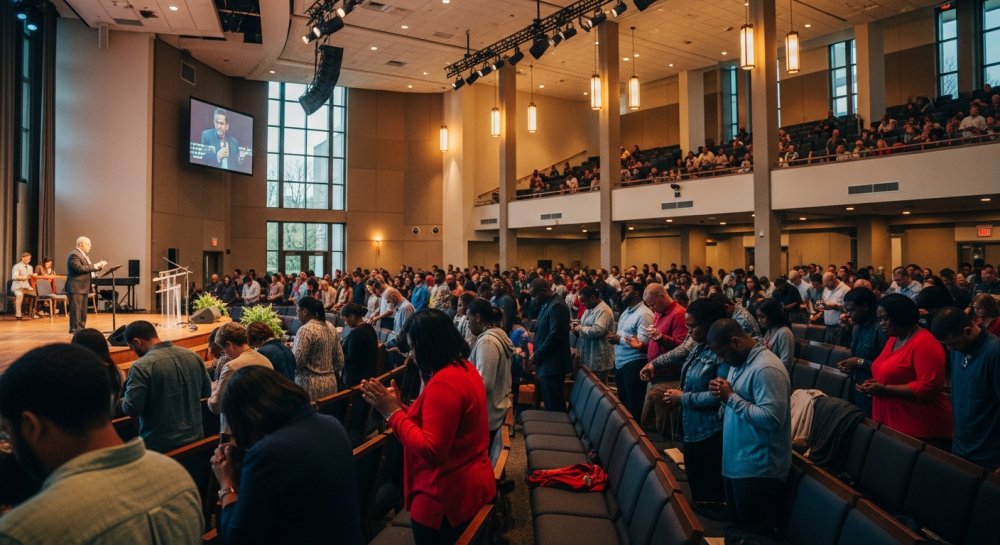
Pastor Jamal Bryant of New Birth Missionary Baptist Church in Stonecrest, Georgia, called his congregation to prayer Sunday for the grieving family at the center of a tragic loss. The service came as authorities work to determine the circumstances surrounding the death of 18-year-old Nolan Wells.
Wells’ body was discovered near Horn Island off the Mississippi Gulf Coast one week ago. Investigators have not yet released details about the cause or manner of death, and the case remains under active investigation by local authorities.
Bryant’s decision to lift up the Wells family in corporate prayer reflects the church’s commitment to standing with those facing unimaginable loss. The New Birth congregation, known for its community engagement and pastoral care, joined together to seek God’s comfort for a family walking through the valley of grief.
The ongoing investigation has left many questions unanswered as officials work to piece together the events leading to the teenager’s death. Law enforcement has not indicated whether foul play is suspected or if the death appears accidental.
As the Wells family awaits answers, they are being upheld by prayer from believers who understand that God’s presence is a refuge in times of trouble. The church community continues to provide spiritual support during this difficult season.
Let us know what you think, please share your thoughts in the comments below.
Faith
Church Called to Frontline Role in Global Fight Against Hidden Evil
Faith Facts
- Fewer than 1% of human trafficking victims are ever formally identified, leaving millions trapped in modern-day slavery
- A global anti-trafficking leader called on churches to step into the gap, citing their unique position in communities worldwide
- The call was issued at a United Nations side event addressing the fundamental failure of current protection systems
Churches across America and around the world are being called to take a more active role in combating one of the most insidious evils of our time: human trafficking. The sobering reality is that current protection systems are failing to reach the vast majority of victims trapped in this modern form of slavery.
Speaking at a United Nations side event on Monday, a leading anti-trafficking advocate delivered a stark assessment of the global crisis. Fewer than one in a hundred victims of human trafficking is ever formally identified — a statistic that reveals the massive scope of suffering hidden in plain sight across our communities.
The advocate called this shocking gap “a fundamental failure of protection systems worldwide” and issued a direct challenge to faith communities. Churches, the leader emphasized, are uniquely positioned to help address this crisis in ways that government agencies and secular organizations cannot.
Human trafficking represents a direct assault on human dignity and the sanctity of life — core values central to Christian teaching. As believers committed to loving our neighbors and defending the vulnerable, American Christians have both a moral obligation and a strategic opportunity to stand against this evil.
The church’s grassroots presence in communities, trusted relationships, and commitment to compassion make it an ideal partner in identifying and helping victims who might otherwise remain invisible to authorities. From urban centers to rural towns, congregations can serve as safe havens and pathways to freedom for those trapped in exploitation.
This call to action comes at a critical time when traditional American values of freedom and human dignity are under assault from multiple directions. Human trafficking strips away the God-given liberty and worth of every person, making it a battle that transcends politics and demands unified action from people of faith.
The fact that 99% of trafficking victims remain unidentified should compel every church to examine how it can contribute to the solution. Whether through training, awareness, partnership with law enforcement, or direct ministry to survivors, congregations have the capacity to make a tangible difference.
As the body of Christ, we are called to be the hands and feet of Jesus to the oppressed and captive. The challenge before us is clear: will we answer the call to help rescue the vulnerable and restore dignity to those who have been exploited?
Let us know what you think, please share your thoughts in the comments below.

Faith
European Evangelicals Speak Out to Reshape Global Perception of Christian Believers
Faith Facts
- The European Evangelical Alliance has released a major statement aimed at correcting widespread misunderstandings about evangelical Christians worldwide
- The document seeks to counter media-driven caricatures largely shaped by American political coverage
- EEA leaders believe the statement can help believers everywhere better articulate their faith in the public square
A groundbreaking statement from the European Evangelical Alliance (EEA) is making waves across the Christian world, offering a clear and compelling vision of evangelical identity that stands apart from distorted media narratives. The declaration comes at a crucial time when believers face increasing misrepresentation in public discourse.
The EEA’s carefully crafted document addresses a pressing concern: the gap between who evangelicals truly are and how they are portrayed in mainstream media. For too long, secular outlets have painted a caricature of Bible-believing Christians based primarily on American political controversies, ignoring the rich diversity and theological depth of the global evangelical movement.
This comprehensive statement provides much-needed clarity on evangelical engagement in public life, rooted in biblical principles rather than partisan politics. The European perspective offers valuable insights that transcend national boundaries and cultural contexts, reminding Christians everywhere of their primary calling to live out the Gospel with integrity and conviction.
The timing of this declaration is significant. As religious liberty faces mounting challenges across Western nations and Christians find themselves increasingly marginalized in public conversations, the EEA statement equips believers with thoughtful, scripturally grounded responses to cultural pressures.
Church leaders and theologians are praising the document for its theological soundness and practical application. The statement emphasizes that evangelical identity centers on core biblical truths: the authority of Scripture, the necessity of personal conversion through faith in Jesus Christ, the importance of sharing the Gospel, and the transformative work of the Holy Spirit in believers’ lives.
By articulating these foundational principles clearly, the EEA helps Christians navigate complex social and political landscapes without compromising their witness. The document reminds evangelicals that their ultimate allegiance belongs to Christ and His Kingdom, transcending earthly political movements or national identities.
The statement also addresses how believers should engage with contemporary issues while maintaining gospel priorities. Rather than retreating from public life or being co-opted by secular ideologies, Christians are called to be salt and light—influencing society through faithful presence and prophetic witness.
What makes this declaration particularly valuable is its global perspective. European evangelicals have wrestled with questions of faith and public engagement in contexts quite different from American culture, offering wisdom that enriches the worldwide body of Christ.
For American believers especially, the EEA statement provides helpful perspective on how Christians in other parts of the world approach their civic responsibilities. It challenges the assumption that evangelical faith must align with any particular political party or cultural movement, instead pointing back to timeless biblical truths.
The document’s influence extends beyond Europe. Christian leaders from Africa, Asia, Latin America, and North America are already citing the statement as a helpful resource for discipleship and public witness. Its clear articulation of evangelical essentials provides common ground for believers across diverse cultural contexts.
As the statement gains traction, it offers hope that Christians worldwide can reclaim the narrative about who evangelicals truly are. Rather than allowing hostile media or political operatives to define evangelical identity, believers themselves can point to this thoughtful, biblically faithful declaration.
The EEA’s work reminds us that the global church is much larger and more diverse than any single national expression. When European brothers and sisters in Christ speak with clarity and conviction, believers everywhere benefit from their insights and experience.
This statement arrives as a gift to the worldwide evangelical movement—a tool for teaching, a framework for engagement, and a testimony to the unity that exists among believers committed to biblical truth. Its impact will likely be measured not in immediate headlines but in the long-term strengthening of Christian witness across nations and cultures.
Let us know what you think, please share your thoughts in the comments below.
Faith
Cardinal Breaks Silence on Controversial Exorcist Removal
Faith Facts
- Cardinal Robert W. McElroy removed a prominent Catholic exorcist from active ministry in his archdiocese, citing concerns over the increasingly public nature of his work.
- The exorcist had gained attention for statements connecting UFO phenomena to demonic activity, though the Cardinal insists this was not the reason for the removal.
- The decision has sparked debate within Catholic circles about the proper boundaries between exorcism ministry and public engagement.
Cardinal Robert W. McElroy has clarified his decision to remove a well-known exorcist from ministry in his archdiocese, addressing speculation that has circulated within Christian communities. In a recent interview, the Cardinal emphasized that his concerns centered on the public profile of the ministry rather than theological disagreements.
The exorcist in question had developed a significant following through public appearances and statements about spiritual warfare. Among his more controversial positions was the assertion that many UFO sightings and phenomena have demonic origins—a view that has found support among some Christians who see spiritual explanations for unexplained events.
Exorcist Stephen Rossetti: “Most UFO sightings are likely Demons” ????????
A Catholic Priest for the Archdiocese of Washington, he explains that demons hide to manipulate us more effectively. “Demons like to hide. They don’t want us to know they’re out… they can kind of get into… pic.twitter.com/qrbt7I3WzI
— Interstellar (@InterstellarUAP) May 31, 2026
Cardinal McElroy stated that the removal was not motivated by these theological opinions. Instead, he expressed concern that the increasingly public nature of the exorcism ministry was creating issues that warranted intervention. The Cardinal’s decision reflects ongoing tensions within the Catholic Church about how spiritual deliverance ministries should be conducted and promoted.
The controversy highlights broader questions about the role of exorcism in modern Christian ministry. Many believers recognize the reality of spiritual warfare and demonic activity, viewing exorcism as a legitimate and necessary aspect of pastoral care. However, church leaders must balance this conviction with concerns about sensationalism and proper ecclesiastical oversight.
The exorcist’s views on UFOs and demons resonate with some Christians who see contemporary phenomena through a spiritual lens. This perspective holds that not all unexplained events have purely natural explanations, and that demonic deception may manifest in various forms including alleged extraterrestrial encounters.
The Cardinal’s explanation appears designed to address concerns from those who worried the removal represented a dismissal of traditional beliefs about spiritual warfare. By clarifying that his objections were procedural rather than theological, McElroy seeks to maintain respect for exorcism ministry while asserting episcopal authority over how such ministries are conducted.
This situation underscores the delicate balance church leaders must strike between affirming traditional Christian teachings about spiritual combat and maintaining appropriate boundaries for public ministry. As interest in spiritual warfare grows among believers, questions about proper practice and oversight will likely continue.
Let us know what you think, please share your thoughts in the comments below.
-
Self-Reliance1 year agoTrump’s Bold Move Uncovers Massive Social Security Fraud
-

Faith1 year agoNew Clues Emerge in Noah’s Ark Mystery
-

News1 year agoGovernor Walz’s Rhetoric Sparks National Controversy
-

News1 year agoMel Gibson’s ‘The Passion of the Christ’ Sequel Title Announced
-

Family1 year agoTexas Lawmaker Targets Furries in Schools
-

Freedom1 year agoMaine Lawmaker Challenges Sports Fairness Controversy
-

Family1 year agoCanada’s Controversial Policy Sparks Ethical Debate
-
Faith8 months ago
Congress Hears Pleas for Nigerian Christians